
In This Article
Picture Thanksgiving at 4:55 p.m. The mashed potatoes are ready, the green beans are ready, and your aunt is already asking where the cranberry sauce went. Now picture Friday: those same dishes, stacked in the fridge, sealed, visible at a glance, and ready to reheat. That two-day journey — prep, serve, store, reheat — is exactly why glass serving bowls with lids have quietly become one of the hardest-working pieces in an American kitchen.
The appeal is simple. One vessel handles the mixing, goes straight to the table looking presentable, and then snaps shut for leftovers. No transferring food into a sad plastic tub. No hunting for plastic wrap that clings to everything except the bowl.
But not all glass serving bowls with lids are built the same. Some are tempered soda-lime glass that tolerates a preheated oven; others are borosilicate that shrugs off bigger temperature swings; a few aren’t oven-safe at all. Lids vary even more — some seal snugly, some pop off if you look at them sideways, and most can’t go in the microwave.
In this guide, we compared seven real sets available on amazon.com, working from manufacturer spec sheets and aggregated customer feedback from US retailers. You’ll find a quick comparison table, honest product breakdowns, practical care routines, real-world buyer scenarios, and the safety rules that matter when food sits out on a buffet. No hype, no invented test stories — just the analysis you need to choose once and choose well.
What Are Glass Serving Bowls with Lids?
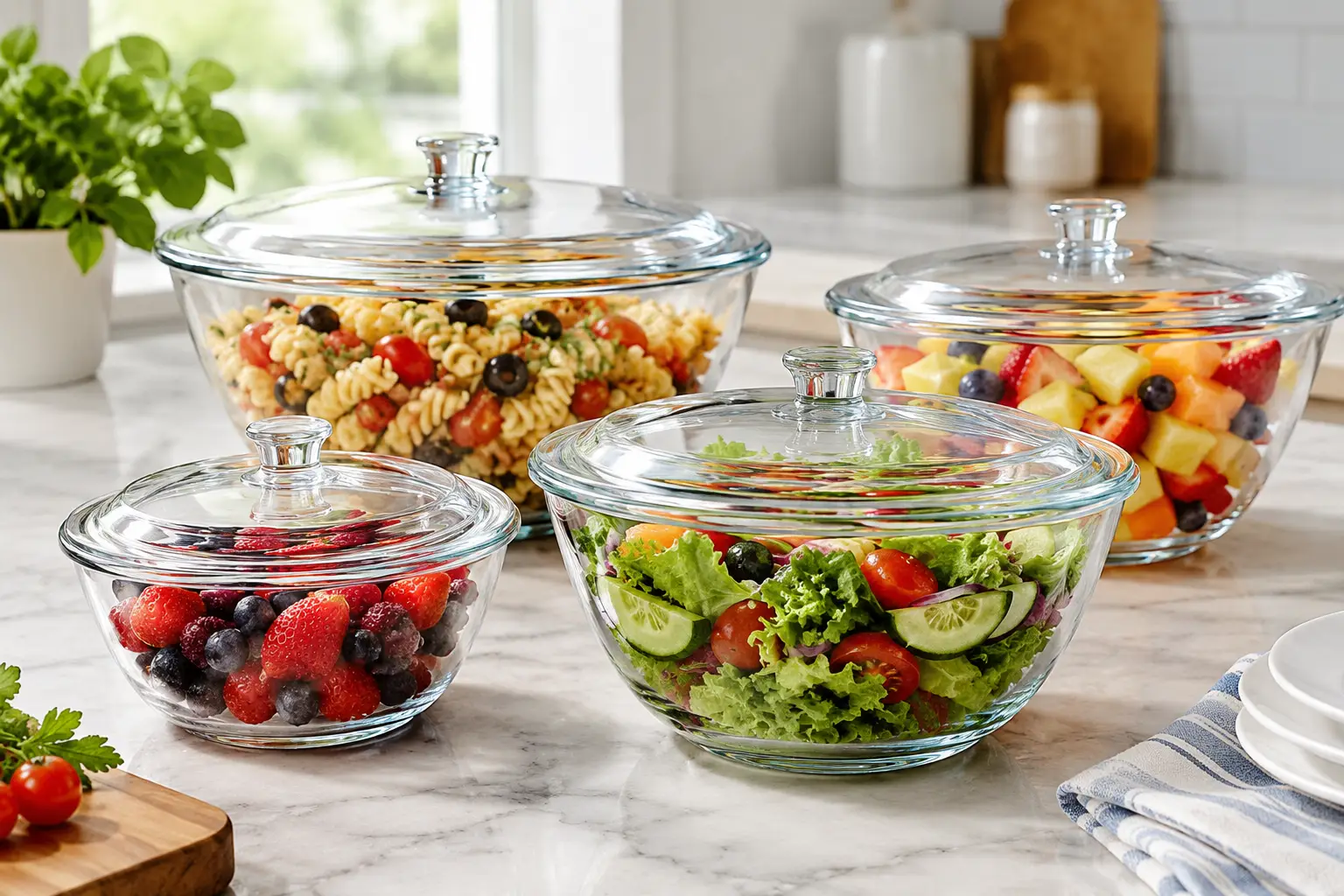
Glass serving bowls with lids are round, clear bowls — usually tempered soda-lime or borosilicate glass — sold with fitted covers, typically BPA-free plastic or silicone. They let you mix, serve, refrigerate, and often microwave or bake in one vessel, while the non-porous glass resists stains and odors.
That definition hides a useful distinction. Many products marketed as “glass mixing bowls with lids” are, in practice, the same thing you’d want on a dinner table: a clean-looking, wide-rimmed bowl that shows off a salad or a trifle. What separates a true serving-grade set from a storage-only set is the look of the glass (clear, sculpted, or tinted), the depth-to-width ratio, and whether the lid seals well enough for transport to a potluck.
Materials matter, too. Tempered soda-lime glass is tough against impact — it’s what most classic American bakeware brands use. Borosilicate glass expands less when heated, which is why it tolerates sudden temperature changes better. Neither is “better” across the board; it depends on whether your bowls spend more time going from fridge to oven or from counter to floor by accident.
Finally, the lid is part of the purchase, not an accessory. Almost every set here restricts the lid from the oven, and several restrict it from the microwave and dishwasher too. Knowing those limits upfront saves you a warped lid in week two.
Quick Comparison: 7 Glass Serving Bowls with Lids at a Glance
| Set | Glass Type | Bowl Sizes | Oven-Safe Bowls? | Best for |
|---|---|---|---|---|
| Pyrex Smart Essentials 8-Piece Set | Tempered soda-lime | 1, 1.5, 2.5, 4 qt | Yes (preheated) | Pyrex Smart Essentials 8-Piece Set: everyday all-rounder |
| Pyrex Colors Sculpted Tinted 6-Piece Set | Tempered soda-lime, tinted | 1.3, 2.3, 4.5 qt | Not the focus; check label | Pyrex Colors Sculpted Tinted 6-Piece Set: table presentation |
| Libbey Baker’s Basics 4-Piece Set | Lead-free soda-lime | 1, 2, 3, 4 qt | Yes | Libbey Baker’s Basics 4-Piece Set: even size spacing |
| Luvan 3-Piece Borosilicate Set | Borosilicate | 1.1, 2.7, 4.5 qt | Yes (lids off) | Luvan 3-Piece Borosilicate Set: big salads and dough |
| FineDine Superior Glass 8-Piece Set | Tempered glass | 27 fl oz, 1.5, 2.5, 4 qt | Not clearly stated | FineDine Superior Glass 8-Piece Set: stable mixing |
| JoyJolt 8-Piece Glass Bowl Set | Thick lead-free glass | 16.5–67.5 oz | No | JoyJolt 8-Piece Glass Bowl Set: small households |
| COOK WITH COLOR 12-Piece Glass Set | Borosilicate | ~26.7 oz to ~150 oz (6 bowls) | Not clearly stated | COOK WITH COLOR 12-Piece Glass Set: most sizes |
Looking at the table, the split is clear: if you want to bake, reheat, and serve from the same bowl, the Pyrex Smart Essentials 8-Piece Set, the Libbey Baker’s Basics 4-Piece Set, and the Luvan 3-Piece Borosilicate Set are the only picks with unambiguous oven ratings. If presentation is your priority, the Pyrex Colors Sculpted Tinted 6-Piece Set wins on looks. And for small kitchens that mostly store and serve, the compact JoyJolt 8-Piece Glass Bowl Set covers everyday needs without eating a whole cabinet.
💬 One click helps other shoppers make an informed choice too! 😊
Top 7 Glass Serving Bowls with Lids: Expert Analysis
1. Pyrex Smart Essentials 8-Piece Set — the dependable everyday workhorse
This is the set most American kitchens already trust, and the spec sheet explains why. The Pyrex Smart Essentials 8-Piece Set includes 1-, 1.5-, 2.5-, and 4-quart rimmed bowls, each with a color-coded plastic lid (green, orange, blue, red) that has the size molded in. In practice, that color coding means you grab the right lid on the first try instead of playing lid roulette at 9 p.m.
The bowls are rated for the refrigerator, freezer, microwave, dishwasher, and a preheated oven. That “preheated” detail matters: tempered soda-lime glass prefers gradual heat, so you slide it into a hot oven rather than letting it ride up from cold. The rimmed edge gives you something to grip when you’re carrying a 4-quart bowl of potato salad to the table.
Who’s it for? Anyone who wants one set that does 90% of kitchen jobs. The size ladder is well spaced for mixing batter, serving sides, and storing leftovers.
Reviews consistently praise the durable glass, the useful range of sizes, and the value for money. The recurring complaint in aggregated feedback is that the plastic lids feel less durable than the bowls — expect to replace a lid before you replace a bowl.
Pros:
- ✅ Four well-spaced sizes cover most daily tasks
- ✅ Color-coded lids with sizes molded in
- ✅ Oven, microwave, freezer, and dishwasher rated bowls
Cons:
- ❌ Lids wear out faster than the glass
- ❌ Classic design looks utilitarian on a dressy table
Typically found in the $25–$40 range at the time of writing (check the current price), it’s among the best value-per-quart sets you can buy.
2. Pyrex Colors Sculpted Tinted 6-Piece Set — prettiest bowls for the dinner table
If your bowls live on the table as often as in the fridge, the Pyrex Colors Sculpted Tinted 6-Piece Set earns its spot on looks alone. It includes 1.3-, 2.3-, and 4.5-quart bowls in soft amber, green, and blue tints, with fluted sides and matching plastic lids.
The fluting isn’t just decoration: those vertical ridges catch light and make a plain fruit salad look deliberate. The heat-tempered glass is rated for the microwave, fridge, and freezer, and resists stains and odors like standard Pyrex. The 4.5-quart bowl is genuinely large — big enough to toss a family-size salad without flinging lettuce across the counter.
Based on the specs, this set suits hosts, people with open shelving, and anyone who gifts kitchenware. It’s less ideal if you mainly bake, since the marketing leans toward prep, serve, and store rather than oven use.
Aggregated reviews on Pyrex’s own site praise the colors, sizes, and quality, and several reviewers love finally having bowls they aren’t embarrassed to set out. However, opinions on the lids are mixed: at least one reviewer reported the largest lid didn’t fit, and another reported a hairline crack after light use. Inspect everything when it arrives.
Pros:
- ✅ Fluted, tinted glass looks serving-dish elegant
- ✅ Generous 4.5-quart bowl handles big salads
- ✅ Resists stains and food odors
Cons:
- ❌ Lid fit reports are inconsistent
- ❌ Tint makes judging food color slightly harder
Expect it roughly in the $35–$55 range (prices may vary); you’re paying a modest premium for design, and for hosts that premium is worth it.
3. Libbey Baker’s Basics 4-Piece Set — cleanest size progression for bakers
The Libbey Baker’s Basics 4-Piece Set stands out for its tidy, one-quart-at-a-time size ladder: 1, 2, 3, and 4 quarts (roughly 6.5 to 10.5 inches across), each with a plastic lid.
Why does even spacing matter? Recipes scale in predictable jumps. A single batch of cookie dough fits the 2-quart; doubled, it moves to the 3- or 4-quart without you guessing. The bowls are lead-free soda-lime glass rated for the oven, microwave, freezer, and dishwasher, while the lids are recommended for the top rack and — per Libbey’s listing for the related 3-piece set — are not microwave- or oven-safe.
Our take: this is the baker’s pick. If you proof dough, melt chocolate, or bake a bread pudding directly in the bowl, the clear oven rating plus predictable sizing makes planning easy. It’s also a strong alternative to Pyrex if you want a slightly larger range at the top end.
On review sentiment, we could not locate a reliable aggregated summary for this specific 4-piece set during research, so we won’t characterize it. What’s verifiable is Libbey’s long track record in US glassware and the clearly published care limits, which is more than many generic brands offer.
Pros:
- ✅ Even 1-to-4-quart sizing suits recipe scaling
- ✅ Oven, microwave, and freezer rated bowls
- ✅ Lead-free glass from an established US brand
Cons:
- ❌ Lids can’t go in the oven or microwave
- ❌ Limited verified review data for this set
At roughly $30–$45 at the time of writing, it’s fair value for a baking-focused set.
4. Luvan 3-Piece Borosilicate Set — best for big-batch salads and dough
The Luvan 3-Piece Borosilicate Set goes big where it counts, pairing a 4.5-quart bowl with 2.7- and 1.1-quart companions, all in borosilicate glass with BPA-free lids.
Borosilicate’s selling point is thermal tolerance. Luvan advertises a range of -4°F to 1040°F for the bowls (lids excluded) — take the top number as a material rating, not a cooking suggestion. What it means in real life: this glass is more forgiving when you pull chilled dough from the fridge and slide it into a warm oven. Luvan does specify removing the lids before the oven, microwave, or dishwasher.
Who’s it for? Sourdough bakers, salad-for-eight hosts, and anyone who wants fewer, larger bowls. The three-piece format also nests compactly, which matters in apartment kitchens.
We couldn’t verify an aggregated review summary for this exact set from a trusted retailer page, so we’ll stay factual: Luvan sells multiple size variants (including a 3.7/2.1/1.1-quart version and an 8-piece set), which tells you the line is established on Amazon. Always confirm which variant you’re ordering.
Pros:
- ✅ Borosilicate glass handles temperature swings better
- ✅ Large 4.5-quart bowl for dough and salads
- ✅ Oven-safe bowls with lids removed
Cons:
- ❌ Lids are hand-wash only
- ❌ Only three sizes; no small prep bowl
Usually around $30–$45 (check the current price), it’s strong value if you need a big bowl that bakes.
5. FineDine Superior Glass 8-Piece Set — steadiest bowls for active mixing
The FineDine Superior Glass 8-Piece Set pitches itself on stability, and the logic holds up: glass is heavier than plastic or thin steel, so a loaded bowl stays put while you whisk.
The set includes 4-quart, 2.5-quart, 1.5-quart, and 27-fluid-ounce bowls, with BPA-free lids. The bowls are dishwasher-safe and microwave-safe without the lids, and they nest neatly. The listing we reviewed does not clearly state an oven rating, so treat these as a no-oven set until the seller confirms otherwise — a real difference from Pyrex or Libbey.
Our analysis: this set is best for people who mix and store far more than they bake. The small 27-ounce bowl is handy for dressings or a single serving of leftovers, and the 4-quart handles a family salad. It’s also available in colored-lid variants, which some buyers prefer for fridge organization.
For honesty’s sake: FineDine is better known for its stainless steel bowls, which have earned positive reviews from testing sites, but that praise doesn’t automatically transfer to the glass line. We didn’t find a verified aggregated review summary for the glass set specifically, so check recent reviews before buying.
Pros:
- ✅ Heavy glass stays stable while mixing
- ✅ Handy small bowl for dressings and sauces
- ✅ Nests compactly in one cabinet stack
Cons:
- ❌ Lids require hand washing
- ❌ No clearly published oven rating
Generally in the $30–$45 range at the time of writing, it’s reasonable value for a prep-and-store set.
6. JoyJolt 8-Piece Glass Bowl Set — compact choice for small households
The JoyJolt 8-Piece Glass Bowl Set is sized for real life in smaller homes: four thick, lead-free bowls holding 16.5, 33.5, 50.5, and 67.5 ounces (the largest is about 2 quarts, 8 inches wide).
Its signature trick is that the bowls nest with lids on, so the whole set moves as one unit — nothing gets separated in the cupboard. The bowls are fridge-, freezer-, microwave-, and dishwasher-safe, but they are not oven-safe, and the lids are neither microwave- nor dishwasher-safe. That’s a clear trade-off: you gain thickness and compactness, you lose bake-and-serve flexibility.
Who’s it for? Singles, couples, college apartments, and anyone who mostly stores leftovers and serves sides. If you host big gatherings, the 2-quart maximum will feel small.
Aggregated feedback on Wayfair highlights the durable, lead-free glass and the popularity of the included lids. On the flip side, some buyers found the bowls smaller than expected, one reviewer said the lids come off easily rather than sealing, and another noted smaller bowls can be tricky to pull out of larger ones.
Pros:
- ✅ Thick glass feels sturdy in hand
- ✅ Nests with lids on for tidy storage
- ✅ Right-sized for one or two people
Cons:
- ❌ Not oven-safe at all
- ❌ Largest bowl is only about 2 quarts
Typically $25–$40 (prices may vary), it’s good value if your needs are modest.
7. COOK WITH COLOR 12-Piece Glass Set — widest size range in one box
The COOK WITH COLOR 12-Piece Glass Set delivers the most bowls here: six borosilicate bowls from about 26.7 ounces up to roughly 150 ounces (close to 4.7 quarts), each with an ombre-colored lid.
Six sizes mean you’ll almost always have the right bowl — a small one for chopped herbs, a mid-size for a side dish, and a big one for popcorn night. Borosilicate glass handles temperature changes well, and the listing rates the bowls for microwave, freezer, and dishwasher use. The listing we reviewed doesn’t state a clear oven rating, so confirm before baking. The colored lids are translucent in several variants, letting you see contents without opening.
Our take: this is ideal for meal preppers and larger families who want maximum flexibility. The downside is space — twelve pieces take room, and a testing site that evaluated the brand’s plastic bowl set noted that many lids can feel cumbersome to store.
Transparency note: several glowing reviews we found on a major US retailer’s page were labeled “incentivized,” meaning the reviewer received something in return. Those reviews praise heavy-duty glass and see-through lids, but weigh them accordingly and look for unincentivized feedback.
Pros:
- ✅ Six sizes cover nearly every task
- ✅ Borosilicate glass tolerates temperature changes
- ✅ Stylish colored lids aid fridge organization
Cons:
- ❌ Twelve pieces demand real cabinet space
- ❌ Oven rating not clearly published
Usually in the $35–$55 range at the time of writing, it’s solid value per bowl.
Head-to-Head: Specs, Care Limits, and Price Ranges
| Set | Largest Bowl | Lid Care | Microwave (Bowl) | Approx. Price Range | Best for |
|---|---|---|---|---|---|
| Pyrex Smart Essentials 8-Piece Set | 4 qt | Top-rack dishwasher | Yes | $25–$40 | Pyrex Smart Essentials 8-Piece Set: families |
| Pyrex Colors Sculpted Tinted 6-Piece Set | 4.5 qt | Check label | Yes | $35–$55 | Pyrex Colors Sculpted Tinted 6-Piece Set: hosts |
| Libbey Baker’s Basics 4-Piece Set | 4 qt | Top-rack dishwasher | Yes | $30–$45 | Libbey Baker’s Basics 4-Piece Set: bakers |
| Luvan 3-Piece Borosilicate Set | 4.5 qt | Hand wash | Yes (lid off) | $30–$45 | Luvan 3-Piece Borosilicate Set: bread makers |
| FineDine Superior Glass 8-Piece Set | 4 qt | Hand wash | Yes (lid off) | $30–$45 | FineDine Superior Glass 8-Piece Set: prep cooks |
| JoyJolt 8-Piece Glass Bowl Set | ~2 qt | Hand wash | Yes (lid off) | $25–$40 | JoyJolt 8-Piece Glass Bowl Set: couples |
| COOK WITH COLOR 12-Piece Glass Set | ~4.7 qt | Check label | Yes | $35–$55 | COOK WITH COLOR 12-Piece Glass Set: meal preppers |
The biggest hidden cost in this table is lid care. Hand-wash-only lids (Luvan, FineDine, JoyJolt) add a few minutes after every use, while the two Pyrex sets and the Libbey Baker’s Basics 4-Piece Set let you toss lids on the top rack. If you run the dishwasher daily, that convenience compounds into hours saved per year — worth more than a $10 price difference.
✨ Found your match? Don’t let it slip away!
🔍 Take your hosting and meal prep to the next level with this carefully curated lineup. Click any highlighted set above to check current pricing and availability — these picks will help you serve, store, and reheat with less mess and fewer dishes the whole family will appreciate!
Your First 30 Days: A Practical Care and Use Guide
New glass bowls are tough, but the first month is when most avoidable mistakes happen. Here’s a simple routine that protects both glass and lids.
Week 1 — Wash and inspect. Wash everything before first use and hold each bowl up to the light. You’re looking for chips on the rim or hairline cracks near the base. Retailer reviews for several sets mention the occasional defect on arrival, and it’s far easier to exchange now than after a month of use.
Week 1 — Learn your lid rules. Tape a note inside a cabinet door: which lids are dishwasher-safe, which are hand-wash, and — for nearly every set here — no lids in the oven. Most warped lids come from one accidental bottom-rack cycle.
Weeks 2–3 — Respect temperature changes. Even borosilicate appreciates gentle transitions. Let a fridge-cold bowl sit on the counter for 10–15 minutes before it goes into a preheated oven, and never set a hot bowl on a wet countertop, a cold granite surface, or a stovetop burner. A dry towel or trivet is your friend.
Weeks 2–3 — Microwave smartly. Remove the lid (or vent it only if the manufacturer allows microwave use), cover loosely with a paper towel, and stir halfway through. Glass heats evenly, but dense leftovers still form cold spots.
Week 4 — Build a storage system. Nest bowls largest to smallest, and store lids flat in a separate bin or standing in a file organizer. Stacking lids on the bowls with food residue underneath is how odors migrate into plastic.
Ongoing — Deal with residue. For cloudy film from hard water, a soak in warm water with a splash of white vinegar usually restores clarity. For lids that pick up tomato stains, a few hours of sunlight often fades them.
Follow this for a month, and it becomes habit — the kind that keeps a $35 set going for a decade.
Real-World Scenarios: Matching the Right Set to Your Life
Specs only make sense when mapped onto actual kitchens. Here are three common buyer profiles and the reasoning behind each match.
Scenario 1: The Holiday Host (family of five, hosts 6–8 gatherings a year)
Budget: flexible, around $50. This buyer mixes a big salad, keeps a side dish warm, and sends guests home with leftovers. The Pyrex Colors Sculpted Tinted 6-Piece Set handles the table beautifully, with a 4.5-quart bowl that looks the part. Pair it with the practical Pyrex Smart Essentials 8-Piece Set for oven work behind the scenes. Why two sets? The tinted set wins presentation; the classic set wins utility. Together they cover every role without compromise.
Scenario 2: The Weekend Baker (couple, bakes bread or desserts most weekends)
Budget: under $45. This person moves dough from the fridge to a warm oven and values predictable sizing. The Luvan 3-Piece Borosilicate Set offers a 4.5-quart bowl and borosilicate glass that’s more tolerant of temperature swings. If the baker prefers more sizes, the Libbey Baker’s Basics 4-Piece Set is the alternative, with its clean 1-to-4-quart ladder and published oven rating.
Scenario 3: The Apartment Meal Prepper (one person, cooks Sunday, eats all week)
Budget: around $30. Space is tight, and nothing goes in the oven — the microwave does the reheating. The JoyJolt 8-Piece Glass Bowl Set nests with lids on, fits one cabinet shelf, and has portion-friendly sizes. If this person cooks for two or wants a bigger salad bowl, the COOK WITH COLOR 12-Piece Glass Set offers more range, at the cost of storage space.
Notice the pattern: frequency of use and oven needs decide the pick far more than brand loyalty.
Problem → Solution: Fixing the Most Common Glass Bowl Headaches
Even great glass serving bowls with lids develop quirks. Here are five common issues and practical fixes.
Problem 1: The lid warped and won’t seal. This almost always traces back to heat — the dishwasher’s bottom rack, a heated dry cycle, or a microwave session with the lid on. Solution: replace the lid (Pyrex sells replacement lids for its standard bowl sizes), then wash future lids on the top rack with heated dry off, or by hand.
Problem 2: Nested bowls are stuck together. Suction and a thin film of water lock them in place. Solution: fill the inner bowl with cold water and run warm water over the outside of the outer bowl. The outer bowl expands slightly, and they separate. Never pry with a knife.
Problem 3: A bowl cracked after coming out of the oven. That’s thermal shock, usually from setting the hot bowl on a cold or wet surface, or adding cold liquid to hot glass. Solution: discard any cracked glass immediately — never “just use it for storage.” Going forward, use a dry trivet and pre-warm liquids you add to hot bowls.
Problem 4: Lids smell like last week’s curry. Plastic is slightly porous; glass isn’t. Solution: soak lids in warm water with baking soda for an hour, then air-dry fully before storing. Store lids separately from bowls so trapped moisture can escape.
Problem 5: Glass looks permanently cloudy. Hard-water minerals etch a film over time. Solution: a vinegar soak removes mineral film; if cloudiness remains, it may be etching from harsh detergent, which is cosmetic. Switching to a gentler detergent helps prevent it.
How to Choose Glass Serving Bowls with Lids
Choosing well comes down to seven questions. Answer them in order, and the right set usually becomes obvious.
- Decide whether you’ll bake in them. If yes, shortlist only sets with a published oven rating, like the Pyrex Smart Essentials 8-Piece Set or the Libbey Baker’s Basics 4-Piece Set. “Probably fine” isn’t a rating.
- Pick your largest size first. A family salad needs 4 quarts or more; a couple can live happily with 2. Buying too small is the most common regret in reviews.
- Choose your glass type. Borosilicate handles temperature swings better; tempered soda-lime handles bumps and drops well. Match it to your habits.
- Read the lid rules, not just the bowl rules. Check dishwasher, microwave, and freezer compatibility for the lid separately.
- Consider the table. If bowls go straight to guests, sculpted or tinted glass is worth the premium.
- Measure your cabinet. Nested diameter decides whether the set fits where you want it.
- Check lid availability. Brands that sell replacement lids extend the life of your set considerably.
Work through these, and you’ll avoid the two classic mistakes: bowls that can’t bake and lids that don’t last.
Borosilicate vs Tempered Soda-Lime Glass: Which Should You Buy?
This is the question that confuses most shoppers, largely because marketing blurs it. Here’s the plain-English version.
Borosilicate glass contains boron oxide, which lowers how much the glass expands when heated. Less expansion means less internal stress when temperature changes suddenly — so it’s more resistant to thermal shock. That’s why lab glassware uses it. Among our picks, the Luvan 3-Piece Borosilicate Set and the COOK WITH COLOR 12-Piece Glass Set are borosilicate.
Tempered soda-lime glass is heat-treated so the surface is under compression, which makes it notably resistant to impact. Most mainstream American bakeware and mixing bowls — including the Pyrex Smart Essentials 8-Piece Set and the Libbey Baker’s Basics 4-Piece Set — use soda-lime glass today. It handles oven heat well when used as directed (preheated oven, no sudden shocks).
What this means for you: if your routine involves fridge-to-oven moves, borosilicate gives you more margin. If your kitchen involves kids, crowded counters, and the occasional bump against the faucet, tempered soda-lime’s impact resistance is reassuring. And for serving and storage alone, either performs well.
One honest caveat: neither type is indestructible. When tempered glass does fail, it tends to break into many small pieces rather than a few large shards, while borosilicate tends to crack more conventionally. Both demand the same basic respect — dry trivets, gradual temperature changes, and no stovetop use.
Glass vs Plastic, Stainless Steel, and Ceramic Serving Bowls
| Feature | Glass | Plastic | Stainless Steel | Ceramic/Stoneware |
|---|---|---|---|---|
| Stain & odor resistance | Excellent | Poor to fair | Excellent | Good (if glazed) |
| Microwave-safe | Usually (lid off) | Varies | No | Usually |
| See contents at a glance | Yes | Sometimes | No | No |
| Weight / breakability | Heavy, can break | Light, won’t shatter | Light, unbreakable | Heavy, can chip |
| Table presentation | Clean, versatile | Casual | Modern, casual | Warm, dressy |
| Best for | Glass: prep-serve-store in one | Plastic: picnics, kids | Steel: heavy mixing | Ceramic: formal serving |
The table shows why glass wins for most households: it’s the only material that combines microwave use, stain resistance, and visible contents in one bowl. Stainless steel is the better choice for vigorous whisking or outdoor events where breakage is a risk, and plastic still has a place for kids’ parties. But for a single set that moves from counter to table to fridge to microwave, glass serving bowls with lids are the most versatile option.
There’s also the long game. Plastic bowls often stain and warp within a few years; glass, cared for properly, can last decades. Many readers still own bowls inherited from a parent — a hard claim for any plastic set to match.
Features That Actually Matter (and Ones That Don’t)
Product listings love adjectives. Here’s how to separate useful features from noise.
Features that matter:
- ✅ A published oven rating. It tells you exactly how you can use the bowl. Vague phrasing like “heat resistant” without an oven rating is a red flag.
- ✅ Lid care instructions. The lid is the weak link in every set. Clear, dishwasher-friendly lids save real time.
- ✅ A rim or lip. It gives you grip when carrying a full bowl — and a place to seat the lid securely.
- ✅ Replacement lid availability. It turns a five-year set into a twenty-year set.
- ✅ Sensible size gaps. Evenly spaced capacities mean fewer “almost fits” moments.
Features that matter less than you think:
- ❌ Huge piece counts. “12-piece” includes lids, so it’s six bowls. More isn’t better if you’ll only use three.
- ❌ Extreme temperature numbers. A rating of 1,000°F-plus sounds impressive, but no home oven gets there. What matters is thermal shock behavior, not peak temperature.
- ❌ “Airtight” claims without a gasket. Snap-on plastic lids keep food fresh but typically aren’t truly airtight or leakproof for soups in a tote bag. If you need transport-proof sealing, look for locking lids with silicone gaskets.
Focus your budget on the first list, and you’ll get far more from your purchase.
Safety, Food Storage Rules, and Standards
Glass itself is inert, which is a big reason people switch from plastic. The lids are another story. Most lids in this category are polypropylene or polyethylene labeled BPA-free. The FDA has reviewed the use of BPA in food-contact materials, and choosing BPA-free lids is a simple, low-cost precaution — especially since lids touch food during storage.
Serving safety matters, too, because these bowls often sit on a buffet. The USDA warns that bacteria multiply rapidly in the temperature “Danger Zone” between 40°F and 140°F. Practically, that means:
- Don’t leave perishable food out for more than two hours (one hour if it’s above 90°F, like at a summer cookout).
- Nest a serving bowl of potato salad inside a larger bowl of ice to keep it cool on the table.
- Get leftovers covered and into the fridge promptly — this is exactly where a lid beats plastic wrap.
For glass handling, follow each manufacturer’s instructions strictly: no stovetop or broiler use, no direct contact with heating elements, and no adding liquid to a hot empty bowl. Glass bakeware breakage is a known consumer concern in the US, and nearly all incidents trace to thermal shock or misuse.
One last standard worth knowing: “lead-free” matters most for decorative and tinted glass. Several picks here, including the Libbey Baker’s Basics 4-Piece Set and the JoyJolt 8-Piece Glass Bowl Set, explicitly state lead-free glass — a welcome detail for bowls that hold food daily.
Long-Term Cost and Maintenance
The sticker price is only part of the story. Over five to ten years, three factors drive the true cost of ownership.
1. Lid replacement. Lids fail first. Pyrex sells replacement lids for its standard sizes, so a lost or warped lid is a small fix. With lesser-known brands, a warped lid can leave you with a lidless bowl — effectively reducing the set’s value.
2. Breakage. Glass rarely wears out; it breaks. Sets sold as open stock (individual bowls available separately) are cheaper to maintain because you replace one bowl, not the set.
3. Time. Hand-wash-only lids add a couple of minutes per use. Across daily use, that adds up to many hours a year.
| Cost Factor | Lower Long-Term Cost | Higher Long-Term Cost |
|---|---|---|
| Lid replacement | Pyrex Smart Essentials 8-Piece Set (replacement lids sold) | Niche brands with no spare lids |
| Breakage risk | Thick, tempered sets used as directed | Thin glass, frequent temperature shocks |
| Cleaning time | Dishwasher-safe lids | Hand-wash-only lids |
| Best for | Pyrex Smart Essentials 8-Piece Set: lowest upkeep | COOK WITH COLOR 12-Piece Glass Set: more pieces to maintain |
Reading across the table, the Pyrex Smart Essentials 8-Piece Set has the lowest long-term upkeep because of replaceable, dishwasher-friendly lids. Larger sets like the COOK WITH COLOR 12-Piece Glass Set give you more flexibility, but more pieces also mean more lids to wash and eventually replace. Choose based on how many bowls you’ll really use each week.
Common Mistakes to Avoid When Buying Glass Serving Bowls with Lids
Most regret in this category comes from a handful of predictable errors.
Assuming every glass bowl is oven-safe. It isn’t. The JoyJolt 8-Piece Glass Bowl Set is explicitly not oven-safe, and some other sets don’t publish a rating. Check before you buy, not after the casserole is assembled.
Buying for piece count instead of size. A 12-piece set sounds generous, but if the largest bowl is 2 quarts and you host holidays, you’ll still need a bigger bowl.
Ignoring lid care. A set with hand-wash lids isn’t a bad set, but if you rely on your dishwasher, it’ll frustrate you. Read the lid rules.
Expecting leakproof transport from snap-on lids. Snug is not sealed. For soups or dressings in a car, use a locking container or wrap the bowl.
Skipping the arrival inspection. Retailer reviews show defects occasionally slip through. Inspect rims and bases on day one while returns are easy.
Choosing tinted glass for everything. Tinted bowls are gorgeous but make it harder to judge doneness or color of food. Use them for serving; keep clear glass for baking.
Avoid these six, and your glass bowls will serve you for years rather than months.
FAQ: Glass Serving Bowls with Lids
❓ Where can I buy glass serving bowls with lids that are oven-safe?
❓ Are glass bowls with lids worth the price over plastic?
❓ What size glass salad bowl with lid do I need for a family of four?
❓ Can I buy replacement lids for glass mixing bowls with lids?
❓ Which glass bowls with lids are best as a housewarming gift?
Conclusion: Choose Once, Use for Years
The best glass serving bowls with lids aren’t the ones with the most pieces or the flashiest claims — they’re the ones whose limits match your habits. If you bake, prioritize a published oven rating. If you host, prioritize presentation and a big bowl. If you’re short on space, prioritize nesting and sensible sizes.
For most households, the Pyrex Smart Essentials 8-Piece Set remains the easiest recommendation: well-spaced sizes, oven-rated bowls, and replaceable lids. Hosts who want their bowls to look as good as the food should consider the Pyrex Colors Sculpted Tinted 6-Piece Set. Bakers will appreciate the Libbey Baker’s Basics 4-Piece Set or the borosilicate Luvan 3-Piece Borosilicate Set. Mixers who rarely bake can lean on the FineDine Superior Glass 8-Piece Set, small households will be happy with the JoyJolt 8-Piece Glass Bowl Set, and meal preppers who want every size should look at the COOK WITH COLOR 12-Piece Glass Set.
Whichever you choose, treat the lids gently, avoid sudden temperature changes, and follow the USDA’s cold food storage guidelines for leftovers. Do that, and your bowls will be serving holiday sides long after this year’s trends are forgotten.
🛒 Ready to upgrade your kitchen? Your perfect bowls are one click away!
🔍 Take your cooking, hosting, and meal prep to the next level with this carefully curated lineup. Click any highlighted set to check current pricing and availability — these picks will help you serve and store meals the whole family will enjoy!
Recommended for You
- Microwave Safe Metal Containers: 7 Best Picks That Won’t Spark (2026)
- Meal Kits That Accept EBT: 7 Best SNAP-Smart Picks for 2026
- Stainless Steel Bento Box Lunch Box: 7 Brilliant Picks for 2026
Disclaimer: This post contains affiliate links. As an Amazon Associate, I earn from qualifying purchases made through these links, at no additional cost to you.
✨ Found this article helpful? Share it with someone who needs it! 💬🤗