
In This Article
Introduction: Why the Right Pint Containers Matter More Than You Think
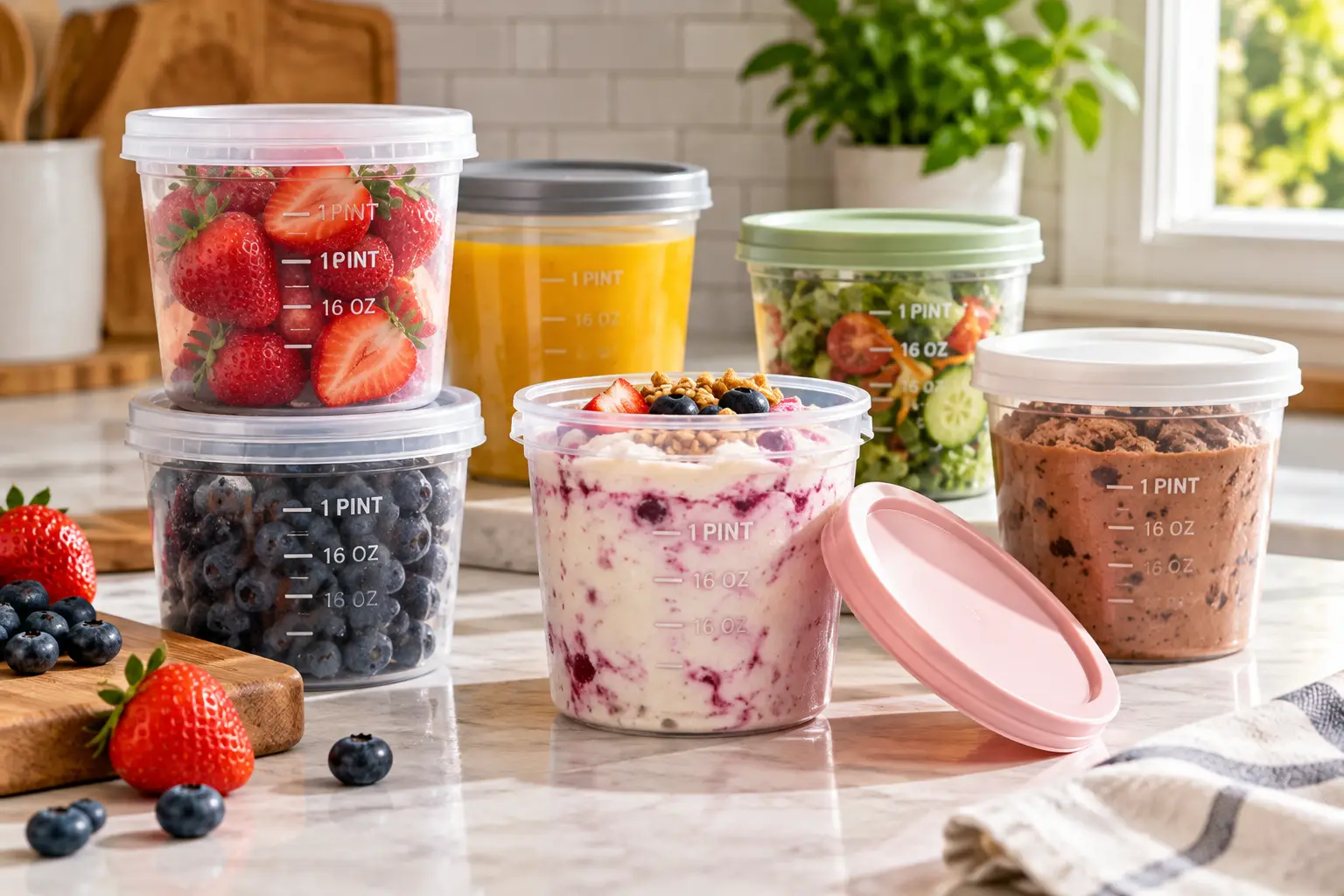
Pint containers are 16-ounce (about 473 ml) food storage vessels — round deli tubs, glass jars, or rigid freezer cups — sized to hold exactly one US pint, which makes them the default unit for soups, sauces, leftovers, and homemade ice cream. That’s the short definition. The longer story is why such a humble object sparks so much frustration in American kitchens.
You’ve probably lived it. A lid that “clicked” shut weeps tomato soup across your fridge shelf. A glass jar cracks in the freezer because nobody mentioned headspace. Or you bought a “pint” for your Ninja CREAMi, only to discover it doesn’t lock into your specific model. Same size on paper, completely different results in practice.
Here’s the thing: the US liquid pint is a fixed 16 fluid ounces, yet the containers built around it vary wildly in material, seal design, temperature tolerance, and machine compatibility. A restaurant-style polypropylene deli cup and a tempered Ball jar both hold a pint — but they solve different problems, cost different amounts over time, and fail in different ways.
This guide cuts through that confusion. We compared seven real pint containers available on amazon.com across three price tiers, using manufacturer spec sheets and aggregated customer review sentiment (not invented test anecdotes). You’ll get honest analysis of who each one suits, a step-by-step freezing guide, real-world buyer scenarios, compatibility notes for ice cream pint containers, and a total-cost breakdown so you stop rebuying junk every six months.
Whether you meal-prep for a family of five, run a small home bakery, or just want soup that doesn’t leak in your work bag, you’ll know exactly which container to grab by the end.
What Are Pint Containers?
A pint container is any lidded vessel with a 16 fl oz capacity designed for storing, freezing, transporting, or (in some cases) processing food. The three main families are plastic deli containers, glass jars or bowls, and machine-specific ice cream pints. Each trades off weight, durability, heat tolerance, and price differently.
Quick Comparison: The 7 Best Pint Containers at a Glance
| Product | Material | Best for | Freezer | Microwave | Price range |
|---|---|---|---|---|---|
| Freshware 16 oz Deli Containers (50 Set) | Polypropylene | Freshware — bulk meal prep on a budget | ✅ | ✅ | Under $25 |
| Stack Man 16 oz Deli Containers (48 Sets) | Polypropylene | Stack Man — restaurant-style soup storage | ✅ | ✅ | $20–$30 |
| Ball Wide Mouth Pint Mason Jars (12 Count) | Glass + metal lid | Ball Wide Mouth — canning and long-term pantry storage | ✅ (with headspace) | Jar only, no metal lid | $15–$25 |
| Ball Plastic Freezer Jars, 16 oz | BPA-free plastic | Ball Freezer Jars — freezer jam and frozen sauces | ✅ | Check label | Under $15 per small pack |
| Pyrex Simply Store 7200 2-Cup Round | Soda-lime glass | Pyrex 7200 — reheat-and-serve leftovers | ✅ | ✅ (glass) | $4–$7 each; sets $25–$35 |
| Ninja CREAMi 16 oz Pint & Lid (XSKPNTLID1) | BPA-free plastic | Ninja CREAMi Pint — guaranteed CREAMi fit | ✅ | ❌ | $15–$20 |
| Omnikit CREAMi Replacement Pints (4 Pack) | BPA-free plastic, dual-wall | Omnikit Pints — budget extra CREAMi pints | ✅ | ❌ | $15–$25 |
Looking at the table, the split is obvious: the two deli-style sets (Freshware and Stack Man) win on cost per container, often landing well under 50 cents each, while glass options like Pyrex 7200 and Ball Wide Mouth cost more upfront but outlast plastic by years. If you own a Ninja CREAMi, only the last two rows matter — general-purpose pint containers won’t lock into the machine’s bowl assembly.
💬 One click helps other shoppers make an informed choice too! 😊
Top 7 Pint Containers: Expert Analysis
1. Freshware 16 oz Deli Containers (50 Set) — best bulk value per pint
The Freshware 16 oz Deli Containers are the “buy once, stop rationing” option, giving you 50 matching tubs and lids in one box.
They’re made from BPA-free polypropylene and marketed as stackable, leakproof, and safe for the microwave, dishwasher, and freezer. In practice, polypropylene matters because it tolerates reheating far better than the thin PET used in many takeout cups — so you can freeze chili Sunday and microwave it Wednesday in the same tub (vented lid, of course). The universal lid fit across the set means no more digging for a match.
Based on comparing specs and listing data, this is the right pick for meal preppers, parents packing lunches, and anyone who gives away food often and doesn’t want to chase containers back. It’s also one of the top-selling items in Amazon’s pint containers with lids category, which signals broad satisfaction rather than a niche fan base.
Customer reviews consistently praise the value and lid fit, while a recurring complaint is that the walls feel thinner than restaurant-grade tubs and can crack if dropped while frozen.
Pros:
- ✅ Very low cost per container in a 50-pack
- ✅ Microwave, freezer, and dishwasher safe
- ✅ One lid size fits every tub
Cons:
- ❌ Thinner walls than commercial-grade deli cups
- ❌ Can turn brittle when dropped frozen
💲 Typically under $25 for the set (check the current price) — hard to beat for everyday leftover duty.
2. Stack Man 16 oz Deli Containers (48 Sets) — restaurant-grade sturdiness
The Stack Man 16 oz Deli Containers lean into the professional-kitchen feel, with a heavier tub that holds its shape when full of hot soup.
Each tub is a true pint (16 oz / 473 ml), and the pack includes 48 containers with 48 lids. What that means in practice: a slightly thicker wall resists the “soft squeeze” problem where you grip a full container and the lid pops off. The translucent body also lets you identify contents at a glance — crucial when your freezer holds six shades of brown stew.
Our honest read: if you cook in batches, store stock, or run a small catering or bakery side hustle, the Stack Man set is worth the modest premium over Freshware. Casual users who mostly pack lunches may not notice the difference.
Aggregated reviews highlight durability through repeated dishwasher cycles and a reliable seal; the most common critique is that lids can be stiff to remove at first, especially with cold fingers.
Pros:
- ✅ Thicker build holds up to repeated reuse
- ✅ True 16 oz capacity with matching lids
- ✅ Stacks neatly in fridge and freezer
Cons:
- ❌ Lids can be tight and stiff initially
- ❌ Costs more per tub than budget sets
💲 Usually in the $20–$30 range — good value if you’ll reuse each tub dozens of times.
3. Ball Wide Mouth Pint Mason Jars (12 Count) — the canning-and-freezing classic
The Ball Wide Mouth Pint Mason Jars are the only pick here built for true home canning, while also doubling as freezer-safe pint containers.
Each 16 oz jar comes with a SureTight lid and band, is BPA-free, and is made in the USA. Ball rates the wide-mouth pint as freezer safe, and the straight-ish wide opening matters: it lets frozen contents expand upward rather than pushing against a narrow shoulder — the main cause of cracked jars. Ball positions this size for salsas, sauces, relishes, and fruit butters.
On paper, this is the most versatile glass option: can tomato sauce in August, freeze bone broth in November, store dry beans the rest of the year. The tradeoff is weight and breakability, so it’s less ideal for lunch bags or kids.
Reviews consistently report high satisfaction with seal quality and the “endless uses” factor; negative feedback mostly involves jars arriving broken in shipping or cracking when filled to the brim before freezing.
Pros:
- ✅ Rated safe for canning and freezing
- ✅ Wide mouth makes filling and cleaning easy
- ✅ Glass won’t absorb stains or odors
Cons:
- ❌ Heavy and breakable for on-the-go use
- ❌ Metal lids aren’t microwave safe
💲 Generally $15–$25 per 12-pack — excellent long-term value given glass lasts for decades.
4. Ball Plastic Freezer Jars, 16 oz — purpose-built for the freezer
The Ball Plastic Freezer Jars exist for one job: freezing jams, sauces, and purées without the risk that comes with glass.
They’re BPA-free plastic with twist-on lids, rated freezer and dishwasher safe, and some versions use a squared shape that packs more efficiently than round tubs. That shape is a quiet win — squares leave fewer dead air gaps between containers, so a crowded freezer drawer holds noticeably more.
Who should buy them? Anyone making freezer jam (no-cook jam recipes are designed around exactly this kind of jar), or households that freeze baby food purées and want a screw-top seal that kids can’t pop off easily. They’re less useful for reheating; check the label before microwaving, since Ball markets them primarily for freezer use.
Aggregated reviews describe them as excellent freezer containers with a dependable seal, though some buyers note the lids can crack over time and the small pack sizes make them pricier per pint than deli cups.
Pros:
- ✅ Shatter-free alternative to glass in the freezer
- ✅ Twist-on lid seals more securely than snap lids
- ✅ Space-efficient shape in many versions
Cons:
- ❌ Higher cost per pint than bulk deli tubs
- ❌ Not designed as a reheating container
💲 Usually under $15 for a small pack (prices vary by color and count) — fair value for dedicated freezer use.
5. Pyrex Simply Store 7200 2-Cup Round — reheat, serve, and store in one dish
The Pyrex Simply Store 7200 holds 2 cups (473 ml — one pint), and it’s the most “go from freezer to table” option on this list.
Made from soda-lime glass, the bowl measures roughly 4.5 x 2 inches, and Pyrex lists the glassware as oven, microwave, dishwasher, and freezer safe (the plastic lid is not oven safe). That shallow, wide shape is the real advantage: food freezes and thaws faster than in a tall jar, and you can reheat leftovers without transferring them to another dish.
Based on the specs, this is ideal for singles and couples portioning dinner leftovers, or anyone trying to cut down on plastic touching hot food. It’s not a soup-transport container — the press-on lid isn’t built for sloshing liquid in a backpack.
Reviews consistently praise stain and odor resistance, but the most frequent complaint is that the plastic lids eventually crack or warp; replacement 7200-PC lids are sold separately.
Pros:
- ✅ Glass goes from fridge to microwave directly
- ✅ Doesn’t stain from tomato sauce or curry
- ✅ Shallow shape thaws faster than tall jars
Cons:
- ❌ Lids wear out before the glass does
- ❌ Not leakproof enough for liquid transport
💲 Around $4–$7 per piece, or $25–$35 for multi-packs — strong long-term value since only the lids need replacing.
6. Ninja CREAMi 16 oz Pint & Lid (XSKPNTLID1) — the guaranteed-fit original
The Ninja CREAMi 16 oz Pint & Lid is the factory replacement pint for the NC300-series CREAMi, so fit is never in question.
It’s a rigid, BPA-free plastic pint built to withstand the machine’s spinning blade (the “Creamify” paddle) shaving down a frozen block. Fit precision matters here more than with any other container: the pint must lock into the outer bowl perfectly, and Ninja also sells distinct pints for the Deluxe (24 oz, NC500 series) and Swirl (NC700 series), which aren’t interchangeable.
Our take: if you make CREAMi ice cream more than once a week, extra pints are the single best upgrade, because each base needs roughly 24 hours in the freezer. Having three or four pints in rotation means you always have one ready.
Customer reviews consistently describe the extra official pints as making the machine far more convenient; the main gripe is the price relative to third-party alternatives.
Pros:
- ✅ Exact fit guaranteed for NC300-series machines
- ✅ Built to handle the machine’s processing stress
- ✅ Fill line molded in for correct portions
Cons:
- ❌ Pricier than compatible third-party pints
- ❌ Won’t fit Deluxe, Swirl, or Breeze models
💲 Typically $15–$20 per pint — worth it if you want zero compatibility risk.
7. Omnikit CREAMi Replacement Pints (4 Pack) — budget extra pints with grip
The Omnikit CREAMi Replacement Pints give you four compatible pints for roughly the price of one or two originals, with an anti-slip textured wall.
The seller lists compatibility with the NC301, NC300, NC299AMZ, NC290WMBF, CN305A, and CN301CO series — and explicitly not the NC700, NC500, NC200, or NC100 models. The dual-wall construction is a practical bonus: it slightly insulates your hand when you grip a rock-hard frozen pint and reduces frost that makes containers slippery.
Honestly, this is the smart buy for CREAMi owners who want a flavor rotation without paying premium prices. Just double-check your model number on the machine’s base before ordering — that’s where most buyer mistakes happen.
Aggregated reviews report a correct fit and good durability, with many buyers saying the quality matches the original; occasional complaints mention lid colors fading in the dishwasher.
Pros:
- ✅ Four pints for a budget-friendly price
- ✅ Anti-slip grip on frozen containers
- ✅ Clearly listed model compatibility
Cons:
- ❌ Third-party, not an official Ninja part
- ❌ Incompatible with Deluxe, Swirl, and Breeze machines
💲 Usually $15–$25 per 4-pack — the best value for multi-flavor CREAMi households.
Top 7 Pint Containers: Feature Comparison
| Product | Seal type | Reheat in container | Transport liquids | Lifespan (typical use) | Best for |
|---|---|---|---|---|---|
| Freshware | Snap-on lid | ✅ (lid off/vented) | Good | 6–18 months | Freshware — giveaway meals |
| Stack Man | Snap-on lid | ✅ (lid off/vented) | Very good | 1–2 years | Stack Man — batch soups |
| Ball Wide Mouth | Two-piece lid + band | Jar only | Excellent | Decades (glass) | Ball Wide Mouth — canning |
| Ball Freezer Jars | Twist-on lid | Check label | Very good | 2+ years | Ball Freezer Jars — freezer jam |
| Pyrex 7200 | Press-on lid | ✅ | Fair | Decades (glass), lids less | Pyrex 7200 — reheat-and-serve |
| Ninja CREAMi Pint | Twist lid | ❌ | Good | Years | Ninja CREAMi Pint — guaranteed fit |
| Omnikit Pints | Twist lid | ❌ | Good | Years | Omnikit Pints — flavor rotation |
The lifespan column is our estimate from material properties and review patterns, not a lab test, but the pattern is consistent: plastic deli tubs are consumables, while glass is an investment. Notice that the best container for transporting liquid (Ball Wide Mouth) is also the worst for a lunch bag due to weight — which is why most kitchens end up owning two types rather than one “perfect” pint.
✨ Don’t miss these kitchen-ready picks!
🔍 Take your food storage to the next level with this carefully curated lineup. Click a highlighted product to check current pricing and availability. These picks will help you get leak-free leftovers the whole family will enjoy!
How to Choose Pint Containers: 7 Steps That Actually Matter
Choosing pint containers gets easier when you start from your use case instead of the product photo. Work through these steps in order:
- Define the main job. Freezing, reheating, transporting, canning, or ice cream processing — pick the top one. A container that does everything usually does nothing exceptionally.
- Pick the material. Polypropylene (#5 plastic) handles microwave reheating; glass handles high heat and resists stains; rigid freezer plastic handles cold without shattering.
- Check the seal design. Twist-on lids beat snap-on lids for transport; two-piece canning lids are the only option for vacuum-sealed shelf storage.
- Confirm temperature ratings on both parts. The body and lid are often rated differently — a glass bowl may be oven safe while its plastic lid is not.
- Match compatibility if a machine is involved. For CREAMi owners, the model number on the base determines the pint, period.
- Think about stacking and footprint. Uniform lid sizes and squared shapes save more freezer space than any organizer bin.
- Calculate cost per use, not cost per pack. A $6 glass bowl used 500 times is cheaper than a 40-cent tub replaced every few months.
The biggest takeaway? Most frustration comes from asking one container to do a job it wasn’t designed for — like transporting soup in a press-on glass bowl.
Pint Containers with Lids: Which Seal Type Wins?
The lid is where pint containers with lids succeed or fail, so it deserves its own breakdown.
Snap-on (deli) lids press over a raised rim. They’re fast, cheap, and universal across a set — the reason restaurants love them. The weakness is that a hard squeeze on the container body flexes the rim and can pop the seal. For best results, burp the lid (press the center while sealing) to push out air and create a slight vacuum.
Twist-on lids, used on the Ball Freezer Jars and CREAMi pints, thread onto the container. Threads distribute pressure evenly, so they’re far less likely to leak when tipped sideways in a bag. The downside: threads trap food residue, so they need a bottle brush now and then.
Two-piece canning lids (the Ball Wide Mouth system) are the gold standard for shelf storage because the flat lid creates a vacuum seal during processing. For everyday fridge use, many people swap in one-piece plastic storage caps, which are easier to open and won’t rust.
Press-on lids like those on the Pyrex 7200 are designed for storage, not transport. They keep air out well enough in the fridge but aren’t engineered to stay sealed when jostled.
Rule of thumb: if it’s going in a bag, choose threads. If it’s staying in the fridge, any lid works.
16 oz Deli Containers vs Glass Pint Containers: Honest Head-to-Head
The 16 oz deli containers vs glass debate isn’t about which is “better” — it’s about which tradeoffs you can live with.
Weight and portability: Deli tubs weigh almost nothing, making them perfect for lunches, picnics, and sending leftovers home with guests. Glass adds real heft, which matters when you’re carrying three servings across a parking lot.
Heat handling: Glass like the Pyrex 7200 reheats evenly and won’t warp. Polypropylene deli cups can be microwaved, but many cooks prefer venting or removing the lid and avoiding very oily foods, which can get extremely hot and soften thin plastic.
Stains and odors: Tomato sauce and turmeric eventually tint plastic orange. Glass stays clear for life.
Breakage: Plastic wins easily. A dropped frozen deli tub might crack; a dropped frozen jar can shatter.
| Option | Advantage over traditional alternatives | Best for |
|---|---|---|
| Deli pint tubs (Freshware, Stack Man) | Cheaper and more uniform than mismatched takeout boxes | Bulk meal prep, giveaways |
| Glass pints (Ball Wide Mouth, Pyrex 7200) | No staining or odor carryover vs. old plastic tubs | Reheating, long-term use |
| Rigid freezer pints vs. zip-top bags | Stackable, reusable, no punctures or burst seams | Liquids, jam, purées |
Reading this table, the pattern is that pint containers beat zip-top bags whenever liquid is involved, since bags puncture and are hard to fill neatly. Meanwhile, glass beats old plastic tubs on hygiene and longevity, but deli tubs remain unbeatable for anything that leaves the house and might not come back.
Getting Started: How to Freeze Food in Pint Containers Without Cracks or Freezer Burn
Freezing is where pint containers earn their keep — and where most first-month mistakes happen. Here’s a practical routine.
🧊 Step 1: Cool before you freeze
Never put steaming food straight into the freezer. Chill it in the fridge first, uncovered or loosely covered, until cool. This protects other frozen items from partial thawing and reduces thermal stress on glass. The USDA’s freezing and food safety guidance notes that holding food at 0°F inactivates microbes, and that recommended freezer times are about quality rather than safety.
📏 Step 2: Leave the right headspace
Liquids expand as they freeze. For wide-top pint containers, extension guidance recommends about ½ inch of headspace for fruit packed in liquid, with more needed for narrow-mouth jars. Penn State Extension’s headspace explainer is a great reference to bookmark. Many Ball jars have a freezer fill line — stop there.
🫙 Step 3: Choose straight-sided jars for glass freezing
Jars with a shoulder trap expanding ice beneath the narrow part, which is exactly where cracks start. Wide-mouth pints are the safer choice.
🏷️ Step 4: Label everything
Write contents and date on masking tape. Future-you won’t remember whether that’s chicken stock or pear purée.
🌬️ Step 5: Thaw gently
Move containers to the fridge overnight. Avoid running hot water over frozen glass — sudden temperature swings are the classic cause of breakage.
Follow this routine for the first 30 days and it becomes automatic.
Real-World Scenarios: Matching Pint Containers to Your Kitchen
Specs only matter when they meet real life. Here are three common profiles and the containers that fit best.
👨👩👧👦 The Sunday meal-prepper (family of four, budget-conscious)
Cooking 15–20 portions on weekends means you need volume and uniformity. A Freshware 50-set keeps the cost per container tiny, and identical lids eliminate the dreaded lid-drawer chaos. Add a handful of Pyrex 7200 bowls for adults who reheat at work — glass handles the office microwave better. Budget: roughly $40–$60 total, with the deli tubs treated as semi-disposable.
🍅 The home preserver (garden harvest, seasonal use)
Someone canning salsa in August and freezing pesto in September needs containers that handle both heat processing and deep freezing. Ball Wide Mouth jars cover canning, while Ball Freezer Jars take over for freezer jam and herb pastes. Budget: $30–$50 at the start, but glass jars last for decades, so the yearly cost is minimal.
🍦 The weekly CREAMi fan (ice cream two to three times a week)
Each base needs about a day to freeze solid, so one pint creates a bottleneck. Start with one Ninja CREAMi Pint for guaranteed fit, then add an Omnikit Pints 4-pack for flavor rotation. Budget: $30–$45 for a five-pint system that keeps a fresh flavor always ready.
Notice the theme: almost no one needs a single container type. Mixing two styles covers about 90% of real kitchen jobs.
Problem → Solution: Fixing Common Pint Container Headaches
Problem 1: The lid pops off when frozen. Solution: You overfilled it. Leave ½ inch of headspace. With Freshware or Stack Man tubs, seal the lid after the contents are fully chilled, not while warm, since cooling air contracts and can warp a thin lid.
Problem 2: Plastic stained orange. Solution: Wipe the tub with a thin layer of oil before adding tomato sauce, or reserve glass like the Pyrex 7200 for tomato-heavy dishes. Sunlight can also fade existing stains.
Problem 3: Glass jar cracked in the freezer. Solution: Use straight-sided wide-mouth jars like the Ball Wide Mouth pints, respect the fill line, and cool the food first. Never freeze a jar sealed tight while the contents are warm.
Problem 4: CREAMi pint won’t lock in. Solution: Check the model number on the motor base. NC300-series pints won’t fit Deluxe (NC500) or Swirl (NC700) machines. The Omnikit Pints and Ninja CREAMi Pint fit only the listed series.
Problem 5: Soup leaked in my bag. Solution: Switch to a threaded lid — Ball Freezer Jars or a mason jar with a one-piece storage cap — and place the container upright in a zip-top bag as backup insurance.
🛒 Ready to upgrade your storage game?
🔍 Stop fighting leaky lids and cracked jars. Click any highlighted product above to check current pricing and availability — and build a pint system that actually fits how you cook!
Ice Cream Pint Containers: Ninja CREAMi Compatibility Explained
Ice cream pint containers are the fastest-growing corner of this category, mostly thanks to the Ninja CREAMi. Unfortunately, they’re also the most confusing.
The key fact: Ninja makes several CREAMi lines, and their pints are not cross-compatible.
- Original/NC300 family (including NC299AMZ, NC301): uses the 16 oz pint, such as the Ninja CREAMi Pint (XSKPNTLID1).
- CREAMi Deluxe (NC500 series): uses a larger 24 oz pint.
- CREAMi Swirl (NC700 series): uses its own 16 oz pint design, sold separately as a different part.
- CREAMi Breeze (NC100/NC200 series): uses yet another pint style.
Third-party sellers often clearly state these exclusions — the Omnikit Pints, for example, list NC300-family compatibility and explicitly exclude the NC700, NC500, NC200, and NC100 models. That honesty is a good sign, and you should look for the same clarity in any third-party listing.
What about using regular deli containers for homemade ice cream? For storage, absolutely — a Stack Man tub works fine for ice cream made in a traditional churn machine. But never try to process a non-CREAMi container in a CREAMi; the machine relies on precise dimensions to lock the pint, and a poor fit can damage the unit or the container.
One more tip: always freeze CREAMi bases on a level surface. A tilted freeze creates an uneven top that the blade struggles with, which is one of the most common causes of crumbly results.
Common Mistakes to Avoid When Buying Pint Containers
Even savvy shoppers trip on these:
❌ Buying by piece count alone. A 100-pack of flimsy tubs that crack in a month costs more than 48 sturdy ones. Look at wall thickness and review complaints about brittleness.
❌ Ignoring the lid’s ratings. Glass bodies are often oven safe while lids are not. Microwaving a metal canning lid is a serious mistake — remove it first.
❌ Assuming “16 oz” means identical dimensions. A tall deli tub and a shallow Pyrex bowl both hold a pint but fit differently in freezer drawers, lunch boxes, and machines.
❌ Buying CREAMi pints without checking the model number. This is the number-one return reason in the ice cream pint category based on recurring review complaints.
❌ Choosing narrow-shoulder jars for freezing. Decorative jars and regular-mouth jars with pronounced shoulders crack more easily when liquids expand.
❌ Forgetting about mixing sizes. Many cooks benefit from pairing pint containers with quart containers (32 oz) using the same lid size — some deli sets share lids across 16 and 32 oz tubs, which keeps your lid drawer manageable.
Avoid these six and you’ll skip most of the buyer’s remorse that fills one-star reviews.
Long-Term Cost and Maintenance of Pint Containers
The sticker price tells you little. What matters is cost per use over the container’s life.
| Type | Upfront cost per pint | Realistic reuses | Approx. cost per use | Best for |
|---|---|---|---|---|
| Budget deli (Freshware) | Under $0.50 | 30–80 | ~1¢ | Freshware — high-turnover use |
| Heavy deli (Stack Man) | $0.40–$0.65 | 80–200 | <1¢ | Stack Man — batch cooks |
| Glass jar (Ball Wide Mouth) | $1.25–$2.00 | 500+ | <0.5¢ | Ball Wide Mouth — lifetime use |
| Glass bowl (Pyrex 7200) | $4–$7 | 500+ (lids less) | ~1¢ incl. lid replacements | Pyrex 7200 — daily reheats |
| CREAMi pint (Ninja CREAMi Pint) | $15–$20 | Hundreds | ~5–10¢ | Ninja CREAMi Pint — machine use |
Reuse figures are our estimates based on material durability and review patterns, not controlled testing. Even so, the math is striking: glass costs several times more upfront yet ends up cheaper per use than budget plastic over a few years. The deli tubs still make sense when containers regularly leave your home, because a lost glass bowl is a far bigger loss than a lost 40-cent tub.
Maintenance tips that extend life:
- Wash plastic on the top rack of the dishwasher to avoid warping near the heating element.
- Replace plastic containers that become deeply scratched or cloudy, since grooves hold residue.
- Hand-dry metal canning bands to prevent rust.
- Store glass bowls with lids off so trapped moisture doesn’t cause odors.
Safety, Materials, and Standards for Pint Containers
Food storage safety in the US comes down to three practical questions: is the material food-grade, is it rated for the temperature you’re using, and does the closure fit the job?
Material basics. Most reusable deli tubs are polypropylene (resin code #5), valued for heat tolerance and chemical resistance. Glass options use soda-lime glass, which is non-porous, so it doesn’t absorb flavors. Every product on this list is marketed as BPA-free, which matters to many families even though glass makes the question moot.
Temperature ratings. Read each rating as separate for the body and lid. Glass labeled “freezer safe” still needs headspace, and “microwave safe” plastic should usually be vented. Pyrex-style glass carries a warning against sudden temperature changes — don’t move it from freezer directly into a hot oven.
Freezing guidance. The National Center for Home Food Preservation’s container guide, hosted by the University of Georgia, recommends rigid containers and wide-mouth dual-purpose jars for liquids and notes that ordinary glass jars break more easily in the freezer. That’s the science behind our preference for wide-mouth pints.
Canning safety. Only use jars and lids designed for canning, such as Ball’s two-piece system, and follow tested recipes. Deli tubs and freezer jars are never suitable for heat processing.
Labeling. Date everything. Freezing keeps food safe indefinitely at 0°F, but quality declines over months, so rotation matters.
FAQ About Pint Containers
❓ Are pint containers microwave safe?
❓ How many ounces is a pint container?
❓ Can I use regular pint containers in a Ninja CREAMi?
❓ What are the best pint containers for freezing soup?
❓ Where can I buy pint containers in bulk?
Conclusion: Build a Pint Container System, Not a Pile
The smartest way to shop for pint containers is to stop looking for one perfect product. Instead, build a small system around how you actually cook.
For most households, that means a bulk set of deli tubs — Freshware for budget value or Stack Man for restaurant-grade durability — paired with a few glass pieces for reheating and long-term storage. The Pyrex 7200 shines for daily leftovers, while the Ball Wide Mouth jars are unbeatable if you can or freeze in quantity. Freezer-jam makers should add Ball Freezer Jars for a shatter-free, twist-sealed option.
CREAMi owners face a simpler choice: start with the Ninja CREAMi Pint for guaranteed fit, then expand with Omnikit Pints once you’ve confirmed your model number.
Whatever you choose, the fundamentals stay the same. Respect headspace. Match the lid to the job. Cool before freezing. And calculate cost per use, not cost per pack — that’s how a $6 glass bowl ends up cheaper than a “bargain” tub.
Get those basics right, and your fridge will be tidier, your freezer more efficient, and your lunch bag blissfully soup-free.
🚀 Your leak-free kitchen starts today!
🔍 Pick the pint containers that match your cooking style from our lineup above. Click a highlighted product to check current pricing and availability — and enjoy fresher, better-organized food the whole family will love!
Recommended for You
- Glass Flour Sugar Canisters: 7 Best Airtight Picks for 2026
- Commercial Food Storage Containers with Lids: 7 Best Picks (2026)
- Tupperware Flour Canister: 7 Best Picks That Keep Pests Out (2026)
Disclaimer: This post contains affiliate links. As an Amazon Associate, I earn from qualifying purchases made through these links, at no additional cost to you.
✨ Found this article helpful? Share it with someone who needs it! 💬🤗