
In This Article
Introduction: Why Your Fridge Deserves Better Than Mystery Tubs
What Are Glass Fridge Storage Containers?
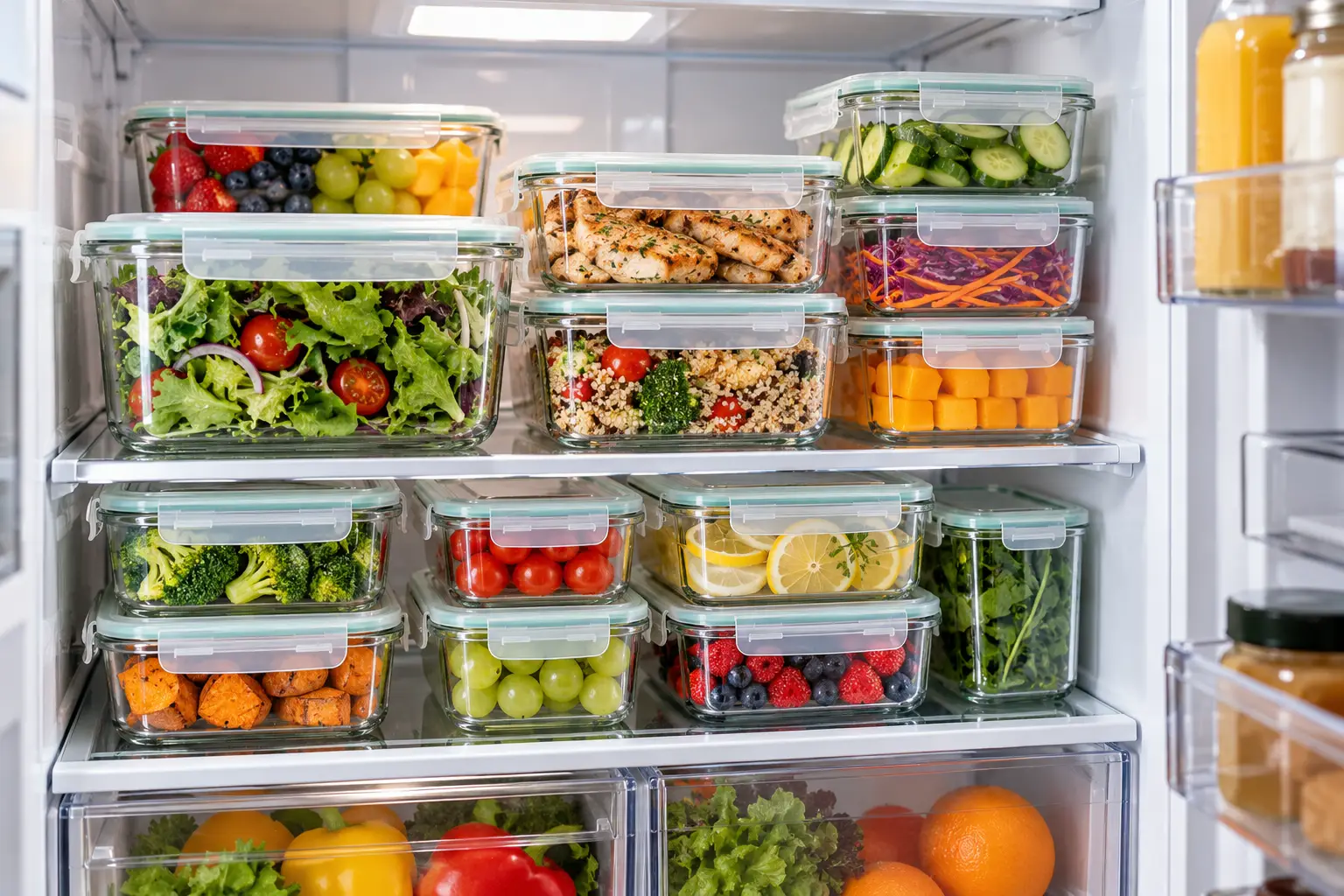
Glass fridge storage containers are food containers with a glass base — usually tempered soda-lime or borosilicate glass — and a sealing lid made of plastic, silicone-rimmed glass, or both. They keep leftovers, prepped meals, and produce fresh in the refrigerator, resist stains and odors, and often go straight from fridge to microwave or oven.
Now for the part nobody puts on the box. Open almost any American fridge and you’ll find the same archaeology: a stack of cloudy plastic tubs, at least one lid that fits nothing, and a container of chili that turned the plastic permanently orange in 2023. Glass fridge storage containers fix most of that in one move. Glass doesn’t absorb tomato sauce, doesn’t hold onto last week’s curry smell, and lets you see exactly what’s hiding in the back corner before it becomes a science project.
But “just buy glass” is lazy advice. The real differences between sets live in the details: whether the glass is tempered or borosilicate, whether the lid actually locks or just sits there looking optimistic, whether the lid can go in the microwave, and whether the whole thing stacks without turning your middle shelf into a Jenga tower.
This guide compares seven real sets you can find on amazon.com, from budget-friendly workhorses to a premium ceramic-coated option. Every recommendation is grounded in manufacturer specs, independent testing where it exists, and the aggregated themes that show up repeatedly in customer reviews — no invented testing stories, no fake star ratings. You’ll also get a getting-started routine, real-world buyer profiles, a troubleshooting guide, and an honest look at long-term cost, so you can pick the set that fits how you actually cook and store food.
Quick Comparison: The 7 Best Glass Fridge Storage Containers at a Glance
| Product | Glass Type | Lid Style | Oven-Safe Base | Approx. Price Range | Best For |
|---|---|---|---|---|---|
| Pyrex Simply Store 18-Piece Set | Tempered glass | Press-on plastic | Yes (preheated) | $30–$45 | Pyrex Simply Store 18-Piece Set: budget-friendly everyday leftovers |
| Rubbermaid Brilliance Glass Set | Tempered glass | Latching plastic, vented | Yes, up to 450°F | $35–$60 | Rubbermaid Brilliance Glass Set: leakproof soups and sauces |
| OXO Good Grips 16-Piece Smart Seal Glass Set | Borosilicate | 4-tab locking, removable gasket | Yes, up to 450°F (preheated) | $60–$90 | OXO Good Grips 16-Piece Smart Seal Glass Set: easy-to-clean seals |
| Pyrex Ultimate 10-Piece Set with Glass Lids | Glass base + glass lid | Glass lid, silicone rim | Yes, lid included | $60–$80 | Pyrex Ultimate 10-Piece Set with Glass Lids: minimal plastic contact |
| Glasslock 18-Piece Assorted Oven Safe Set | Tempered glass | 4-tab snap-lock | Yes (glass only) | $40–$70 | Glasslock 18-Piece Assorted Oven Safe Set: tight stacking |
| Bayco 24-Piece Glass Storage Set | Borosilicate | 4-tab snap-lock | Yes (glass only) | $35–$50 | Bayco 24-Piece Glass Storage Set: max pieces per dollar |
| Caraway Glass Food Storage Set | Ceramic-coated borosilicate | Glass lid, silicone seal | Yes, up to 450°F | $200–$250 | Caraway Glass Food Storage Set: style-first kitchens |
Looking at the table, the real dividing line isn’t price — it’s the lid. The Pyrex Simply Store 18-Piece Set is the cheapest way into glass, but its press-on lids don’t lock, so it’s best for solid foods rather than brimming soup. If leaks are your biggest worry, the Rubbermaid Brilliance Glass Set and the OXO Good Grips 16-Piece Smart Seal Glass Set justify their higher cost, while the Caraway Glass Food Storage Set is a design purchase first and a value purchase second.
💬 One click helps other shoppers make an informed choice too! 😊
Top 7 Glass Fridge Storage Containers: Expert Analysis
1. Pyrex Simply Store 18-Piece Set — the classic budget starter kit
If you want to clear out plastic without spending much, this is the set most people start with — and for good reason. The Pyrex Simply Store 18-Piece Set pairs nine tempered glass containers with nine color-coded plastic lids in a spread of round and rectangular sizes. The glass resists stains and odors, which in practice means your marinara container still looks like a container after a year. The lids are a snug press-on fit rather than a locking design, so they’re quick to open with wet hands but not built to survive a tipped-over lunch bag.
Based on comparing the specs, this is the right pick for households that mostly store solid leftovers, chopped vegetables, and cooked grains, and that want a lot of sizes on day one. It’s less ideal for commuters carrying soup. Notably, EatingWell’s testing team named this set its best overall glass storage pick, praising how well it kept produce fresh. In customer reviews, the recurring complaint is lid warping after people microwave with the lid on — so treat the lids as fridge-only.
Pros:
- ✅ Very low cost per container for genuine Pyrex glass
- ✅ Color-coded lids make sorting sizes fast
- ✅ Nests compactly inside itself in a cabinet
Cons:
- ❌ Press-on lids don’t lock for travel
- ❌ Plastic lids can warp if microwaved
Typically found in the $30–$45 range at the time of writing — prices may vary — making it the strongest value for a first all-glass fridge setup.
2. Rubbermaid Brilliance Glass Set — best for leakproof soups and stews
This is the set for anyone who has ever opened a lunch bag to find it marinating in its own soup. The Rubbermaid Brilliance Glass Set uses crystal-clear plastic lids with a dual-latch system that Rubbermaid markets as 100% airtight and leakproof, plus built-in vents so you can microwave with the latches popped open. The glass base is oven-safe up to 450°F once the lid comes off, so one container can hold, reheat, and even finish a casserole.
What most buyers overlook is the lid system: Brilliance lids are designed to fit across Brilliance containers of the same footprint regardless of material, which makes replacements and mix-and-match storage far easier than with off-brand sets. On paper, that’s a long-term advantage, not just a convenience. Customer reviews consistently highlight the seal as the standout — people report carrying liquids without drips — while the most common gripe is that the glass bases are heavy and the set feels pricey compared with basic Pyrex.
Pros:
- ✅ Latching lids are genuinely leak-resistant for liquids
- ✅ Microwave vents reduce splatter during reheating
- ✅ Crystal-clear lids let you see contents from above
Cons:
- ❌ Heavier than plastic, noticeable in lunch bags
- ❌ Lids should go on the top dishwasher rack only
Expect roughly $35–$60 depending on set size — check the current price — and strong value if spills are your main pain point.
3. OXO Good Grips 16-Piece Smart Seal Glass Set — easiest seal to keep clean
The quiet hero here is a piece of silicone you can actually pull out. The OXO Good Grips 16-Piece Smart Seal Glass Set uses borosilicate glass containers that OXO rates for freezer-to-preheated-oven use, with polypropylene lids that clamp down via four locking tabs onto a removable silicone gasket. That removable gasket matters more than it sounds: trapped moisture under a fixed gasket is where funky smells and mildew start.
Here’s what to weigh: OXO’s glass leans toward thermal-shock resistance thanks to borosilicate, and the lids also fit OXO’s same-size plastic Smart Seal containers, which gives you flexible spares. America’s Test Kitchen named the OXO 8-cup Smart Seal rectangle its top glass storage pick after leak and odor testing, which lines up with what customer reviews say — the seal holds, and the gasket is easy to clean. The tradeoff is cost; this set sits a tier above Pyrex and Rubbermaid.
Pros:
- ✅ Removable gasket prevents hidden mold buildup
- ✅ Borosilicate glass handles temperature swings better
- ✅ Lids interchange with OXO plastic Smart Seal containers
Cons:
- ❌ Pricier per piece than mainstream sets
- ❌ Four tabs take a moment longer to close
Usually around $60–$90 at the time of writing, a fair price for the most hygienic seal design in this lineup.
4. Pyrex Ultimate 10-Piece Set with Glass Lids — least plastic touching your food
If you’ve been switching to glass specifically to cut down on plastic, this set goes further than most. The Pyrex Ultimate 10-Piece Set with Glass Lids pairs five glass containers — 7-cup, 4-cup, and 2-cup rounds plus 6-cup and 3-cup rectangles — with transparent glass lids wrapped in a silicone rim. Because the lid is glass, retailers list it as preheated-oven-safe, so you can bake, cover, and refrigerate in the same dish.
Based on comparing the specs, this set suits people who batch-cook casseroles and roasts, and those who prefer that only glass and silicone touch their food. Seeing contents through the lid is a real advantage in bottom-freezer drawers. Retail listings describe the glass as tempered in some markets and borosilicate in others, so check the packaging if that distinction matters to you. In customer feedback, the praise centers on the all-glass feel, while a recurring frustration is that replacement lids for this specific line can be hard to find.
Pros:
- ✅ Glass lids are oven-safe, unlike most sets
- ✅ Minimal plastic contact with stored food
- ✅ See-through tops help in drawers and freezers
Cons:
- ❌ Glass lids are heavy and less drop-tolerant
- ❌ Replacement lids are harder to source
Often in the $60–$80 range — prices may vary — good value for plastic-averse cooks, less so for lunch-packers.
5. Glasslock 18-Piece Assorted Oven Safe Set — the tightest stacker in the fridge
Glasslock has been making snap-lock glass containers for years, and that track record shows in how predictable this set is. The Glasslock 18-Piece Assorted Oven Safe Set (model 11292) includes nine tempered glass containers in rectangular, square, and round shapes, each with a polypropylene lid that clamps down using four locking flaps. The glass goes in the oven, but the lids do not — and the lids also need to come off for the microwave.
Here’s what to weigh: Glasslock’s uniform footprints stack well, which is why EatingWell’s testers singled it out as their favorite locking-lid set, specifically for space-saving stacking. That makes it a smart buy for small fridges and apartment kitchens. Customer reviews often mention seals that stay tight for many years, along with a common caveat — some people find the four tabs stiff at first, and the lids aren’t microwave-safe, so you’ll need a paper towel or splatter cover.
Pros:
- ✅ Uniform shapes stack neatly on crowded shelves
- ✅ Four-flap lids create a reliable airtight seal
- ✅ Long-standing reputation for durable seals
Cons:
- ❌ Lids must come off for the microwave
- ❌ Stiff latches can be hard for weaker grips
Generally $40–$70 at the time of writing; a solid value if fridge space is your biggest constraint.
6. Bayco 24-Piece Glass Storage Set — most containers for the money
Sometimes you just need a lot of containers, fast. The Bayco 24-Piece Glass Storage Set delivers twelve borosilicate glass containers and twelve snap-lock lids across three shapes and multiple sizes, with each lid sealed by four locks and a silicone ring. Borosilicate at this price is the headline: it’s the glass type known for handling rapid temperature changes better than standard glass.
On paper, this is the meal-prepper’s bulk buy — enough containers to portion a full week of lunches plus leftovers without running the dishwasher every night. It also makes sense as a second set for the freezer. One detail most buyers overlook appears in Bayco’s own listing: wash and dry both lids and containers before storing them, because damp silicone rings can stick to the glass. Customer reviews generally praise the price-to-quality ratio for meal prep, while some note that lids are the weak link over time compared with name-brand sets.
Pros:
- ✅ Twelve borosilicate containers at a budget price
- ✅ Four-lock lids handle most liquids well
- ✅ Great for weekly meal prep batches
Cons:
- ❌ Lid durability trails premium brands
- ❌ Silicone rings need careful drying
Commonly around $35–$50 — check the current price — and the best cost per container in this lineup.
7. Caraway Glass Food Storage Set — the showpiece for open-shelf kitchens
This is the splurge pick, and it doesn’t pretend otherwise. The Caraway Glass Food Storage Set uses borosilicate glass bodies with a non-stick ceramic coating in colors that match Caraway cookware, tempered glass lids with silicone seals, and storage organizers that keep lids and containers neatly racked. The containers are oven-safe up to 450°F, but the lids and inserts are not microwave-safe.
What the spec sheet doesn’t say, but reviews reveal, is that this set is as much about organization as storage. The included racks solve the “avalanche of lids” problem better than anything else here, and the ceramic coating makes cheesy or sticky leftovers release more easily. That said, it’s built for households that value a coordinated look and are willing to pay for it. Reviewers frequently describe the set as beautiful and well-made, while the most common criticism is simple: the price is several times higher than a comparable Pyrex or OXO setup. Some retail listings also recommend handwashing.
Pros:
- ✅ Ceramic-coated interiors release sticky foods easily
- ✅ Included organizers end the lid avalanche
- ✅ Coordinates with Caraway cookware colors
Cons:
- ❌ Far more expensive than functional equivalents
- ❌ Lids can’t go in the microwave
Typically $200–$250 at the time of writing — prices may vary — worth it only if aesthetics and organization are top priorities.
Head-to-Head: Detailed Feature Comparison
| Product | Locking Lid? | Microwave With Lid? | Removable Gasket? | Plastic-Free Food Contact? | Best For |
|---|---|---|---|---|---|
| Pyrex Simply Store 18-Piece Set | No | No (fridge-only lids) | No gasket | No | Pyrex Simply Store 18-Piece Set: first-time glass buyers |
| Rubbermaid Brilliance Glass Set | Yes, 2 latches | Yes, vented, unlatched | No | No | Rubbermaid Brilliance Glass Set: soups and commuters |
| OXO Good Grips 16-Piece Smart Seal Glass Set | Yes, 4 tabs | Check manual | Yes | No | OXO Good Grips 16-Piece Smart Seal Glass Set: hygiene-focused cooks |
| Pyrex Ultimate 10-Piece Set with Glass Lids | Snap seal | Glass lid | Silicone rim | Mostly | Pyrex Ultimate 10-Piece Set with Glass Lids: casserole cooks |
| Glasslock 18-Piece Assorted Oven Safe Set | Yes, 4 flaps | No | No | No | Glasslock 18-Piece Assorted Oven Safe Set: small fridges |
| Bayco 24-Piece Glass Storage Set | Yes, 4 locks | No | Yes | No | Bayco 24-Piece Glass Storage Set: bulk meal prep |
| Caraway Glass Food Storage Set | Silicone seal | No | Yes | Mostly | Caraway Glass Food Storage Set: display-worthy storage |
The pattern here is clear: locking lids and microwave convenience rarely come in the same package. The Rubbermaid Brilliance Glass Set is the only pick that combines latching lids with built-in microwave vents, which is why it’s the safest all-rounder for people who reheat at work. If your main concern is food touching plastic, the Pyrex Ultimate 10-Piece Set with Glass Lids and the Caraway Glass Food Storage Set are the only two that minimize it.
✨ Don’t miss these top-rated picks!
🔍 Take your fridge organization to the next level with this carefully curated lineup. Click a highlighted item to check current pricing and availability. These picks will help you get fresher leftovers and a cleaner fridge the whole family will enjoy!
Getting Started: Your First 30 Days With Glass Fridge Storage Containers
New glass containers come with a small learning curve, mostly around heat and lids. Here’s a practical routine.
Day 1: Wash, dry, and sort. Run everything through a wash before first use. For snap-lock sets like the Bayco 24-Piece Glass Storage Set or OXO Good Grips 16-Piece Smart Seal Glass Set, pull the gaskets out, wash them separately, and let everything dry completely before reassembling. Then match each lid to its base and store lids vertically in a bin or file organizer — it saves endless digging.
Week 1: Learn your lids. Read which lids can go in the microwave. Only the Rubbermaid Brilliance Glass Set is designed for vented, lid-on reheating; with most others, the lid comes off first. A cheap microwave splatter cover solves the mess.
Week 2: Respect temperature changes. Glass hates sudden shocks. Don’t pour boiling soup into a cold container straight from the fridge, and don’t set a hot dish on a wet countertop. Let food cool briefly, then portion it into shallow containers so it chills quickly.
Week 3: Build a fridge map. Assign zones — prepped proteins on one shelf, cut vegetables in another, leftovers front and center. Clear glass works best when the oldest food sits in front.
Week 4: Audit your seals. Fill a container with water, lock it, and tilt it over the sink. Any drip means the gasket isn’t seated or needs cleaning.
⚡ Common first-month mistakes: overfilling (liquids expand when frozen), forcing lids onto warm food, and running plastic lids on the bottom dishwasher rack, where heat can warp them.
Real-World Scenarios: Matching Glass Meal Prep Containers to Your Life
Specs only matter once they meet a real routine. Here are three common profiles and the reasoning behind each match.
🧑💼 The Weekday Commuter (budget: $40–$60, daily use)
You prep five lunches on Sunday, carry one daily, and reheat in an office microwave. Your biggest risks are leaks in transit and splatter at work. The Rubbermaid Brilliance Glass Set fits best because the latching lids hold liquids and the vents let you reheat without removing the lid in a shared kitchen. If you mostly pack grain bowls instead of soup, the Bayco 24-Piece Glass Storage Set stretches the same budget across more glass meal prep containers.
👨👩👧 The Family of Four (budget: $50–$90, several uses daily)
Leftovers, school snacks, cut fruit, and the occasional baked ziti all compete for shelf space. Here, size variety and stacking matter more than anything. The OXO Good Grips 16-Piece Smart Seal Glass Set offers a broad size range with hygienic, easy-to-clean seals — important when kids are opening and closing containers all day. Add a Pyrex Simply Store 18-Piece Set for extra fridge-only storage at low cost.
🍲 The Batch Cook and Casserole Fan (budget: $60–$100, a few big uses weekly)
You cook once, eat three times, and bake in the same dish you store in. The Pyrex Ultimate 10-Piece Set with Glass Lids shines here because its glass lid can go in a preheated oven, so you can cook, cover, chill, and reheat without swapping vessels. In a small apartment, the Glasslock 18-Piece Assorted Oven Safe Set is the more space-efficient alternative.
Problem → Solution: Fixing the Most Common Glass Storage Headaches
Problem 1: The lid smells even though the glass is spotless. Glass doesn’t hold odors, but silicone gaskets and plastic lids can. Solution: remove gaskets on sets that allow it (the OXO Good Grips 16-Piece Smart Seal Glass Set, Bayco 24-Piece Glass Storage Set), soak them in warm water with baking soda, and air-dry fully before reinstalling.
Problem 2: Soup leaks in your bag. A press-on lid like the one on the Pyrex Simply Store 18-Piece Set isn’t designed for liquids on the move. Solution: switch to leakproof glass containers with lids that latch, such as the Rubbermaid Brilliance Glass Set, and leave about half an inch of headspace so pressure doesn’t push the seal.
Problem 3: Lids warp and stop fitting. This almost always comes from microwaving with the lid on or bottom-rack dishwashing. Solution: microwave lids only when the manufacturer says so, and keep plastic lids on the top rack.
Problem 4: A container cracked in the oven. Thermal shock is the usual culprit. Solution: preheat the oven first, avoid freezer-to-hot-oven jumps unless the maker explicitly allows it, and never add cold liquid to a hot dish.
Problem 5: Your fridge looks organized for a week, then collapses. Solution: commit to one or two lid systems. Mixing five brands guarantees orphan lids. The Caraway Glass Food Storage Set organizers or a simple lid rack keep the system working.
How to Choose Glass Fridge Storage Containers
Use these steps to narrow the field in a few minutes:
- Decide how much you’ll carry food. If containers leave the house, prioritize latching lids. Fridge-only use can get by with press-on lids.
- Pick your glass type. Borosilicate handles temperature swings better; tempered glass is tougher against bumps. Neither is “bad” — they’re optimized for different risks.
- Check lid microwave rules. A set where the lid must come off every time adds friction to daily reheating.
- Look for removable gaskets. They’re the difference between a seal you can clean and one that quietly grows mildew.
- Measure your shelves. Note shelf height and depth. Rectangular containers waste less space than rounds.
- Count realistic sizes. Most households use 2–4 cup containers constantly and 7–8 cup containers occasionally. A set with ten tiny cups won’t help much.
- Think about replacement lids. Mainstream brands like Pyrex, Rubbermaid, and OXO sell lids separately, which extends the life of the whole set.
For a deeper look at how testers judge leak resistance and odor retention, America’s Test Kitchen’s glass storage container review explains its leak and odor testing in useful detail. The big takeaway: lid design matters far more than the glass itself once you’re past the basics.
Glass Food Storage Containers for Fridge vs. Plastic Containers
Plastic still has fans, and it’s worth being honest about why. It’s light, cheap, and won’t shatter on tile. But for fridge storage specifically, glass wins on most of the things that affect daily life.
| Factor | Glass Containers | Plastic Containers | Best For |
|---|---|---|---|
| Stain resistance | Excellent; tomato and turmeric rinse out | Often stains permanently | Glass: saucy leftovers |
| Odor retention | Glass body holds none | Can absorb strong smells | Glass: curries and garlic dishes |
| Weight | Heavy, roughly double plastic | Very light | Plastic: kids’ lunches, hiking |
| Oven use | Most bases are oven-safe | Not oven-safe | Glass: cook-and-store meals |
| Breakage risk | Can chip or shatter | Cracks, rarely shatters | Plastic: households with toddlers |
| Lifespan | Many years with lid replacements | Tends to warp and cloud | Glass: long-term value |
The table shows a simple trade: glass is heavier and breakable, but it lasts longer and stays clean-looking far longer than plastic. For the fridge — where weight doesn’t matter and stains do — glass is the more sensible default. Many households land on a hybrid: glass for the fridge and reheating, lightweight plastic for kids’ lunches and anything going on a hike.
There’s also a reheating argument. Most plastic lids and containers aren’t meant for high heat, while a glass base can go into the microwave or oven without a second thought. If you reheat leftovers daily, that alone tilts the decision.
Tempered vs. Borosilicate Glass Storage Containers: What the Label Really Means
This is the most misunderstood spec in the category. Both types work well in the fridge; the difference shows up when temperatures change quickly.
Borosilicate glass contains boron trioxide, which gives it a low coefficient of thermal expansion. In plain English, it doesn’t expand and contract as much when heated or cooled, so it’s more resistant to cracking from sudden temperature changes. The Wikipedia entry on borosilicate glass explains why lab glassware has relied on it for over a century. In this lineup, the OXO Good Grips 16-Piece Smart Seal Glass Set, Bayco 24-Piece Glass Storage Set, and Caraway Glass Food Storage Set use borosilicate.
Tempered soda-lime glass is heat-treated to be stronger against physical impact, and when it does break, it tends to crumble into smaller pieces rather than large shards. The Pyrex Simply Store 18-Piece Set, Rubbermaid Brilliance Glass Set, and Glasslock 18-Piece Assorted Oven Safe Set use tempered glass.
What does that mean for you? Borosilicate glass storage containers are the safer bet if you regularly move food from fridge to oven or freezer to microwave. Tempered glass is the better bet if you’re more likely to knock a container off the counter than shock it with heat. Either way, follow the maker’s instructions — “oven-safe” almost always means a preheated oven, not a cold oven that heats up around the glass.
Features That Actually Matter (and Ones That Don’t)
Marketing copy for glass fridge storage containers is full of bold claims. Here’s how to sort signal from noise.
✅ Features worth paying for
- Locking lids with a real gasket. This is what makes airtight glass containers for refrigerator use genuinely airtight. Air exposure dries out leftovers and speeds up wilting in cut produce.
- Removable gaskets. A gasket you can’t remove is a gasket you can’t fully clean.
- Interchangeable lids within a brand. Systems like Rubbermaid Brilliance Glass Set and OXO Good Grips 16-Piece Smart Seal Glass Set let one lid fit multiple containers of the same footprint, which reduces orphaned pieces.
- Microwave vents. Only valuable if you reheat with the lid on, but a big quality-of-life upgrade if you do.
- Rectangular shapes. They use fridge space far more efficiently than rounds.
❌ Features that matter less than you’d think
- Huge piece counts. “24-piece” means 12 containers and 12 lids. Compare container counts, not piece counts.
- Tiny condiment cups. Handy, but they inflate set sizes without adding much real storage.
- Measurement markings. Nice for baking, rarely used for leftovers.
- “Leakproof” with no locking mechanism. If the lid just presses on, treat leak claims cautiously.
The key insight: you’re really buying a lid system with glass attached. Choose the lid first, then the glass.
Long-Term Cost and Maintenance
The sticker price is only part of the story. What you actually pay over five years depends on how often lids fail and whether you can replace them.
| Product | Approx. Price Range | Containers Included | Approx. Cost per Container | Best For |
|---|---|---|---|---|
| Pyrex Simply Store 18-Piece Set | $30–$45 | 9 | Under $5 | Pyrex Simply Store 18-Piece Set: lowest upfront cost |
| Bayco 24-Piece Glass Storage Set | $35–$50 | 12 | Around $3–$4 | Bayco 24-Piece Glass Storage Set: volume buyers |
| Rubbermaid Brilliance Glass Set | $35–$60 | Varies by set | Around $5–$7 | Rubbermaid Brilliance Glass Set: leak-free value |
| Caraway Glass Food Storage Set | $200–$250 | 5 main + small inserts | $35+ | Caraway Glass Food Storage Set: design-led buyers |
The math favors budget sets upfront, but replacement lids change the long-term picture. Mainstream brands sell replacement lids, so a cracked lid costs a few dollars instead of a whole set. With lesser-known brands like the Bayco 24-Piece Glass Storage Set, a failed lid often means losing that container’s usefulness entirely.
🔧 Simple maintenance schedule
- Weekly: Remove and wash gaskets on any set that allows it.
- Monthly: Check lids for cracks near latches, where stress concentrates.
- Yearly: Inspect glass for chips on rims. A chipped rim can’t seal properly and can harbor bacteria — retire that piece.
Glass itself almost never wears out from normal use. Lids are the consumable part, so budget for them like you would replacement filters.
Safety, Regulations, and Standards for Fridge Food Storage
Containers are only half of food safety; storage habits are the other half. The USDA’s guidance on leftovers and food safety recommends refrigerating leftovers promptly, keeping them for three to four days, and reheating them to 165°F. Your fridge should stay at 40°F or below.
How do glass containers help? Shallow glass containers let food cool faster, which shortens the time it spends in the “danger zone” between 40°F and 140°F. Clear walls also make it easier to spot food that’s been sitting too long. For storage times by food type, the FoodSafety.gov cold food storage chart is a handy reference to keep bookmarked.
On materials: glass is inert, so the main material questions involve lids. Most mainstream lids are labeled BPA-free, and food-contact materials sold in the US fall under FDA food-contact regulations. That said, “BPA-free” doesn’t mean a lid can handle high heat — always follow the manufacturer’s microwave and dishwasher guidance.
⚠️ Safety tips worth remembering
- Don’t put glass directly on a stovetop burner or under a broiler unless the maker approves it.
- Let frozen glass thaw in the fridge before heating.
- Discard containers with chips or cracks — damaged glass is more likely to fail under heat.
- Label containers with dates using a dry-erase marker or masking tape.
FAQ About Glass Fridge Storage Containers
❓ Can glass fridge storage containers go in the freezer?
❓ Is it safe to put hot food in glass containers in the fridge?
❓ Which brand of glass storage containers lasts the longest?
❓ Are glass containers with plastic lids still worth buying?
❓ How many glass containers does a typical household need?
Conclusion: Pick the Lid, Then the Glass
The best glass fridge storage containers aren’t the ones with the most pieces — they’re the ones whose lids match your routine. If you’re just starting out and mostly store food at home, the Pyrex Simply Store 18-Piece Set gets you into glass for very little. If you carry soups and sauces, the Rubbermaid Brilliance Glass Set is the most dependable leak-resistant choice. For the cleanest, most hygienic seals, the OXO Good Grips 16-Piece Smart Seal Glass Set is the pick, backed by independent testing.
Plastic-averse batch cooks will appreciate the oven-safe glass lids of the Pyrex Ultimate 10-Piece Set with Glass Lids, while small-fridge households will love how the Glasslock 18-Piece Assorted Oven Safe Set stacks. Meal preppers on a budget get the most containers per dollar with the Bayco 24-Piece Glass Storage Set, and if your kitchen is a showcase, the Caraway Glass Food Storage Set brings organization and style — at a premium.
Whatever you choose, pair it with good habits: cool food quickly, respect the three-to-four-day leftover window, and replace lids before they fail. Do that, and your fridge goes from mystery tubs to a system you actually trust.
🛒 Ready to upgrade your fridge?
✨ Click any highlighted product above to check current pricing and availability, and start building a cleaner, fresher, leak-free fridge today!
Recommended for You
- Meat Storage Containers: 7 Best Picks That Stop Freezer Burn (2026)
- Glass Flour Sugar Canisters: 7 Best Airtight Picks for 2026
- Commercial Food Storage Containers with Lids: 7 Best Picks (2026)
Disclaimer: This post contains affiliate links. As an Amazon Associate, I earn from qualifying purchases made through these links, at no additional cost to you.
✨ Found this article helpful? Share it with someone who needs it! 💬🤗