
In This Article
Introduction: Why the Humble Rectangular Glass Container Deserves a Spot in Your Kitchen
Open almost any American fridge and you’ll find the same scene: a tower of mismatched plastic tubs, a few warped lids, and one mysterious orange-stained bowl nobody wants to claim. A good rectangular glass container fixes most of that mess in one move. Glass doesn’t hold onto last week’s chili smell, it doesn’t turn orange after a tomato sauce, and the rectangular shape fills shelf space the way round bowls never can.
But here’s the catch. Not every rectangular glass container is built the same. Some are made from borosilicate glass that can go from freezer to a preheated oven; others use tempered soda-lime glass that’s tough against drops but less forgiving with sudden temperature swings. Some lids lock with four tabs and a silicone gasket; others simply press on and hope for the best. And a few sets that look identical in product photos behave very differently once you toss soup in a work bag.
This guide cuts through that noise. We compared spec sheets, warranty terms, and the aggregated sentiment in thousands of real customer reviews across major US retailers to find seven rectangular glass food storage containers worth your money in 2026. You’ll get honest commentary on who each one suits, a few comparison tables, a practical first-30-days guide, real-world buyer scenarios, and fixes for the most common frustrations (yes, including stuck lids and mystery leaks).
Whether you’re a Sunday meal prepper, a parent packing four lunches a day, or someone who just wants leftovers that don’t taste like plastic, you’ll know exactly which rectangular glass containers with lids fit your life by the end.
What Is a Rectangular Glass Container?
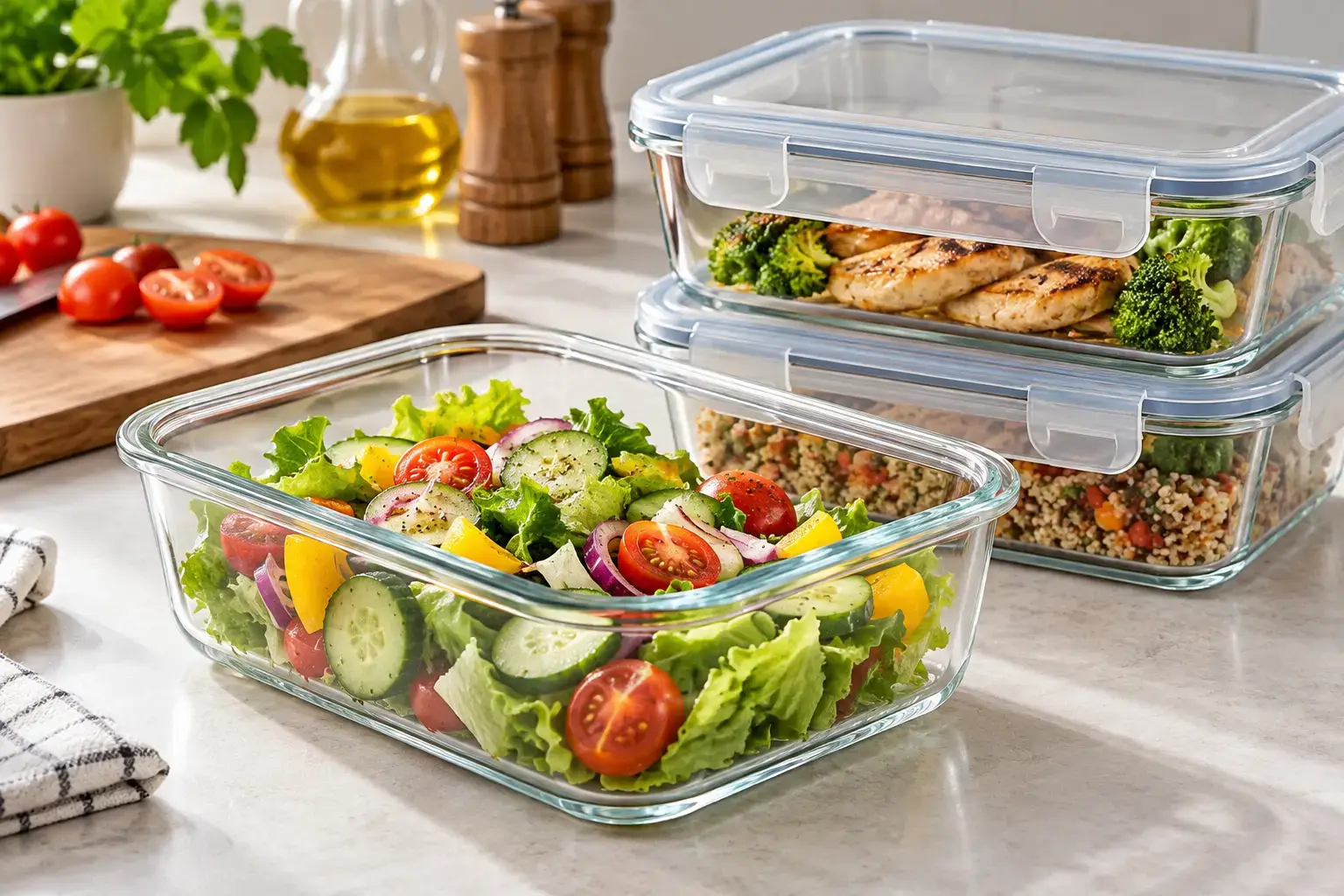
A rectangular glass container is a food storage vessel with a flat-sided, four-cornered glass base and a matching lid, designed to store, reheat, and often bake food. Its shape maximizes fridge and cabinet space, while non-porous glass resists stains and odors better than plastic.
That’s the short answer. The longer one matters more when you’re actually buying.
Two glass types dominate the US market. The first is borosilicate glass, which contains boron trioxide and expands very little when heated, so it handles quick temperature changes well. OXO and Prep Naturals use it. The second is tempered soda-lime glass, which is heat-treated to be stronger against impact; US-market Pyrex, Anchor Hocking, and Glasslock rely on this type. Neither is “bad,” but they reward different habits, and we’ll unpack that later.
Lids matter just as much as the base. Most rectangular glass containers use plastic lids (often BPA-free polypropylene or Tritan) with either a press-fit rim or locking tabs plus a removable silicone gasket. A few, like some Glasslock pieces, offer glass lids. As a rule, the glass base can go in the oven while the lid cannot, even when the base is rated to 425°F or 450°F.
Finally, “rectangular” isn’t just aesthetics. Square corners line up edge to edge on shelves, stack more stably, and fit lasagna, enchiladas, sliced veggies, and sandwich-style lunches far better than round bowls. For meal preppers, that geometry is the whole point.
Quick Comparison: The 7 Best Rectangular Glass Containers at a Glance
| Product | Glass Type | Lid Style | Oven-Safe Base | Typical Price Range | Best For |
|---|---|---|---|---|---|
| Pyrex Simply Store | Tempered | Press-fit plastic | Yes (preheated) | Under $35 for a 3-pack | Pyrex Simply Store — budget basics |
| Rubbermaid Brilliance Glass | Tempered | 4-latch, vented | Up to 450°F | $30–$60 per set | Rubbermaid Brilliance Glass — leakproof commutes |
| OXO Good Grips Smart Seal Glass | Borosilicate | 4 tabs + gasket | Yes (freezer to oven) | $40–$65 per set | OXO Good Grips Smart Seal Glass — freezer-to-oven cooks |
| Snapware Total Solution Pyrex Glass | Tempered | 4 tabs + gasket | Yes (preheated) | $15–$35 per set | Snapware Total Solution Pyrex Glass — mid-budget locking lids |
| Glasslock Oven Safe | Tempered | 4 tabs, some glass lids | Up to ~446°F | $25–$55 per set | Glasslock Oven Safe — plastic-minimal kitchens |
| Prep Naturals Glass Meal Prep | Borosilicate | Snap-lock plastic | Yes | $25–$45 per 5-pack | Prep Naturals Glass Meal Prep — portioned weekly prep |
| Anchor Hocking TrueLock | Tempered | Locking, dry-erase | Up to 425°F | Under $15 per piece | Anchor Hocking TrueLock — bake-and-store dishes |
Looking at the table, the split is clear: if you mostly store and reheat, the Pyrex Simply Store and Anchor Hocking TrueLock deliver the most glass for the least money. If you’ll toss containers in a bag daily, the four-latch designs from Rubbermaid Brilliance Glass and OXO Good Grips Smart Seal Glass are worth the premium. And if thermal-shock resistance is your top concern, the borosilicate picks (OXO Good Grips Smart Seal Glass and Prep Naturals Glass Meal Prep) earn their spot.
💬 One click helps other shoppers make an informed choice too! Tap any highlighted product to check today’s price and availability on Amazon. 😊
Top 7 Rectangular Glass Food Storage Containers: Expert Analysis
1. Pyrex Simply Store Rectangular Glass Containers — best no-frills value
If you want dependable glass without paying for latches, the Pyrex Simply Store line is the classic starting point. The rectangular pieces come in 3-, 6-, and 11-cup sizes, often bundled as a 3-pack, and they nest and stack with other Pyrex storage. In practice, that size spread covers a side of rice, a family’s leftover casserole, and a big batch of chopped salad greens.
The glass is tempered, stain- and odor-resistant, and rated dishwasher, freezer, and microwave safe, plus preheated-oven safe for the base. The plastic lid is a simple press-fit, which means it seals well enough for the fridge but isn’t built for sloshing soup in a backpack. Pyrex backs the glass and lid with a 2-year limited warranty.
Based on comparing the specs, this is the right buy for home-only storage, especially for households replacing a drawer of tired plastic. Reviews consistently praise the durability and the generous 11-cup size, while a common pattern is that press-fit lids loosen or crack after years of dishwasher cycles; replacement lids are widely sold, which softens the blow.
Pros:
- ✅ Very affordable entry into quality glass storage
- ✅ Three useful sizes that nest neatly
- ✅ Familiar brand with easy lid replacements
Cons:
- ❌ Press-fit lids aren’t truly leakproof for transport
- ❌ Tempered glass dislikes sudden temperature jumps
Typically under $35 for a 3-pack (check the current price), it’s one of the best value-per-cup buys in this guide.
2. Rubbermaid Brilliance Glass Food Storage Containers — most leakproof for commuters
The Rubbermaid Brilliance Glass set is built for people whose lunch rides in a tote bag. Its crystal-clear lids latch on all four sides and are marketed as 100% airtight and leakproof, with built-in vents under the latches.
Those vents are the underrated feature: you can microwave without removing the lid, so steam escapes and your office microwave stays clean. The glass bases are oven safe up to 450°F, and the universal lids fit across all Brilliance containers regardless of material, so you can mix glass and plastic pieces without a lid hunt.
On paper, this is the strongest choice for liquid-heavy meals like soups, curries, and overnight oats. The rectangular footprint also stacks tightly in crowded fridges. Customer reviews at major US grocery and big-box retailers are strongly positive, with repeated praise for the seal and clarity; a recurring note is that the lids, while clear, should stay out of the oven since they’re a different material than the base.
Pros:
- ✅ Four-latch seal handles soups and sauces
- ✅ Vented lids reheat without splatter
- ✅ Glass base rated to 450°F
Cons:
- ❌ Latches add bulk compared to flat lids
- ❌ Costs more per container than basic sets
Usually between $30 and $60 depending on set size, it’s worth the premium if leaks have ever ruined your laptop bag.
3. OXO Good Grips Smart Seal Glass Rectangle Containers — best freezer-to-oven performer
The OXO Good Grips Smart Seal Glass containers stand out for one reason: borosilicate glass. OXO states these can go from freezer to a preheated oven without fully thawing, which is exactly where cheaper tempered glass gets risky.
The rectangle sizes run 1.6, 3.5, and 8 cups, plus tiny 4-ounce pieces in some sets. Four locking tabs and a removable silicone gasket create the seal, and that removable gasket matters more than it sounds; you can pop it out and clean underneath, which is where mildew tends to hide in fixed-seal lids. The lids also interchange with same-size plastic Smart Seal containers.
Here’s what to weigh: if you batch-cook lasagna or casseroles, freeze them, and bake straight from frozen, this is the safest material choice in this lineup. Reviews generally highlight the sturdy glass and reliable seal, while some buyers report that hand-washing lids extends their life, and certain retailers recommend hand washing for longevity even though the set is listed as dishwasher safe.
Pros:
- ✅ Borosilicate glass resists thermal shock
- ✅ Removable gasket is easy to clean
- ✅ Nests and stacks for compact storage
Cons:
- ❌ Pricier than tempered-glass alternatives
- ❌ Lids last longer with hand washing
Typically in the $40–$65 range per set, it’s the smartest long-term buy for freezer-heavy cooks.
4. Snapware Total Solution Pyrex Glass Rectangle Containers — locking lids on a mid budget
The Snapware Total Solution Pyrex Glass line pairs Pyrex glass with Snapware’s four-tab locking lids, giving you transport-ready security without premium pricing.
The 6-cup rectangle measures roughly 9 x 7 x 2.75 inches, while the 2-cup is about 7 x 5 x 2.5 inches, a useful pairing for a main dish and a side. Lids include a built-in write-and-erase label area, which sounds gimmicky until you’re squinting at three identical brown stews in February. The glass carries a 2-year limited warranty, and the plastic lids carry a limited lifetime warranty.
Based on the specs, this suits buyers who want locking lids but plan to keep containers mostly at home and work. However, the honest caveat is lid durability: customer reviews on the brand’s own site repeatedly mention locking tabs breaking or stretching after months of use, and some note replacement lids aren’t cheap. That lifetime lid warranty is therefore worth registering for.
Pros:
- ✅ Four-tab lids at a moderate price
- ✅ Built-in label area on lids
- ✅ Lifetime warranty on plastic lids
Cons:
- ❌ Reviews report tabs breaking over time
- ❌ Replacement lids can be relatively expensive
Usually $15–$35 for a set, it’s fair value if you claim the lid warranty when needed.
5. Glasslock Oven Safe Rectangular Containers — fewest plastic touchpoints
For shoppers trying to minimize plastic contact, the Glasslock Oven Safe rectangles are the strongest pick, since some pieces in the range ship with glass lids.
The containers are made in Korea from tempered glass, oven safe up to 230°C (about 446°F) and freezer safe down to -20°C (about -4°F). A silicone seal and four locking clips make them airtight and leakproof, and they’re top-rack dishwasher safe. Practically, the glass-lidded versions mean the part touching your food on top isn’t plastic at all.
Here’s what to weigh: Glasslock is a good match for health-conscious households and for anyone who bakes and stores in the same dish. The trade-off is weight; glass lids add heft that isn’t ideal for daily commuting. Real US review data varies by specific set and listing, so check the exact model’s current reviews; across retailers, buyers tend to describe the seal as tight and the glass as thick.
Pros:
- ✅ Some sets include glass lids
- ✅ Oven safe to roughly 446°F
- ✅ Silicone seal with four locking clips
Cons:
- ❌ Heavier than plastic-lid competitors
- ❌ Microwave use requires removing the lid
Typically $25–$55 per set, it’s solid value for plastic-minimal kitchens.
6. Prep Naturals Glass Meal Prep Containers — built for portioned weekly prep
The Prep Naturals Glass Meal Prep containers are designed around one ritual: cooking five lunches on Sunday. The popular 5-pack holds about 30 ounces per container, with 2- and 3-compartment versions also available.
The bases are borosilicate glass and rated microwave, oven, freezer, and dishwasher safe (lids excluded from the oven). Uniform sizing is the hidden benefit; identical containers stack perfectly and make portion control almost automatic, since each one holds roughly one meal.
Based on comparing the specs, this is the best fit for fitness-focused meal preppers and anyone cooking for one. Reviews consistently describe the glass as thick and sturdy, and several long-term buyers report years of use. However, a recurring theme is inconsistent sealing; some buyers report occasional containers that don’t latch perfectly, and others warn against microwaving with the lid on because the plastic can warp. Treat it as a reheat-lid-off container.
Pros:
- ✅ Borosilicate glass at a moderate price
- ✅ Uniform sizes make portioning simple
- ✅ Compartment options keep foods separate
Cons:
- ❌ Seal quality reportedly varies between units
- ❌ Lids can warp if microwaved
Usually $25–$45 per 5-pack, it’s excellent value per meal for disciplined preppers.
7. Anchor Hocking TrueLock Rectangular Glass Containers — best bake-and-store dish
The Anchor Hocking TrueLock rectangles blur the line between food storage and bakeware, making them ideal for cooks who bake, store, and serve in one dish.
The 3.75-cup and 6-cup rectangles use tempered glass rated for the fridge, freezer, microwave, and oven up to 425°F, and Anchor Hocking also sells larger TrueLock bakeware like a 3-quart rectangle. The lids are BPA-free, top-rack dishwasher safe, flat for stacking, and you can label them with a dry-erase marker. In real life, that means writing “Tues: chicken bake” right on the lid.
Here’s the honest read: this is a budget-friendly workhorse for families who cook casseroles and want leftovers sealed in the same dish. Reviews are generally positive about lid fit and the heft of the glass. That said, the care instructions advise thawing food before cooking or reheating, which is typical for tempered glass and a key difference from borosilicate options.
Pros:
- ✅ Oven safe base up to 425°F
- ✅ Dry-erase friendly, flat-stacking lids
- ✅ Low price per piece
Cons:
- ❌ Thaw food before oven reheating
- ❌ Fewer small sizes for snacks
Typically under $15 per piece (prices may vary), it’s the best value if baking matters as much as storing.
Head-to-Head: Specs That Actually Separate Them
| Product | Max Oven Temp (Base) | Seal System | Key Sizes | Warranty Notes | Best For |
|---|---|---|---|---|---|
| Pyrex Simply Store | Preheated oven (see care guide) | Press-fit | 3, 6, 11 cups | 2-year limited | Pyrex Simply Store — home storage |
| Rubbermaid Brilliance Glass | 450°F | 4 latches, vented | Multiple, universal lids | Check listing | Rubbermaid Brilliance Glass — soups on the go |
| OXO Good Grips Smart Seal Glass | Freezer-to-oven rated | 4 tabs + removable gasket | 1.6, 3.5, 8 cups | Check listing | OXO Good Grips Smart Seal Glass — batch freezing |
| Snapware Total Solution Pyrex Glass | Preheated oven | 4 tabs + gasket | 2, 6, 8 cups | 2-yr glass, lifetime lid | Snapware Total Solution Pyrex Glass — labeled leftovers |
| Glasslock Oven Safe | ~446°F | 4 clips + silicone | Multiple | Check listing | Glasslock Oven Safe — minimal plastic |
The table reveals that oven ratings cluster tightly between 425°F and 450°F, so temperature alone rarely decides a purchase; the seal system and glass type do. If you freeze and bake often, the borosilicate OXO Good Grips Smart Seal Glass has a structural edge, whereas the Snapware Total Solution Pyrex Glass wins on warranty coverage for its lids.
🔥 Ready to retire your stained plastic tubs?
🔍 Upgrade your kitchen storage with this carefully curated lineup. Click any highlighted product to check current pricing and availability on Amazon, and enjoy leftovers that taste like dinner, not like the container!
Getting Started: Your First 30 Days With Glass Meal Prep Containers
New glass containers come with a short learning curve. Get these habits right in the first month and your set can last for years.
Week 1: Set Up Smart
- ✅ Wash everything before first use and remove any removable gaskets to rinse underneath.
- ✅ Label lid sizes with a dry-erase marker or tape if your set mixes similar sizes.
- ✅ Assign zones: big rectangles on the bottom fridge shelf, small ones up top where you’ll see them.
Weeks 2–3: Learn Your Glass
Check whether your set is borosilicate or tempered glass. If it’s tempered (Pyrex, Anchor Hocking, Glasslock, Rubbermaid), avoid moving it from the freezer straight into a hot oven, and never set a hot dish on a wet or cold countertop. Instead, rest it on a dry towel or trivet. Borosilicate sets like the OXO Good Grips Smart Seal Glass are more forgiving, but even they should go into a preheated oven, not a cold oven heating up around them.
Week 4: Build a Maintenance Routine
- ✅ Pop out silicone gaskets weekly and air-dry them before reinserting.
- ✅ Wash lids on the top rack only, away from the heating element.
- ✅ Inspect glass monthly for chips along the rim; a chipped rim is a retirement signal, not a cosmetic issue.
Common First-Month Mistakes
The biggest one? Microwaving with a sealed, non-vented lid, which builds pressure and can warp plastic. Pop at least one latch or use a vented lid like the Rubbermaid Brilliance Glass. The second mistake is overfilling before freezing; liquids expand, so leave about half an inch of headroom.
Real-World Scenarios: Matching the Right Container to Your Life
Specs only matter in context, so here are three common US buyer profiles and the reasoning behind each match.
Profile 1: The Commuting Professional
Maya rides the train 45 minutes each way and brings soup or curry three days a week. Her budget is around $50, and she reheats in a shared office microwave. Leak resistance is non-negotiable, and vented reheating is a big plus. The Rubbermaid Brilliance Glass fits best: four latches handle liquids, the vents prevent splatter, and the universal lids simplify mornings. A runner-up is the OXO Good Grips Smart Seal Glass if she also batch-freezes.
Profile 2: The Family Batch Cook
The Garcias are a family of five who cook two big casseroles on Sundays and freeze half. Their budget is flexible, but durability under freezer-to-oven use is critical. The OXO Good Grips Smart Seal Glass 8-cup rectangle is the logical pick because borosilicate glass tolerates the temperature swing. For budget relief, adding a couple of Anchor Hocking TrueLock dishes works well for meals they thaw overnight first.
Profile 3: The Solo Fitness Meal Prepper
Jordan, a college student, cooks five chicken-and-rice lunches every Sunday on a budget under $40. Uniform sizing matters more than premium lids, and meals are reheated lid-off. The Prep Naturals Glass Meal Prep 5-pack is the natural match, offering borosilicate glass and identical portions. If Jordan mainly stores dinner leftovers instead, the Pyrex Simply Store 3-pack stretches the budget further.
The thread connecting all three: start with how food travels and heats, not with piece count. A 24-piece set is pointless if only four containers suit your routine.
Problem → Solution: Fixing the Most Common Glass Container Frustrations
Even great containers have quirks. Here are five common problems and precise fixes.
Problem 1: The Lid Leaks Even Though It’s “Leakproof”
Solution: Remove the silicone gasket and check that it’s seated evenly all the way around; a twisted gasket is the top cause. Also confirm you’re using the matching lid, since similar sizes from the same brand don’t always interchange. Four-latch designs like the Rubbermaid Brilliance Glass need every latch closed, not just two.
Problem 2: Lingering Smells in the Lid
Solution: Glass won’t hold odors, but plastic lids and gaskets can. Soak gaskets in warm water with a splash of white vinegar, then air-dry fully. Removable gaskets, like those on the OXO Good Grips Smart Seal Glass, make this a two-minute job.
Problem 3: A Lid Is Stuck After Freezing
Solution: Run warm (not hot) water over the lid’s edge for 30 seconds. Never pry with a knife, because you can chip the rim. Leaving headroom before freezing prevents this vacuum effect.
Problem 4: Tabs Breaking on Locking Lids
Solution: Open tabs by lifting from the outer edge, not by yanking from the side. If tabs do snap, check your warranty; the Snapware Total Solution Pyrex Glass lids carry a limited lifetime warranty on plastic.
Problem 5: Fear of Shattering
Solution: Avoid sudden temperature changes with tempered glass, always preheat the oven, and add a little liquid to dry foods before baking. For freezer-to-oven cooking, choose borosilicate options like the Prep Naturals Glass Meal Prep set.
How to Choose a Rectangular Glass Container
Choosing well comes down to seven decisions. Run through them in order and the right set almost picks itself.
- Identify the glass type first. Borosilicate handles abrupt temperature swings better, while tempered soda-lime resists impact. If you bake from frozen, prioritize borosilicate.
- Match the seal to your commute. Press-fit lids are fine for the fridge; four-latch or four-tab lids with gaskets are essential for anything that travels.
- Check the oven rating for the base, not the lid. Most bases handle 425–450°F, but almost no plastic lid is oven safe.
- Count the sizes you’ll actually use. A set of three to six well-chosen rectangles beats 24 pieces you never touch.
- Look for nesting and stacking design. Containers that nest save cabinet space, and stackable lids prevent fridge avalanches.
- Read the warranty terms. Lids fail first, so a lid warranty is often worth more than a glass warranty.
- Consider weight. Glass is heavy; if you walk or bike to work, smaller rectangles are kinder to your shoulders.
The physics behind point one is worth a quick look. Thermal shock happens when one part of a material expands or contracts faster than another, creating stress that can crack it. Borosilicate’s low expansion is why it tolerates sudden changes better. In everyday terms, a tempered container straight from a 0°F freezer into a 400°F oven is gambling; a borosilicate one is making a calculated bet. Either way, preheating and avoiding cold, wet surfaces dramatically reduces risk.
Borosilicate vs. Tempered Glass: Which Rectangular Glass Containers Hold Up Better?
This is the most misunderstood choice in glass food storage, so let’s untangle it.
Borosilicate Glass
Borosilicate is the material used in lab glassware. Its strength is thermal performance; it expands very little when heated, so it’s less likely to crack during temperature swings. In this guide, the OXO Good Grips Smart Seal Glass and Prep Naturals Glass Meal Prep use it. The trade-off is that borosilicate can be more prone to breaking from a hard drop than tempered glass, and it typically costs more.
Tempered Soda-Lime Glass
Tempered glass is heat-treated so its surface is under compression, making it notably tougher against bumps and drops. Glasslock describes its tempered glass as three times stronger than regular glass. US-market Pyrex, Anchor Hocking, Rubbermaid, and Glasslock all rely on tempered glass. Its weakness is sudden temperature change. And when tempered glass does break, it tends to shatter into many small pieces rather than cracking into large shards.
What This Means for You
If your containers mostly live between the fridge and microwave, tempered glass is perfectly sensible and cheaper. If you regularly freeze meals and reheat them in the oven, borosilicate is the safer pick. And if you have kids who help unload the dishwasher, tempered glass’s impact resistance may matter more than thermal performance. In short, choose based on how your containers are likely to fail in your home: dropped or temperature-shocked.
Rectangular Glass Containers vs. Plastic and Stainless Steel
Glass isn’t the only option, so here’s how it stacks up against the two most common alternatives.
| Feature | Glass (Rectangular) | Plastic | Stainless Steel | Best For |
|---|---|---|---|---|
| Stain & odor resistance | Excellent | Poor to fair | Excellent | Glass — tomato sauces, curries |
| Microwave safe | Yes (lid vented/off) | Often yes | No | Glass — office reheating |
| Oven safe | Yes (base) | No | Often yes | Glass — bake-and-store |
| Weight | Heavy | Very light | Light | Plastic — kids’ lunches |
| Visibility | See-through | Often clear | Opaque | Glass — reducing food waste |
The pattern is consistent: glass wins on versatility, since it’s the only material here that comfortably handles microwave, oven, freezer, and fridge while staying stain-free. Plastic still makes sense where weight and breakage are the main concerns, such as young children’s lunches. Stainless steel is great for cold lunches but can’t go in the microwave, which rules it out for most office workers.
There’s also a food-waste angle. Clear glass shows you exactly what’s inside, so the forgotten-leftovers problem shrinks. Opaque containers tend to become science experiments. Meanwhile, the rectangular shape wastes less fridge space than round bowls, meaning more food stays visible at eye level instead of buried behind the milk.
Safety, Regulations, and Standards for Glass Food Storage
Glass itself is chemically inert, which is a big part of its appeal. But the lids, seals, and use habits deserve attention.
BPA and Lid Materials
Most lids in this guide are marketed as BPA-free. The U.S. Food and Drug Administration oversees materials that contact food and maintains a public overview of BPA use in food contact applications. Practically, the glass base is the part that touches hot food most, which is why glass-lidded options like the Glasslock Oven Safe pieces appeal to plastic-cautious buyers.
Heat Ratings Are Component-Specific
A “450°F” rating on the Rubbermaid Brilliance Glass applies to the glass base only. Rubbermaid itself notes the lids are a different material, meant for storage and microwave reheating. Never put a plastic lid in a conventional oven or under a broiler.
Microwave Safety
Always vent or crack the lid before microwaving. Sealed containers can build pressure, warp lids, or pop open.
Warranty and Recalls
Keep proof of purchase. Pyrex and Snapware glass carry 2-year limited warranties, and Snapware’s plastic lids have a limited lifetime warranty. If you ever suspect a product defect, the U.S. Consumer Product Safety Commission is the agency that handles recalls and consumer reports.
Dishwasher Safety
Put lids and gaskets on the top rack only. High heat near the bottom element is the most common cause of lid warping, which then breaks the seal.
Long-Term Cost and Maintenance: What Glass Really Costs
The sticker price tells only half the story. Let’s look at cost over time.
| Product | Upfront Cost Range | Likely Weak Point | Long-Term Value | Best For |
|---|---|---|---|---|
| Pyrex Simply Store | Low | Press-fit lids | High | Pyrex Simply Store — tight budgets |
| OXO Good Grips Smart Seal Glass | High | Lid wear (hand-wash helps) | High | OXO Good Grips Smart Seal Glass — heavy daily use |
| Snapware Total Solution Pyrex Glass | Low–mid | Locking tabs | Mid (high with warranty) | Snapware Total Solution Pyrex Glass — warranty-savvy buyers |
| Prep Naturals Glass Meal Prep | Mid | Seal consistency | Mid–high | Prep Naturals Glass Meal Prep — weekly preppers |
The takeaway: glass bases rarely wear out, so lids determine lifetime cost. That’s why the cheaper Pyrex Simply Store still scores high on value, since replacement lids are easy to find, while the Snapware Total Solution Pyrex Glass becomes a strong value only if you actually use its lid warranty.
Maintenance That Extends Lifespan
- ✅ Hand-wash lids when practical, even if dishwasher safe.
- ✅ Store lids flat, not crammed under heavy containers.
- ✅ Replace gaskets that crack or lose elasticity.
Consider the math: a family that swaps a cheap plastic set every couple of years can easily outspend a single quality glass set over a decade. Glass also skips the staining and warping that sends plastic to the trash, so fewer replacements mean less waste and less money spent.
Common Mistakes to Avoid When Buying Rectangular Glass Food Storage Containers
Smart shoppers still fall into a few predictable traps. Avoid these and you’ll be happier long term.
Mistake 1: Buying by Piece Count
A “24-piece” set usually means 12 containers and 12 lids, often with sizes you’ll rarely use. Instead, count the sizes that match your meals.
Mistake 2: Ignoring the Lid Design
Many buyers focus on glass and forget the lid is the part that fails. For travel, insist on four latches or tabs with a gasket.
Mistake 3: Assuming “Oven Safe” Means the Whole Thing
It almost never includes the lid. Read the fine print before casserole night.
Mistake 4: Choosing Tempered Glass for Freezer-to-Oven Cooking
If you love baking frozen meals, borosilicate is the better fit, so skip tempered options for that job.
Mistake 5: Storing Leftovers Too Long Because Glass “Keeps Food Fresh”
An airtight seal slows drying and odor transfer, but it doesn’t stop bacterial growth. According to the USDA’s leftovers and food safety guidance, refrigerated leftovers should be eaten within three to four days, and shallow containers help food cool quickly. That makes flat, rectangular glass containers ideal for quick cooling, but it doesn’t extend safe storage time.
Mistake 6: Forgetting About Weight
A full 8-cup glass rectangle is heavy. If you carry lunch on foot or by bike, smaller containers make daily life easier.
FAQ: Rectangular Glass Containers
❓ Can you put a rectangular glass container in the oven?
❓ Are glass meal prep containers worth buying over plastic?
❓ What size rectangular glass containers should I buy first?
❓ Do rectangular glass containers with lids really prevent leaks?
❓ Which oven safe glass containers are best for freezer-to-oven cooking?
Conclusion: The Right Rectangular Glass Container for Your Kitchen
The best rectangular glass container isn’t the one with the most pieces or the flashiest marketing. It’s the one that matches how your food moves through your week: from stove to fridge, fridge to bag, freezer to oven.
For pure value, the Pyrex Simply Store remains hard to beat for home storage. Commuters who carry soups and sauces should look first at the Rubbermaid Brilliance Glass, thanks to its four-latch seal and vented lids. Batch cooks who freeze and bake will appreciate the borosilicate OXO Good Grips Smart Seal Glass, while weekly preppers on a budget will find the Prep Naturals Glass Meal Prep set fits the Sunday ritual neatly. Mid-budget shoppers who want locking lids can lean on the Snapware Total Solution Pyrex Glass and its lid warranty, plastic-cautious buyers should consider the Glasslock Oven Safe line, and casserole lovers will get the most from the Anchor Hocking TrueLock.
Whichever you choose, the habits matter as much as the hardware: preheat your oven, vent lids in the microwave, leave headroom before freezing, and treat lids as the part that needs the most care. Do that, and your glass containers could easily outlast several generations of plastic.
✨ Don’t miss these top-rated picks!
🔍 Take your food storage to the next level with this carefully curated lineup. Click any highlighted product to check current pricing and availability on Amazon. These picks will help you enjoy fresher leftovers and easier meal prep that the whole family will appreciate!
Recommended for You
- Meal Prep Cook Book Guide 2026: 7 Best Picks That Truly Deliver
- Weekly Planner with Meal Planning: 7 Best Picks That Work (2026)
- Glass Condiment Containers: 7 Best Picks That Actually Seal (2026)
Disclaimer: This post contains affiliate links. As an Amazon Associate, I earn from qualifying purchases made through these links, at no additional cost to you.
✨ Found this article helpful? Share it with someone who needs it! 💬🤗