
In This Article
Why the Right Circular Container Changes Your Kitchen
Open almost any American fridge and you’ll find the same scene: a stack of mismatched lids, a takeout tub of chili from two weeks ago, and one container that leaked onto the bottom shelf. A good circular container fixes more of that chaos than you’d expect. Round shapes have no corners for food to hide in, they’re easier to scrape clean, and liquids like soup, stock, and sauce pour out of them without a mess.
But “round container” covers a lot of ground. A circular container can be tempered glass you can bake in, a twist-top plastic tub for your kid’s lunch, a commercial polyethylene bucket for 2 quarts of brine, or a sleeve of deli cups that cost pennies each. Each one wins in a different situation, and the wrong pick means stained lids, cracked glass, or a sauce-soaked lunch bag.
Here’s something most buyers don’t know: the U.S. version of Pyrex kitchenware has been made from tempered soda-lime glass since the late 1990s, not the borosilicate glass the brand was famous for. That single fact changes how you should treat glass containers going from freezer to oven, and it’s exactly the kind of detail product listings skip.
In this guide, you’ll get an honest comparison of 7 real round containers sold to US shoppers, built from manufacturer spec sheets and aggregated customer feedback (no invented testing, no fake quotes). You’ll also find a 30-day setup routine, problem-fixing tips, and a buying framework, so you can pick the right circular container for how you actually cook, store, and pack food in 2026.
What Is a Circular Container?
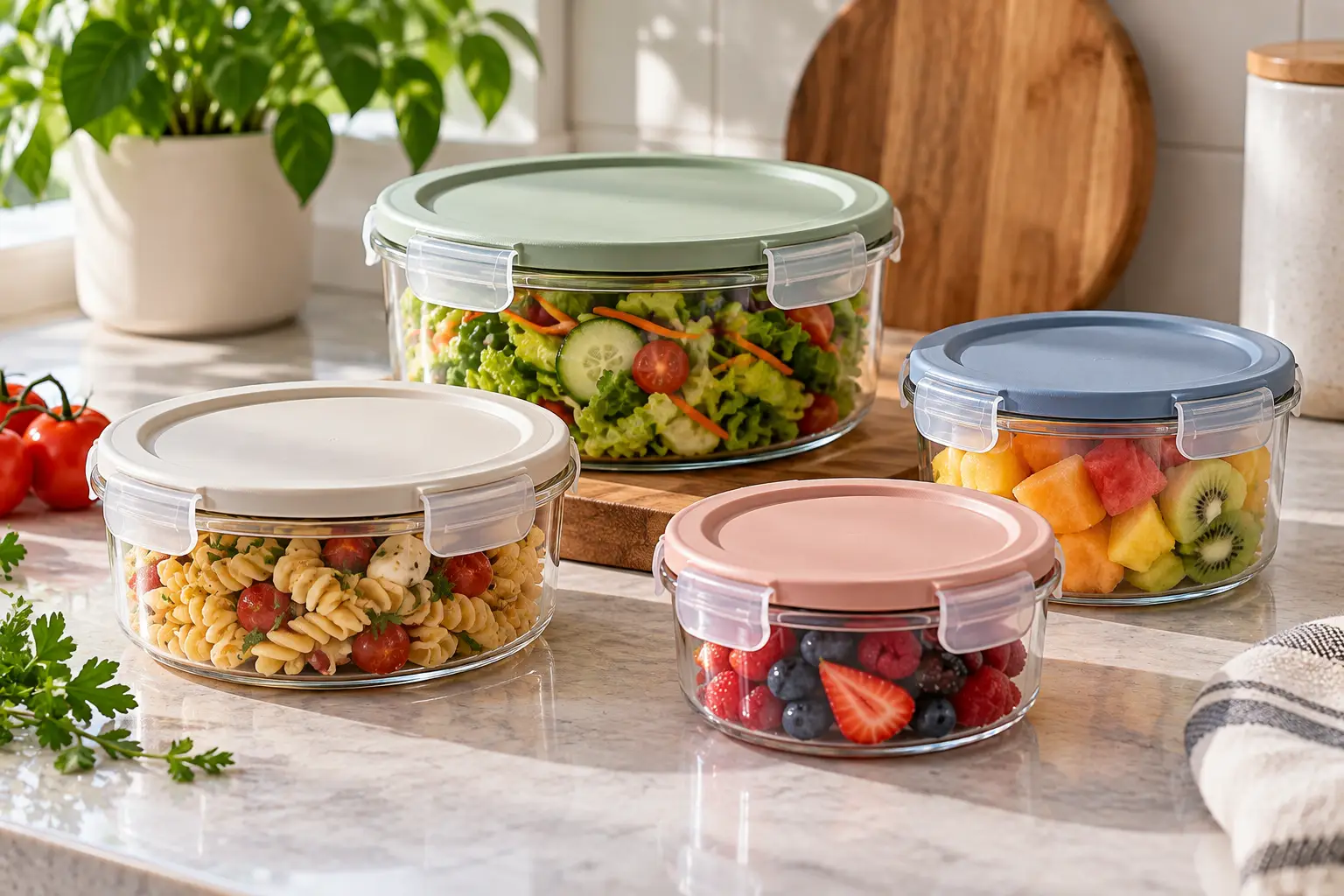
A circular container is a round food storage vessel, usually glass, plastic, polyethylene, or stainless steel, with a matching lid that seals by pressing, snapping, locking, or twisting. Its round shape spreads pressure evenly, cleans easily, and suits liquids like soups and sauces. Common sizes run from 1 cup to 2 quarts or more.
Quick Comparison: 7 Circular Container Picks at a Glance
| Product | Material | Lid Style | Oven Safe? | Typical Price Range | Best for |
|---|---|---|---|---|---|
| Pyrex Simply Store Round Glass Set | Tempered soda-lime glass | Press-on plastic | Glass only, preheated oven | $20–$35 (6–10 pc) | Pyrex Simply Store Round Glass Set: everyday leftovers |
| Anchor Hocking SnugFit Round Glass Containers | Tempered glass | SnugFit press-on | Up to 425°F, glass only | Under $15 (small sets) | Anchor Hocking SnugFit Round Glass Containers: budget glass |
| OXO Good Grips Smart Seal Glass Round Container | Borosilicate glass | 4-tab locking + gasket | Yes, glass only | $15–$20 each | OXO Good Grips Smart Seal Glass Round Container: freezer-to-oven |
| Rubbermaid TakeAlongs Round Containers | BPA-free plastic | Quik Clik snap | No | $8–$15 (6-pack) | Rubbermaid TakeAlongs Round Containers: potlucks, sharing |
| Ziploc Twist ‘n Loc Round Containers | BPA-free plastic | Twist-on screw | No | Under $10 (2–4 pack) | Ziploc Twist ‘n Loc Round Containers: soups, lunches |
| Cambro RFS Round Food Storage Containers | NSF polyethylene | Lid sold separately | No (not microwave safe) | Around $5–$8 per container | Cambro RFS Round Food Storage Containers: bulk, brining |
| Fit Meal Prep Round Deli Containers | Polypropylene (PP5) | Universal press-on | No | $15–$30 (36–40 pack) | Fit Meal Prep Round Deli Containers: freezer portions |
Looking at the table, the split is really about heat. If you want to reheat or even bake in the same dish, the three glass picks are your shortlist, and the OXO Good Grips Smart Seal Glass Round Container is the only one built from borosilicate for bigger temperature swings. If you mostly freeze, share, or transport food, the plastic and polyethylene options cost far less per container and won’t shatter when they hit the floor.
💬 One click helps other shoppers make an informed choice too! 😊
Top 7 Circular Container Picks: Expert Analysis
1. Pyrex Simply Store Round Glass Set — best all-around glass value
If you want one circular container system that handles most kitchen jobs, this is the safest place to start.
The Simply Store round sets come in classic 1-, 2-, 4-, and 7-cup sizes, and the common 6-piece set pairs 2-, 4-, and 7-cup bowls. In practice, that ladder covers a single serving of rice, a family’s leftover pasta, and a full batch of soup. The glass resists stains and odors, so tomato sauce and curry won’t leave the orange ghost that plastic keeps forever. Pyrex lists the glass as freezer, microwave, and dishwasher safe, and it nests with other Pyrex storage.
Based on comparing the specs, this is the right pick for households replacing a drawer of tired plastic. Just remember US Pyrex is tempered soda-lime glass, so avoid moving it straight from the freezer into a hot oven.
Reviews on major US retailers consistently praise the thick glass and stain resistance; the most common gripe is that the plastic lids wear out and seal less tightly over time, rather than leaking from day one.
Pros:
- ✅ Stain- and odor-resistant glass keeps sauces from ghosting
- ✅ Practical 2-, 4-, and 7-cup size ladder
- ✅ Widely available replacement lids
Cons:
- ❌ Press-on lids are not truly leakproof for travel
- ❌ Needs gentle temperature changes to avoid thermal shock
Expect roughly $20–$35 for a 6- to 10-piece set at the time of writing; that’s strong value for daily-use glass.
2. Anchor Hocking SnugFit Round Glass Containers — cheapest way into glass
The Anchor Hocking SnugFit Round Glass Containers prove you don’t need a big budget to ditch plastic.
The brand lists its tempered glass as safe in a preheated oven up to 425°F, plus the microwave, fridge, freezer, and dishwasher, and the BPA-free SnugFit lids go on the top rack. That oven rating matters: you can bake a single-serve casserole in a 2-cup round, then snap on the lid and refrigerate the leftovers in the same dish. Anchor Hocking also notes its glass is made in Lancaster, Ohio, and backs SnugFit storage with a 5-year warranty.
This is the pick for meal preppers who want many small rounds without paying premium prices. Interestingly, Anchor Hocking and Pyrex now share an owner, so the glass quality gap between them is narrower than brand loyalists assume.
Aggregated reviews describe the glass as thick and sturdy, but several buyers note the lids are “snug” rather than leakproof, and lids tend to crack before the glass does.
Pros:
- ✅ Oven safe to 425°F without the lid
- ✅ Very low cost per glass container
- ✅ Five-year warranty on SnugFit storage
Cons:
- ❌ Lids are not rated fully leakproof
- ❌ Glass is heavy for daily commuting
Small 2-cup sets often run under $15, while 20- to 30-piece sets land around $30–$45; check the current price.
3. OXO Good Grips Smart Seal Glass Round Container — best freezer-to-oven performer
The OXO Good Grips Smart Seal Glass Round Container is the one to buy when temperature swings are part of your routine.
OXO makes this round from borosilicate glass and states it can move from the freezer to a preheated oven or microwave without fully thawing. Borosilicate tolerates roughly three times the sudden temperature difference of tempered soda-lime glass, which is why that claim is believable. The lid uses four locking tabs plus a removable silicone gasket, so you get a real leakproof seal and can pull the gasket out to scrub it. Lids also interchange with same-size OXO glass and plastic Smart Seal containers.
What most buyers overlook is the gasket: it’s the reason this container travels with soup inside, and it’s also the part you must clean to avoid trapped odors.
Retailer reviews are strongly positive about the seal and the oven-to-table convenience; the main complaints are the higher price per piece and the effort of removing the gasket.
Pros:
- ✅ Borosilicate glass handles freezer-to-oven moves
- ✅ Locking lid with removable silicone gasket
- ✅ Lids swap across same-size Smart Seal pieces
Cons:
- ❌ Costs several times more per container
- ❌ Gasket needs regular removal and washing
A single 4-cup round usually runs about $15–$20; worth it if you bake and reheat often.
4. Rubbermaid TakeAlongs Round Containers — best for sharing and potlucks
The Rubbermaid TakeAlongs Round Containers are the containers you hand to a guest without worrying about getting them back.
The popular 6.2-cup round comes in 6-packs with Quik Clik Seal lids that click audibly when closed. That click is more useful than it sounds, because it tells you the lid is fully seated before you stack a salad bowl in a hot car. The lids have ridges for stable stacking, the bases are microwave safe, and everything is BPA-free, freezer safe, and top-rack dishwasher safe. Larger 15.7-cup versions add handles and measurement marks for big-batch sides.
Based on the specs, this is the budget circular container for families who host, pack big salads, or send leftovers home with relatives. It isn’t built for decades of daily reheating, and Rubbermaid only lists the bases as microwave safe.
On Walmart’s listing, the 6.2-cup 6-pack holds roughly a 4.7-star average across about 3,000 ratings at the time of writing, with buyers praising value and staining resistance.
Pros:
- ✅ Audible click confirms the seal
- ✅ Low cost per container for gifting
- ✅ Stable ridged lids stack neatly
Cons:
- ❌ Thin plastic can warp with heavy reheating
- ❌ Lids are not microwave safe
A 6-pack typically costs $8–$15; hard to beat for disposable-feeling reliability.
5. Ziploc Twist ‘n Loc Round Containers — best leak resistance on a budget
The Ziploc Twist ‘n Loc Round Containers solve the classic soup-in-the-backpack problem with a lid that screws on like a jar.
Ziploc markets them as leak-resistant for soups, stews, and gravies, with measurement lines, a wide rim, and finger grips. A threaded lid can’t pop off when the container gets squeezed, which is the usual failure point of press-on lids. They’re BPA-free and labeled safe for the dishwasher, microwave, and freezer (use as directed), and the mini sizes fit car cup holders for dips and snacks.
This is the best fit for students, commuters, and parents packing liquids. Honestly, it’s less ideal for long-term pantry storage, since thin walls scratch and cloud with repeated use.
Customer sentiment is mixed: on Walmart, the medium 2-pack averages about 4.5 stars, while grocery-chain listings for the pint size sit closer to 3.8 stars, with complaints mostly about lids cross-threading or cracking.
Pros:
- ✅ Twist-on lid resists popping open
- ✅ Measurement lines help portion control
- ✅ Compact sizes fit lunch bags easily
Cons:
- ❌ Lids can cross-thread if rushed
- ❌ Thin walls cloud over time
Packs usually cost under $10; a cheap upgrade for anyone carrying liquids.
6. Cambro RFS Round Food Storage Containers — restaurant-grade bulk storage
The Cambro RFS Round Food Storage Containers are what professional kitchens use, and they’re surprisingly practical at home.
Models like the RFS2148 (2 quarts) are made of NSF-listed polyethylene rated from -40°F to 160°F, with printed graduations on the side. That temperature range means freezer duty and cold brining, but the 2-quart model is clearly listed as not microwave safe. Sizes run from 1 quart up to 22 quarts, so one brand covers flour bins, pickle batches, and a whole Thanksgiving turkey brine.
What the spec sheet implies is simple: this is storage, not reheating. Lids are sold separately, so buy the matching size every time.
Commercial-supplier reviews repeatedly mention durability and versatility for dry goods, sauces, and soup batches; the most common frustration is buying containers and forgetting matching lids.
Pros:
- ✅ NSF-listed, commercial-grade durability
- ✅ Huge size range up to 22 quarts
- ✅ Exterior graduations simplify measuring
Cons:
- ❌ Not microwave safe
- ❌ Lids are purchased separately
Expect around $5–$8 per container (plus lid) in small quantities, and excellent long-term value.
7. Fit Meal Prep Round Deli Containers — cheapest freezer portions
The Fit Meal Prep Round Deli Containers are the round deli containers home cooks borrow from restaurant kitchens.
They’re molded from polypropylene (resin code 5), listed as BPA- and phthalate-free, and sold in 8-, 16-, and 32-ounce combo packs. One lid size fits all three heights, which instantly ends lid-matching frustration. They’re labeled microwave, freezer, and top-rack dishwasher safe. Because each unit costs well under a dollar, you can freeze 12 portions of stock without tying up your good glass.
This is the best choice for batch cooks, freezer stockpilers, and anyone who sends food home with friends. Don’t expect heirloom durability; think of them as reusable for months, not years.
Retailer reviews generally say the lids fit snugly and seal well, though several are marked as incentivized, so weigh that sentiment with caution.
Pros:
- ✅ Universal lid across three sizes
- ✅ Extremely low cost per portion
- ✅ Stacks tightly in freezers
Cons:
- ❌ Thin walls crack if dropped frozen
- ❌ Some reviews are incentivized
Combo packs of 36–40 usually land in the $15–$30 range; excellent value for freezer portions.
✨ Don’t miss these exclusive deals!
🔍 Take your food storage to the next level with this carefully curated lineup. Click a highlighted item to check current pricing and availability. These picks will help you get fresher leftovers and less waste the whole family will enjoy!
Your First 30 Days With a New Circular Container Set
Buying the right circular container is half the job; setting up good habits is the other half. Here’s a simple routine that keeps food safe and containers in shape.
Week 1: Set Up the System
- ✅ Wash every piece before first use, and pull out any removable gaskets (like the OXO lid’s) so you know how they reseat.
- ✅ Assign zones: glass for leftovers you’ll reheat, plastic for lunches, deli cups and Cambro rounds for the freezer and pantry.
- ✅ Label lids with masking tape and a marker: what’s inside and the date.
Week 2: Cool and Store Food the Right Way
This is where round shapes quietly earn their keep. The USDA’s leftovers guidance says to refrigerate leftovers within 2 hours and to divide large batches into shallow containers so they cool quickly. In practice, that means splitting a pot of chili into several 2-cup rounds instead of one deep 7-cup bowl. The USDA also notes leftovers keep 3 to 4 days in the fridge and 3 to 4 months in the freezer for best quality.
Week 3: Reheat Without Damage
- ✅ Take press-on plastic lids off glass before microwaving; vent or remove twist lids too.
- ✅ Let tempered glass rest on the counter for a few minutes before it goes into a hot oven.
- ✅ Never put a polyethylene Cambro RFS Round Food Storage Containers piece in the microwave.
Week 4: Maintenance Check
Inspect lids for cracks, warping, and stiff gaskets. Lids almost always fail before bodies do, so order spares now rather than after a leak.
Real-World Scenarios: Matching a Circular Container to Your Life
🎒 The commuting student (budget under $25, daily use). You carry soup or pasta salad 5 days a week. The Ziploc Twist ‘n Loc Round Containers are your core pick because the threaded lid won’t pop in a crowded bag. Add a 2-cup Anchor Hocking SnugFit Round Glass Containers set for reheating at home, where leaks don’t matter.
👨👩👧 The family of four (budget $50–$80, cooking 4–5 nights a week). You need to reheat, store, and occasionally bake. Build around the Pyrex Simply Store Round Glass Set for everyday leftovers, plus one or two OXO Good Grips Smart Seal Glass Round Container pieces for freezer-to-oven casseroles. Keep a 6-pack of Rubbermaid TakeAlongs Round Containers for potlucks and grandma’s leftovers.
🍲 The Sunday batch cook (budget around $40, weekly prep). You make 3 gallons of stock or 20 portions of chili at once. Use a 4- or 8-quart Cambro RFS Round Food Storage Containers piece to cool and hold the batch, then portion into Fit Meal Prep Round Deli Containers for the freezer. Your glass stays free for the week’s meals.
Problem → Solution: Fixing Common Circular Container Headaches
- Lids won’t match anything. Standardize. Deli cups with a universal lid, or a single glass brand with consistent sizes, cut lid chaos fast.
- Soup leaks in your bag. Press-on lids flex when squeezed. Switch to a twist-on lid or a locking lid with a gasket.
- Tomato stains on plastic. Store acidic, oily sauces in glass. For existing stains, a baking-soda paste and sunlight usually fade them.
- Glass cracked in the oven. Tempered soda-lime glass dislikes sudden temperature jumps. Thaw first, or use borosilicate for freezer-to-oven cooking.
- Freezer cups split. Leave about half an inch of headspace, since liquids expand as they freeze.
How to Choose a Circular Container
- Decide where food gets reheated. If it’s in the same dish, choose glass; plastic lids and polyethylene don’t belong in a hot oven.
- Match the lid to the trip. Press-on lids are fine for the fridge. For travel, choose twist-on or locking lids with a gasket.
- Check the glass type. Borosilicate handles sudden temperature swings far better than tempered soda-lime, which matters for freezer-to-oven cooking.
- Buy a size ladder, not a pile. Two or three sizes (2-, 4-, and 7-cup, for example) nest neatly and cover most meals.
- Confirm every “safe” label. Microwave safe, freezer safe, and dishwasher safe often apply to the base only, not the lid.
- Count the lids. Some commercial lines, like Cambro, sell lids separately, so the cheap container isn’t the full cost.
- Think about weight. Glass is heavy; if you carry lunch daily, plastic may save your shoulder.
Round Food Storage Containers vs Rectangular Containers
Round food storage containers and rectangular ones each win in different spots, and most kitchens benefit from both.
| Factor | Round containers | Rectangular containers | Best for |
|---|---|---|---|
| Cleaning | No corners to trap food | Corners hold residue | Round: sauces, stews |
| Pouring liquids | Smooth, drip-free pour | Corners can dribble | Round: soup, stock |
| Shelf space | Gaps between circles | Packs edge to edge | Rectangular: crowded fridges |
| Even reheating | Heats evenly, no hot corners | Corners can overcook | Round: microwave meals |
| Lid fit | Pressure spreads evenly | Corners flex with wear | Round: long-term seal |
The table shows round shapes win on cleaning, pouring, and reheating, while rectangles win on raw space efficiency. A practical split is round containers for liquids and reheated leftovers, and rectangles for sandwiches and layered meal-prep boxes. If fridge space is tight, choose rounds that nest when empty, like the Pyrex Simply Store Round Glass Set.
Glass vs Plastic vs Polyethylene: Which Material Wins?
Round Glass Containers With Lids
Round glass containers with lids are the long-haul choice. Glass doesn’t absorb stains or odors, it can go into the oven, and it lasts for years if you avoid thermal shock. The trade-offs are weight and breakage risk. Within glass, borosilicate (like the OXO Good Grips Smart Seal Glass Round Container) tolerates bigger temperature jumps, while tempered soda-lime (like the Anchor Hocking SnugFit Round Glass Containers) is stronger against everyday bumps.
Round Plastic Containers With Lids
Round plastic containers with lids win on weight, price, and portability. Many shoppers worry about BPA; the FDA’s current position is that BPA is safe at the levels currently found in foods, and every plastic pick in this guide is labeled BPA-free anyway. The bigger practical issue is wear: plastic scratches, stains, and can warp under high heat, so follow the “microwave safe” label exactly.
Round Deli Containers
Round deli containers are polypropylene cups sold in bulk with universal lids. They’re cheap enough to give away, freeze flat-topped and stackable, and they make lid-matching nearly automatic. The Fit Meal Prep Round Deli Containers are a good example; treat them as semi-disposable workhorses rather than lifetime storage.
Features That Actually Matter (and Ones That Don’t)
Matter: a seal that suits your use (gasket or twist for travel), honest temperature ratings, replaceable lids, and sizes that nest. These decide whether a circular container lasts five years or five months.
Don’t matter much: huge piece counts (a “32-piece set” counts each lid as a piece, so it’s 16 containers), trendy tinted colors, and vague “airtight” marketing without a gasket or locking mechanism behind it.
Common Mistakes to Avoid When Buying a Circular Container
- ❌ Buying one giant set of tiny sizes. Many sets are heavy on 1-cup rounds you’ll rarely use; check the size breakdown.
- ❌ Assuming every lid is leakproof. Press-on lids like SnugFit are designed to be snug, not spill-proof in a bag.
- ❌ Microwaving the lid. Most lids are only top-rack dishwasher safe, not microwave safe.
- ❌ Mixing brands in a hurry. Lids rarely cross-fit between brands, so standardize early.
- ❌ Forgetting freezer headspace. Liquids expand and can crack both glass and thin plastic.
Safety, Regulations, and Standards
In the US, materials that touch food are regulated by the FDA as food contact substances, so reputable brands formulate lids and containers to meet those rules. Commercial lines like Cambro RFS Round Food Storage Containers carry NSF listing, an independent sanitation standard common in restaurant kitchens. For glass, the key safety habit is avoiding thermal shock: don’t add cold liquid to a hot dish or move tempered glass straight from freezer to a hot oven. Finally, follow USDA timing for leftovers, because no container makes week-old soup safe.
Long-Term Cost and Maintenance
| Product | Approx. upfront cost | Expected lifespan with care | Value verdict | Best for |
|---|---|---|---|---|
| Pyrex Simply Store Round Glass Set | $20–$35 | Many years (replace lids) | High | Pyrex Simply Store Round Glass Set: daily leftovers |
| OXO Good Grips Smart Seal Glass Round Container | $15–$20 each | Many years (replace gasket) | High for bakers | OXO Good Grips Smart Seal Glass Round Container: freezer-to-oven |
| Rubbermaid TakeAlongs Round Containers | $8–$15 per 6-pack | 1–3 years | Good | Rubbermaid TakeAlongs Round Containers: sharing |
| Fit Meal Prep Round Deli Containers | $15–$30 per 36–40 | Months to a year | Excellent per portion | Fit Meal Prep Round Deli Containers: freezer batches |
Glass costs more upfront but often wins on total cost of ownership, because you mostly replace lids rather than whole containers. Deli cups look cheapest, yet you’ll rebuy them; that’s fine, since their real value is flexibility. The smartest budget usually mixes one durable glass set with a cheap plastic layer for giveaways and freezing.
FAQ: Circular Container Questions Shoppers Ask
❓ What is the best circular container for soup?
❓ Are round glass containers with lids oven safe?
❓ Which is better to buy, a round or a square food storage container?
❓ Can you microwave round plastic containers with lids?
❓ How many circular containers does a family really need?
Conclusion: Pick the Circular Container That Fits How You Cook
There’s no single best circular container, only the best one for a job. If you reheat leftovers most nights, a glass base like the Pyrex Simply Store Round Glass Set or the more budget-friendly Anchor Hocking SnugFit Round Glass Containers will outlast years of plastic. If you regularly move food from freezer to oven, the borosilicate OXO Good Grips Smart Seal Glass Round Container justifies its higher price.
For life on the go, the threaded Ziploc Twist ‘n Loc Round Containers stop soup disasters, and the Rubbermaid TakeAlongs Round Containers make sharing food painless. Serious batch cooks should pair a Cambro RFS Round Food Storage Containers piece for big volumes with Fit Meal Prep Round Deli Containers for portions.
Whatever you choose, the habits matter as much as the hardware: cool food in shallow rounds, label everything, keep lids out of the microwave, and replace worn seals early. Do that, and your new circular container system will save food, money, and more than a few cleanup headaches in 2026 and beyond.
🛒 Ready to upgrade your fridge?
✨ Click any highlighted product above to check current pricing and availability, and build a round-container lineup that finally fits the way your household cooks, stores, and shares food!
Recommended for You
- Easy Meal Prep Ideas for Lunch: 12 Fail-Proof Picks + 7 Tools (2026)
- Meal Prep Cook Book Guide 2026: 7 Best Picks That Truly Deliver
- Weekly Planner with Meal Planning: 7 Best Picks That Work (2026)
Disclaimer: This post contains affiliate links. As an Amazon Associate, I earn from qualifying purchases made through these links, at no additional cost to you.
✨ Found this article helpful? Share it with someone who needs it! 💬🤗