
In This Article
What Are 16 ounce plastic containers with lids?
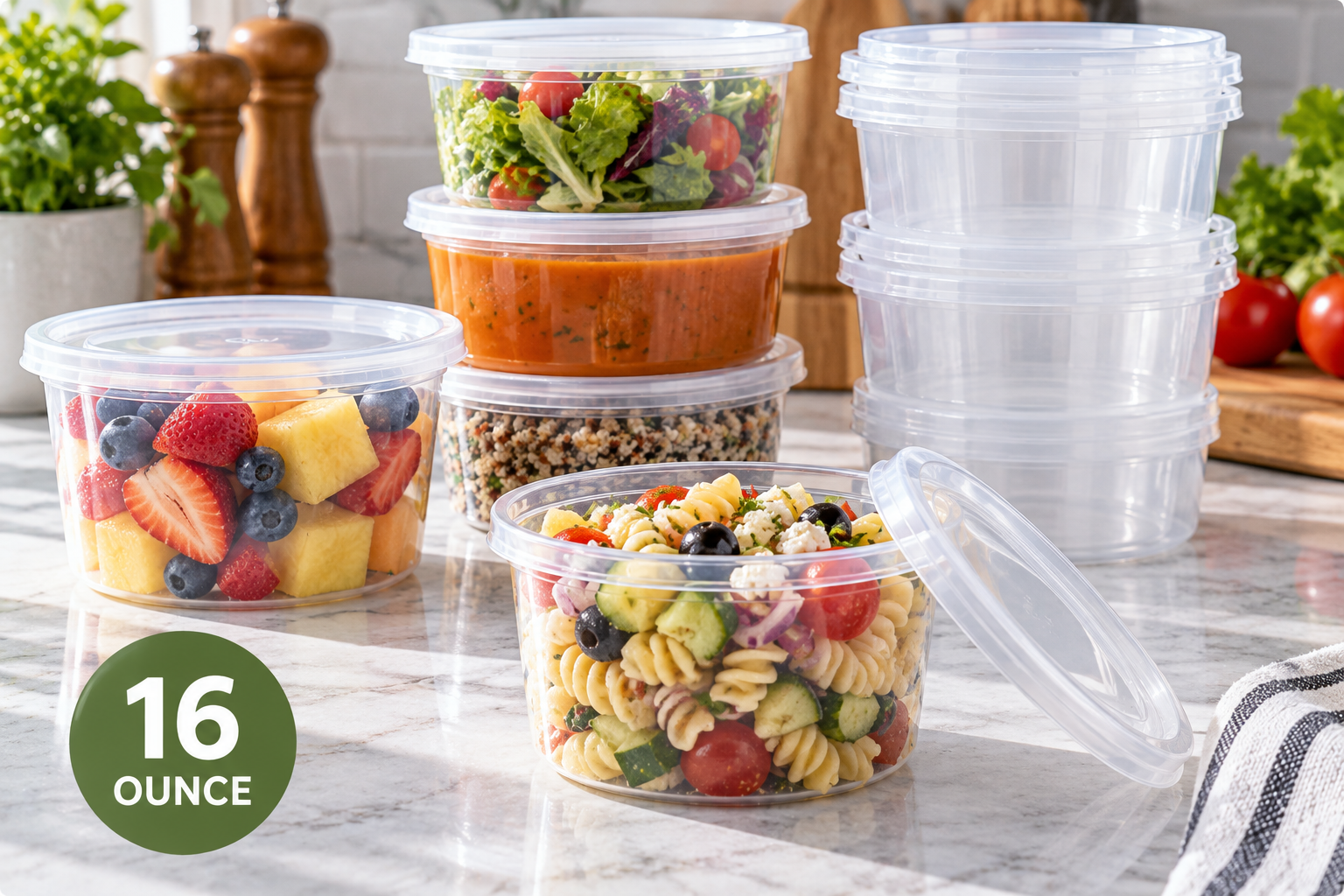
16 ounce plastic containers with lids are pint-size (two-cup) food storage tubs, usually round and made from polypropylene, that seal with a snap-on or twist-on lid. Restaurants call them “deli containers” or “quarts’ little sibling.” At home, they handle soup, sauces, leftovers, meal prep, freezer portions, and pantry staples without taking over your shelves.
Here’s the funny thing about the humble pint container: it’s the one piece of kitchen gear that professional cooks and college students agree on. Walk into almost any restaurant prep kitchen and you’ll see towers of translucent tubs holding diced onions, stock, vinaigrette, and the occasional emergency glass of water. Then open a typical home cabinet and you’ll find the opposite — a landslide of mismatched lids, cracked takeout tubs, and one glass container nobody wants to carry to work because it weighs as much as a bowling ball.
The pint size hits a sweet spot. Two cups is one generous serving of soup, a full batch of salad dressing, a week of overnight-oats portions, or exactly enough chili to freeze for a lazy Tuesday. It’s small enough to stack ten high in a freezer door and big enough to be genuinely useful.
But not all pint containers are equal. Some are thin, single-use takeout tubs that crack after three dishwasher cycles. Others are heavy-gauge polypropylene built to survive years of freezer-to-microwave abuse. Some lids are universal across sizes; some fit exactly one container and vanish forever.
This guide compares seven real options available to US shoppers, from 50-packs that cost pennies per unit to branded twist-lid containers built for lunchboxes. You’ll get honest analysis based on spec sheets and aggregated review themes — plus practical how-tos, mistake-proofing tips, and a cost breakdown that Amazon listings simply won’t give you.
Quick Comparison: The Best 16 oz Food Storage Containers at a Glance
| Product | Pack Size | Lid Style | Standout Strength | Best for |
|---|---|---|---|---|
| Freshware 16 oz Deli Containers | 50 sets | Snap-on, universal | Best-selling all-rounder | Everyday meal prep |
| Reditainer Extreme Freeze 16 oz | 36 sets | Snap-on, universal | Rated down to -40°F | Freezer-heavy households |
| TashiBox 16 oz Deli Containers | 50 sets | Snap-on | Lowest cost per unit | Budget buyers, crafts, parties |
| Ziploc Twist ‘n Loc Small (16 oz) | 3 sets | Twist-on | Jar-style leak resistance | Soups in lunch bags |
| Rubbermaid TakeAlongs On the Go 2.0 Cup | 2 sets | Twist & Seal + dip tray | Built-in topping tray | Yogurt, parfaits, snacks |
| Dart Solo MicroGourmet MN16-0100 | 500 bases | Sold separately | Made-in-USA commercial stock | Food businesses, bake sales |
| Newspring DELItainer YSD2516 | 240 combos | Flat LLDPE lid | Heavy-gauge commercial build | Caterers, bulk soup sellers |
Looking at the table, the split is clear: the first three are home-friendly bulk packs, the middle two are branded “keep forever” containers, and the last two are true foodservice stock. If you cook for one or two people, the Freshware 16 oz Deli Containers or Reditainer Extreme Freeze 16 oz will cover 90% of your needs. If you sell food or run a meal-prep side hustle, the Dart Solo MicroGourmet MN16-0100 and Newspring DELItainer YSD2516 make more financial sense once you factor in volume.
💬 One click helps other shoppers make an informed choice too! 😊
Top 7 16 ounce plastic containers with lids: Expert Analysis
1. Freshware 16 oz Deli Containers — the best-selling all-rounder
The Freshware 16 oz Deli Containers set earns its reputation by doing the basics consistently well, which is exactly what a pint container should do. Third-party Amazon sales trackers list this 50-set as one of the top sellers in the deli-container category through 2026.
The set is marketed as BPA-free, stackable, leakproof, and microwave-, dishwasher-, and freezer-safe. In practice, “stackable” is the feature that changes your fridge: identical round footprints mean you can build vertical columns instead of a sprawl. Fifty sets also means you can afford to give food away in them without mourning the container.
Based on the spec sheet, this is the right pick for people who meal-prep weekly and want enough containers that a few always sit clean in the cabinet. It’s not a premium product — think of it as reliable infrastructure, not heirloom tupperware. Check the resin code on the bottom before microwaving; a “5” means polypropylene, which is the heat-friendly plastic you want.
Detailed, verifiable review themes for this specific listing were limited during research, so treat its strong sales ranking as a popularity signal rather than a guarantee of individual durability.
Pros:
- ✅ Fifty sets cover a full week of meal prep
- ✅ Uniform shape stacks neatly in fridge and freezer
- ✅ Marketed as microwave, dishwasher, and freezer safe
Cons:
- ❌ Thinner walls than heavy-gauge commercial options
- ❌ Round shape wastes some corner space on shelves
Typically priced in the $15–$25 range for the 50-set at the time of writing (check the current price), it’s strong value for anyone who cooks in batches.
2. Reditainer Extreme Freeze 16 oz — the freezer specialist
The Reditainer Extreme Freeze 16 oz line is built around one promise: it won’t turn brittle when your freezer runs cold. The manufacturer rates these heavy-gauge polypropylene containers down to -40°F.
That freezer rating matters more than it sounds. Cheaper thin-wall tubs can crack when you drop them straight out of a 0°F freezer, especially along the rim. The universal lid fits the 8, 16, and 32 oz Reditainer sizes, so mixing sizes doesn’t mean hunting for matches. Customers also point out two fill lines inside the container, with the upper line marking exact capacity — handy for portioning stock.
Who’s it for? Anyone who batch-cooks soup, stock, or chili and freezes it in single servings. If your freezer is basically a pint-container library, this is the sturdiest home-focused option here.
Reviews consistently praise the tight lid seal, interchangeable lids, and resistance to staining. The common complaints: lids can be stiff to pry off until you get the knack, round containers aren’t the most space-efficient, and lightweight lids tend to fly around in the dishwasher.
Pros:
- ✅ Rated for freezer temperatures as low as -40°F
- ✅ One lid fits 8, 16, and 32 oz sizes
- ✅ Reviewers report minimal staining over time
Cons:
- ❌ Lids can be hard to remove at first
- ❌ Light lids scatter in the dishwasher
Usually in the $20–$35 range for a 36-pack (prices may vary), and the heavier build justifies the small premium.
3. TashiBox 16 oz Deli Containers — the cheapest per container
The TashiBox 16 oz Deli Containers 50-pack is the pick when cost per unit matters more than anything else. A recent Amazon deal put the whole set in the low-teens, which works out to roughly a quarter or less per container-and-lid set.
The listing promises BPA-free plastic, airtight leakproof lids, stackability, and microwave and freezer safety. Clear walls let you identify contents without opening the lid — a small thing until you’re staring at six identical brown soups. The “restaurant quality” claim should be read generously: these are disposable-grade containers that happen to be reusable.
Here’s what to weigh: if you’re packing party favors, slime for a kids’ birthday, potluck sides you’ll never see again, or craft supplies like beads and buttons, there’s no reason to pay more. For daily microwave reheating over many months, a heavier option like the Reditainer Extreme Freeze 16 oz will likely outlast it.
Detailed independent review data for this listing was limited during research; its strongest verifiable selling point is the low price, so judge it as a budget utility product.
Pros:
- ✅ Very low cost per container-and-lid set
- ✅ Clear walls make contents easy to identify
- ✅ Great for giveaways, crafts, and potlucks
Cons:
- ❌ Long-term durability is less documented than bigger brands
- ❌ Not the best choice for daily microwave use
Generally in the $12–$20 range for 50 sets (check current pricing), making it the clear budget champion.
4. Ziploc Twist ‘n Loc Small (16 oz) — jar-style leak resistance
The Ziploc Twist ‘n Loc Small (16 oz) solves the main weakness of snap-on deli lids: they can pop off when a bag gets squished. This lid screws on like a jar, which is a far more forgiving seal in a crowded tote.
Each container measures about 4.5 x 4.5 x 3.25 inches and is made from polypropylene, with measurement lines molded into the side. Ziploc says the line is made without BPA or phthalates and that the containers are recyclable. A wide rim, finger grips, and a ridged lid make opening easier for people with reduced hand strength — a genuinely underrated benefit.
One important usage note from the label: unscrew or remove the lid before microwaving, let hot contents cool before screwing the lid down tight, and wash on the top rack. Twist lids trap steam pressure, so this rule matters.
Resale listings show the containers became harder to find for a stretch, and Ziploc’s own product page describes the line as reintroduced. Fans clearly hunted them down, which says a lot about loyalty.
Pros:
- ✅ Twist lid resists popping open in bags
- ✅ Built-in measurement lines help portion control
- ✅ Grippy rim is easier for arthritic hands
Cons:
- ❌ Must remove the lid before microwaving
- ❌ Small pack sizes cost more per container
At retail, a three-pack usually lands under $10, though third-party Amazon sellers sometimes charge more — compare before buying.
5. Rubbermaid TakeAlongs On the Go 2.0 Cup — the topping-tray trick
The Rubbermaid TakeAlongs On the Go 2.0 Cup containers add one smart feature most pint tubs skip: a removable dip tray that keeps toppings separate. Two cups equals 16 ounces, so it squarely fits this category.
That tray changes how breakfast and snacks travel. Granola stays crunchy above yogurt, croutons stay dry above salad, and hummus doesn’t swamp the pita chips. The Twist & Seal lid adds the same in-bag security as a screw-top jar. Rubbermaid markets the TakeAlongs line as lightweight and portable, with freezer and top-rack dishwasher safety; check the specific package for microwave guidance before reheating.
On paper, this is the strongest pick for parents packing school snacks and office workers who bring parfaits or salads. It’s not a bulk-storage solution — two containers won’t organize a freezer — but it’s a clever specialist.
Reviews of the broader TakeAlongs range tend to praise durability, secure lids, and stackability; verified review data specific to the 2.0-cup On the Go model was thinner, so weigh that accordingly.
Pros:
- ✅ Removable tray keeps toppings crisp and separate
- ✅ Twist & Seal lid travels securely
- ✅ Trusted brand with wide US retail availability
Cons:
- ❌ Only two containers per pack
- ❌ Tray reduces usable volume when inserted
Typically under $10 per two-pack (prices vary by color and seller), fair for a specialized lunch container.
6. Dart Solo MicroGourmet MN16-0100 — made-in-USA commercial stock
The Dart Solo MicroGourmet MN16-0100 is what many delis and grab-and-go counters actually use, made by a Michigan-based packaging giant. It’s foodservice stock, so expect cases rather than cute retail packs.
Specs are precise: polypropylene construction, a 16 oz capacity, about 4.7 inches across the top, 3.83 inches at the base, and 2.9 inches tall. Dart says it handles cold and oily foods and can go from refrigerator to microwave in the same container. Here’s the catch most buyers miss — compatible lids are sold separately, so budget for them or you’ll own 500 open cups.
Who should buy this? Bakers selling soup at farmers markets, small cafés, church kitchens, and anyone running a meal-prep business. Uniform commercial sizing means your labels, lids, and stacking systems stay consistent order after order. Distributors list the containers as recyclable in most areas, though local acceptance varies.
Public customer-review data on this SKU was sparse at the time of writing; its track record is largely its long presence in commercial supply catalogs.
Pros:
- ✅ Made in the USA by a major foodservice brand
- ✅ Consistent dimensions for professional labeling
- ✅ Handles oily foods and microwave reheating
Cons:
- ❌ Lids must be purchased separately
- ❌ 500-count case is too much for most homes
A full case generally falls in the $60–$80 range before lids (check current pricing), very cheap per unit for businesses.
7. Newspring DELItainer YSD2516 — heavy-gauge build for caterers
The Newspring DELItainer YSD2516 is the tough commercial option, sold as a container-and-lid combo so you aren’t hunting for separate lids. It’s built for stacking under load during delivery.
The containers use heavy-gauge polypropylene that resists bending when stacked, while the flat lid is LLDPE — a softer plastic that flexes to grip the rim. Newspring (part of Pactiv) markets the line for hot and cold food, freezer storage, refrigeration, and microwaving, and distributors list it as top-rack residential dishwasher safe.
Based on comparing the specs, this is the step up from the Dart Solo MicroGourmet MN16-0100 for caterers who want lids included and a sturdier wall. Home cooks who freeze huge batches — think a family of six making stock monthly — could also split a case with friends and come out ahead on cost per unit.
Verifiable aggregated reviews for this specific SKU were limited; its credibility comes mainly from widespread distributor stocking and commercial use.
Pros:
- ✅ Lids included in the 240-count combo
- ✅ Heavy-gauge walls resist crushing when stacked
- ✅ Handles hot, cold, freezer, and microwave use
Cons:
- ❌ Bulk case requires serious storage space
- ❌ Overkill for occasional home use
Cases usually run in the $55–$80 range (prices may vary), an excellent per-unit value for high-volume users.
✨ Don’t miss these smart storage upgrades!
🔍 Take your meal prep to the next level with this carefully curated lineup. Click a highlighted container to check current pricing and availability — these picks will help you get a calmer fridge and fewer soggy lunches the whole family will enjoy!
How to Get the Most out of Your 16 oz Deli Containers (First 30 Days)
A stack of new containers is only as good as the system you build around them. Here’s a practical start-up routine that Amazon listings never mention.
Day 1: Wash and sort. Run everything through the top rack of the dishwasher before first use. Then decide on a home: containers nested in one stack, lids filed vertically in a small bin like plates in a dish rack. Lids are what go missing — give them a dedicated spot.
Week 1: Learn your fill line. A 16 oz container filled to the brim holds 16 oz, but you rarely want that. For anything you’ll freeze, leave about half an inch to an inch of headspace, because water expands as it freezes and can pop a snap lid. The Reditainer Extreme Freeze 16 oz helps here with its interior fill lines.
Week 2: Label everything. Painter’s tape and a marker on the lid beat any fancy label maker. Write the contents and date. The USDA’s freezing and food safety guide explains that food held at 0°F stays safe indefinitely, with recommended storage times relating only to quality — so the date tells you when flavor, not safety, starts slipping.
Week 3: Reheat the smart way. Pop the lid off or set it loosely on top before microwaving, especially twist styles like the Ziploc Twist ‘n Loc Small (16 oz). Heat in short bursts and stir. Very fatty or sugary foods get hotter than water and can warp thinner walls, so transfer those to a ceramic bowl.
Week 4: Audit and retire. Check for cloudy scratches, cracks near the rim, and lids that no longer click. Retired containers make excellent garage organizers for screws, seeds, and cable ties.
Real-World Scenarios: Matching the Right Pint Container to Your Life
Specs are abstract. Here’s how the picks shake out for three common US households.
The solo commuter who meal-preps on Sundays
Budget: around $25. Use context: five lunches and two dinners a week, microwaved at an office breakroom. The Freshware 16 oz Deli Containers cover the volume, and two Ziploc Twist ‘n Loc Small (16 oz) containers handle soup days when a snap lid in a backpack feels risky. Total spend stays modest, and losing a deli container at the office isn’t a tragedy.
The family of five that freezes in batches
Budget: $40–$60. Use context: a big pot of chili or stock every other weekend, frozen in single servings. The Reditainer Extreme Freeze 16 oz earns its place because the cold-temperature rating protects against cracked rims, and universal lids mean kids can’t “lose the matching lid.” Add a pack of Rubbermaid TakeAlongs On the Go 2.0 Cup containers for yogurt-and-granola school snacks.
The weekend farmers-market soup seller
Budget: $100–$150 per restock. Use context: 150–300 pints sold monthly. Consistent sizing and labeling matter more than anything, so the Newspring DELItainer YSD2516 (lids included) or the Dart Solo MicroGourmet MN16-0100 (plus matching lids) wins. Check your state and county health department rules for cottage food or temporary food vendor permits before selling — requirements differ widely across states.
Problem → Solution: Fixing the Most Common Pint Container Headaches
Problem 1: The lid won’t come off. Tight deli lids are a feature, not a defect. Lift from one edge with your thumb while pressing down on the container rim with your fingers; running the lid under warm water for a few seconds also softens the seal. Reviewers of the Reditainer Extreme Freeze 16 oz report it gets easier with practice.
Problem 2: Tomato sauce stained the plastic. Polypropylene absorbs pigments from tomato, turmeric, and curry. Coat the inside with a thin film of oil or cooking spray before adding red sauces, and wash promptly. If staining happens, a paste of baking soda and water — or a few hours in direct sunlight — fades most discoloration.
Problem 3: Soup leaks in my bag. Snap lids can release under side pressure. Switch to a twist-on design like the Ziploc Twist ‘n Loc Small (16 oz) or Rubbermaid TakeAlongs On the Go 2.0 Cup, and always pack liquids upright.
Problem 4: Containers cracked in the freezer. Overfilling and thin walls are the usual culprits. Leave headspace, let food cool before freezing, and choose a heavy-gauge option.
Problem 5: Lids fly around the dishwasher. Clip them in a mesh dishwasher basket or cutlery caddy, top rack only. Melting is far less likely up there, away from the heating element.
How to Choose 16 ounce plastic containers with lids
- Check the resin code. Look for “5” (polypropylene) inside the recycling triangle; it tolerates heat better than many other common plastics.
- Decide snap vs. twist lids. Snap lids are faster and stack well; twist lids win for transporting liquids.
- Look for universal lid compatibility. If one lid fits your 8, 16, and 32 oz containers, you’ll never play lid roulette again.
- Match wall thickness to your use. Heavy-gauge for freezer and daily microwaving; thin-wall is fine for parties and crafts.
- Calculate cost per set, not per pack. A 3-pack and a 50-pack aren’t comparable until you divide.
- Confirm what’s included. Commercial cases sometimes sell bases and lids separately.
- Read care instructions. Top-rack-only and lid-off-to-microwave rules protect the plastic and you.
These seven checks take two minutes and filter out almost every disappointing purchase. The most common regret in deli-container reviews isn’t a bad product — it’s buying the wrong type for the job.
Common Mistakes to Avoid When Buying 16 oz Soup Containers with Lids
Buying bases without lids. It sounds absurd, yet commercial listings like the Dart Solo MicroGourmet MN16-0100 clearly state lids are sold separately. Double-check before you’re stuck with a case of open cups.
Assuming “microwave safe” means “microwave forever.” Microwave-safe usually means the container won’t melt or deform under normal reheating. It doesn’t mean high-fat foods won’t scorch the walls, and it doesn’t cover heating with the lid sealed tight.
Ignoring shape and storage footprint. Round containers waste corner space. If your fridge is tiny, a square option may store more food per shelf — though round pints remain easier to stir in and clean.
Mixing brands without testing lids. Deli containers look similar across brands, but rim diameters differ slightly. A lid that “almost fits” will leak. Stick to one brand for your core set.
Overbuying thin containers for heavy use. Fifty budget tubs feel like a bargain until a third of them crack within months of hot-food use. For daily reheating, pay a little more for heavy-gauge walls like those on the Reditainer Extreme Freeze 16 oz.
Forgetting about freezer expansion. Filling to the brim before freezing guarantees popped lids and messy freezer shelves. Remember that headspace rule — it’s the single cheapest way to protect both food and containers.
Pint Size Plastic Containers vs. Glass Containers
Glass has a devoted fan base, and for good reasons: it doesn’t stain, it’s oven-safe in many cases, and it feels sturdy. But pint-size plastic containers win in more everyday situations than people expect.
| Factor | Plastic 16 oz deli containers | Glass storage containers | Best for |
|---|---|---|---|
| Weight | Very light | Heavy | Plastic for commuters |
| Breakage risk | Low; may crack if very cold | Can shatter if dropped | Plastic for kids and travel |
| Staining | Stains with tomato and turmeric | Doesn’t stain | Glass for curries and sauces |
| Oven use | Never | Often oven-safe (check label) | Glass for bake-and-store |
| Cost per container | Pennies to a few dollars | Several dollars or more | Plastic for bulk storage |
Reading the table, plastic dominates on weight, cost, and portability, while glass wins on stain resistance and oven compatibility. The practical answer for most households is a mix: plastic pints like the Freshware 16 oz Deli Containers for freezer portions and lunches, plus a few glass containers for reheating tomato-heavy dishes. If you only buy one material, choose based on whether you travel with food (plastic) or mostly reheat at home (glass).
Long-Term Cost and Maintenance of 16 oz Food Storage Containers
Price tags hide the real math. A 3-pack of twist-lid containers might cost several times more per unit than a bulk deli pack, but it may also last years longer in a lunch bag. Here’s a realistic per-unit view using price ranges at the time of writing.
| Product | Approx. pack price | Approx. cost per set | Expected lifespan with care | Best for |
|---|---|---|---|---|
| TashiBox 16 oz Deli Containers | $12–$20 / 50 | ~$0.25–$0.40 | Months of light use | Parties and crafts |
| Freshware 16 oz Deli Containers | $15–$25 / 50 | ~$0.30–$0.50 | Many months of regular use | Weekly meal prep |
| Reditainer Extreme Freeze 16 oz | $20–$35 / 36 | ~$0.55–$1.00 | A year or more | Freezer batches |
| Ziploc Twist ‘n Loc Small (16 oz) | Under $10 / 3 | ~$1.50–$3.00 | Years with gentle use | Daily lunch soups |
The pattern is simple: bulk deli containers are close to disposable in cost, so replacing them is painless, while branded twist-lid containers spread their higher price across a longer life. For most families, the Reditainer Extreme Freeze 16 oz offers the best balance of durability and per-unit price. Maintenance keeps costs low — top-rack washing, no lid-on microwaving, and avoiding abrasive scrubbers easily doubles the useful life of any plastic container.
Safety, Regulations, and Standards for Plastic Food Containers
In the US, plastic food storage containers fall under FDA oversight of “food contact substances” — materials intended to touch food without becoming an ingredient. The FDA explains how it regulates substances that come into contact with food, including authorization through food contact notifications or food additive regulations. In plain terms, reputable brands use resins cleared for food contact.
A few practical safety points translate that regulation into kitchen habits:
- ✅ “BPA-free” is now standard for polypropylene deli containers. BPA was historically associated with polycarbonate, not polypropylene, so the label is reassuring but not a differentiator.
- ✅ Follow heat instructions. “Microwave safe” refers to intended use as directed — lid vented or removed, short heating intervals. Never use plastic containers in a conventional oven, under a broiler, or on a stovetop.
- ✅ Retire damaged containers. Deep scratches and cracks trap food residue and are harder to clean thoroughly.
- ✅ Understand California Prop 65 notices. Some commercial listings display a Proposition 65 warning. That label means a listed chemical may be present at some level; it isn’t a federal ruling that the product is unsafe, but it’s worth knowing what you’re reading.
- ✅ Check recycling locally. Polypropylene carries resin identification code 5. Many curbside programs accept it, but not all, so confirm with your city.
16 oz Containers for Specific Audiences: Seniors, Parents, and Small Businesses
Different users need different features — here’s how to tailor your choice.
For seniors and anyone with limited grip strength
Snap lids can be tough to pry open. The Ziploc Twist ‘n Loc Small (16 oz) has finger grips and a ridged lid designed for easier handling. Lightweight plastic is also safer than heavy glass for anyone with reduced wrist strength.
For parents packing school lunches
Kids lose things. That’s the honest truth behind recommending inexpensive bulk containers like the TashiBox 16 oz Deli Containers for backpacks, plus a couple of Rubbermaid TakeAlongs On the Go 2.0 Cup containers for snack days when toppings need to stay separate. Write your child’s name on the lid with permanent marker.
For small food businesses
Consistency is everything. Commercial stock such as the Newspring DELItainer YSD2516 or Dart Solo MicroGourmet MN16-0100 keeps dimensions identical across orders, which means your printed labels and portion costs stay predictable. Buy one case first to confirm lid fit before committing to recurring orders.
Features That Actually Matter (and Ones That Don’t)
Matters: lid fit across sizes. A universal lid system saves real time and frustration every single day.
Matters: wall thickness. It decides whether a container survives a freezer drop or a hot-chili reheat. Heavy-gauge construction is worth paying for if you freeze often.
Matters: clarity. Translucent walls let you identify leftovers instantly, which reduces food waste. You eat what you can see.
Matters: measurement lines. Built-in markings, like those on the Ziploc Twist ‘n Loc Small (16 oz), turn the container into a measuring cup for portion control and recipes.
Doesn’t matter much: “restaurant quality” claims. It’s marketing shorthand, not a standard. Look at gauge and material instead.
Doesn’t matter much: “BPA-free” as a selling point. Nearly all modern polypropylene containers qualify; it’s table stakes.
Doesn’t matter much: “airtight” vs. “leakproof” wording. Sellers use these interchangeably. Test with water over the sink before trusting any container with soup in your bag.
FAQ: 16 ounce plastic containers with lids
❓ Are 16 ounce plastic containers with lids microwave safe?
❓ Where can I buy 16 oz deli containers in bulk?
❓ Can you freeze soup in 16 oz plastic containers?
❓ Do 16 oz deli container lids fit 32 oz containers?
❓ How many cups is a 16 oz plastic container?
Conclusion: Pick the Pint That Fits Your Routine
The best 16 ounce plastic containers with lids aren’t necessarily the most expensive — they’re the ones that match how you actually cook, store, and carry food. For everyday meal prep, the Freshware 16 oz Deli Containers deliver dependable value. If your freezer is the heart of your kitchen, the Reditainer Extreme Freeze 16 oz is the sturdiest home-focused choice with its -40°F rating and universal lids. Bargain hunters and party planners will love the TashiBox 16 oz Deli Containers.
For transporting soup without drama, the Ziploc Twist ‘n Loc Small (16 oz) brings jar-style security, while the Rubbermaid TakeAlongs On the Go 2.0 Cup keeps toppings crisp with its clever tray. And if you’re feeding customers rather than just family, the Dart Solo MicroGourmet MN16-0100 and Newspring DELItainer YSD2516 offer the consistency and per-unit pricing that a business needs.
Whatever you choose, the habits matter as much as the hardware: leave headspace, vent lids in the microwave, wash on the top rack, and label everything. Do that, and a simple stack of pint containers will quietly save you money, reduce food waste, and make next week’s lunches a lot less chaotic.
🛒 Ready to upgrade your kitchen storage?
✨ Click a highlighted product to check current pricing and availability, and build a container system that finally keeps every lid where it belongs! 🥣
Recommended for You
- Separated Lunch Containers: 7 Best Picks That Won’t Leak (2026)
- Circular Container Guide 2026: 7 Best Picks (Glass, Plastic & Deli)
- Rectangular Glass Container: 7 Best Leakproof Picks for 2026
Disclaimer: This post contains affiliate links. As an Amazon Associate, I earn from qualifying purchases made through these links, at no additional cost to you.
✨ Found this article helpful? Share it with someone who needs it! 💬🤗