
In This Article
Why a Weekly Planner with Meal Planning Changes Your Whole Week
Transparency note: this guide contains affiliate links. If you buy through them, we may earn a small commission at no extra cost to you.
It’s 5:47 p.m. on a Tuesday. Soccer practice ends at 6:30, the chicken in the fridge is “probably fine,” and somebody just asked the question that ruins evenings: “What’s for dinner?” If that scene feels familiar, a weekly planner with meal planning is one of the cheapest fixes you can buy. It puts your schedule and your menu on the same page, so you stop planning lasagna for the one night you’ll be home at 8 p.m.
What Is a Weekly Planner with Meal Planning?
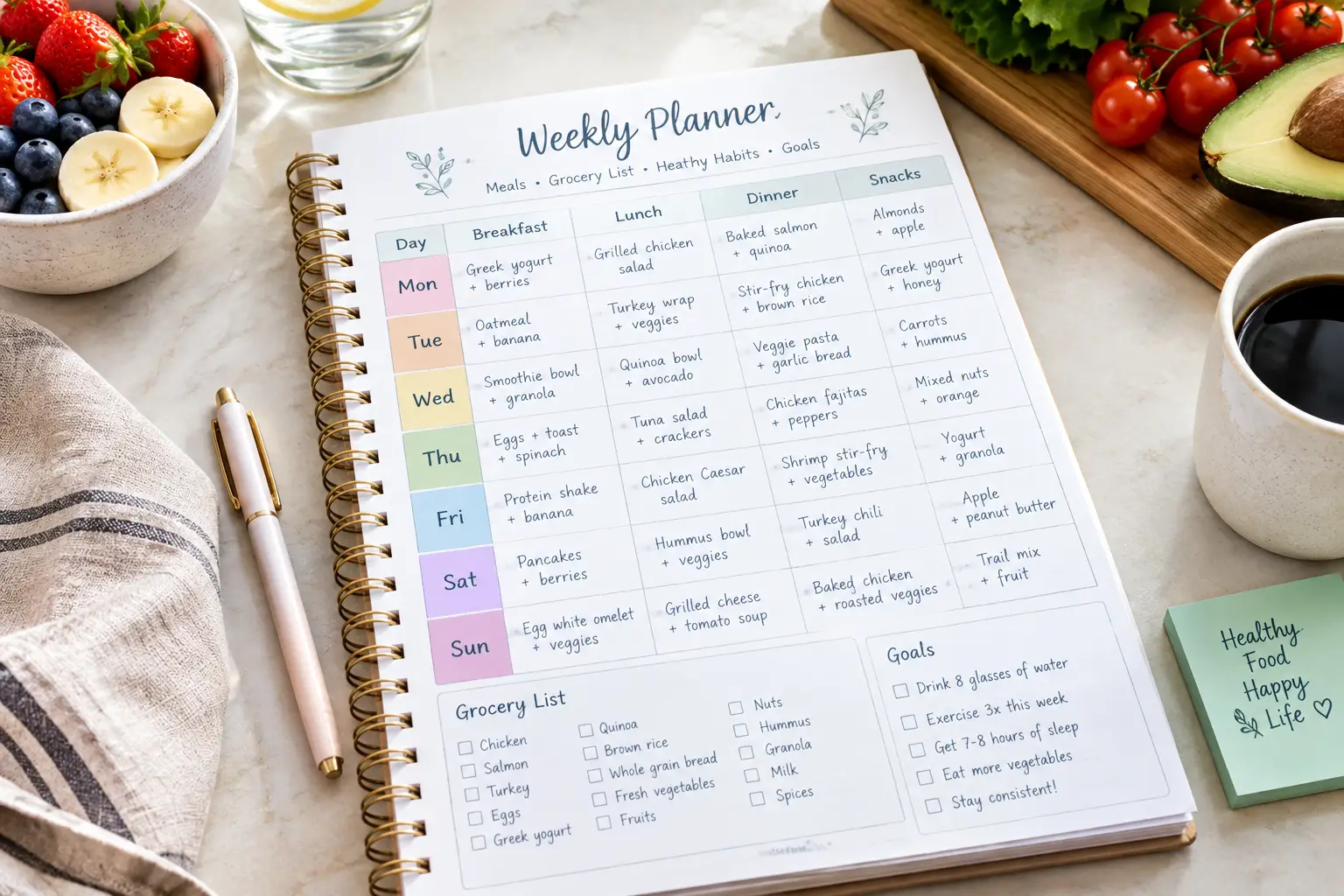
A weekly planner with meal planning is a paper pad, notebook, or reusable board that lays out all seven days with dedicated spaces for meals — usually breakfast, lunch, dinner, and snacks — plus a grocery list. Its job is simple: decide what you’ll eat before the week starts, then shop once, with a list.
That matters more than it sounds. A Rutgers Cooperative Extension fact sheet on reducing food waste notes that USDA estimates roughly 30–40% of the U.S. food supply ends up thrown away, and it points to meal planning as one of the most practical ways households can cut both waste and spending. In other words, a ten-dollar notepad on your fridge isn’t just stationery — it’s a budgeting tool.
In this guide, we compare seven real products you can find on amazon.com, from tear-off magnetic pads to dry-erase fridge boards to a hardcover food journal. To be clear about our method: we didn’t hand-test these planners. Instead, we compared published specs, page counts, sizes, and materials, and we summarized recurring themes from real customer reviews where we could verify them. Where review data was thin, we say so — and we lean harder on spec-based analysis instead.
Quick Comparison: The 7 Best Meal Planning Picks at a Glance
| Planner | Format | Capacity | Grocery List | Best for |
|---|---|---|---|---|
| Decorably Magnetic Weekly Meal Planner | Magnetic tear-off pad, 8.5″ x 11″ | 52 undated sheets | Yes, on the same sheet | Decorably: families who want a big, readable fridge menu |
| Naler Weekly Meal Planner and Grocery List Pad | Magnetic pad, 7″ x 9″ | 50 weeks | Yes | Naler: first-time planners on a tight budget |
| Inkdotpot Weekly Meal Planner Notepad | Magnetic pad, 7″ x 10″ | 54 undated sheets | Tear-off strip | Inkdotpot: style-minded kitchens |
| Lavish Cover Weekly Meal Planner Pad | Spiral-bound pad, approx. 5″ x 6.7″ | Weekly tear-off pages | Yes | Lavish Cover: small kitchens and countertop use |
| Clever Fox Food Journal | A5 hardcover journal | 6 months, undated | Planning + tracking pages | Clever Fox Food Journal: health and fitness goals |
| DasKid Magnetic Dry Erase Weekly Planner | Reusable dry-erase sheet, 15″ x 11.75″ | Unlimited (erasable) | DIY on board | DasKid: households that want zero paper |
| Hivillexun Magnetic Dry Erase Board Set | 3-piece dry-erase set | Unlimited (erasable) | Dedicated board | Hivillexun: families juggling calendar, meals, and lists |
Looking at the table, the split is really about paper versus erasable. The Decorably, Naler, and Inkdotpot pads give you a fresh sheet every week and a tear-off list for the store, while the DasKid and Hivillexun boards trade that grab-and-go list for never buying refills. The Clever Fox Food Journal sits in its own lane — it’s the pick if you want to plan meals and track what you actually ate.
💬 One click helps other shoppers make an informed choice too! 😊
Top 7 Weekly Planner with Meal Planning Picks: Expert Analysis
1. Decorably Magnetic Weekly Meal Planner and Grocery List Notepad — biggest at-a-glance fridge menu
The Decorably Magnetic Weekly Meal Planner and Grocery List Notepad earns its spot because it’s simply large enough for a whole household to read from across the kitchen.
It’s a full 8.5″ x 11″ spring-bound pad with 52 undated pastel sheets and four magnets, and each sheet pairs the weekly meal grid with a grocery list. In practice, 52 undated sheets means a full year of Sundays, and you never waste pages if you skip a week for vacation. The letter-size format also gives you room to write actual dish names rather than cryptic abbreviations, which matters when a teenager is the one starting dinner.
Based on comparing the specs, this is the best fit for families of three or more who want one shared “source of truth” on the fridge. Four magnets instead of a single strip is a quiet win: the pad is less likely to slide when you tear a sheet off. The trade-off is that a pad this big eats real estate on smaller or textured fridge doors.
One reviewer-focused roundup we found noted that the paper resists marker bleed but that ballpoint pens work best — worth knowing if you love bold felt-tips.
Pros:
- ✅ Letter-size layout is easy for the whole family to read
- ✅ Undated sheets cover a full year without waste
- ✅ Four magnets keep the pad steady during tear-offs
Cons:
- ❌ Takes up a lot of space on smaller fridges
- ❌ Heavy markers may not be the best match
Usually in the $10–$15 range (check the current price) — strong value for a year of planning.
2. Naler Weekly Meal Planner and Grocery List Pad — best budget starter pad
The Naler Weekly Meal Planner and Grocery List Pad is the low-risk way to find out whether weekly meal planning will stick in your house.
It’s a magnetic 7″ x 9″ pad with 50 weeks of pages and a built-in grocery section. The slightly smaller footprint is a practical compromise: still big enough to write seven dinners clearly, but it won’t swallow your fridge door or block the kids’ art. Fifty weeks also lines up neatly with real life, since most families skip at least a week or two around the holidays.
Our honest take: if you’ve tried meal planning before and quit after three weeks, don’t spend more until you’ve built the habit. That’s exactly where the Naler pad shines — it’s inexpensive enough that abandoning it costs you almost nothing, yet structured enough to make Sunday planning take ten minutes instead of thirty.
We couldn’t verify a substantial body of detailed customer reviews for this specific pad, so we’re not going to characterize its sentiment. What we can say from the specs is that the magnetic backing and grocery section cover the two features that matter most for a starter planner.
Pros:
- ✅ Affordable entry point for new meal planners
- ✅ Compact size fits most fridge doors comfortably
- ✅ Fifty weeks of pages cover nearly a full year
Cons:
- ❌ Limited verified review data to confirm durability
- ❌ Smaller boxes leave less room for prep notes
Typically around $10–$12 at the time of writing — about as cheap as a year of structure gets.
3. Inkdotpot Weekly Meal Planner Notepad — most design options for your kitchen
The Inkdotpot Weekly Meal Planner Notepad is for people who want their planning tool to look like part of the kitchen décor, not an office supply.
Each pad measures 7″ x 10″ with 54 undated sheets, a magnetic back, and a tear-off grocery shopping list. The brand sells the same core layout in multiple header designs — “This Week’s Menu,” “Diet Plan,” and “Kitchen Menu” among them — so you can match the tone of your space or your goal. The tear-off strip is the real functional highlight: you rip off just the list, leave the menu on the fridge, and the whole family can still see what’s for dinner while you shop.
What most buyers overlook with this style is that separating the list from the menu solves a classic problem — the plan disappears into your purse along with the list. With the Inkdotpot layout, it stays home where it’s needed.
We found retailer listings with hundreds of ratings for some Inkdotpot variants, but not enough written review detail to summarize recurring praise or complaints honestly. Treat our assessment as spec-based.
Pros:
- ✅ Several header designs to suit your kitchen style
- ✅ Tear-off list keeps the weekly menu on the fridge
- ✅ 54 undated sheets give a little extra cushion
Cons:
- ❌ Pricing varies widely by design and seller
- ❌ Fewer verifiable review details than bigger brands
Prices range roughly from $12 to $25 depending on the design — good value at the lower end, so compare variants before buying.
4. Lavish Cover Weekly Meal Planner Pad — best compact pad for small kitchens
The Lavish Cover Weekly Meal Planner Pad proves that a planner doesn’t need to be big to be useful — it just needs to be where you’ll actually see it.
At roughly 5″ x 6.7″, it’s spiral-bound with color-coded daily sections and tear-off pages that include a grocery list. Color coding sounds cosmetic, but it genuinely speeds up scanning: your eye jumps straight to “Thursday” instead of reading down a column. The small size means it can live on a countertop, inside a cabinet door, or next to the coffee maker — handy if your fridge is stainless steel and non-magnetic.
Here’s what to weigh: the compact boxes favor quick notes (“tacos,” “leftovers,” “slow cooker chili”) rather than detailed prep steps. That’s perfect for singles, couples, and apartment dwellers who cook simply, but large families will feel cramped by Wednesday.
We weren’t able to verify a meaningful set of customer reviews for this pad, so we’re not presenting any review sentiment. On paper, the spiral binding should make tearing pages cleaner than glued pads, though that’s an inference from the format, not tested data.
Pros:
- ✅ Small footprint works on counters and cabinets
- ✅ Color-coded days make the layout fast to scan
- ✅ Doesn’t require a magnetic fridge surface
Cons:
- ❌ Boxes are tight for big households or detailed notes
- ❌ Little verified feedback on long-term use
Usually around $10 (check the current price) — fair value for small households.
5. Clever Fox Food Journal — best for planning plus nutrition tracking
The Clever Fox Food Journal goes beyond “what’s for dinner” and answers “how am I actually eating?”
It’s an undated, six-month A5 journal (5.8″ x 8.3″) with an eco-leather hardcover, thick 120gsm paper, an elastic closure, a pen loop, three ribbon bookmarks, a back pocket, and stickers. Inside, it combines meal planning with calorie and nutrient tracking plus weight-tracker pages. The 120gsm paper is noticeably heavier than standard notebook stock, which in practice means gel pens and highlighters are far less likely to ghost through to the next page — important when you’re writing on both sides daily.
Based on comparing the features, this is the right pick for anyone with a specific goal — weight loss, muscle gain, managing a health condition with a dietitian, or simply eating more vegetables. It’s overkill if you just want a family dinner rota. The six-month span is a smart design choice: it’s long enough to see real patterns, short enough not to feel like a lifetime commitment.
On one major U.S. retailer, the journal averages about 4.7 stars across several dozen ratings, and reviewers often mention excitement about using it for calorie tracking — a positive signal, though from a modest sample.
Pros:
- ✅ Combines meal planning with calorie and nutrient tracking
- ✅ Thick 120gsm paper handles gel pens well
- ✅ Durable hardcover survives a bag or backpack
Cons:
- ❌ Only lasts six months per journal
- ❌ Too detailed for simple family dinner planning
Typically $25–$30 at the time of writing — premium-priced, but the tracking tools justify it for goal-driven users.
6. DasKid Magnetic Dry Erase Weekly Planner — best reusable fridge board
The DasKid Magnetic Dry Erase Weekly Planner is the “buy once” answer for households tired of restocking paper pads.
It measures 15″ x 11.75″ and is built on 30 mil magnetic sheeting with a dry-erase surface, and it ships with four color-coded magnetic markers and a cloth eraser. That 30 mil thickness is the detail that matters: thin magnetic sheets tend to curl at the corners, while thicker sheeting lies flatter and grips harder. Color-coded markers let you assign one color per family member or one color for meals versus activities — a simple trick that makes a busy board readable.
Reviews consistently report that it sticks firmly to the fridge, lies flat after unrolling, and works well for chores, reminders, and meal planning. However, a common complaint is gradual staining over time, since it’s a dry-erase coating on a magnet rather than a rigid board. One reviewer specifically found the green marker harder to erase, and another wished the cloth eraser were magnetic so it wouldn’t vanish into a drawer.
Our take: it’s ideal if you plan the week, rarely need a portable list, and want a big shared calendar. Wipe it weekly with a proper whiteboard cleaner to slow staining.
Pros:
- ✅ Thick 30 mil magnet lies flat and grips firmly
- ✅ Magnetic color-coded markers stay with the board
- ✅ Large surface handles meals and activities together
Cons:
- ❌ Surface may stain gradually with regular use
- ❌ Eraser cloth isn’t magnetic and goes missing
Generally in the $15–$25 range — strong long-term value since there are no refills to buy.
7. Hivillexun Magnetic Dry Erase Board Set — best all-in-one family command center
The Hivillexun Magnetic Dry Erase Board Set turns your fridge into a full family command center rather than a single menu.
The set includes three magnetic dry-erase pieces — a calendar board, a weekly meal planner, and a grocery list/notepad board — plus eight fine-tip dry-erase markers, each with an eraser on the cap. Splitting functions across three boards is smarter than it looks: your grocery list can be erased and rewritten mid-week without disturbing the meal plan, and the calendar shows why Thursday needs a 15-minute dinner. Fine tips also matter, since chunky markers make small boxes unreadable.
Who it’s for: busy families with multiple schedules, shared custody calendars, or anyone who’s ever planned a roast for the night of a school concert. It’s less ideal for small fridges, since three boards need room.
Reviews on a major U.S. retailer frequently praise the set as a good purchase and note that the included markers arrived working and actually erase cleanly from the boards — not a given with budget dry-erase sets. The brand also highlights a thickened, no-slip magnet designed to keep the boards from sliding or bubbling.
Pros:
- ✅ Three boards separate calendar, meals, and groceries
- ✅ Eight fine-tip markers with built-in erasers included
- ✅ Reviewers report markers erase cleanly
Cons:
- ❌ Needs a lot of fridge space for all three boards
- ❌ No tear-off list to carry to the store
Usually in the $15–$20 range (prices may vary) — excellent value for a complete reusable system.
Side-by-Side: How the Top 7 Planners Really Compare
| Planner | Price Range | Reusable? | Refills Needed | Review Signal | Best for |
|---|---|---|---|---|---|
| Decorably | $10–$15 | No | ~1 pad/year | Limited; paper praised | Decorably: large families |
| Naler | ~$10–$12 | No | ~1 pad/year | Not verified | Naler: budget beginners |
| Inkdotpot | ~$12–$25 | No | ~1 pad/year | Many ratings, thin detail | Inkdotpot: design lovers |
| Lavish Cover | ~$10 | No | Varies | Not verified | Lavish Cover: small spaces |
| Clever Fox Food Journal | $25–$30 | No | 2 journals/year | ~4.7 stars, small sample | Clever Fox Food Journal: health goals |
| DasKid | $15–$25 | Yes | Markers only | Strong grip; staining noted | DasKid: paper-free planners |
| Hivillexun | $15–$20 | Yes | Markers only | Markers erase well | Hivillexun: busy families |
Reading the table this way changes the math. The paper pads look cheapest up front, but the DasKid and Hivillexun boards only need occasional marker replacements, so they often pull ahead by year two. Meanwhile, the Clever Fox Food Journal costs the most per year — but it’s also the only option here that doubles as a nutrition log.
✨ Don’t miss these smart kitchen upgrades!
🔍 Take your meal planning to the next level with this carefully curated lineup. Click a highlighted product to check current pricing and availability. These picks will help you get calmer weeknights and fewer wasted groceries the whole family will notice!
How to Set Up Your First Week of Meal Planning (Step-by-Step)
Buying the planner is the easy part. Here’s a simple routine that turns it into a habit.
Step 1: Pick a planning day and stick to it
Most people choose Saturday or Sunday, right before the big grocery run. Block 15 minutes, put it in your calendar, and treat it like an appointment.
Step 2: Fill in the calendar first, meals second
This is the step most beginners skip. Before writing a single dinner, mark late meetings, practices, and nights out. Then match meals to the day: slow-cooker or leftovers on busy nights, the more involved recipes on relaxed evenings.
Step 3: Shop your fridge and pantry
Check what you already have and build two or three meals around it. That’s where the real savings live.
Step 4: Write the grocery list by store section
Group items by produce, dairy, meat, pantry, and frozen. You’ll shop faster and forget less.
Step 5: Plan leftovers on purpose
Cook once, eat twice. Just keep safety in mind: the federal FoodSafety.gov cold food storage chart lists cooked meat and poultry leftovers at 3 to 4 days in the refrigerator, so schedule “leftover night” within that window.
Common mistakes in the first 30 days
- ❌ Planning seven brand-new recipes in week one
- ❌ Forgetting breakfast and lunch entirely
- ❌ Not leaving a “flex night” for when plans change
Start with three or four planned dinners, then add more as the habit settles in.
Real-World Scenarios: Matching the Right Planner to Your Life
Specs are useful, but life is messier. Here’s how the picks map to three common households.
👨👩👧👦 The busy family of five
Two working parents, three kids, and a different activity every night. Budget: around $20. Frequency: daily glances, weekly planning. The Hivillexun Magnetic Dry Erase Board Set is the best match here because the calendar board explains why Tuesday’s dinner needs to be a 20-minute sheet-pan meal. The separate grocery board means anyone can add “out of milk” without smudging the menu. If you’d rather have paper, the Decorably pad is the runner-up thanks to its letter-size readability.
🏙️ The single professional in an apartment
One person, small kitchen, stainless steel fridge that won’t hold magnets. Budget: about $10. Cooks four or five nights a week and hates wasting half a bag of spinach. The Lavish Cover Weekly Meal Planner Pad fits this life perfectly — it sits on the counter, needs no magnets, and its compact boxes match simple cooking. Planning smaller portions with a list is exactly how single-person households cut the waste that tends to hit them hardest.
💪 The fitness-focused meal prepper
Batch-cooks on Sunday, tracks protein, and works with specific calorie targets. Budget: up to $30. The Clever Fox Food Journal is the only pick that combines a weekly plan with calorie and nutrient tracking, so you can see whether your meal prep actually hit its targets. Pair it with a cheap Naler pad on the fridge for the shopping list and you’ve got planning and accountability.
Problem → Solution: Fixing the Most Common Meal Planning Headaches
Even the best weekly planner with meal planning won’t fix everything on its own. Here’s how to troubleshoot the problems people run into most.
Problem 1: “I plan meals, then ignore the plan.” ✅ Solution: Move the plan where your eyes already go. A magnetic pad like the Decorably or Inkdotpot at eye level on the fridge beats a notebook in a drawer every time.
Problem 2: “I always forget the grocery list at home.” ✅ Solution: Use a tear-off format like the Inkdotpot pad and snap a phone photo of the list as backup. If you use a dry-erase board, photograph it before you leave.
Problem 3: “My dry-erase board is getting ghost stains.” ✅ Solution: As reviewers of the DasKid board noticed, coated magnetic sheets can stain over time. Erase within a week, use a whiteboard spray cleaner every Sunday, and avoid leaving dark colors on for weeks.
Problem 4: “Food still spoils before we eat it.” ✅ Solution: Schedule the most perishable meals early in the week — fish and fresh greens on Monday or Tuesday, pantry-based meals like pasta or chili toward the weekend.
Problem 5: “My family complains about the menu.” ✅ Solution: Let each person pick one dinner per week and write it in their own marker color on the Hivillexun or DasKid board. Buy-in goes up when people see their name on Thursday.
How to Choose a Weekly Planner with Meal Planning
Use these six criteria to narrow your options in minutes.
- Decide paper or erasable. Paper pads give you a portable grocery list; dry-erase boards save money long term. Pick based on whether you carry your list or photograph it.
- Measure your fridge door. A letter-size pad or 15-inch board needs clear, flat, magnetic space. Stainless steel doors often aren’t magnetic, so a countertop pad may be the only practical option.
- Count your household. Families need bigger boxes and a shared view. Singles and couples do fine with compact pads.
- Check the grocery list design. A tear-off strip that leaves the menu behind is more useful than a list printed on the same sheet as the menu.
- Look at undated versus dated. Undated pages let you skip weeks without wasting paper — every planner in our lineup is undated or reusable for that reason.
- Match your goal. If you’re tracking nutrition, choose a journal with tracking pages. For balance, many planners build menus around the food groups in USDA’s MyPlate guidance, which is a simple way to make sure every dinner has a vegetable.
A weekly planner with meal planning only works if it fits your space and your routine, so prioritize criteria 1 and 2 before falling for a cute design.
Paper Pads vs. Dry-Erase Boards vs. Meal Planning Apps
Apps get a lot of attention, so it’s fair to ask why anyone still buys a physical planner. The short answer: visibility. An app plan lives behind a lock screen; a fridge planner is seen by everyone, every time they grab a snack.
| Feature | Paper Meal Planner Pad | Dry-Erase Board | Meal Planning App |
|---|---|---|---|
| Visible to the whole family | Yes | Yes | Only if shared |
| Portable grocery list | Yes (tear-off) | Photo only | Yes |
| Ongoing cost | Refill pads | Markers only | Often a subscription |
| Screen time required | None | None | Yes |
| Best for | Decorably, Inkdotpot users | DasKid, Hivillexun users | Tech-first solo planners |
The table shows why physical planners still win for families: they create a shared, always-visible plan without anyone needing to open an app. Apps do beat paper on recipe storage and automatic grocery lists, so many households end up combining both — the app for recipes, the fridge planner for the plan. If you live alone and your phone is always in hand, an app may honestly be enough.
Features That Actually Matter (and Ones That Don’t)
Meal planner listings love buzzwords. Here’s how to separate useful features from marketing fluff.
✅ Features that matter
- A separate or tear-off grocery list. This single feature determines whether your plan survives the trip to the store.
- Magnet strength and coverage. Multiple magnets or full magnetic backing (like the DasKid board’s 30 mil sheet) prevent sliding and curling.
- Paper weight. Heavier paper, like the 120gsm stock in the Clever Fox Food Journal, stops bleed-through when you use markers or highlighters.
- Undated layouts. They save money and guilt when you skip a week.
- Room for snacks and breakfast. Dinner-only layouts leave half your grocery spending unplanned.
❌ Features that matter less than you think
- Motivational quotes on every page. Nice for a week, invisible by week three.
- Dozens of stickers. Fun, but they don’t change whether you cook.
- Calorie columns on a family fridge pad. Unless someone is actively tracking, they’re clutter.
- Fancy covers on a pad you’ll tear apart. Spend on function — paper quality and layout — instead.
The best weekly planner with meal planning is the one that removes friction, not the one with the longest feature list.
Long-Term Cost and Value: Is It Worth It?
Let’s run the honest math. A paper pad costs roughly $10–$25 a year. A reusable dry-erase board costs roughly $15–$25 once, plus a few dollars a year for fresh markers. A journal like the Clever Fox Food Journal runs about $50–$60 a year if you replace it every six months.
Now compare that to what’s at stake. The USDA’s consumer food waste guidance estimates that the average family of four loses about $1,500 a year to uneaten food. You don’t need to eliminate all of that for a planner to pay off — cutting waste by even a small fraction covers the cost many times over.
| Planner Type | Approx. Year-1 Cost | Approx. Year-2 Cost | Value Verdict |
|---|---|---|---|
| Paper pad (Naler, Decorably, Inkdotpot, Lavish Cover) | $10–$25 | $10–$25 | Low cost, steady refills |
| Dry-erase board (DasKid, Hivillexun) | $15–$25 | A few dollars for markers | Best long-term value |
| Food journal (Clever Fox Food Journal) | $50–$60 | $50–$60 | Worth it only with a tracking goal |
The pattern is clear: dry-erase boards win on pure cost after the first year, while paper pads win on convenience. The journal is the priciest, so it only makes sense if the nutrition tracking is something you’ll genuinely use. Whatever you choose, the real return comes from fewer impulse buys, fewer takeout nights, and less produce dying in the crisper drawer.
Meal Planning for Specific Households
A weekly planner with meal planning works differently depending on who’s at the table.
👶 Families with young kids
Plan around nap times and early bedtimes, and keep a “kid-approved backup” meal (like quesadillas) you can swap in any night. A big, visible board such as the Hivillexun set helps older kids see what’s coming and reduces dinner-time negotiations.
👵 Seniors and empty nesters
Smaller portions and fewer shopping trips are the priority. A compact pad like the Lavish Cover or Naler keeps planning simple, and writing in large print on a letter-size Decorably sheet can help if small boxes are hard to read.
🎓 College students and roommates
Shared fridges need shared rules. A dry-erase board lets roommates claim cooking nights and split grocery lists without awkward group texts.
🥗 People with dietary goals or restrictions
If you’re managing allergies, a diabetes meal plan from your doctor, or a weight goal, the Clever Fox Food Journal lets you plan and record in one place — handy to bring to appointments. Always follow the guidance of your healthcare provider or registered dietitian for medical diets.
Common Mistakes to Avoid When Buying a Meal Planner
Even a great product can be the wrong product for you. Watch for these pitfalls.
1. Ignoring your fridge material. Many stainless steel doors aren’t magnetic. Test with an existing magnet before buying any magnetic pad or board.
2. Buying for the person you wish you were. If you’ve never meal planned, a detailed six-month nutrition journal can feel like homework. Start simple with a pad like the Naler and upgrade later.
3. Choosing a list that leaves with the plan. If the grocery list is printed on the same sheet as the menu, you’ll tear off the whole plan. Tear-off strips solve this.
4. Overlooking marker quality on dry-erase sets. Cheap markers dry out or stain. Reviews of the Hivillexun set specifically mention markers that erase cleanly, while DasKid reviewers flagged one color as harder to erase — small details that affect daily use.
5. Going too small for a big household. A 5-inch pad can’t hold dinner plans for five people plus notes. Size to your family, not your counter.
6. Expecting the planner to do the planning. It’s a tool, not a habit. Pair it with a set weekly planning time, and it will earn its keep.
FAQ: Weekly Planner with Meal Planning
❓ Is a weekly planner with meal planning worth buying if I already use a phone calendar?
❓ Where should I put a magnetic meal planner if my fridge isn't magnetic?
❓ How many meals should I plan per week as a beginner?
❓ Can I use a dry erase meal planner with regular markers?
❓ Which meal planner is best for weight loss tracking?
Conclusion: Pick the Planner That Fits Your Week
There’s no single “best” weekly planner with meal planning — there’s the best one for your fridge, your household, and your habits. If you want a big, shared paper menu, the Decorably pad is the standout. If you’re testing the waters, the Naler pad keeps the cost tiny. Style-focused kitchens will like the Inkdotpot designs, while small spaces and non-magnetic fridges point to the Lavish Cover pad.
For goal-driven eaters, the Clever Fox Food Journal is the only pick here that combines planning with tracking. And if you never want to buy another pad, the DasKid board and the Hivillexun three-piece set are the long-term value plays — the latter especially for families who need a calendar right next to the menu.
Whatever you choose, remember the real win isn’t the product. It’s the 15 minutes on Sunday that saves you from the 5:47 p.m. panic, the forgotten chicken, and the third takeout order of the week. Start small, plan three dinners, and let the habit grow.
🛒 Ready to take back your weeknights?
✨ Pick the planner that matches your household, check today’s price and availability, and make this Sunday your first planning day. Your future self — and your grocery budget — will thank you!
Recommended for You
- Meal Prep Fridge Guide 2026: 7 Best Picks That Actually Fit
- How Long Does Meal Prep Last in Fridge? 7 Proven Tools (2026)
- How Long Do Meal Prep Meals Last? 7 Proven Picks & Rules (2026)
Disclaimer: This post contains affiliate links. As an Amazon Associate, I earn from qualifying purchases made through these links, at no additional cost to you.
✨ Found this article helpful? Share it with someone who needs it! 💬🤗