
In This Article
Round Containers Used for Cooking: Why the Shape Still Wins
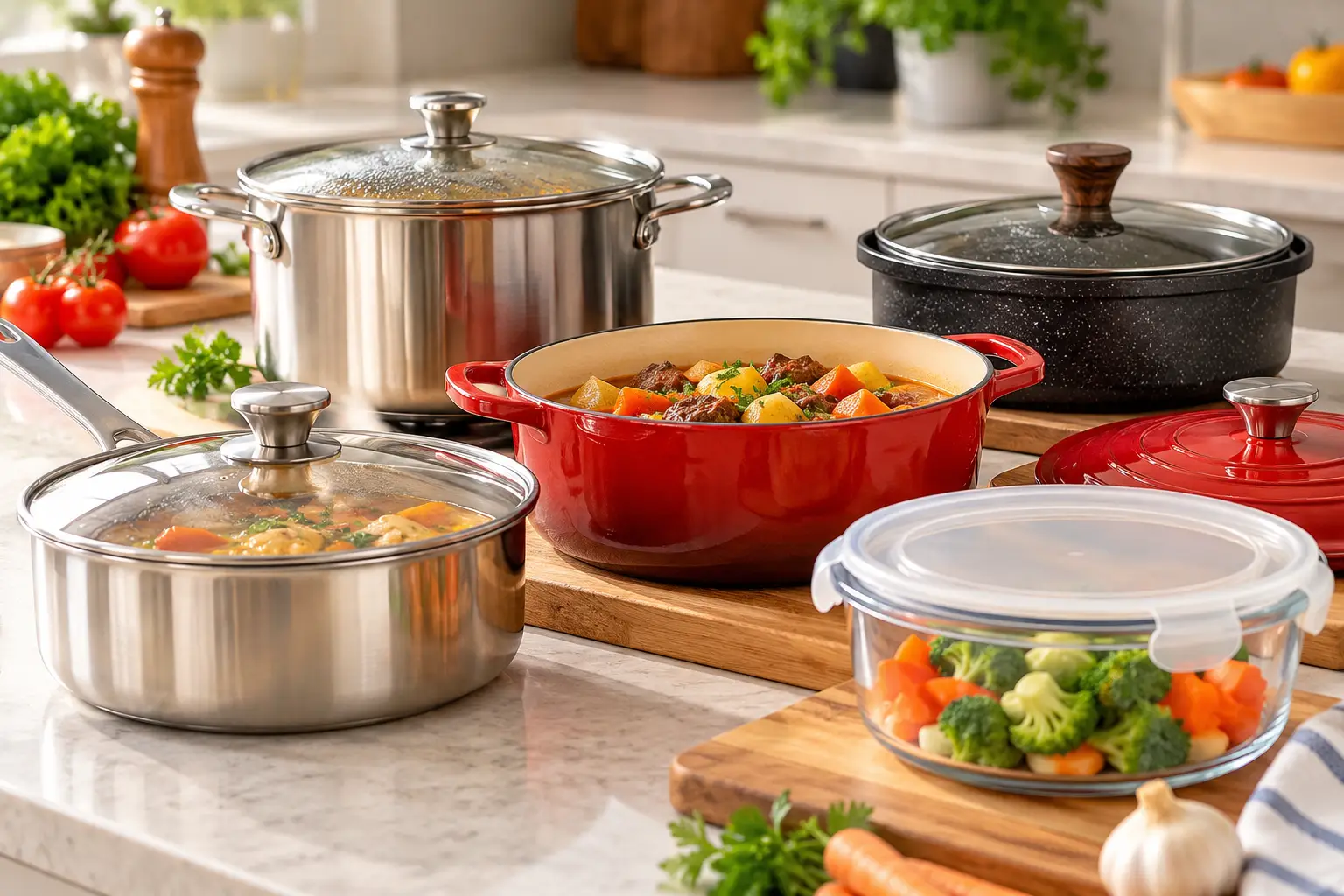
Walk into any serious kitchen — a Brooklyn bistro, a Texas chuckwagon cook-off, a dim sum restaurant in San Francisco — and you’ll notice the same thing: almost every pot that does the heavy lifting is round. That’s not tradition for tradition’s sake. Round containers used for cooking heat more evenly, circulate liquid more naturally, and leave no square corners for sauce to scorch in or for a whisk to miss.
Still, “round pot” covers a huge range of gear. A 12-quart stockpot and a 4-quart French cocotte are both round, but they solve completely different problems. Buy the wrong one and you end up with a beautiful 11-pound pot that’s too small for your Sunday chili, or a thin stockpot that burns every batch of beans.
This guide cuts through that. Based on comparing manufacturer spec sheets, retailer listings, and the patterns that show up again and again in customer reviews, we’ve narrowed the field to seven round cooking pots that cover the real-world jobs most US home cooks face: braising, baking bread, simmering stock, cooking grains and sauces, and high-heat stir-frying.
You’ll get honest analysis of what each spec means in practice, who each pot actually suits, and where each one falls short. You’ll also find a 30-day getting-started guide, a problem-solving section, and a buying framework, so you can pick once and cook for decades. If you want the historical backstory, the classic heavy-lidded Dutch oven has been a staple of American kitchens since colonial times — and three of our seven picks descend directly from it.
Prices below are shown as ranges only, because Amazon pricing changes constantly — always check the current price before you buy.
What Are Round Containers Used for Cooking?
Round containers used for cooking are circular pots and pans — Dutch ovens, cocottes, stockpots, saucepans, and woks — designed so heat spreads evenly from the base up the curved walls. Their shape eliminates corner hot spots, makes stirring easier, and helps liquids circulate for braising, simmering, boiling, and stir-frying.
That definition hides an important split. Round cooking pots fall into three performance families:
- ✅ Heat-retainers (enameled cast iron Dutch ovens and cocottes): slow to heat, slow to cool, ideal for braises, stews, and bread.
- ✅ Heat-responders (tri-ply stainless saucepans and stockpots): react quickly when you adjust the burner, ideal for sauces, grains, pasta, and stock.
- ✅ High-heat specialists (carbon steel woks): thin, fast, and built to take ripping-hot flames for searing and stir-frying.
Why does that matter? Because the single most common buying mistake is choosing a pot on looks or brand when the real question is how the metal behaves. A cast iron pot that holds heat beautifully for a four-hour short-rib braise will fight you when you need a delicate béchamel to cool down fast. A thin stainless stockpot that boils 12 quarts of pasta water quickly will scorch a thick bean stew if you walk away.
Once you know which family fits your cooking, the rest of the decision — size, budget, brand — gets much easier. The comparison table below maps each of our picks to its family and its best job.
Quick Comparison: 7 Round Cooking Pots at a Glance
| Product | Type | Capacity | Material | Price Range | Best For |
|---|---|---|---|---|---|
| Lodge 6 Quart Enameled Cast Iron Dutch Oven | Round Dutch oven | 6 qt | Enameled cast iron | Around $70–$110 | Lodge 6 Quart Enameled Cast Iron Dutch Oven: best-value everyday braiser |
| Le Creuset Signature 5.5-Quart Round Dutch Oven | Round Dutch oven | 5.5 qt | Enameled cast iron | Around $400–$450 | Le Creuset Signature 5.5-Quart Round Dutch Oven: heirloom all-rounder |
| Staub Cast Iron 4-Quart Round Cocotte | Cocotte | 4 qt | Enameled cast iron | Around $250–$350 | Staub Cast Iron 4-Quart Round Cocotte: moist braises for 2–4 |
| Tramontina 6.5-Quart Enameled Cast Iron Round Dutch Oven | Round Dutch oven | 6.5 qt | Enameled cast iron | Around $60–$100 | Tramontina 6.5-Quart Enameled Cast Iron Round Dutch Oven: max capacity per dollar |
| Cuisinart Chef’s Classic 12-Quart Stockpot (766-26) | Stockpot | 12 qt | Stainless, aluminum disc base | Around $50–$90 | Cuisinart Chef’s Classic 12-Quart Stockpot (766-26): stock, pasta, canning |
| All-Clad D3 Stainless 3-Quart Saucepan | Saucepan | 3 qt | Tri-ply stainless | Around $150–$230 | All-Clad D3 Stainless 3-Quart Saucepan: sauces, grains, precision |
| Craft Wok 14-Inch Hand-Hammered Carbon Steel Wok (731W88) | Round-bottom wok | 14 in. | Carbon steel | Around $50–$80 | Craft Wok 14-Inch Hand-Hammered Carbon Steel Wok (731W88): true high-heat stir-fry |
Looking at the table, the biggest takeaway is that price tracks craftsmanship and finish far more than it tracks capacity: the Tramontina 6.5-Quart Enameled Cast Iron Round Dutch Oven gives you the most volume for the least money, while the Le Creuset Signature 5.5-Quart Round Dutch Oven costs several times more for a slightly smaller pot. What you pay extra for is enamel durability, weight balance, and warranty — not a bigger stew. And notice that no single pot covers every job; most kitchens are best served by one heat-retainer plus one heat-responder.
💬 One click helps other shoppers make an informed choice too! 😊
Top 7 Round Containers Used for Cooking: Expert Analysis
1. Lodge 6 Quart Enameled Cast Iron Dutch Oven — best value for everyday braising
The Lodge 6 Quart Enameled Cast Iron Dutch Oven (model EC6D43) delivers most of the premium Dutch oven experience at a fraction of the cost. It measures about 10¾ inches across, handles oven temperatures up to 500°F (including the stainless steel knob), and works on gas, electric, ceramic, and induction cooktops. In practice, that 500°F rating matters: it’s high enough for the classic no-knead bread method, so one pot covers both Tuesday’s chili and Saturday’s sourdough.
Based on comparing the specs, this is the pot for first-time Dutch oven buyers and families who cook large batches. Six quarts comfortably feeds six people and fits a whole chicken, which is the sweet spot for most US households.
Customer reviews consistently praise its heat retention and even cooking, often comparing it favorably to pots costing far more. The recurring complaints are its weight (independent reviewers put it near 14 pounds), occasional enamel chipping along the rim, and interior staining over time.
Pros:
- ✅ Oven-safe to 500°F, knob included, for bread baking
- ✅ Six-quart size fits a whole chicken or big batches
- ✅ Works on every cooktop, including induction
Cons:
- ❌ Heavy to lift when full, especially for smaller cooks
- ❌ Rim enamel can chip with careless handling
Price usually lands around $70–$110, and for most kitchens that’s the strongest value-for-money verdict on this list.
2. Le Creuset Signature 5.5-Quart Round Dutch Oven — the heirloom all-rounder
The Le Creuset Signature 5.5-Quart Round Dutch Oven is the benchmark every other enameled pot gets measured against, and the reasons are practical, not just cosmetic. Retailers list it at roughly 11 pounds 4 ounces with the lid — noticeably lighter than the Lodge 6 Quart Enameled Cast Iron Dutch Oven — and Le Creuset says it’s sand-cast, hand-finished, and given two coats of enamel fired twice. That double enamel layer is what owners credit for better chip resistance over years of use.
The light sand-colored interior is an underrated feature: you can actually see your fond browning, so you catch onions before they burn. The Signature line’s oversized loop handles also make a real difference when you’re pulling a full pot out of a 450°F oven wearing thick mitts.
Here’s what to weigh: this is a buy-it-once pot for cooks who braise weekly and want a lifetime limited warranty from a brand with a long service record. Reviews consistently describe it as easier to clean than rivals and remarkably durable, with the price being the main objection.
Pros:
- ✅ Lighter per quart than most enameled rivals
- ✅ Light interior makes browning easy to monitor
- ✅ Lifetime limited warranty and made in France
Cons:
- ❌ Costs several times more than budget alternatives
- ❌ 5.5 quarts runs tight for large families
Expect prices in the $400–$450 range; the value case rests on decades of use rather than day-one savings.
3. Staub Cast Iron 4-Quart Round Cocotte — moisture king for small households
The Staub Cast Iron 4-Quart Round Cocotte is engineered around one idea: keep every drop of moisture in the pot. The underside of its heavy lid is covered in small spikes that collect condensation and drip it evenly back onto the food, which Staub describes as a self-basting “rain-forest effect.” The pot body is oven-safe to 900°F without the lid, while the lid itself is rated to 500°F.
What most buyers overlook is the matte black enamel interior. It’s textured, which helps meat brown aggressively, and it hides stains — but it also makes it harder to judge how dark your fond is getting compared with the light interior of the Le Creuset Signature 5.5-Quart Round Dutch Oven.
At 4 quarts, this is best for couples, small households, or as a second pot for side dishes and bread boules. Reviews repeatedly praise how tender and juicy braised meats come out; one recurring observation from independent testers is that it lets out so little steam that sauces may stay thinner unless you reduce them uncovered at the end.
Pros:
- ✅ Self-basting lid spikes keep braises exceptionally moist
- ✅ Textured black interior sears and hides stains
- ✅ Very high oven rating for the pot body
Cons:
- ❌ Dark interior makes fond harder to monitor
- ❌ Four quarts is small for family batch cooking
It typically sells around $250–$350, a strong value if you prioritize braising quality over capacity.
4. Tramontina 6.5-Quart Enameled Cast Iron Round Dutch Oven — most capacity per dollar
The Tramontina 6.5-Quart Enameled Cast Iron Round Dutch Oven is the lesser-known workhorse that keeps showing up in “don’t overspend” conversations. You get 6.5 quarts — more than any other Dutch oven here — plus a lid with condensation ridges that mimic self-basting, a cast stainless steel knob, and a cream enamel interior that makes browning easy to watch.
On paper, the key limitation is heat: independent reviews cite Tramontina’s own 450°F oven rating for this model, which is 50 degrees lower than the Lodge 6 Quart Enameled Cast Iron Dutch Oven. For stews and pot roasts that’s irrelevant; for bread recipes that call for a 475–500°F preheat, it’s a real constraint.
This is the pick for budget-conscious cooks who mostly braise, make soups, and cook beans for a crowd. Customer feedback frequently praises the thick, heavy walls and the price, while some buyers report cosmetic flaws or small chips on arrival and note that the exposed cast iron rims benefit from a light coat of oil to prevent rust.
Pros:
- ✅ Largest capacity among the Dutch ovens reviewed
- ✅ Cream interior makes monitoring browning simple
- ✅ Thick walls hold steady, even heat
Cons:
- ❌ Lower 450°F oven rating limits high-heat bread baking
- ❌ Quality control on finish is less consistent
Usually priced around $60–$100, it’s the value champion for cooks who want size over prestige.
5. Cuisinart Chef’s Classic 12-Quart Stockpot (766-26) — the big-batch boiler
The Cuisinart Chef’s Classic 12-Quart Stockpot (766-26) fills the gap that no Dutch oven can: sheer volume without crushing weight. Its stainless steel body sits on an aluminum disc encapsulated in the base, so the bottom heats quickly and evenly, and interior measurement markings save you from hunting for a measuring cup when you’re building stock. Cuisinart lists it at about 11 inches wide and 9 inches tall, with a lifetime warranty.
Translate that into real life: 12 quarts is enough for a double batch of chicken stock, a full pound of long spaghetti without snapping it, or a steamer load of crabs. The flat base is a genuine advantage on glass-top stoves, and canning bloggers note it comfortably fits eight half-pint jars for small-batch preserving.
The trade-off is that the heat lives in the base only — the walls are thin single-ply steel. That’s fine for boiling and simmering, but thick chili can scorch at the bottom if you don’t stir. Reviews consistently praise the depth, quality, and cool-staying handles; a few owners wish the lid were glass.
Pros:
- ✅ Twelve quarts handles stock, pasta, and canning
- ✅ Flat, encapsulated base suits glass-top stoves
- ✅ Interior measurement markings speed up prep
Cons:
- ❌ Thin walls can scorch thick stews
- ❌ Solid lid means lifting it to check progress
It typically runs around $50–$90, outstanding value for a pot you’ll use for decades.
6. All-Clad D3 Stainless 3-Quart Saucepan — precision control for sauces and grains
The All-Clad D3 Stainless 3-Quart Saucepan is the heat-responder of this list. Its tri-ply construction sandwiches an aluminum core between two layers of stainless steel, bonded all the way up the walls — not just in a disc at the base like the Cuisinart Chef’s Classic 12-Quart Stockpot (766-26). Retailers note the D3 line is bonded in Canonsburg, Pennsylvania, and All-Clad lists it as induction-compatible.
Why does fully clad construction matter? When you turn the burner down, the whole pan cools down with it. That’s the difference between a caramel that stays amber and one that races to burnt, or a pot of rice that simmers gently instead of welding itself to the bottom.
This saucepan suits confident home cooks, anyone making sauces and custards regularly, and people building a stainless set piece by piece. Reviews consistently praise its even heating and longevity; the common learning curve is that stainless steel sticks unless you preheat properly, and some owners find the classic handle less comfortable than rounder designs.
Pros:
- ✅ Fully bonded tri-ply heats evenly up the walls
- ✅ Responds quickly when you adjust the heat
- ✅ Induction-compatible and extremely durable
Cons:
- ❌ Food sticks without proper preheating technique
- ❌ Premium price for a single small pot
Expect roughly $150–$230; a buy-once piece that pays off if you cook sauces and grains often.
7. Craft Wok 14-Inch Hand-Hammered Carbon Steel Wok (731W88) — authentic wok hei at home
The Craft Wok 14-Inch Hand-Hammered Carbon Steel Wok (731W88) is the only true high-heat specialist here. It’s made from 15-gauge (about 1.8 mm) carbon steel, hand-hammered in Guangzhou according to the manufacturer, and weighs about 4.6 pounds — far lighter than any Dutch oven on this list, which is exactly what lets you toss food over a roaring flame.
The hammered surface isn’t just decoration: those small dimples help oil cling and give food something to rest against once the wok is seasoned. It has a long wooden handle plus a steel helper handle, so you can lift a full wok with two hands.
Here’s the crucial caveat: this is a round-bottom model, and Craft Wok states it is not suitable for flat electric or flat induction stoves. It shines on gas ranges and outdoor wok burners. If you cook on glass or induction, look for Craft Wok’s flat-bottom version (731W316) instead.
Reviews consistently celebrate the searing and smoky “wok hei” flavor, while the recurring learning curve is seasoning and rust prevention — carbon steel must be dried and oiled after every wash.
Pros:
- ✅ Handles extreme heat for real stir-fry searing
- ✅ Light enough to toss food one-handed
- ✅ Builds a natural nonstick patina over time
Cons:
- ❌ Round bottom won’t work on flat electric or induction
- ❌ Rusts quickly if left wet or unseasoned
Priced around $50–$80, it’s an excellent value for gas-stove cooks who stir-fry weekly.
Detailed Comparison of the Top 7
| Product | Oven Limit | Induction | Approx. Weight | Warranty | Best For |
|---|---|---|---|---|---|
| Lodge 6 Quart Enameled Cast Iron Dutch Oven | 500°F | Yes | ~14 lb (reviewer figure) | Limited | Lodge 6 Quart Enameled Cast Iron Dutch Oven: families on a budget |
| Le Creuset Signature 5.5-Quart Round Dutch Oven | 500°F | Yes | ~11.3 lb with lid | Lifetime limited | Le Creuset Signature 5.5-Quart Round Dutch Oven: weekly braisers |
| Staub Cast Iron 4-Quart Round Cocotte | 900°F body / 500°F lid | Yes | Heavy for size | Limited lifetime (check) | Staub Cast Iron 4-Quart Round Cocotte: couples, bread boules |
| Tramontina 6.5-Quart Enameled Cast Iron Round Dutch Oven | 450°F | Yes (per retailers) | Not published | Check listing | Tramontina 6.5-Quart Enameled Cast Iron Round Dutch Oven: big batches, low budget |
| Cuisinart Chef’s Classic 12-Quart Stockpot (766-26) | Oven-safe (check listing) | Check listing | Light | Lifetime | Cuisinart Chef’s Classic 12-Quart Stockpot (766-26): stock and canning |
| All-Clad D3 Stainless 3-Quart Saucepan | High (All-Clad lists up to 600°F for stainless) | Yes | Light | Limited lifetime | All-Clad D3 Stainless 3-Quart Saucepan: sauces and grains |
| Craft Wok 14-Inch Hand-Hammered Carbon Steel Wok (731W88) | Stovetop tool | No (round bottom) | ~4.6 lb | Check listing | Craft Wok 14-Inch Hand-Hammered Carbon Steel Wok (731W88): gas-stove stir-fry |
The pattern here is clear: the three French-style and enameled pots cluster around similar oven limits, so your real choice among them comes down to weight, interior color, and budget. The Staub Cast Iron 4-Quart Round Cocotte stands out for extreme oven heat but trades away capacity, while the Craft Wok 14-Inch Hand-Hammered Carbon Steel Wok (731W88) is the only pick that rules itself out for induction kitchens — double-check your cooktop before ordering. Where a spec is marked “check listing,” the manufacturer doesn’t publish a clear figure, so confirm on the product page.
✨ Don’t miss the right pot for your kitchen!
🔍 Take your home cooking to the next level with this carefully curated lineup. Click a highlighted pot to check current pricing and availability — these picks will help you turn out braises, stocks, and stir-fries the whole family will love!
Getting Started: Your First 30 Days With a New Round Pot
A great pot can still disappoint if the first month goes wrong. Here’s a practical break-in plan by material.
Enameled Cast Iron (Lodge, Le Creuset, Staub, Tramontina)
- ✅ Day 1: Wash with warm, soapy water and dry thoroughly — including the unenameled rim, which is bare iron on most models. A thin wipe of oil on that rim prevents the rust spots some Tramontina 6.5-Quart Enameled Cast Iron Round Dutch Oven owners report.
- ✅ Week 1: Always preheat on low to medium heat for 5–10 minutes. Enamel is glass fused to iron, and sudden temperature jumps are the leading cause of cracking and chipping.
- ✅ Week 2: Never plunge a hot pot into cold water. Let it cool on the stovetop first.
- ✅ Month 1: Light staining is cosmetic. A paste of baking soda and water lifts most of it without scratching.
Tri-Ply Stainless (All-Clad, Cuisinart)
- ✅ Preheat empty for 1–2 minutes, then add oil. When oil shimmers, add food — this is the “water droplet” moment that prevents sticking in the All-Clad D3 Stainless 3-Quart Saucepan.
- ✅ Salt water only after it boils; salt dropped into cold water can cause small pits over time.
- ✅ Bar Keepers Friend–style cleansers remove rainbow heat tint in seconds.
Carbon Steel (Craft Wok)
The Craft Wok 14-Inch Hand-Hammered Carbon Steel Wok (731W88) ships with a protective factory coating that must be scrubbed off before first use. After that, it needs seasoning — thin layers of oil heated until they polymerize into a slick, protective surface. Heat the wok until the steel changes color, rub in a very thin layer of high-smoke-point oil, and repeat several times. For the first month, cook oily foods (stir-fries, fried rice, shallow-frying) rather than acidic dishes like tomato sauce, which strip young seasoning. After every wash, dry it over a burner and wipe on a drop of oil.
Common first-month mistake across all materials: cranking the heat to “high.” Heavy round pots need patience; thin ones need attention. Medium is almost always the right starting point.
Real-World Scenarios: Matching the Right Round Pot to Your Kitchen
Specs only matter in context, so here are three realistic buyer profiles and the picks that fit them best.
Profile 1: The Busy Family of Five (Budget: Under $150)
Maria cooks dinner five nights a week in a suburban kitchen with a glass-top electric range. Her rotation is chili, pot roast, soups, and pasta night. She wants to buy once and doesn’t want to baby her cookware.
Recommendation: the Lodge 6 Quart Enameled Cast Iron Dutch Oven plus the Cuisinart Chef’s Classic 12-Quart Stockpot (766-26). Combined, they typically land well under $200 and cover every dish on her list. The Lodge handles slow-cooked mains and bread; the Cuisinart boils pasta and makes stock in batches large enough to freeze. Both have flat bases that sit well on glass tops.
Profile 2: The Couple Who Loves Weekend Projects (Budget: Flexible)
Jordan and Sam live in a city apartment with a gas range, cook for two most nights, and spend Sundays on braises and sourdough. Storage is tight.
Recommendation: the Staub Cast Iron 4-Quart Round Cocotte for braises and bread boules, paired with the Craft Wok 14-Inch Hand-Hammered Carbon Steel Wok (731W88) for fast weeknight stir-fries. The cocotte’s size fits a two-person kitchen, and the wok’s gas-stove requirement is no issue here. The wok can hang on a wall hook, saving cabinet space.
Profile 3: The Precision Cook Building a Forever Kit (Budget: $600+)
Priya is upgrading from a nonstick starter set, cooks on induction, and wants pieces that last 30 years.
Recommendation: the Le Creuset Signature 5.5-Quart Round Dutch Oven and the All-Clad D3 Stainless 3-Quart Saucepan. Both are fully induction-compatible, both carry long warranties, and together they cover the heat-retainer and heat-responder roles. She should skip the round-bottom wok; the flat-bottom Craft Wok variant is the better fit for induction.
Problem → Solution: Fixing the Most Common Round Cookware Headaches
Even the best round cooking pots run into trouble. Here are five issues that come up repeatedly in customer reviews — and how to solve them.
1. Food sticks and burns at the bottom of a stockpot. Thin-walled stockpots like the Cuisinart Chef’s Classic 12-Quart Stockpot (766-26) concentrate heat in the base. Solution: use it for liquid-heavy cooking (stock, pasta, boiling), and move thick stews and chili to an enameled Dutch oven. If you must use the stockpot, stir every 10 minutes and keep the burner at medium-low.
2. Enamel chips near the rim. This is the most frequent complaint about budget enameled pots. Solution: don’t tap metal spoons on the rim, store pots with pot protectors or a folded towel between lid and body, and avoid heating an empty pot on high. Check the manufacturer’s warranty terms — some cover enamel defects.
3. Braising liquid stays too thin. Tight lids, especially on the Staub Cast Iron 4-Quart Round Cocotte, trap nearly all moisture. Solution: remove the lid for the final 20–30 minutes to reduce the sauce, or start with about 20% less liquid than the recipe calls for.
4. Stainless saucepan sticks to everything. Solution: preheat before adding fat, let proteins release naturally before flipping or stirring, and deglaze stuck bits with a splash of liquid — that fond is flavor, not failure.
5. Carbon steel wok turns rusty or sticky. Rust means moisture sat on bare steel; stickiness means too much oil during seasoning. Solution: scrub rust off with steel wool, re-season with very thin oil layers, and always heat-dry the Craft Wok 14-Inch Hand-Hammered Carbon Steel Wok (731W88) after washing.
How to Choose Round Containers Used for Cooking
Choosing among round containers used for cooking comes down to seven decisions. Work through them in order:
- Identify your main cooking job. Braising and bread point to enameled cast iron; sauces and grains point to tri-ply stainless; stir-frying points to carbon steel. The broad families of cookware and bakeware materials each behave differently under heat, so start with the task, not the brand.
- Match capacity to household size. Roughly 1 quart per person for Dutch ovens; 4 quarts suits 2–3 people, 5.5–7 quarts suits 4–6.
- Check your cooktop. Induction needs magnetic, flat-bottomed cookware. Round-bottom woks need gas or a wok ring.
- Confirm the oven rating. For no-knead bread, you want 450–500°F including the knob.
- Consider weight honestly. A full 6-quart cast iron pot can top 20 pounds. If lifting is an issue, stainless or a smaller cocotte is safer.
- Look at interior color. Light interiors show browning; dark interiors hide stains and sear harder.
- Read the warranty. Premium brands back enamel for decades; budget brands vary — confirm the terms on the listing.
Following these steps prevents the classic regret: a gorgeous round Dutch oven that’s too heavy, too small, or incompatible with your stove.
Round Dutch Oven vs Stockpot vs Saucepan vs Wok: Which Shape Does What?
These four round cooking pots look related, but they perform very differently. Think of them as a team where each player has a position.
A round Dutch oven is the slow-and-low specialist. Thick cast iron walls store heat, so the temperature inside barely dips when you add cold ingredients — perfect for searing short ribs, then braising for hours. Its drawback is agility: it takes a long time to heat and cool.
A stainless steel stockpot is tall and narrow by design. The height reduces evaporation over long simmers, which is exactly what you want for stock. It’s lighter than cast iron and boils water fast, but thin walls make it a poor choice for thick foods.
A saucepan is the precision tool. Fully clad models like the All-Clad D3 Stainless 3-Quart Saucepan respond within seconds to burner changes, which matters for sauces, custards, grains, and reheating.
A wok is the sprinter. Its curved bowl creates a gradient of heat: scorching at the bottom, cooler up the sides, so you can sear ingredients in the center and push cooked ones up the wall.
| Round Container | Heat Style | Main Advantage Over Alternatives | Best For |
|---|---|---|---|
| Round Dutch oven | Slow, even, retained | Holds temperature for long braises and bread | Lodge 6 Quart Enameled Cast Iron Dutch Oven, Le Creuset Signature 5.5-Quart Round Dutch Oven |
| Stockpot | Fast base heat, tall walls | Huge volume with low evaporation | Cuisinart Chef’s Classic 12-Quart Stockpot (766-26) |
| Saucepan | Highly responsive | Precise control for delicate liquids | All-Clad D3 Stainless 3-Quart Saucepan |
| Wok | Intense, zoned heat | Searing and fast stir-frying | Craft Wok 14-Inch Hand-Hammered Carbon Steel Wok (731W88) |
The table makes the case for owning at least two shapes: no single round container wins every job. If you only buy one, a 5.5–6 quart round Dutch oven is the most versatile, because it can braise, boil, fry, and bake — just less efficiently than a specialist at each.
Long-Term Cost and Maintenance
The sticker price is only part of the story. Round cooking pots that last 30 years cost less per year than cheap ones replaced every three.
Consider the math using typical price ranges. A Le Creuset Signature 5.5-Quart Round Dutch Oven in the $400–$450 range, used for 30 years, works out to roughly $14–$15 per year. A Lodge 6 Quart Enameled Cast Iron Dutch Oven around $70–$110 costs about $3–$4 per year over 30 years — if the enamel holds up that long. The honest difference is risk: premium enamel is more likely to survive decades of heavy use without chipping.
| Product | Typical Price Range | Maintenance Needs | Long-Term Value Verdict | Best For |
|---|---|---|---|---|
| Tramontina 6.5-Quart Enameled Cast Iron Round Dutch Oven | Around $60–$100 | Oil exposed rims, gentle heat | Great if you accept cosmetic risk | Tramontina 6.5-Quart Enameled Cast Iron Round Dutch Oven: lowest upfront cost |
| Staub Cast Iron 4-Quart Round Cocotte | Around $250–$350 | Hand wash recommended | Excellent for heavy braisers | Staub Cast Iron 4-Quart Round Cocotte: quality over size |
| All-Clad D3 Stainless 3-Quart Saucepan | Around $150–$230 | Occasional polish | Near-indestructible | All-Clad D3 Stainless 3-Quart Saucepan: lifetime daily use |
| Craft Wok 14-Inch Hand-Hammered Carbon Steel Wok (731W88) | Around $50–$80 | Dry and oil after every wash | Improves with age | Craft Wok 14-Inch Hand-Hammered Carbon Steel Wok (731W88): frequent stir-fry |
Stainless steel and carbon steel are the long-term winners on durability, since there’s no coating to chip. Enameled cast iron sits in the middle, where brand quality matters most. Hidden costs to budget for: pot protectors, a good brush, and — for carbon steel — the few minutes of drying and oiling after every use.
Features That Actually Matter (and Ones That Don’t)
Marketing copy loves buzzwords. Here’s what genuinely changes your cooking — and what doesn’t.
⚡ Features That Matter
- ✅ Knob and handle heat limits. A pot rated to 500°F with a plastic knob rated lower is effectively a lower-rated pot. The Lodge 6 Quart Enameled Cast Iron Dutch Oven and Le Creuset Signature 5.5-Quart Round Dutch Oven both use knobs rated to 500°F.
- ✅ Fully clad vs. disc-bottom construction. Clad-to-the-rim stainless heats the walls too; disc-bottom pots heat only the base. That matters for sauces, not for boiling.
- ✅ Handle size. Big loop handles are a safety feature when you’re wearing oven mitts.
- ✅ Flat vs. round bottom. This decides whether a wok works on your stove at all.
🙄 Features That Matter Less Than You’d Think
- ❌ Color. Beautiful, but it doesn’t change performance.
- ❌ “Self-basting” claims on every lid. Lid spikes and ridges help somewhat, but a heavy, tight lid does most of the work on its own.
- ❌ Dishwasher-safe labels. Many enameled pots are technically dishwasher safe, yet manufacturers still recommend hand washing to protect the finish. Plan on hand washing anyway.
- ❌ Huge sets. A 14-piece set often includes pans you’ll never use; two or three well-chosen round cooking pots beat a cabinet full of filler.
Safety, Regulations, and Standards
Cookware touches your food every day, so material safety deserves a moment of attention.
Lead in imported cookware. In 2025, the FDA issued and repeatedly expanded a warning about imported cookware that may leach lead into food. The flagged products were mainly aluminum, brass, and aluminum alloys (sold under names like Hindalium or Indalium), often from small importers. None of the seven products in this guide are on that list, but the lesson is clear: stick with established brands that sell through reputable channels and publish their material information.
PFAS and nonstick coatings. Every pick in this guide avoids PTFE-style nonstick coatings entirely. Enameled cast iron uses a glass-based coating, stainless steel is uncoated, and carbon steel relies on seasoning. Lodge, for example, markets its enameled line as PFOA- and PTFE-free.
Physical safety. Heavy round Dutch ovens are a burn and drop risk when full. Always use two hands and dry oven mitts, and never lift a full pot above shoulder height. Keep handles turned inward so children can’t bump them.
Induction and electrical compatibility. Induction requires magnetic cookware. A quick test: if a fridge magnet sticks firmly to the base, it will work. Round-bottom woks won’t make proper contact with flat glass or induction surfaces, as Craft Wok itself warns.
Food safety. Cast iron’s heat retention can keep food in the danger zone longer as it cools. Transfer leftovers to shallow containers and refrigerate within two hours rather than cooling them in the heavy pot.
Common Mistakes to Avoid When Buying Round Cooking Pots
Most buyer’s remorse with round containers used for cooking comes from a handful of predictable errors.
Buying too small. A 3.5-quart Dutch oven looks spacious in the box, but it won’t fit a whole chicken or a double batch of stew. For families, 5.5–7 quarts is the practical minimum.
Ignoring weight. An empty 6-quart enameled pot can weigh 12–14 pounds; add food and liquid and you’re lifting over 20. If you have wrist or back issues, a lighter pot per quart, like the Le Creuset Signature 5.5-Quart Round Dutch Oven, or a stainless alternative is worth considering.
Forgetting the cooktop. Buying a round-bottom wok for an induction range is one of the most common returns in this category.
Assuming expensive means better for every job. A $400 Dutch oven is still the wrong tool for boiling two pounds of pasta — that’s what an inexpensive stockpot like the Cuisinart Chef’s Classic 12-Quart Stockpot (766-26) is for.
Chasing a deal from an unknown seller. Very cheap look-alike pots from unfamiliar sellers can come with inconsistent enamel or unclear material sourcing. Buy from the brand’s official storefront or a trusted retailer, and read recent reviews for quality-control complaints.
Skipping the warranty check. Enamel warranties vary widely. Two minutes spent reading the terms can save you a replacement bill later.
FAQ About Round Containers Used for Cooking
❓ What size round Dutch oven should I buy for a family of four?
❓ Is Le Creuset worth the price compared to Lodge?
❓ Can I use a round-bottom wok on an electric stove?
❓ Are enameled cast iron pots safe for acidic foods like tomato sauce?
❓ Which stockpot size is best for canning and making stock?
Conclusion: Pick the Round Pot That Matches How You Actually Cook
The best round containers used for cooking aren’t the most expensive or the most photogenic — they’re the ones that match how you really cook. If you braise, bake bread, and batch-cook, start with a round Dutch oven: the Lodge 6 Quart Enameled Cast Iron Dutch Oven for value, the Le Creuset Signature 5.5-Quart Round Dutch Oven for heirloom durability, the Staub Cast Iron 4-Quart Round Cocotte for small-household braising, or the Tramontina 6.5-Quart Enameled Cast Iron Round Dutch Oven for maximum capacity on a tight budget.
If you boil pasta, make stock, or can vegetables, the Cuisinart Chef’s Classic 12-Quart Stockpot (766-26) does the heavy lifting for very little money. For sauces and grains, the All-Clad D3 Stainless 3-Quart Saucepan gives you control that thicker pots can’t match. And if you cook on gas and crave restaurant-style stir-fries, the Craft Wok 14-Inch Hand-Hammered Carbon Steel Wok (731W88) is a small investment with a big flavor payoff.
The smartest kitchens usually pair one heat-retainer with one heat-responder. Start with the pot that covers most of your weekly meals, learn its quirks during the first 30 days, and add a specialist when a real gap appears.
🍲 Ready to upgrade your kitchen?
👉 Click any highlighted pot above to check current pricing and availability on Amazon. The right round pot turns weeknight dinners into meals everyone lingers over — find yours today!
Recommended for You
- Microwave Safe Metal Containers: 7 Best Picks That Won’t Spark (2026)
- Meal Kits That Accept EBT: 7 Best SNAP-Smart Picks for 2026
- Stainless Steel Bento Box Lunch Box: 7 Brilliant Picks for 2026
Disclaimer: This post contains affiliate links. As an Amazon Associate, I earn from qualifying purchases made through these links, at no additional cost to you.
✨ Found this article helpful? Share it with someone who needs it! 💬🤗