
In This Article
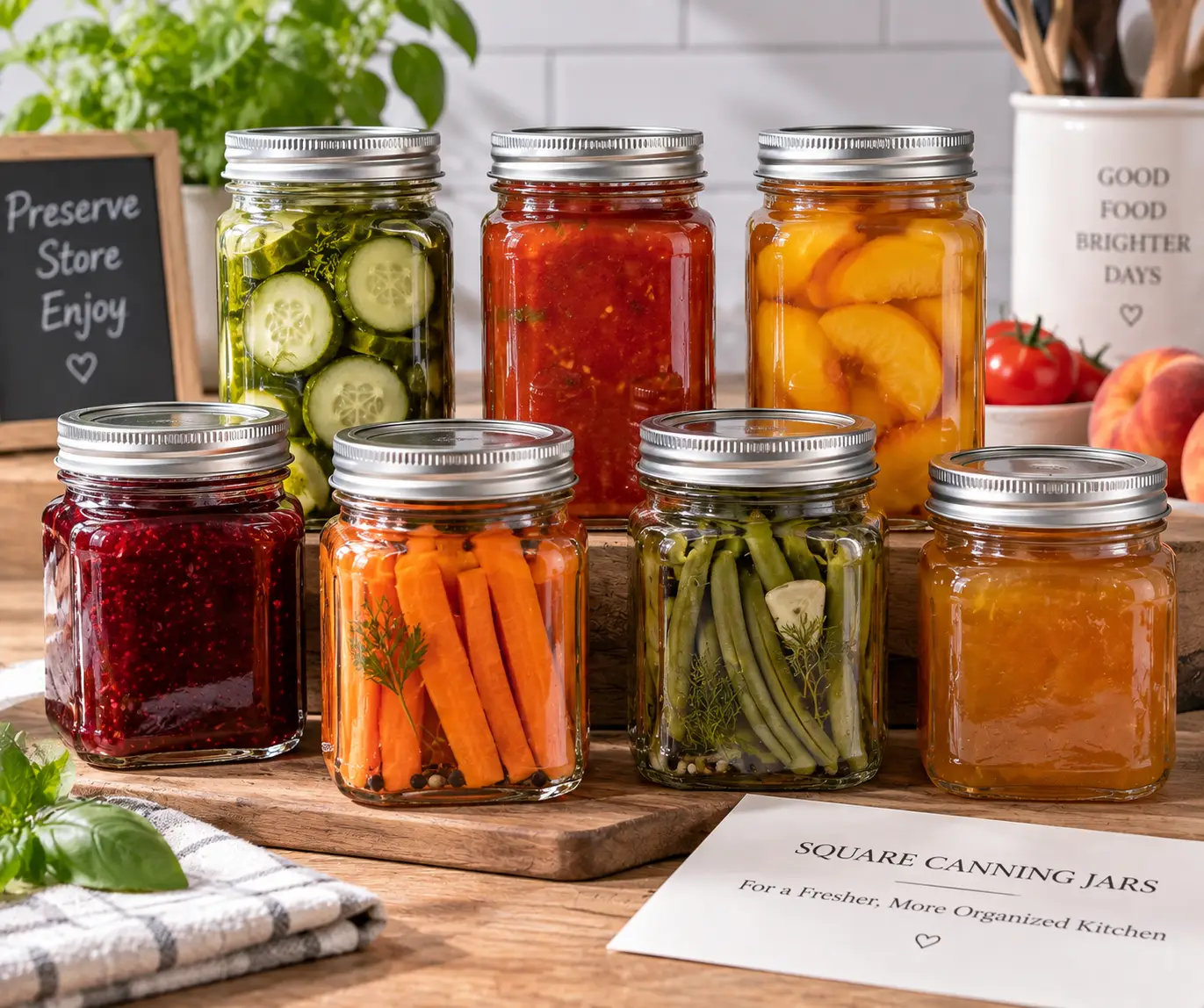
If you’ve ever tried to fit a shelf full of round mason jars into a cabinet, you already know the problem: round jars waste space. The gaps between curved sides add up fast, especially in a pantry that’s already tight on real estate. That’s the whole appeal of square canning jars — the flat sides sit flush against each other, they pack into boxes and shelves without wasted air, and they give you a wide, flat panel that’s actually easy to label. Whether you’re a weekend jam-maker, a market vendor packaging honey for sale, or someone who just wants a tidier-looking pantry, square canning jars solve a real, practical problem.
square canning jars aren’t a single product, though — the category spans tiny 6-ounce gift jars, classic “Mason”-embossed pint jars meant for actual water-bath processing, and European-style clip-top jars built more for storage and quick pickles than for USDA-tested preserving. Picking the wrong one for your use case is an easy mistake, and it’s one this guide is built to help you avoid.
Below, we’ve researched seven real square canning jars available in the US market, compared their construction, lid systems, and true canning suitability, and broken down what the National Center for Home Food Preservation actually recommends for safe home canning — because not every “square canning jar” on the market is rated for a boiling-water canner. By the end, you’ll know exactly which style fits your kitchen, your budget, and what you’re actually planning to preserve.
Disclosure: This post contains affiliate links. As an Amazon Associate, I earn from qualifying purchases made through these links, at no additional cost to you.
What Are Square Canning Jars?
Square canning jars are glass preserving jars with four flat sides instead of a traditional cylindrical body, designed to seal food for storage through water-bath or pressure canning, or simply to hold pantry staples and homemade gifts. Some are true “Mason”-style square jars built for a standard two-piece canning lid; others, like European clip-top jars, use a rubber gasket and hinge instead.
That distinction matters more than the shape itself. A jar can look like a classic canning jar and still not be rated for the pressure or thermal cycling that real home canning demands, so understanding which type you’re buying is the first real decision in this guide.
Quick Comparison: Square Canning Jars at a Glance
| Jar | Capacity | Style | True Canning Use | Best For |
|---|---|---|---|---|
| Nakpunar Square Glass Jars | 6 oz | Mini square, screw lid | Water-bath (small batch) | Gifts, honey, favors |
| North Mountain Supply Square Jars | 8 oz | Smooth square, regular mouth | Water-bath | Jams & jellies |
| Nakpunar Victorian Square Jar | 16 oz | Tapered square, regular mouth | Water-bath | Sauces, pantry storage |
| North Mountain Supply Mason Square Jars | 16 oz | Embossed square, regular mouth | Water-bath | Classic pint canning |
| Jucoan Square Mason Jars | 24 oz | Wide square, regular mouth | Water-bath | Salsa, pickles |
| Kilner Square Clip Top Jar | 33.8 oz (1L) | Swing-top, rubber gasket | Not USDA-tested | Quick pickles, pantry |
| Kilner Square Clip Top Jar | 67.75 oz (2L) | Swing-top, rubber gasket | Not USDA-tested | Bulk dry storage |
Looking at the table, the split between the five North Mountain Supply, Nakpunar, and Jucoan jars and the two Kilner jars is really a split between two different jobs. The threaded square jars are built to pair with standard two-piece metal lids that the USDA has actually tested for a vacuum seal, while the Kilner jars use a European clip-and-gasket system that’s better suited to refrigerator storage, quick refrigerator pickles, or dry pantry goods than to a boiling-water canner. If shelf-stable, long-term preserving is your goal, lean toward the threaded jars; if you mostly want attractive, airtight storage for things you’ll eat within weeks, the clip-tops earn their keep.
💬 Ready to start stocking your pantry? Tap a jar above to check current availability and pricing on Amazon.
Top 7 Square Canning Jars: Expert Analysis
Here’s a closer look at each of the seven jars, based on real specs, real construction details, and honestly reported buyer sentiment.
1. Nakpunar Square Glass Jars — smallest footprint for gifting
The Nakpunar Square Glass Jars are built for exactly the moments when a full pint jar feels like overkill — wedding favors, tiny honey portions, or a single serving of jam to slip into a gift basket. At roughly 6 ounces each, they’re sized for single-use gifting rather than pantry stockpiling. Made from lead-free glass and sold in sets, these jars come with a metal lid, and because Nakpunar manufactures for the DIY and small-business crowd, the glass is consistent from jar to jar, which matters if you’re filling dozens by hand.
The distinguishing feature here is genuinely the size: this is one of the few square jars widely available in a true mini format, which most bulk-jar brands skip because it’s less profitable per case. Reviewers who use these for candle-making or spice storage consistently note the tight, consistent fit of the lids, though a few mention the glass is noticeably thinner than a standard Ball jar — expected, given the size, but worth knowing if you plan to process them in a rolling boil rather than just fill and refrigerate.
Reviews consistently report that the small size makes these more forgiving to fill neatly than larger jars, since there’s less room for spills. A common complaint is that the narrow opening makes packing anything chunkier than jam or honey a bit fiddly.
Pros:
- ✅ Compact size is ideal for gifts and favors
- ✅ Consistent lead-free glass quality across sets
- ✅ Square shape stacks and labels cleanly
Cons:
- ❌ Too small for real pantry-stocking canning
- ❌ Narrow mouth makes filling chunky foods awkward
At around $12–$20 for a set of six, the Nakpunar Square Glass Jars are priced like a craft-and-gifting product, not a bulk canning supply — and for that specific job, they deliver solid value.
2. North Mountain Supply 8 oz Square Jars — best entry point for jam-makers
The North Mountain Supply 8 oz Square Jars are what a lot of people picture when they hear “square canning jar for jelly.” At 8 ounces with a regular mouth opening, a height of about 3.13 inches, and a 3-inch outside diameter, they’re sized almost identically to a standard round half-pint jelly jar — just with flat sides. They ship in cases of 12 with safety-button metal lids, the same style of one-time-use lid the USDA recommends for a genuine vacuum seal.
What sets this jar apart is the “softened square” shape: the corners are gently rounded rather than sharp, which reduces stress points in the glass during the heating and cooling cycles of water-bath canning. Based on comparing the specs to boxier competitors, that detail is a meaningful one — sharper-cornered glass jars are more prone to stress cracks under thermal shock, so a jar explicitly designed with this in mind is a better bet for anyone actually processing jars in a canner rather than just displaying them.
Reviews consistently report clean, reliable seals when used with fresh lids and proper headspace, and buyers frequently mention the smooth, unembossed sides make labels sit flat instead of curling at the edges. A recurring critique is that the lids, like most one-time safety-button lids, should be replaced every canning season rather than reused.
Pros:
- ✅ Rounded corners reduce thermal stress cracking
- ✅ Smooth sides give labels a clean, flat surface
- ✅ Includes USDA-style safety-button lids
Cons:
- ❌ Lids are single-use, adding a recurring cost
- ❌ 8 oz size limits batch output per jar
Priced in the $15–$25 range for a case of 12, this is one of the more budget-friendly ways to get genuinely canning-rated square jars, and it’s a smart starter case for anyone testing whether they like the square format before committing to larger sizes.
3. Nakpunar Victorian Square Jar — best all-purpose mid-size option
The Nakpunar Victorian Square Jar steps up to 16 ounces while keeping the tapered-shoulder square silhouette that makes Nakpunar’s line easy to spot on a shelf. It’s built with smooth sides and softly rounded edges, and it’s sold with a choice of lid finish, which is a nice touch for anyone matching jars to a specific packaging look for gifting or resale.
The practical upside of the tapered shoulder is better headspace control: the gentle narrowing toward the neck helps hold contents down during processing, which matters more than people expect — insufficient headspace is one of the most common reasons a home-canned jar fails to seal. What most buyers overlook with this model is that the “square” shape here is really more of a rounded-square, which trades a little bit of the maximum shelf-packing density you’d get from a hard-cornered jar in exchange for a jar that photographs and displays a bit more elegantly — a fair trade if you’re selling product or giving jars as gifts.
Aggregated feedback on this style of jar tends to praise the fit and finish, describing it as sturdier than ultra-cheap import jars in the same price bracket, while a subset of buyers wish Nakpunar sold this exact size in larger bulk case counts.
Pros:
- ✅ Tapered shoulder helps with headspace control
- ✅ Attractive finish suited to gifting or resale
- ✅ Sturdier glass than many budget imports
Cons:
- ❌ Sold in smaller bulk counts than some competitors
- ❌ Rounded taper sacrifices some packing density
Typically priced between $20 and $35 depending on pack size, the Nakpunar Victorian Square Jar lands in the middle of this lineup — a reasonable pick for anyone who wants a step up in polish without jumping to a premium European jar.
4. North Mountain Supply 16 oz Mason Square Jars — most classic canning-ready square jar
If you want a square jar that reads as “real” canning equipment rather than a decorative container, the North Mountain Supply 16 oz Mason Square Jars are the strongest match in this lineup. The word “Mason” is embossed on all four shoulders, and graduation marks are debossed on two adjacent sides so you can actually measure contents without pulling out a separate cup. It uses the same 70-450 lid finish as most standard round pint jars, meaning it works with off-the-shelf two-piece metal lids and standard canning bands.
The embossing is a small but genuinely useful feature: the graduation marks let you eyeball how much sauce, jam, or pickled produce you’re filling without extra tools, something none of the smoother, label-first jars in this lineup offer. Based on comparing the specs, this jar is also explicitly rated by the manufacturer for both hot-fill and water-bath canning when paired with the right lid — a detail worth checking on any square jar before you commit to it for shelf-stable preserving, since not every square jar on the market makes that claim.
Reviews consistently report satisfaction with seal reliability and note the classic embossed look photographs well for farmers-market or Etsy-style product listings. A common critique is that the embossing, while functional, does reduce the clean labeling surface compared to the fully smooth jars elsewhere in this roundup.
Pros:
- ✅ Embossed graduation marks aid accurate filling
- ✅ Rated for hot-fill and water-bath canning
- ✅ Standard 70-450 finish fits common lids
Cons:
- ❌ Embossing reduces clean label space
- ❌ Slightly pricier than plain square jars of the same size
At roughly $20–$30 per case of 12, this jar earns its price by being one of the few in this list explicitly positioned by its maker as functional canning equipment, not just a stylish container.
5. Jucoan 24 oz Square Mason Jars — best for larger batches
Stepping up in volume, the Jucoan 24 oz Square Mason Jars are aimed at people canning in bigger batches — think chunky salsa, pickled vegetables, or tomato sauce made from a full garden harvest. At 3 x 3 x 6.4 inches with a 2.75-inch opening, this is a noticeably taller jar than the others on this list, and it comes with silver metal airtight caps rather than the two-piece band-and-lid combo some canners prefer.
The larger capacity is the obvious draw, but the real trade-off worth understanding is heat penetration. Larger jars take longer for heat to reach the center during processing, which the USDA’s own guidance accounts for by extending processing times for bigger jar sizes — so if you’re switching from an 8-ounce jar to this 24-ounce jar, don’t assume the same recipe timing applies. Here’s what to weigh: the convenience of fewer, bigger jars per batch has to be balanced against following the correct, longer processing time for the larger volume, or you risk an unsafe seal.
Aggregated customer sentiment describes the jars as sturdy and good value for the size, with the square shape earning specific praise for how well the finished jars stack in a fridge or pantry. A recurring critique is that the one-piece metal caps, while convenient, can be trickier to confirm a proper vacuum seal on compared to traditional two-piece lids with a separate popping button.
Pros:
- ✅ Larger 24 oz size suits bigger batches
- ✅ Square shape maximizes fridge and pantry space
- ✅ Sturdy glass construction at a fair price
Cons:
- ❌ Requires longer processing times than smaller jars
- ❌ One-piece caps make seal-checking less intuitive
Priced around $30–$45 for a 12-pack, this is a solid mid-range option for anyone whose canning habit has outgrown half-pint jars.
6. Kilner Square Clip Top Jar (1L) — best for European-style pickling and storage
The Kilner Square Clip Top Jar takes a completely different approach: instead of a threaded lid, it uses a hinged glass lid, a stainless-steel clip, and a replaceable rubber gasket, all made in England from BPA-free soda-lime glass with 30% recycled content. At 1 liter (about 33.8 ounces), it’s roomy enough for a batch of quick pickles or a chunk of pantry staples like pasta or rice.
This is where honesty about canning suitability really matters: clip-top jars like this are a European preserving tradition, and while they can be processed in a water bath for high-acid recipes in some traditions, they are not tested or endorsed by the USDA’s canning guidance the way threaded two-piece-lid jars are. The National Center for Home Food Preservation is specific about only recommending jars manufactured for home canning with the associated tested lid system — so treat this jar as excellent for refrigerator pickles, dry pantry storage, and short-term preserving, not as a substitute for a USDA-tested shelf-stable canning process.
Reviews consistently praise the elegant look and the satisfying mechanical “clip” seal, and many buyers specifically like that a broken gasket is cheap and easy to replace rather than needing a whole new jar. A common complaint is that the seal, while airtight for storage, isn’t rated for the same shelf-stable canning use as a traditional Mason-style jar — echoing the caution above.
Pros:
- ✅ Elegant, reusable hinge-and-clip design
- ✅ Replaceable gasket extends the jar’s life
- ✅ Great for dry pantry storage and quick pickles
Cons:
- ❌ Not tested or rated for USDA shelf-stable canning
- ❌ Pricier per jar than threaded Mason-style options
Typically priced around $12–$18 per jar, the Kilner Square Clip Top Jar is less a canning jar in the strict USDA sense and more a premium, reusable storage-and-quick-preserving jar — know that going in, and it’s genuinely excellent at that job.
7. Kilner Square Clip Top Jar (2L) — best for bulk pantry and dry-goods storage
The larger sibling in Kilner’s square lineup, this 2-liter (about 67.75-ounce) jar uses the same hinged clip-and-gasket system, just scaled up for serious pantry storage — think flour, rice, pasta, or a big batch of preserved vegetables meant for the fridge rather than the pantry shelf.
The distinguishing benefit at this size is less about canning and more about consolidation: swapping five or six small containers for one large, airtight, stackable square jar genuinely declutters a pantry shelf, and the square shape means two or three of these can sit side by side without the wasted gaps you’d get from round jars this size. What the spec sheet doesn’t say, but the shape makes obvious, is that a jar this large is heavy once filled — factor that into where you plan to store it, since lifting a full 2-liter glass jar off a high shelf isn’t something you want to do one-handed.
Aggregated reviews highlight the jar’s usefulness for bulk dry goods and its ability to keep pantry staples fresher longer thanks to the gasket seal, with several buyers specifically mentioning it keeps pasta and flour free of pantry moths compared to the original packaging. A common critique is the price per jar, which is noticeably higher than a comparable round storage container of the same capacity.
Pros:
- ✅ Large capacity consolidates pantry storage
- ✅ Airtight seal helps deter pantry pests
- ✅ Square shape saves real shelf space at scale
Cons:
- ❌ Heavy and awkward to handle fully filled
- ❌ Premium price compared to round storage jars
Expect to pay somewhere in the $20–$30 range for this jar, and while that’s more than a basic plastic bin, the combination of an airtight seal and genuine space efficiency makes it a reasonable investment for anyone serious about pantry organization.
Get Started the Right Way: A Practical First-Batch Guide
Buying the jars is the easy part — using them correctly the first time is where most new canners run into trouble. Here’s a straightforward path through your first few batches.
Inspect before you fill. Every jar, square or round, should be checked for chips or hairline cracks around the rim before use, since even a tiny nick can prevent a proper seal. Run a finger around the opening; you’ll feel a flaw before you see it.
Match your jar to your lid system. Threaded square jars like the North Mountain Supply and Jucoan options need fresh, single-use metal lids each canning session — don’t reuse a lid that’s already been popped. Clip-top jars like the Kilner need their rubber gasket checked for cracks or stiffness before every use, since a worn gasket is the most common cause of a failed seal on that style.
Respect headspace. Overfilling is one of the single biggest causes of seal failure across every jar style in this guide. Most half-pint and pint recipes call for around ¼ to ½ inch of headspace; check your specific recipe rather than guessing.
Process for the right time, at the right size. As noted with the larger Jucoan jars above, bigger jars need longer processing times to heat through completely. Never shortcut a tested recipe’s timing just because the food looks done.
Cool undisturbed. Once jars come out of the canner, let them sit untouched for 12–24 hours. You’ll hear the satisfying “ping” of lids sealing during this window — don’t press down on lids to test them before they’ve had time to cool naturally, as that can actually cause a false seal.
✨ Stock up on the right jars before your next canning session — check current pricing and availability now!
Real-World Scenarios: Matching the Jar to the Job
Not every home canner has the same goals, so here’s how three common buyer profiles tend to land.
The weekend jam-maker with a small kitchen. If you’re making a few batches of jam a season and storing them in a cabinet that’s already crowded, the North Mountain Supply 8 oz Square Jars or the Nakpunar Victorian Square Jar hit the sweet spot — canning-rated, space-efficient, and sized for realistic small-batch output without committing to cases of jars you might not fill.
The market vendor selling homemade honey or preserves. For anyone packaging product to sell, presentation matters almost as much as function. The Nakpunar Square Glass Jars for small gift sizes and the embossed North Mountain Supply 16 oz Mason Square Jars for standard retail sizes both photograph well and give a consistent, professional look across a product line — a meaningful factor when customers are comparing jars sitting side by side on a table.
The bulk pantry organizer who rarely cans but loves tidy storage. If actual shelf-stable canning isn’t the priority and the goal is decluttering a pantry full of half-used bags and boxes, the Kilner Square Clip Top Jars in both sizes are the better fit — the airtight gasket keeps dry goods fresher and pest-free, and the stackable square shape does more for a cluttered shelf than any canning-rated jar in this list.
Square Canning Jars vs. Round Mason Jars
The most obvious difference is shelf efficiency: square jars pack edge-to-edge with essentially no wasted space, while round jars leave curved gaps between every neighbor — Ball’s own product pages note this is one of the main selling points of their square-format lines. Over a full pantry shelf, that difference can mean fitting several extra jars in the same footprint.
But round jars still win in a few specific ways. Round Mason jars from major US brands come in a far wider range of sizes, from 4-ounce jelly jars up through half-gallon jars, and their curved shape distributes the stress of thermal expansion more evenly during processing, which is part of why round jars remain the default recommendation in most USDA-tested recipes. Round jars are also simply more common, meaning replacement lids, bands, and accessories like jar lifters and funnels are easier to find in a pinch.
| Factor | Square Jars | Round Jars |
|---|---|---|
| Shelf/pantry space efficiency | Excellent | Good |
| Size range available | Moderate | Very wide |
| Thermal stress resistance | Good (varies by brand) | Excellent |
| Accessory/lid availability | Good | Excellent |
| Best for | Space-limited kitchens, gifting | High-volume, varied canning |
The table above makes the trade-off pretty clear: if pantry real estate is your biggest constraint, square jars like the North Mountain Supply and Jucoan options are worth the switch. If you’re canning in large volumes across many different recipe types and want maximum flexibility in sizing and accessories, round jars are still the safer default. Plenty of experienced canners end up using both — square for gifting and small-batch jams, round for the bulk of their seasonal harvest.
Common Mistakes to Avoid When Buying Square Canning Jars
Assuming “square” always means “canning-safe.” As covered above with the Kilner jars, not every attractive square jar is rated for a boiling-water canner. Always check whether the manufacturer specifically states the jar is designed for canning, not just food storage.
Buying the wrong lid finish. Square jars aren’t universally standardized the way round Mason jars are; a 70-450 finish jar won’t accept a lid built for a different thread size. Double-check the finish specification before assuming a lid you already own will fit.
Underestimating processing time for larger jars. As mentioned with the 24-ounce Jucoan jars, bigger jars need longer time in the canner. Buying larger jars without adjusting your process is a genuine food-safety risk, not just an inconvenience.
Ignoring corner stress. Sharp-cornered square jars are more prone to stress cracking during rapid temperature changes than rounded-corner designs like the North Mountain Supply jars. If you’re processing jars regularly rather than just storing dry goods, corner design is worth checking.
Skipping a test batch. Before committing to a full case for a big canning weekend, run one or two jars through a complete cycle first — fill, process, cool, and check the seal — to confirm the lid system and jar work well together in your specific kitchen setup.
Square Canning Jars for Small-Batch and Gift-Focused Preservers
If your canning habit leans more toward gifting than stockpiling — holiday jam baskets, wedding favors, or the occasional honey jar for a neighbor — square jars have a genuine edge over round ones beyond just space efficiency. The flat sides give handwritten or printed labels a clean, uncurved surface to sit on, and jars like the Nakpunar Square Glass Jars are specifically sized for single servings rather than bulk storage.
For this audience, the calculus around canning-safety matters a little differently, too. A lot of gift jars are filled with jam or preserves meant to be refrigerated and eaten within weeks rather than stored shelf-stable for a year, which means a jar that isn’t strictly USDA-tested for long-term canning — like the smaller Kilner jar — can still be a perfectly reasonable choice, provided the giver is honest with the recipient about how the contents should be stored.
Safety, Regulations, and Standards
Home canning safety in the US is governed less by a single federal regulation on jars themselves and more by tested, research-based processes from institutions like the USDA and land-grant university extension programs. The National Center for Home Food Preservation, hosted by the University of Georgia, is the standard reference most extension offices point to, and it specifically recommends jars manufactured for home canning, used with lids designed and tested for that jar’s finish — a detail that rules out reusing commercial food jars (like mayonnaise jars) for pressure canning, since their thinner glass isn’t built for that stress.
It’s also worth knowing that jar failures aren’t purely theoretical. The Consumer Product Safety Commission has recalled canning jars in the past due to glass fragments found inside jars posing a laceration hazard — a good reminder to inspect every jar, square or round, before filling it, and to buy from established brands with quality-control reputations rather than the cheapest unbranded listing available.
For anyone using clip-top or gasket-sealed square jars, it’s worth understanding that this style has a long documented history in European home preserving, going back over a century — but that tradition developed alongside its own set of tested recipes and practices that don’t map one-to-one onto USDA guidance. When in doubt about whether a specific jar and recipe combination is shelf-stable safe, defaulting to a USDA-tested jar-and-lid system is the lower-risk choice.
Long-Term Cost and Maintenance
The sticker price on a case of jars is only part of the real cost of canning. Threaded jars like the North Mountain Supply and Jucoan options need a fresh metal lid every time you can a new batch — lids typically run a few dollars for a dozen, so budget for that as an ongoing cost, not a one-time purchase. The jars themselves, if handled carefully, can be reused for years; the glass doesn’t wear out, it just needs periodic inspection for chips.
Clip-top jars like the Kilner models flip that equation: there’s no annual lid cost, but the rubber gasket does wear out over one to several years depending on use, and replacements need to be bought separately, usually in small multi-packs.
| Jar Type | Upfront Cost | Recurring Cost | Jar Lifespan |
|---|---|---|---|
| Threaded square (Mason-style) | Lower per jar | New lid every use | Many years (glass) |
| Clip-top (Kilner-style) | Higher per jar | Occasional gasket replacement | Many years (glass + gasket) |
Looking at the numbers, threaded jars have a lower barrier to entry but a small recurring cost baked into every canning session, while clip-top jars front-load the cost into the jar itself and then cost very little to maintain afterward. For someone who cans several times a season, the lid costs on threaded jars add up modestly over a decade; for someone who mostly uses jars for storage rather than repeated processing, the clip-top’s near-zero recurring cost can work out cheaper long term.
💬 Found your favorite jar in this guide? Grab it now while today’s pricing is available!
Features That Actually Matter (and Ones That Don’t)
Actually matters: the lid system and whether it’s rated for canning, the glass thickness and corner design relative to thermal stress, and the exact mouth/finish size so replacement lids are easy to source. These directly affect whether your food seals safely and whether you can keep using the jar for years.
Doesn’t matter much: decorative embossing beyond basic graduation marks, and minor color tints in the glass, which have no meaningful effect on food safety or shelf life for jars intended for opaque or refrigerated contents. Marketing language like “heirloom quality” or “vintage-inspired” is worth ignoring in favor of checking the actual lid-finish spec and canning rating.
FAQs
❓ Are square canning jars safe for water bath canning?
❓ Do square canning jars save space compared to round jars?
❓ What size square canning jars should I buy for jam?
❓ Can I reuse the lids on square canning jars?
❓ Where can I buy square canning jars with lids?
Conclusion
Square canning jars aren’t a gimmick — the space savings are real, and for anyone working with a tight pantry or cabinet, that alone can be worth the switch. But the category covers more ground than it first appears: threaded, USDA-friendly jars like the North Mountain Supply and Jucoan options are built for genuine shelf-stable canning, mid-range picks like the Nakpunar Victorian Square Jar split the difference between function and presentation, and premium clip-top jars like the Kilner Square Clip Top Jar are better understood as excellent storage and quick-preserving containers rather than true canning replacements.
The right pick really does come down to what you’re actually doing with the jar. If you’re processing food for long-term shelf storage, stick with a threaded jar and a tested USDA lid system. If you’re gifting small batches, the smaller Nakpunar options shine. And if space-saving pantry storage is the real goal, the Kilner jars deliver an elegant, airtight solution that just happens to also be excellent for the occasional batch of refrigerator pickles.
Whatever you choose, the fundamentals stay the same: inspect your jars, respect your headspace, and match your processing time to your jar size — the shape of the glass is the easy part.
Recommended for You
- 7 Best Square Food Containers for 2026: Smarter Storage, Less Wasted Space
- Small Dipping Bowls: 7 Best Picks for 2026 (Ceramic vs Glass)
- 7 Best Potato Container Picks for 2026 (Stop Sprouting Fast)
Disclaimer: This post contains affiliate links. As an Amazon Associate, I earn from qualifying purchases made through these links, at no additional cost to you.
✨ Found this article helpful? Share it with someone who needs it! 💬🤗