
In This Article
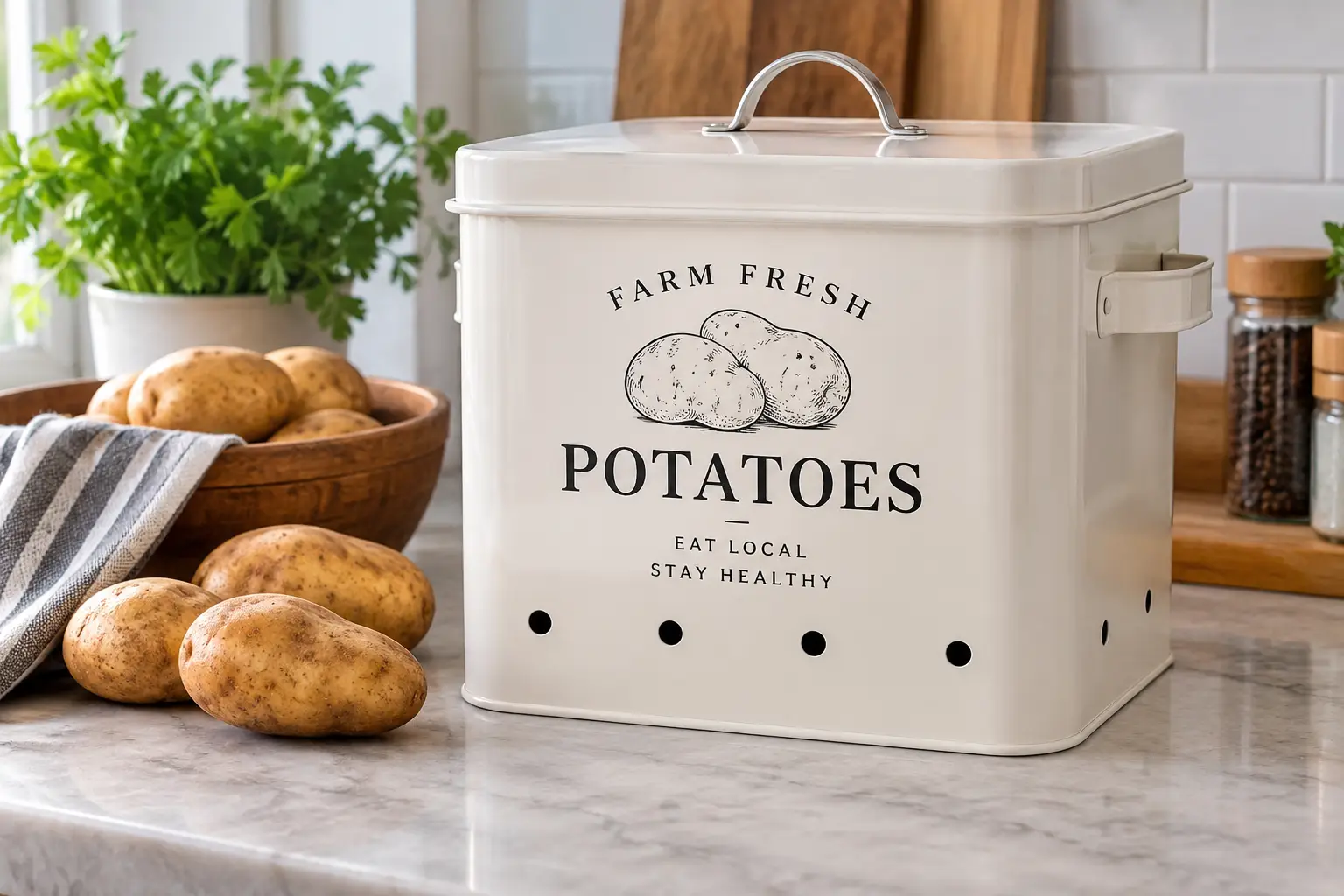
A potato container is a ventilated, opaque storage bin or basket designed to hold loose potatoes away from light, moisture, and heat, slowing sprouting and greening so the tubers stay firm longer. If you’ve ever pulled a bag of potatoes out of the pantry only to find them soft, sprouting little green shoots, or turning an unappetizing shade of khaki, you already know why this matters. The right potato container isn’t a luxury — it’s the difference between actually using the ten-pound bag you bought on sale and tossing half of it in the trash three weeks later.
Here’s the thing most people don’t realize: potatoes are still alive after harvest. According to University of Idaho Extension research on home potato storage, tubers keep using oxygen and releasing carbon dioxide long after they’re pulled from the ground, which is exactly why they need fresh air during storage. A sealed plastic bag or an airtight bin basically suffocates them, trapping moisture and accelerating rot. That’s exactly the problem the seven potato containers below are built to solve, each in a slightly different way depending on your kitchen, your budget, and how many pounds of potatoes you actually buy at once.
Below, we’ve broken down seven real, purchasable options — from a $20 wire basket to a $70-plus rolling storage cart — based on their construction, ventilation design, and what real buyers report after weeks and months of use. We’ll also walk through how to actually set one up, common storage mistakes, and how a dedicated container stacks up against just tossing potatoes in a cupboard.
Quick Comparison: Potato Container Options at a Glance
| Container | Material | Approx. Capacity | Price Range | Best For |
|---|---|---|---|---|
| ZICOTO Potato and Onion Storage Set | Powder-coated metal | ~9–10 lbs | Around $35–$45 | Countertop style + function |
| HOMESTEAD Bamboo Stackable Bins | Solid wood/bamboo | ~22 lbs (3-bin set) | Around $40–$50 | Eco-conscious, larger households |
| Progressive Prepworks ProKeeper+ Produce Container | BPA-free plastic | 5.7 quarts | Around $20–$28 | Fridge or small-batch storage |
| Pethiy Potato Onion Storage Bin (Set of 2) | Powder-coated steel | ~6.4 lbs | Around $25–$32 | Budget-friendly with retro looks |
| IRIS USA Wire Basket for Pantry (2-Pack) | Steel wire + wood lid | ~15–20 lbs per basket | Around $19–$28 | Tight budgets, easy assembly |
| Packism 4-Tier Rolling Vegetable Cart | Metal wire + casters | 20+ lbs total | Around $60–$80 | Bulk buyers, small kitchens |
| GGIU Stackable Wire Storage Basket | Carbon steel + wood lid | ~10–12 lbs | Around $20–$30 | Renters, apartment pantries |
Looking at the table, the split comes down to budget versus volume: the IRIS USA Wire Basket and GGIU Stackable Wire Storage Basket win on price, but the HOMESTEAD Bamboo Stackable Bins and Packism 4-Tier Rolling Vegetable Cart hold meaningfully more weight, which matters if you’re a family of five buying 10-pound bags weekly. Meanwhile, the Progressive Prepworks ProKeeper+ Produce Container is the outlier here — it’s the only one built primarily for refrigerator or countertop use with small quantities, not pantry-scale bulk storage. If you only ever buy a 2- to 3-pound bag at a time, it may be all you need; everyone else should lean toward the larger bins.
💬 One click helps other shoppers make an informed choice too! 😊
Top 7 Potato Containers: Expert Analysis
1. ZICOTO Beautiful Potato and Onion Storage Container Set — matching pair with real capacity
The ZICOTO set pairs a 10.1 x 7.5 x 7.2-inch potato bin with a slightly smaller 8.9 x 6.5 x 6.2-inch onion bin, and that dual-bin design is the whole point — it solves the storage problem most guides gloss over.
Both bins are made from powder-coated metal with built-in vent holes on the sides, which matters more than it sounds: metal doesn’t absorb odors or moisture the way untreated wood can, and the embossed detailing plus a wooden lid handle keep it from looking like a warehouse bin on your countertop. The potato side holds roughly 9-10 pounds, enough for about two weeks of cooking for a family of four.
Who is this for? Households that want potatoes and onions stored separately (which matters — more on that below) without dedicating a whole pantry shelf to two clunky containers. Based on comparing the specs against plastic alternatives, the powder-coated finish is also the more washable, longer-lasting option if you’re the type who wipes down containers regularly rather than replacing them.
Reviews consistently report that buyers appreciate the “farmhouse” aesthetic enough to leave it out on the counter rather than hiding it in a cabinet, and that the vent holes noticeably cut down on the musty smell that plastic bins can develop over time. A recurring comment in customer feedback is that the lid, while sturdy, doesn’t create a fully dust-proof seal — which is actually correct behavior for potato storage, even if it surprises first-time buyers expecting an airtight canister.
Pros:
- ✅ Separate onion and potato compartments prevent cross-spoilage
- ✅ Powder-coated metal resists odor and moisture buildup
- ✅ Attractive enough for open countertop display
Cons:
- ❌ Not fully dust-sealed, so debris can enter through vents
- ❌ Hand-wash only, which adds a small maintenance step
Expect to pay somewhere in the $35–$45 range at the time of writing, though prices may vary — check the current price before buying. For the design quality and the fact that you’re really getting two containers in one purchase, this is a solid value pick for anyone upgrading from a plastic grocery bag.
2. HOMESTEAD Bamboo Stackable Storage Bins (3-Pack) — best for sustainability-minded bulk buyers
The HOMESTEAD Bamboo Stackable Storage Bins ship as a set of three open-front baskets that interlock vertically, and the stacking system is the headline feature — you get roughly 22 pounds of combined capacity without needing three separate shelves.
The bins are constructed from solid wood or bamboo (depending on the specific listing), with slatted or open-front panels that let air circulate freely around the tubers. That open-front design means you don’t need to lift a lid to grab a potato, which sounds minor until you’re cooking dinner one-handed and appreciate not fumbling with a latch. The stacking legs also double as small feet, keeping the bottom bin slightly elevated off a cabinet floor for better airflow underneath.
What most buyers overlook with this model is that the open-front design, while great for ventilation, also means less light-blocking than a fully enclosed bin — so placement in a genuinely dark pantry corner (not a sunlit counter) still matters even with the “right” container. This is a great option for larger households or anyone who cooks with potatoes multiple times a week and doesn’t want to restock a small bin every few days.
Reviews consistently highlight the sturdiness of the material and the fact that the bins arrive needing no assembly — you simply stack them. A common thread in aggregated feedback is that buyers use the smallest bin for onions or garlic and the two larger ones for potatoes, effectively turning the 3-pack into a mini root-cellar system on a countertop or pantry shelf.
Pros:
- ✅ Roughly 22 lbs of combined stackable capacity
- ✅ Renewable bamboo/solid-wood construction, no plastic
- ✅ No assembly required, ready to use out of the box
Cons:
- ❌ Open-front design lets in more ambient light than a lidded bin
- ❌ Heavier and bulkier than wire or plastic alternatives
Pricing typically lands in the $40–$50 range for the set, which works out to a reasonable per-pound storage cost given the total capacity. If you buy potatoes in bulk from a farmers market or warehouse club, this is one of the better value-for-capacity picks on this list.
3. Progressive Prepworks ProKeeper+ Produce Storage Container (5.7-Quart) — best for small-batch or fridge storage
The Progressive Prepworks ProKeeper+ is a clear, BPA-free plastic container with a Stay-Fresh vent system built into the lid, and that vent system is genuinely different from the vent-hole approach used by the metal and wire options above — it’s a mechanical airflow valve rather than passive holes.
The container includes a grooved colander-style base that lets excess moisture drain away from the produce rather than pooling at the bottom, which is the feature that sets it apart for anyone storing pre-washed or slightly damp potatoes. Because it’s clear plastic, you can see at a glance when you’re running low, without opening the lid — useful for a container that’s more likely to live in a fridge crisper drawer or a countertop next to other prepped produce.
Here’s the honest trade-off: this isn’t sized for 10-pound bulk bags the way the wire baskets or bamboo bins are. At 5.7 quarts, it’s better suited to a few pounds of potatoes you plan to use within one to two weeks, or for households that buy small quantities frequently rather than stocking up. Reviews consistently report that the vent system does measurably slow down sogginess compared to a fully sealed container, though a common complaint in customer feedback is that the vent mechanism can trap small bits of dirt or peel if potatoes aren’t rinsed and dried first.
Pros:
- ✅ Dishwasher-safe, unlike most metal/wood potato bins
- ✅ Clear construction makes inventory checks fast
- ✅ Grooved base actively drains excess moisture
Cons:
- ❌ Capacity too small for bulk 10-lb bags
- ❌ Vent mechanism needs occasional cleaning to stay effective
At around $20–$28, this is one of the most affordable entries here, and it’s the only one genuinely designed to also work inside a refrigerator, which matters in hot, humid climates where pantry storage alone isn’t cool enough.
4. Pethiy Potato Onion Storage Bin (Set of 2) — best budget retro-style pick
The Pethiy bin set brings two powder-coated steel canisters with wooden lids, sized to hold about 6.4 pounds of potatoes and 4 pounds of onions respectively, and the retro tin aesthetic is the immediate draw for anyone who wants function without a “storage bin” look.
Each canister uses aerating holes stamped into the steel sides for airflow, paired with a solid wooden lid that blocks light almost completely when closed — a genuine advantage over open-front wood bins, since light exposure is what triggers the greening (and mild toxin buildup) that ruins potatoes. The vintage embossed graphics on the front are purely cosmetic, but they explain why this set shows up so often in farmhouse-style kitchen photos.
Based on comparing the specs against pricier metal sets like the ZICOTO above, the Pethiy set trades some capacity and material thickness for a noticeably lower price point, which makes it the more sensible pick for a one- or two-person household that isn’t buying potatoes ten pounds at a time.
Reviews consistently report that the set “looks more expensive than it is,” and a recurring theme in aggregated feedback is that the lids stack neatly when both bins are placed side by side, saving counter space. Some buyers note the steel is thinner than premium competitors, so it’s not the choice for anyone planning to toss it in a garage or basement where it might get knocked around.
Pros:
- ✅ Fully light-blocking wooden lids reduce greening risk
- ✅ Compact footprint fits small kitchens and apartments
- ✅ Noticeably lower price than comparable metal sets
Cons:
- ❌ Thinner steel than premium competitors
- ❌ Smaller capacity limits bulk buying
Expect a price in the $25–$32 range, making this one of the better entry points if you’re testing whether a dedicated potato container is even worth it before investing in a larger system.
5. IRIS USA Wire Basket for Pantry (2-Pack) — best for tight budgets
The IRIS USA Wire Basket ships as a 2-pack of snap-together steel wire baskets topped with natural wooden lids, and the tool-free assembly is the standout feature for anyone who wants something functional within minutes of opening the box.
Each basket is rated to hold up to 26 pounds per tier (52 pounds total per unit), and when two units are stacked, the manufacturer specs put combined capacity around 79 pounds — which is dramatically more than most buyers will ever need for potatoes alone, but useful if you’re also storing onions, squash, or canned goods in the same system. The open wire construction means airflow is essentially unrestricted, which is ideal for ventilation but does mean more visible light exposure unless the baskets sit in a genuinely dark pantry or cabinet.
What most buyers overlook with this model is that the fold-flat design, marketed as a storage convenience for the empty baskets, also means the wire gauge is thinner than a rigid welded basket — fine for potatoes, but not something you’d want to overload with canned goods stacked directly on the wire without the wooden lid distributing weight.
Reviews consistently praise the snap-together assembly and the “elegant” look of the natural wood lid against the black or gray wire, and a common thread in customer feedback is that the 2-pack price makes this one of the most cost-effective ways to get real bulk storage capacity, even if the individual baskets feel less substantial than heavier steel alternatives.
Pros:
- ✅ No-tool assembly in under a minute
- ✅ High rated weight capacity per basket
- ✅ Folds flat for compact storage when unused
Cons:
- ❌ Thinner wire gauge than premium welded baskets
- ❌ Open sides let in more light than a lidded bin
At roughly $19–$28 for the 2-pack (frequently discounted further), this is the entry point for anyone who wants dedicated potato storage without committing much budget to the experiment.
6. Packism 4-Tier Rolling Vegetable Storage Cart — best for bulk buyers and small kitchens
The Packism rolling cart is the largest-capacity option on this list, combining four stacked wire tiers with lockable caster wheels, and that mobility is the feature that sets it apart from every static bin above — you can roll a fully loaded cart out from under a counter, use what you need, and roll it back.
Each tier includes a protective mat to keep wire ridges from bruising potatoes, and the whole unit is designed to separate different produce by shelf — potatoes on one tier, onions on another, garlic and citrus higher up where ethylene sensitivity matters less. For anyone with a genuinely small kitchen and no dedicated pantry, the vertical, wheeled design solves a real space problem that fixed bins can’t: it tucks against a wall and rolls out only when needed.
Here’s what the spec sheet doesn’t say outright but reviews reveal: because it’s a four-tier open design, it’s not as effective at fully blocking light as a lidded bin, so it performs best in a closet, laundry room, or under-counter nook rather than a sunlit kitchen corner. For households buying 10- to 20-pound bags regularly — large families, or anyone who cooks for a crowd — the combined capacity across four tiers comfortably outpaces every other option here.
Reviews consistently report that the lockable wheels are a genuine upgrade over fixed rolling carts, preventing the frustrating drift that happens when you’re trying to grab something off a top shelf. A recurring complaint in aggregated feedback involves assembly time, since more tiers naturally means more parts to put together compared to a simple stackable basket.
Pros:
- ✅ Largest combined capacity of any option here
- ✅ Lockable wheels add real mobility without drift
- ✅ Separate tiers keep ethylene-sensitive produce apart
Cons:
- ❌ Longer assembly time than single-tier bins
- ❌ Open tiers need a dark room placement to block light
Pricing generally falls in the $60–$80 range, which is the highest on this list, but per pound of storage capacity it’s competitive — and for anyone currently juggling multiple mismatched bins, consolidating into one rolling cart may actually save counter and floor space overall.
7. GGIU Stackable Wire Storage Basket — best lightweight apartment pick
The GGIU basket combines a carbon-steel wire body with a thick natural-wood lid and a pre-installed buckle system, and that buckle is the detail worth highlighting — it lets you connect stacked units in about ten seconds without tools, faster than most competitors in this wire-basket category.
The lid alone is rated for meaningful load-bearing capacity, meaning you can safely stack a second basket (or other pantry items) directly on top without the wood flexing or cracking. Non-slip feet on the base grip into the gaps of the lid below when stacked, which reduces the sliding-and-shifting problem that plagues cheaper wire baskets when a cabinet door swings open.
This is a strong fit for renters, apartment dwellers, or anyone furnishing a first kitchen who wants ventilated storage without spending on the larger bamboo or rolling-cart options above. The matte powder-coated finish on the wire is also worth calling out: it’s specifically treated to resist rust and deformation, addressing the most common long-term complaint about cheap wire storage — sagging or rusting after a few months of humidity exposure.
Reviews consistently report satisfaction with the quick setup and the basket’s compact footprint on a countertop or cabinet shelf, and a common theme in aggregated feedback is that buyers appreciate being able to see the potatoes through the wire sides without fully exposing them to light, since the coloring of the wire itself provides some shade. Some buyers do note the single-basket capacity is modest, better suited to a household of one or two than a large family.
Pros:
- ✅ Ten-second buckle assembly, no tools needed
- ✅ Rust-resistant matte powder coating on the wire
- ✅ Compact footprint fits apartment kitchens well
Cons:
- ❌ Modest single-basket capacity for larger households
- ❌ Wire sides offer less light-blocking than solid lids
Typical pricing runs around $20–$30 per basket or set, depending on the pack size selected at checkout — check the current price, as multi-packs occasionally see promotional pricing.
Comparing the Top 7: Feature and Price Breakdown
| Container | Ventilation Style | Assembly | Ideal Household Size |
|---|---|---|---|
| ZICOTO Storage Set | Side vent holes | None | 3–4 people |
| HOMESTEAD Bamboo Bins | Open-front slats | None | 4+ people |
| Progressive ProKeeper+ | Mechanical vent valve | None | 1–2 people |
| Pethiy Storage Bin | Stamped aerating holes | None | 1–2 people |
| IRIS USA Wire Basket | Open wire | Snap-together | 3–5 people |
| Packism Rolling Cart | Open wire tiers | Multi-part | 5+ people |
| GGIU Wire Basket | Open wire | Buckle-connect | 1–3 people |
The pattern that jumps out here is that ventilation style tracks almost exactly with light exposure — the more open a design is (wire baskets, open-front bamboo), the better the airflow but the more you need to compensate with a genuinely dark storage location. Assembly time correlates with capacity too: the Packism Rolling Vegetable Cart takes the longest to put together but rewards that effort with the most storage per dollar for larger households, while single-canister options like Pethiy and Progressive Prepworks ProKeeper+ are ready in seconds but cap out fast if you’re feeding more than two people.
Advantages Over Traditional Potato Storage
| Traditional Method | Typical Shelf Life | Main Failure Point |
|---|---|---|
| Plastic grocery bag | 1–2 weeks | Traps moisture, accelerates rot |
| Open bowl on counter | 1–2 weeks | Light exposure causes greening |
| Refrigerator crisper | Weeks, but alters starch | Cold converts starch to sugar |
| Dedicated potato container | 4–8+ weeks | Requires cool, dark placement |
A dedicated container outperforms these traditional methods largely because it solves the ventilation and light problems simultaneously, rather than trading one for the other. Refrigeration technically extends how long a potato stays firm, but it does so at the cost of flavor and texture, since cold storage converts starch into sugar and can leave potatoes with a noticeably sweeter, sometimes grittier result when cooked. A properly ventilated container placed in the right spot sidesteps that trade-off entirely.
💬 One click helps other shoppers make an informed choice too! 😊
How to Set Up Your Potato Container the Right Way (First 30 Days)
Getting a new potato container isn’t just “put potatoes in, close lid.” The first month is when most people make mistakes that undercut the container’s entire purpose, so here’s the practical sequence worth following.
Start by choosing placement before you even unbox the container: a cabinet, pantry corner, or closet that stays consistently cool and gets minimal light is far more important than the container itself. Wipe down the interior with a dry cloth before first use, since manufacturing dust or packaging residue can otherwise trap moisture against the first batch of potatoes. When you load it, resist the urge to wash the potatoes first — dirt-on potatoes actually store better than scrubbed ones, since washing removes a natural protective layer and introduces surface moisture that speeds spoilage.
During the first two weeks, check the container every few days rather than assuming it’s maintenance-free; this is when you’ll catch a bruised or damaged potato before it spreads rot to its neighbors. One common early mistake is loading a brand-new bag directly on top of older potatoes already in the bin — always rotate so older stock gets used first, and keep a small gap for airflow rather than packing the container to capacity. By day 30, you should have a feel for how fast your household goes through a full load, which tells you whether you sized the container correctly or need to size up or down for future purchases.
Real Households, Real Potato Storage: Three Scenarios
If you’re a single-person household or a couple who cooks a few times a week, something compact like the Pethiy Potato Onion Storage Bin or a single GGIU Stackable Wire Storage Basket makes more sense than a bulk container that will sit half-empty and take up unnecessary counter space; buying a smaller 3- to 5-pound bag more frequently also means less risk of forgotten, sprouting potatoes in the back of a large bin.
If you’re a family of four to five cooking dinner most nights, the ZICOTO Beautiful Potato and Onion Storage Container Set or the IRIS USA Wire Basket 2-pack hits the sweet spot — enough capacity for a weekly 10-pound bag with some buffer, without needing a rolling cart’s footprint. Budget-conscious families in this bracket should lean toward the IRIS USA option specifically, since the price-per-pound of capacity is hard to beat.
If you’re feeding a large household, meal-prepping in bulk, or simply buying potatoes from a warehouse club in 15- to 20-pound sacks, the Packism 4-Tier Rolling Vegetable Storage Cart or the HOMESTEAD Bamboo Stackable Storage Bins are the only two options on this list built for that volume without needing multiple separate bins scattered around the kitchen.
Potato Storage Problems, Solved
If your potatoes keep sprouting within a week or two of buying them, the most common cause is light exposure rather than a container failure — move the bin to a genuinely dark cabinet, closet, or pantry corner rather than an open counter, even if the container itself blocks some light.
If you’re noticing a musty or earthy smell building up in the container over time, it’s almost always trapped moisture from unwashed dirt combined with insufficient airflow — switch to a more open-vent design like a wire basket, and make sure the container isn’t sitting flush against a cabinet wall that blocks air circulation on one side.
If potatoes are turning green on the surface, that’s chlorophyll developing from light exposure. Per horticultural extension guidance, that green color is harmless on its own, but it often signals a buildup of solanine, a naturally occurring compound in the potato plant, and any potato showing significant greening should simply be discarded rather than cooked. You can read more about solanine’s chemistry on Wikipedia’s overview of the compound.
If you’re seeing rapid softening or shriveling, that typically means the storage spot is too warm and too dry — most home kitchens run 65-75°F, which is well above the ideal window, so relocating to an unheated closet, basement, or insulated garage often solves it without buying a new container at all.
If onions and potatoes stored together seem to be spoiling faster than expected, separate them — onions release ethylene gas that accelerates potato sprouting, which is exactly why containers like the ZICOTO and Pethiy sets build in distinct compartments rather than one shared bin.
✨ Don’t miss these exclusive deals!
🔍 Take your kitchen storage to the next level with this carefully curated lineup. Click a highlighted item to check current pricing and availability. These picks will help you keep fresh potatoes on hand all season long!
How to Choose a Potato Container
- Start with your typical purchase volume. If you consistently buy 10-plus pounds at a time, prioritize the HOMESTEAD Bamboo Stackable Storage Bins or Packism 4-Tier Rolling Vegetable Storage Cart over smaller canisters.
- Check the ventilation style, not just the presence of vents. Passive holes (like on the ZICOTO and Pethiy sets) work differently than open wire or a mechanical vent valve like the Progressive Prepworks ProKeeper+ — match the style to how much light control you can provide separately.
- Confirm the material fits your maintenance tolerance. Metal and plastic wipe clean quickly; bamboo and untreated wood need to stay fully dry to avoid warping over months of use.
- Measure your storage spot before ordering. A rolling cart needs floor clearance a stackable basket doesn’t, and cabinet shelf height can rule out taller bins entirely.
- Decide whether you need separate onion storage. Combined sets save space but only work if you’ll actually use both compartments as intended.
- Factor in assembly time realistically. If you want something functional in under a minute, skip multi-tier carts in favor of snap-together wire baskets.
- Set a price ceiling based on how experimental you want to be. First-time buyers testing whether dedicated storage is worth it should start around the $20–$30 range before committing to premium options.
Common Mistakes to Avoid When Buying a Potato Container
The single most common mistake is buying based on appearance alone — a beautiful farmhouse-style bin does nothing if it sits on a sunlit counter, since light exposure undoes most of the storage benefit regardless of how well-built the container is. A close second is underestimating capacity needs: buyers frequently choose a compact, attractive option like the Pethiy set for a household that actually needs the volume of the IRIS USA Wire Basket or Packism cart, then end up overflow-storing extra potatoes in a plastic bag anyway, defeating the purpose.
Another frequent misstep is ignoring maintenance requirements before buying — a hand-wash-only metal bin like the ZICOTO set is a fine trade-off for its looks and odor resistance, but it’s a poor fit for someone who wants to toss storage containers in the dishwasher without a second thought. Finally, many buyers skip checking whether a container is rated to separate potatoes from onions and end up storing both together in a single-compartment bin, which — as covered above — actively shortens both items’ shelf life due to ethylene gas exposure.
Potato Container vs. Traditional Root Cellar Storage
A dedicated potato container is essentially a compact, indoor stand-in for what a root cellar accomplishes at scale, and understanding the comparison helps set realistic expectations. Traditional root cellars rely on consistent underground temperatures — typically in the 40-50°F range — combined with high humidity and complete darkness. Under those ideal conditions, extension research indicates mature, late-season potato varieties can stay in good condition for seven to eight months. Most home containers can’t fully replicate that range indoors, since the typical home runs 65-75°F, well above a potato’s ideal storage window of roughly 42-50°F.
What a good container can replicate is the ventilation and darkness piece of the equation, even without root-cellar temperatures — and that’s still enough to meaningfully outperform a countertop bowl or plastic bag. For apartment dwellers or anyone without basement or garage access, placing a container like the GGIU Stackable Wire Storage Basket in the coolest interior closet available gets you most of the practical benefit without needing an actual cellar. If you do have access to an unheated garage, basement, or three-season porch, moving a bulkier option like the HOMESTEAD Bamboo Stackable Storage Bins there in colder months can meaningfully extend results closer to true root-cellar performance.
What to Expect: Everyday Performance
In day-to-day use, the difference a proper container makes usually isn’t dramatic in week one — it shows up in week three and beyond, which is exactly when unprotected potatoes typically start sprouting. Expect a well-placed, well-ventilated container to keep russets and yellow potatoes firm and sprout-free for roughly four to eight weeks, depending on the variety and how consistently cool and dark the storage spot stays.
Day-to-day, the biggest practical difference between the options above comes down to access convenience. Lidded bins like Pethiy and ZICOTO require lifting a lid every time, which is a minor friction point during meal prep but helps block light more completely. Open designs like the IRIS USA Wire Basket and Packism cart let you grab a potato without breaking stride, at the cost of needing a darker placement to compensate. Neither approach is objectively better — it’s a genuine trade-off between convenience and light control that comes down to where in your home the container will actually live.
Long-Term Cost and Maintenance
Thinking beyond the sticker price, the real cost comparison is between a one-time container purchase and the recurring cost of wasted potatoes from poor storage. If a household throws away even one pound of spoiled potatoes every couple of weeks — a realistic scenario with bag-only storage — that waste adds up to meaningfully more over a year than what any container on this list costs upfront.
Maintenance costs are low across the board but not zero. Hand-wash-only metal and wood options like the ZICOTO, HOMESTEAD, and Pethiy picks require occasional wiping down with a dry or barely damp cloth (never soaking, which can warp wood or trigger rust on metal), roughly once a month with regular use. Wire baskets like IRIS USA and GGIU need even less — an occasional wipe and a visual check for rust spots on the wire, which the powder-coated finishes on both largely prevent. The Progressive Prepworks ProKeeper+ is the only dishwasher-safe option here, making it the lowest-maintenance choice if that convenience matters more to you than bulk capacity.
Features That Actually Matter (and Ones That Don’t)
Ventilation quality matters more than almost any other spec — whether it’s passive holes, open wire, or a mechanical valve, airflow is the single biggest factor in preventing rot. Light-blocking, whether through a solid lid or an opaque material, matters nearly as much, since it’s the primary defense against greening and sprouting. Capacity sized to your actual buying habits matters practically, even though it’s the easiest spec to get wrong by either over- or under-buying.
What matters far less than marketing copy suggests: decorative embossing, color options, and “farmhouse aesthetic” branding, all of which affect how a container looks on your counter but do nothing for shelf life. Stackability is a genuine convenience feature but isn’t essential if you have adequate flat shelf or cabinet space already. And while dishwasher-safe construction is a nice-to-have, hand-washing a container once a month is a minor enough task that it shouldn’t be a dealbreaker if a bamboo or metal option otherwise fits your needs better.
Safety, Regulations, and Standards
Food-contact plastic containers sold in the US, including options like the Progressive Prepworks ProKeeper+, are expected to meet FDA food-contact material standards, and BPA-free labeling — which several products on this list carry — reflects a widely adopted industry response to consumer health concerns about that specific chemical in food storage plastics. Metal containers with powder-coated finishes, like the ZICOTO and Pethiy sets, use coatings formulated to be food-safe on contact, which is standard practice for kitchen storage products in this category.
Beyond the container material itself, the bigger safety consideration is what’s inside it: as covered earlier, greening potatoes signal solanine buildup, and agricultural extension guidance is consistent on this point — discard any potato showing excessive greening rather than simply cutting the green portion away. On the transparency side, the FTC’s Endorsement Guides require that any product recommendation — including this one — clearly disclose material connections like affiliate relationships, which is exactly what the disclosure at the top and bottom of this article does.
For anyone storing large volumes long-term, it’s worth periodically checking in on published guidance from agricultural extension programs; the University of Idaho Extension’s home storage research remains one of the most detailed public studies on how home storage conditions affect potato quality over time, and it’s a genuinely useful read if you want to go deeper than this guide.
Frequently Asked Questions
❓ What is the best container to store potatoes in?
❓ Should potatoes be stored in the refrigerator?
❓ How long do potatoes last in a proper storage container?
❓ Can I store potatoes and onions in the same container?
❓ Do potato storage containers need to be airtight?
Conclusion
Choosing the right potato container really comes down to matching capacity and ventilation style to how your household actually shops and cooks, rather than chasing the most attractive option on a shelf. Small households or apartment dwellers will likely get the most value from something compact like the Pethiy Potato Onion Storage Bin or GGIU Stackable Wire Storage Basket, while larger families or bulk shoppers should lean toward the HOMESTEAD Bamboo Stackable Storage Bins or the Packism 4-Tier Rolling Vegetable Storage Cart for the capacity headroom.
If you’re still unsure, the ZICOTO Beautiful Potato and Onion Storage Container Set and IRIS USA Wire Basket both sit in a comfortable middle ground — enough capacity for most families, reasonable price points, and ventilation designs that have held up well across aggregated customer feedback. Whichever you choose, the placement matters just as much as the container itself: find the coolest, darkest spot available in your kitchen or pantry, and let the container do the rest.
Whatever you land on, remember that the goal isn’t a perfect root cellar replica — it’s simply slowing down what would otherwise happen anyway, buying yourself weeks of usable, firm potatoes instead of days.
✨ Ready to stop tossing sprouted potatoes? Compare the seven picks above and find the one that fits your kitchen. 🥔
Recommended for You
- Mini Glass Containers With Lids: 7 Best Picks (2026 Guide)
- 7 Best Microwave Pots and Pans for 2026 (Safe & Non-Toxic Picks)
- 8 Oz Mason Jars With Lids: 7 Best Picks for 2026 (Buyer’s Guide)
Disclaimer: This post contains affiliate links. As an Amazon Associate, I earn from qualifying purchases made through these links, at no additional cost to you.
✨ Found this article helpful? Share it with someone who needs it! 💬🤗