
In This Article
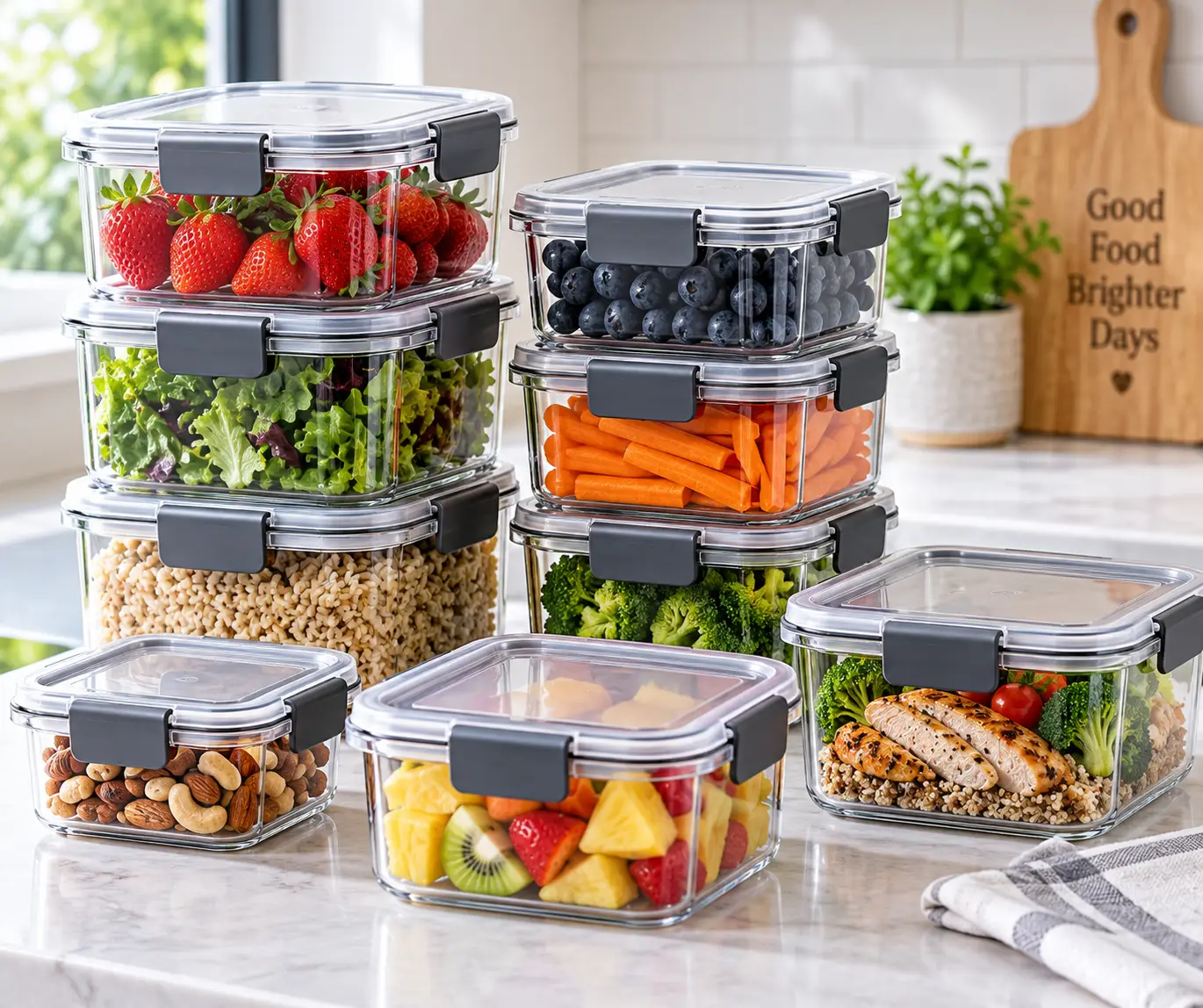
Open almost any fridge in America and you’ll find the same quiet chaos: round containers wedged at odd angles, wasted gaps between shelves, and lids that never seem to match their bases. Square food containers exist to fix exactly that problem. A square food container is a food-safe storage vessel with flat, right-angled sides designed to sit flush against shelves, other containers, and cabinet walls, maximizing usable space in the fridge, freezer, or pantry…
That’s not a small thing. Anyone who meal preps, batch-cooks on Sundays, or just wants their fridge to stop looking like a game of Tetris gone wrong knows that shape matters as much as size. Square food storage containers with lids typically pack 15-20% more usable shelf space than round equivalents of the same volume, simply because they nest against flat surfaces instead of leaving curved gaps.
This guide breaks down seven real, currently available square food containers spanning entry-level plastic sets to premium glass and airtight pantry systems. We’ve dug into published spec sheets, aggregated customer review sentiment, and independent testing coverage from outlets like Wirecutter to give you honest, practical guidance — not just a features list lifted from a product page. Whether you’re outfitting your first apartment kitchen, upgrading a scratched-up mismatched set, or trying to build a meal-prep system that actually survives a busy week, you’ll find a fit below. We’ll also walk through how to choose between plastic and glass, how square containers compare to round ones, common buying mistakes, and the safety standards that matter when food touches plastic. Let’s get into it.
Quick Comparison: Square Food Containers at a Glance
| Product | Material | Best For | Price Range |
|---|---|---|---|
| GoodCook Click & Fresh Square Containers | BPA-free plastic | Big-batch leftovers | Under $15 |
| GladWare XL Square Containers | BPA-free plastic | Casual, giveaway-friendly storage | Under $10 |
| Rubbermaid TakeAlongs Square Set | BPA-free plastic | Everyday variety, lunches | Under $15 |
| Sistema Klip It Plus Square | BPA-free plastic | Leak-resistant clip-seal storage | $15-$25 |
| Rubbermaid Brilliance Square Set | Tritan plastic | Leak-proof, stain-resistant daily use | $20-$35 |
| Glasslock Square Glass Set | Tempered glass | Oven-to-table, long-term durability | $20-$35 |
| OXO Good Grips POP Square Container | BPA-free plastic + silicone | Airtight pantry storage | $15-$40 |
Looking at the table above, budget-focused shoppers land comfortably with the GoodCook Click & Fresh Square Containers or GladWare XL Square Containers, both of which stay under $15 while still covering big-batch storage needs. If leak resistance and daily durability matter more than price, the Rubbermaid Brilliance Square Set and Sistema Klip It Plus Square justify their higher price with genuinely better seals. Anyone who wants glass for oven-safe reheating or a dedicated dry-goods pantry system should look straight at the Glasslock Square Glass Set or the OXO Good Grips POP Square Container, both of which trade affordability for materials and mechanisms that plastic simply can’t match.
💬 One click helps other shoppers make an informed choice too! 😊
The 7 Best Square Food Containers for 2026 (Expert Picks)
1. GoodCook Click & Fresh Square Containers — best value for big-batch leftovers
The distinguishing benefit here is capacity per dollar: this two-pack gives you two 11.7-cup square containers for less than most single premium containers cost. Each container uses a snap-tight “Click and Fresh” lid system, and the domed lid design adds vertical clearance so tall food — a stacked lasagna portion, a mound of pasta — doesn’t get crushed flat the way it would in a shallow container.
What this means in practice: the domed lid isn’t just a design flourish. Reviewers and product testers consistently point out that flat-lidded budget containers force you to either underfill them or squash food to get the lid on; the dome solves that without adding bulk to the footprint. The vented lid also lets you microwave directly in the container, which matters more than it sounds like when you’re reheating lunch at work and don’t want to dirty a plate.
Who it’s for: this is the container for anyone hosting a potluck, storing a full batch of chili, or freezing a week’s worth of soup. It’s not the pick for someone who wants a matched, color-coordinated set — this is a workhorse, not a showpiece. Based on comparing the specs against similarly priced competitors, the 11.7-cup capacity is genuinely large for the category; most budget square containers top out closer to 7-9 cups.
Aggregated customer review sentiment across major retailers is consistently positive on capacity and lid seal, with a recurring theme that the containers “survive the freezer without cracking” — a common failure point for cheap plastic. A smaller number of reviews mention the lids becoming harder to snap after repeated dishwasher cycles, which tracks with what you’d expect from a budget-tier plastic over 1-2 years of daily use.
Pros:
- ✅ Very high capacity for the price point
- ✅ Domed lid protects tall or bulky food
- ✅ Vented lid allows direct microwave reheating
Cons:
- ❌ Lid seal can loosen after heavy dishwasher use
- ❌ Only available in one large size per pack
Expect to pay under $15 for the two-pack at the time of writing, and given the capacity, this is one of the strongest value-for-money picks in the category — check the current price before buying, since retailers rotate promotions often.
2. GladWare XL Square Containers — best for giveaway-friendly storage
The short version: these are the containers you don’t mind losing. GladWare built its reputation on containers designed to be handed off — sending leftovers home with a guest, dropping off a casserole for a neighbor — without the guilt of losing a $30 set piece. The XL square size holds a generous portion while staying light enough to carry one-handed.
Key features with practical meaning: the snap-on lid isn’t rated as airtight in the way a clip-seal or push-button system is, but it’s tight enough for short-to-medium refrigerator storage and casual transport. The plastic is noticeably thinner than premium brands, which keeps the price low but also means these containers are better suited to lighter use than daily heavy rotation.
Honest analytical opinion: this is the right call for anyone who regularly gives food away, hosts casual gatherings, or just wants a cheap backup set for overflow storage during holidays. It is not the pick for someone building a primary, long-term storage system — the thinner walls and simpler lid mean these won’t hold up to years of daily dishwasher and freezer cycling the way a Rubbermaid Brilliance Square Set would.
Reviews consistently report satisfaction with the price-to-size ratio, and a common comment is that buyers keep a rotating stock specifically for sharing food rather than for everyday kitchen storage — which tells you a lot about how the market actually uses this product.
Pros:
- ✅ Inexpensive enough to give away without regret
- ✅ Generous XL capacity for the price
- ✅ Lightweight and easy to carry one-handed
Cons:
- ❌ Thinner plastic than premium alternatives
- ❌ Lid seal isn’t rated fully airtight
Price sits in the $6-$10 range for a multi-pack at the time of writing, making this one of the cheapest entries on this list — genuinely useful as a secondary set rather than your only one.
3. Rubbermaid TakeAlongs Square Set — best everyday variety pack
The Rubbermaid TakeAlongs square line’s standout trait is range: a single 16-piece set typically includes four different square sizes — from a 1.2-cup snack size up to a 5.2-cup entrée size — all sealed with the same “Quick Click” lid mechanism, so you’re never hunting for the one lid that fits.
What the sizing range means in practice: instead of buying separate sets for snacks, sandwiches, and dinner portions, one TakeAlongs set covers all three. The ridged lid design lets containers of different sizes stack securely on top of each other, which is a small detail that makes a real difference when your fridge shelf height is fixed and you can’t waste vertical space on containers that wobble.
Who it’s for: this is the practical middle-of-the-road pick for households that need variety more than they need premium materials — think families packing multiple lunches, or anyone who stores everything from single portions of sauce to full dinner leftovers. Based on comparing the specs, TakeAlongs sits a notch below Brilliance in leak resistance but well above GladWare in build durability, which is exactly the gap in the market it’s designed to fill.
Customer review sentiment is strongly positive on the “click” seal confirmation — reviewers frequently mention appreciating the audible click that confirms the lid is actually sealed, which reduces spill anxiety when packing lunches. A recurring complaint involves the bases showing stains from tomato-based sauces over time, a known issue with lower-Tritan plastics.
Pros:
- ✅ Four container sizes in one set covers most needs
- ✅ Audible click confirms a secure seal
- ✅ Ridged lids stack cleanly at different sizes
Cons:
- ❌ Bases can stain from acidic sauces over time
- ❌ Microwave-safe base only, not the lid
At around $8-$12 for a 16-piece set at the time of writing, this remains one of the best per-container prices in the category, and the size variety alone justifies it for most households.
4. Sistema Klip It Plus Square — best clip-lock leak resistance
Sistema’s Klip It Plus line distinguishes itself with a genuinely different sealing mechanism: rather than a snap-on or push-button lid, it uses four corner clips plus a built-in flexible gasket seal, engineered and manufactured in New Zealand from virgin BPA-free plastic rather than recycled stock.
Key features with practical meaning: the four-clip design distributes sealing pressure evenly around the entire lid perimeter, instead of relying on a single center latch. In practice, this means the container tolerates being knocked or squeezed in a packed lunch bag without popping open — a common failure mode for cheaper single-latch designs. The corner shoulders on the base are also shaped to nest compactly when containers aren’t stacked with their lids, saving cabinet space during storage.
Honest analytical opinion: this container earns its mid-tier price through the seal mechanism specifically. What most buyers overlook with clip-style containers is that the seal quality often has less to do with the plastic and more to do with the gasket — and Sistema’s flexible seal is a genuine step up from basic rubber-free snap lids. This is the pick for anyone who transports food regularly — commuters, students, anyone packing a bag rather than just moving a container from counter to fridge.
Real aggregated review sentiment highlights the clip mechanism as a strong point, with users specifically calling out confidence in transporting liquid-heavy meals like soups and stews without leaks. A smaller cluster of reviews notes that the clips themselves can become brittle after several years of heavy use, eventually cracking off at the hinge.
Pros:
- ✅ Four-clip seal resists popping open in transit
- ✅ Made from virgin, not recycled, BPA-free plastic
- ✅ Nests compactly when stored unstacked
Cons:
- ❌ Clips can become brittle after years of heavy use
- ❌ Pricier per-container than basic snap-lid sets
Expect to pay in the $15-$25 range for a 3-pack at the time of writing — a reasonable premium given how much better the leak resistance is for anyone who actually carries these day to day.
5. Rubbermaid Brilliance Square Set — best leak-proof clarity and stain resistance
Rubbermaid Brilliance is the best-known name in this category for a reason: it’s built from Tritan plastic rather than standard polypropylene, and the lids use a genuine latch-and-gasket system that Rubbermaid rates as 100% leak-proof — not just leak-resistant.
What that means in practice: Tritan is naturally more resistant to staining and odor absorption than the plastic used in most budget containers, so a container that’s held tomato sauce or curry today can go back to holding rice tomorrow without lingering color or smell. Built-in vents under the latches let you microwave with the lid on without removing it entirely, venting steam automatically instead of requiring you to crack the lid manually.
Who it’s for: this is the pick for anyone who’s been burned by stained, cloudy, or leaking containers before and wants to stop replacing their storage set every year. Based on comparing the specs against every other product on this list, Brilliance has the strongest combination of clarity, seal quality, and long-term durability in the plastic category — reviewers with years of daily use consistently report the containers “still look new,” which is a meaningfully different claim than what most budget lines can back up.
Real review data is unusually strong here: publicly available Amazon customer review counts for Brilliance sets regularly exceed 100,000 ratings at a 4.7-4.8 star average, an exceptionally large and consistent sample size for this category. Common praise centers on stain resistance and the audible, tactile latch confirmation; a recurring complaint involves the latches feeling stiff on brand-new units before they loosen up with use.
Pros:
- ✅ Genuinely leak-proof latch-and-gasket seal
- ✅ Tritan plastic resists staining far better than average
- ✅ Vented lid enables no-hassle microwave reheating
Cons:
- ❌ New latches can feel stiff for the first few uses
- ❌ Costs noticeably more per piece than basic sets
Multi-piece sets typically run between $20 and $35 at the time of writing, and given the review volume and consistency, this is arguably the safest all-around bet on this list for anyone upgrading their entire container drawer at once.
6. Glasslock Square Glass Set — best oven-safe glass option
The Glasslock Square Glass Set swaps plastic for tempered glass entirely, paired with a four-latch polypropylene lid that Glasslock rates as airtight and leak-proof. A representative 3-piece set holds roughly 3.3 cups per container and is rated oven-safe up to 450°F.
Key features with practical meaning: tempered glass doesn’t absorb stains or odors the way plastic can, regardless of how many wash cycles it goes through, and it genuinely goes from freezer to oven to table without a container swap — something no plastic option on this list can claim. The oven-safe rating specifically means you can reheat a casserole directly in the storage container rather than dirtying a separate baking dish, which is a real time-saver on a weeknight.
Honest analytical opinion: glass is heavier and can chip along the rim if mishandled, so this isn’t the pick for someone who needs ultra-lightweight lunch containers to carry daily. What the spec sheet doesn’t say, but reviews reveal, is that glass containers tend to outlast plastic ones by years rather than months when it comes to visible wear — several long-term reviewers report using the same set for 5+ years without cracking, staining, or lid failure, something almost no plastic line in this category can match.
Aggregated review sentiment is strongly positive on durability and stain resistance, with buyers specifically noting that square Glasslock containers pack more efficiently in a fridge than the brand’s round equivalents — the exact reason square shapes exist in the first place. A recurring caution across reviews: never move a hot glass container directly onto a cold or wet countertop, since the thermal shock can cause the glass to shatter.
Pros:
- ✅ Genuinely oven-safe up to 450°F
- ✅ Glass never stains or holds odors long-term
- ✅ Outlasts plastic containers by years in daily use
Cons:
- ❌ Heavier than plastic, less ideal for daily transport
- ❌ Can chip or shatter if thermally shocked
Sets typically land in the $20-$35 range depending on piece count at the time of writing — a fair price for a material this durable, especially for anyone who reheats leftovers in the oven regularly.
7. OXO Good Grips POP Square Container — best airtight pantry system
The OXO Good Grips POP Square Container isn’t built primarily for leftovers — it’s a dry-goods pantry system. Its signature push-button lid mechanism creates an audible, tactile airtight seal with a single press, and the button doubles as a handle for lifting the lid off.
What this means in practice: the airtight seal is specifically engineered to keep moisture and pantry pests out of dry goods like flour, sugar, pasta, rice, cereal, and pet food — a different job than sealing in liquid leftovers. Curved interior corners are designed for smooth pouring, and a printed fill line helps with consistent measuring, both details aimed squarely at pantry organization rather than meal storage.
Who it’s for: this is the pick for anyone decanting bulk pantry purchases into a uniform, stackable system rather than someone looking for everyday leftover storage. Based on comparing the specs, the modular square design is engineered specifically to interlock with other POP containers in the same product family, which matters if you’re trying to build a full matching pantry wall rather than buying containers piecemeal.
Real customer review sentiment is consistently enthusiastic about the push-button seal’s reliability over years of daily pantry use, with many reviewers specifically noting they’ve expanded a starter set into a full pantry system over time because the modular sizing made it easy to add pieces. The most common complaint is price: per-container cost runs noticeably higher than any other product on this list, and a few reviewers note the silicone gasket needs periodic removal and cleaning to keep the seal working properly.
Pros:
- ✅ Reliable one-touch airtight seal for pantry goods
- ✅ Modular sizing lets you expand the system over time
- ✅ Curved corners make pouring dry goods clean and easy
Cons:
- ❌ Highest per-container cost on this list
- ❌ Not designed primarily for wet, liquid-heavy leftovers
Individual containers range widely by size, generally landing between $15 and $40 at the time of writing — a real investment, but one that consistently earns praise in pantry-organization reviews across the category.
How to Set Up a Square Container System in Your Kitchen
Getting real value out of square food containers isn’t just about buying them — it’s about setting up your kitchen so they actually get used. Start by measuring your fridge shelf depth and your cabinet shelf height before buying anything; square containers only deliver their space-saving advantage if the dimensions actually match your storage, and a container that’s a half-inch too tall to stack under a shelf defeats the entire purpose.
Once containers arrive, resist the urge to mix every size and brand into one drawer. Group containers by size and keep lids nested separately from bases in a shallow bin or drawer divider — this single habit is the difference between a system that stays organized and one that becomes a “lid graveyard” within a month, which is consistently the top complaint in negative container reviews across every brand.
In the first 30 days, avoid two common mistakes: running new plastic containers through the dishwasher’s heated dry cycle repeatedly (this is what causes premature warping and stiff latches), and storing hot food directly in glass containers pulled straight from the fridge or freezer (thermal shock risk). For plastic, hand-dry or air-dry when possible during the break-in period. For glass, let containers come closer to room temperature before introducing hot food, and never set a hot glass container on a cold or wet surface.
Finally, label your system. Whether it’s a strip of painter’s tape and a marker or a dedicated dry-erase set, dating your containers when you freeze batch-cooked meals prevents the single most common source of food waste in home kitchens: forgotten containers pushed to the back of the freezer.
🍽️ Ready to build a fridge that finally makes sense? Grab a set from the picks above and start with just one shelf.
Real-World Scenarios: Which Square Container Set Fits Your Household
Consider three household types and how their container needs actually differ in practice. A single professional meal-prepping five lunches a week needs fewer, larger containers rather than dozens of small ones — someone in this position is generally best served by the Rubbermaid Brilliance Square Set or Sistema Klip It Plus Square, both of which handle daily transport and reheating without staining or leaking, at a budget of roughly $25-$30 for a set that lasts years.
A family of four managing school lunches, weeknight leftovers, and weekend batch cooking has a fundamentally different need: volume and size variety matter more than premium materials, since containers get lost, borrowed, and occasionally left in a backpack for a week. The Rubbermaid TakeAlongs Square Set fits this profile well precisely because its multi-size range and lower per-piece cost make losing an occasional container less painful, while the audible click seal reduces the parental stress of a leaking lunch box.
A household that cooks in bulk on weekends — think a person who roasts a big tray of vegetables or a full pot of grain every Sunday and portions it out through the week — benefits most from oven-safe, stain-proof storage, which points squarely at the Glasslock Square Glass Set. Being able to reheat directly in the oven, skip a dish, and never worry about tomato or turmeric staining makes glass worth the extra weight and cost for this specific use case. Meanwhile, anyone building out a dedicated dry-goods pantry — flour, rice, cereal, pasta, snacks — should treat that as a separate project entirely and invest in the OXO Good Grips POP Square Container system rather than trying to force a leftover-storage container to do double duty.
Common Problems With Square Food Containers — and How to Fix Them
Problem: Lids won’t seal properly anymore. This is almost always caused by either warping from high heat (microwaving with the lid on when it isn’t vent-rated, or running plastic through a heated dry cycle) or a stretched/damaged gasket on clip-style lids. The fix: switch to vented, microwave-lid-safe containers like the Rubbermaid Brilliance Square Set for reheating, and replace gaskets on Sistema-style clip lids when they visibly deform rather than replacing the whole container.
Problem: Containers stain permanently after storing tomato sauce or curry. Lower-grade plastics absorb pigment from acidic, oily sauces over repeated use. The fix: reserve one or two dedicated “sauce containers” from a budget set like GladWare XL Square Containers for high-stain foods, or switch those specific items to a glass option like the Glasslock Square Glass Set, which never stains regardless of what it holds.
Problem: Cabinets and fridge shelves feel just as cluttered as before, despite switching to square containers. This usually means containers of mismatched brands and sizes are being stored together, which reintroduces the same wasted-space problem round containers had. The fix: standardize on one or two brands’ sizing systems — the Rubbermaid TakeAlongs Square Set‘s four-size range or the OXO Good Grips POP Square Container‘s modular pantry sizing — so everything nests and stacks predictably.
Problem: Freezer contents turn into unlabeled mystery blocks. This isn’t a container problem so much as a habit problem, but the right container makes it worse or better: opaque or deeply tinted containers hide contents entirely. The fix: prioritize clear containers — nearly every product on this list is clear or near-clear — and commit to labeling with masking tape and a date at the moment food goes into the freezer, not later.
How to Choose Square Food Containers: 7 Criteria That Actually Matter
- Material first, brand second. Decide between plastic and glass before comparing specific products — this single choice affects weight, durability, oven-safety, and staining more than any brand name does.
- Seal mechanism. Snap lids, clip lids, latch-and-gasket systems, and push-button seals all perform differently; match the mechanism to how you’ll actually use the container (transport versus stationary fridge storage).
- Actual fridge and cabinet dimensions. Measure your shelf height and depth before buying — a container that’s technically square but too tall for your shelf won’t save the space it promises.
- Microwave and oven compatibility. Not every “microwave-safe” container is safe with the lid on; check whether the lid is vented or needs to be removed, and whether the base alone is rated or the whole unit.
- Stain and odor resistance. If you regularly store tomato-based, turmeric-based, or oily foods, prioritize Tritan plastic or glass over standard polypropylene.
- Size range within a set. A set with only one size forces you to either overfill or underfill for smaller portions — sets with 3-4 sizes, like Rubbermaid TakeAlongs Square Set, offer more flexibility.
- Replacement part availability. Brands like Rubbermaid and Sistema sell individual replacement lids; budget brands often don’t, meaning a lost lid means the whole container becomes trash.
Square Food Containers vs. Round Containers: Which Shape Wins?
The core advantage of square food containers over round ones comes down to geometry: flat sides eliminate the curved dead space that forms when round containers sit next to each other or against a flat fridge wall. In practical terms, this translates to meaningfully more usable shelf space for the same container volume — square containers typically nest with almost no wasted gap, while round containers leave crescent-shaped pockets of unused space between them.
| Factor | Square Containers | Round Containers |
|---|---|---|
| Shelf space efficiency | High — nests flush against walls and other containers | Lower — leaves curved gaps between units |
| Stacking stability | Very stable, flat surfaces align | Can shift or roll if not perfectly centered |
| Ease of cleaning corners | Slightly harder to reach into corners | Easier to wipe clean with no corners |
| Best for | Batch storage, meal prep, pantry systems | Soups, stews, liquid-heavy foods |
Round containers still hold an edge for genuinely liquid-heavy foods — soups and stews swirl and settle more naturally in a rounded base, and corners in square containers can occasionally trap small food particles during cleaning. That said, for the vast majority of everyday storage — leftovers, meal-prepped proteins and grains, pantry staples — the shelf-space and stacking advantages of square containers outweigh the minor cleaning tradeoff, which is exactly why brands like Rubbermaid, Sistema, and OXO all offer dedicated square lines alongside their round ones rather than treating square as a niche option.
Square Plastic vs. Square Glass Food Containers: The Real Trade-Offs
This is the decision that matters most after settling on “square,” and it’s worth taking seriously rather than defaulting to whichever material you already own. Plastic square containers — whether basic polypropylene like GladWare XL Square Containers or premium Tritan like the Rubbermaid Brilliance Square Set — are lighter, more shatter-resistant, and generally cheaper upfront. The federal FDA has reviewed the safety of BPA in food-contact plastics extensively, and every product featured in this guide is explicitly BPA-free, which is now the standard across reputable brands regardless of price tier.
Glass square containers, represented here by the Glasslock Square Glass Set, trade that lighter weight and lower price for oven compatibility, permanent stain and odor resistance, and generally longer usable lifespans — reviewers commonly report glass sets lasting five or more years without meaningful wear, compared to a more typical one-to-three-year replacement cycle for daily-use plastic. The tradeoff is real: glass is heavier to carry in a lunch bag, more expensive per container, and can chip or crack if dropped or thermally shocked.
The practical answer for most households isn’t choosing one exclusively — it’s a hybrid approach. Use lightweight plastic for lunches, transport, and short-term fridge storage where staining is less of a concern, and reserve glass for long-term freezer storage, high-stain foods like tomato sauce or curry, and anything headed for the oven. That split gets you the durability benefits of glass where they matter most without paying the weight and cost premium everywhere.
🔍 Not sure which material fits your routine? Compare the plastic and glass picks above side by side before you decide.
Stackable Square Containers for Small Kitchens and Tight Pantries
Small-kitchen living puts extra pressure on every storage decision, and stackable square containers do more work per cubic inch than almost any other kitchen investment in that context. The key spec to prioritize isn’t capacity — it’s whether a set’s lids are ridged or flat-topped, since ridged lids (like those on the Rubbermaid TakeAlongs Square Set) let containers of different sizes lock securely on top of each other, while flat-lidded budget containers tend to slide when stacked more than two or three high.
For studio and small-apartment kitchens specifically, prioritize nesting: many square container lines, including Sistema Klip It Plus Square, are designed so empty containers nest inside one another with lids removed, shrinking their storage footprint by more than half when not in use. This matters far more in a small kitchen than it does in a spacious one, where cabinet real estate is rarely the limiting factor.
Modular pantry systems like the OXO Good Grips POP Square Container solve a related but distinct small-space problem: bulky bags of flour, rice, and pasta that don’t stack or seal well on their own. Decanting those into a uniform modular square system doesn’t just look tidier — it reclaims real shelf height, since bags of dry goods are notoriously inefficient users of vertical pantry space compared to a stack of same-sized square containers.
Square Meal Prep Containers for Weekly Batch Cooking
Meal preppers have specific needs that differ from general food storage: portion consistency, stackability in a fridge that’s also holding a week’s worth of other groceries, and durability against daily microwave use. Square meal prep containers solve the portion-consistency problem simply by being easier to fill to a visual line evenly than round ones, since the flat walls make eyeballing equal servings more intuitive.
For weekly batch cooking specifically, the Rubbermaid Brilliance Square Set stands out because its vented, microwave-safe lid means a prepped lunch can go from fridge to microwave to table without transferring to a plate — a small convenience that adds up over five reheats a week. Its stain resistance also matters more for meal preppers than casual users, since the same containers cycle through sauces, grains, and proteins dozens of times a month rather than a handful.
Portion control matters here too: a common meal-prep mistake is buying containers sized for what looks reasonable rather than what a realistic portion actually is. Standard meal-prep portions generally range from 2 to 4 cups depending on the meal type, which makes the Rubbermaid TakeAlongs Square Set‘s multi-size range genuinely useful — smaller 2.1-2.9 cup sizes suit single-protein-and-veg lunches, while the larger 5.2-cup size handles grain-heavy or family-style portions without needing a second product line entirely.
Common Mistakes to Avoid When Buying Square Food Storage Containers
The single most common mistake is buying based on set size (a “20-piece set!”) rather than actual capacity needs — a 20-piece set stuffed with tiny 1-cup containers is far less useful for most households than a smaller set of properly sized 3-5 cup containers. Read the individual container capacities, not just the piece count, before comparing prices.
A second frequent misstep is ignoring lid mechanism compatibility with your actual habits. Someone who transports lunches daily needs a clip or latch seal, not a basic snap lid — yet snap-lid sets are often the cheapest and most heavily marketed option, leading buyers to choose based on price alone and then discover the seal isn’t adequate for their use case within weeks.
Buyers also frequently overlook microwave lid ratings, assuming “microwave safe” applies to the whole container including the lid, when in many cases — including several products in this guide — only the base is rated for microwave use, and the lid must be removed or vented separately. Always check this specifically rather than assuming.
Finally, don’t underestimate the value of buying into a brand’s existing size ecosystem if you already own some containers. Mixing incompatible brands means lids rarely fit interchangeably, which recreates the exact mismatched-lid frustration that switching to a unified square system was supposed to solve in the first place.
Long-Term Cost and Maintenance of Square Food Containers With Lids
It’s worth thinking about square food containers as a multi-year investment rather than a one-time purchase, because replacement frequency varies dramatically by material and tier. Budget plastic sets like GladWare XL Square Containers are typically replaced within 1-2 years of regular use as lids lose their seal and plastic stains or warps; premium Tritan sets like the Rubbermaid Brilliance Square Set commonly last 3-5 years with proper care; and glass sets like the Glasslock Square Glass Set frequently exceed 5 years, limited mainly by accidental breakage rather than material wear.
| Tier | Typical Lifespan | Approx. Cost Per Year of Use* |
|---|---|---|
| Budget plastic (GladWare, GoodCook) | 1-2 years | Roughly $5-$8/year |
| Mid-tier plastic (TakeAlongs, Sistema) | 2-4 years | Roughly $4-$7/year |
| Premium plastic (Brilliance) | 3-5 years | Roughly $5-$9/year |
| Glass (Glasslock) | 5+ years | Roughly $4-$6/year |
*Estimates based on typical set pricing divided by expected lifespan; actual costs vary by set size and usage intensity.
Looking at the table above, the annualized cost gap between tiers is smaller than the upfront price difference suggests — glass and premium plastic often work out to a similar or even lower cost per year of ownership than cheap plastic that needs replacing every season. Maintenance-wise, hand-washing lids (even on dishwasher-safe products) extends seal life meaningfully across every brand in this guide, since repeated heated dishwasher cycles are the single biggest driver of premature lid failure in plastic containers.
Safety, Regulations, and Standards for Square Plastic Food Containers
Every product featured in this guide is explicitly marketed as BPA-free, which reflects the current industry standard following years of consumer and regulatory scrutiny of bisphenol A in food-contact plastics — you can read more about the chemical’s history and regulatory status on Wikipedia’s overview of Bisphenol A. While the FDA has maintained that current permitted uses of BPA in food packaging fall within its safety margins, the near-universal shift to BPA-free formulations across mainstream brands reflects sustained consumer demand for it regardless of the underlying regulatory position.
Beyond BPA, it’s worth knowing that the U.S. Consumer Product Safety Commission does track and publish recalls related to food storage products, including past incidents involving glass container breakage — a useful reminder to inspect glass containers periodically for chips or stress cracks near the rim, which meaningfully increase shatter risk under thermal stress. Checking a product’s CPSC recall history before a major purchase, especially for glass, is a five-minute step worth taking.
On the food-safety side rather than the container-safety side, the USDA’s official food storage guidelines are worth bookmarking regardless of which container you choose, since even the best square container can’t compensate for food stored past safe time limits. Pairing good containers with good storage-time habits is what actually prevents both food waste and foodborne illness — the container is only half the equation.
✨ Don’t miss these exclusive deals!
🔍 Take your square food containers to the next level with this carefully curated lineup. Click a highlighted item to check current pricing and availability. These picks will help you get an organized, efficient kitchen the whole family will enjoy!
Frequently Asked Questions
❓ Are square food containers better than round ones for fridge storage?
❓ What's the best material for square food storage containers with lids?
❓ Can square plastic food containers go in the microwave with the lid on?
❓ How many square meal prep containers do I actually need?
❓ Do stackable square containers really save space compared to my current containers?
Conclusion
Square food containers solve a problem that’s easy to underestimate until you’ve lived with it: wasted space, mismatched lids, and a fridge that never quite closes properly. Across the seven products in this guide, the right pick really does depend on how you actually use your kitchen — the GoodCook Click & Fresh Square Containers and GladWare XL Square Containers cover budget and giveaway needs, the Rubbermaid TakeAlongs Square Set and Sistema Klip It Plus Square handle everyday variety and leak-resistant transport, the Rubbermaid Brilliance Square Set delivers the strongest all-around plastic performance for daily use, the Glasslock Square Glass Set wins for long-term durability and oven safety, and the OXO Good Grips POP Square Container solves pantry organization specifically rather than leftover storage generally.
None of these are exact Amazon prices you should expect to pay today — always check the current listing, since pricing and available bundle sizes shift regularly. What stays consistent is the underlying logic: match the material and seal mechanism to how you actually cook and store food, not to whichever set looks most appealing in a photo. Do that, and a good square container system will quietly save you money, space, and food waste for years, exactly the kind of unglamorous kitchen upgrade that pays for itself without you noticing.
✨ Ready to stop fighting your fridge? Pick the set above that matches your household and start reclaiming your shelf space today!
Recommended for You
- Mini Glass Containers With Lids: 7 Best Picks (2026 Guide)
- 7 Best Microwave Pots and Pans for 2026 (Safe & Non-Toxic Picks)
- 8 Oz Mason Jars With Lids: 7 Best Picks for 2026 (Buyer’s Guide)
Disclaimer: This post contains affiliate links. As an Amazon Associate, I earn from qualifying purchases made through these links, at no additional cost to you.
✨ Found this article helpful? Share it with someone who needs it! 💬🤗