
In This Article
Microwave Safe Metal Containers: Why the “No Metal” Rule Just Got an Asterisk
Your grandmother’s kitchen had one sacred commandment: never, ever put metal in the microwave. And for decades, that was excellent advice. A stray fork or a takeout box with a wire handle could turn your microwave into a tiny, crackling fireworks show.
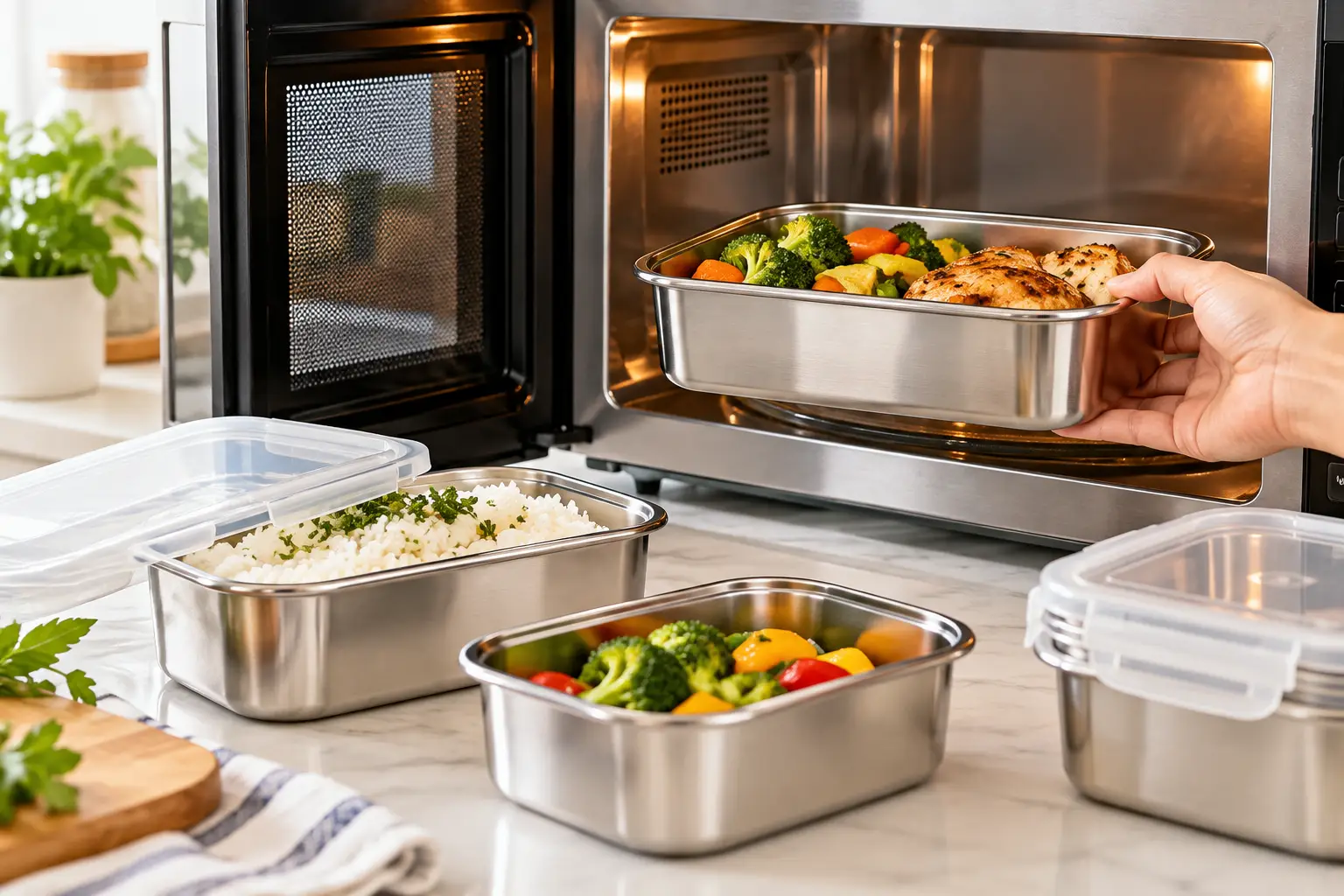
But here’s the plot twist: microwave safe metal containers are now a real, growing product category — and they’re not a gimmick. Brands like Bentgo, Black+Blum, and Genicook now sell stainless steel boxes engineered specifically to go from fridge to microwave without sparking. The secret isn’t magic; it’s geometry and material choice. Smooth, rounded corners and thick, consistent walls avoid the sharp points and thin edges that cause electrical arcing.
Why does this matter to you? Because a lot of people are tired of plastic. They don’t want tubs that stain orange after one batch of chili, warp in the dishwasher, or leave them wondering what’s migrating into lunch. Glass solves some of that — but glass is heavy, breakable, and a pain to carry in a work bag. Metal meal prep containers hit a sweet spot: light, nearly unbreakable, odor-resistant, and now, finally, reheatable.
That said, “microwave safe” on a metal container comes with conditions that plastic and glass don’t. Time limits, wattage caps, lid rules, and spacing from the oven walls all matter. Ignore them, and you’re back to the fireworks show.
In this guide, we compare seven real products available to US shoppers on amazon.com, translate their spec sheets into plain English, and walk you through exactly how to use microwave safe metal containers safely — from the first reheat to year five of ownership.
What Is a Microwave Safe Metal Container?
A microwave safe metal container is a food storage or cooking vessel made wholly or partly of metal — usually 18/8 (304) stainless steel or aluminum — that the manufacturer has designed and tested for microwave use. Rounded edges, smooth surfaces, and defined time and wattage limits prevent arcing while food still heats through.
That definition hides an important nuance. Microwaves can’t pass through metal; they bounce off it. According to the FDA’s overview of how microwave ovens work, these ovens heat food using electromagnetic waves similar to radio waves — and the oven itself is a metal box designed to keep those waves inside. In other words, your microwave’s walls are already metal. The problem was never “metal” in general; it’s metal with sharp points, crinkles, thin edges, or gaps where electrical charge can concentrate and jump.
So how does food inside a steel box heat at all? In most designs, energy reaches the food through the open top or a microwave-transparent lid (glass or silicone), and the steel walls reflect energy back into the food. That’s also why most brands cap heating time and warn you not to seal a metal lid over the top.
There are really three families of products in this category:
- ✅ All-steel containers with microwave-transparent lids (Bentgo, Black+Blum, Genicook, Everusely)
- ✅ Hybrid cookware where metal is only a small, rounded part of the design (Anyday’s glass dishes with steel-rimmed lids)
- ✅ Purpose-built metal microwave tools such as an aluminum egg-boiler insert or a crisper pan
Quick Comparison: The 7 Best Microwave Safe Metal Containers at a Glance
| Product | Metal Type | Microwave Rule (per maker) | Approx. Price Range | Best For |
|---|---|---|---|---|
| Bentgo MicroSteel Heat & Eat Container | 18/8 (304) stainless | Up to 10 min at 1,000W, vent open | Around $20 per container | Bentgo MicroSteel — everyday office lunches |
| Black+Blum Stainless Steel Lunch Box | 18/8 stainless | 2-min intervals, stir between | $30–$45 per box | Black+Blum — leak-proof commuting |
| Genicook Microwave-Safe Stainless Steel Container | 18/8 or 316L stainless | Varies by line; some lids must come off | From ~$13 each; sets ~$50–$55 | Genicook — budget-friendly sets |
| Everusely Microwavable Stainless Steel Food Container | SUS304 stainless | Up to 10 min at 1,000W, lid resting | Roughly $15–$35 (check) | Everusely — see-through glass lid |
| Anyday Glass Microwave Dish | Stainless-rimmed lid | Keep 1 inch from oven walls | $35–$50 per dish | Anyday — actual microwave cooking |
| Nordic Ware Microwave Egg Boiler | Aluminum insert | Follow wattage chart | Under $20 | Nordic Ware Egg Boiler — fast boiled eggs |
| Whirlpool W10187336A Microwave Crisper Pan | Coated metal pan | Check model compatibility | Varies by seller (check) | Whirlpool Crisper Pan — crispy reheats |
Looking at the table, the three all-steel boxes — Bentgo MicroSteel, Black+Blum, and Everusely — cover most people’s lunch-reheating needs, but their rules differ in ways that matter: Black+Blum wants short two-minute bursts, while Bentgo MicroSteel and Everusely allow up to ten minutes at 1,000 watts. If you actually cook in the microwave rather than just reheat, Anyday is in a different league. And the two specialty tools solve narrow problems brilliantly but won’t replace your storage containers.
💬 One click helps other shoppers make an informed choice too! 😊
Top 7 Microwave Safe Metal Containers: Expert Analysis
Every pick below is a real product sold to US shoppers. We haven’t personally tested these; instead, we compared manufacturer spec sheets and usage rules, then layered in published third-party testing and customer feedback where it could be verified.
1. Bentgo MicroSteel Heat & Eat Container — the most forgiving everyday reheater
The Bentgo MicroSteel stands out because it gives you the most generous heating window of any all-steel box here, which makes it the least fussy to live with. Bentgo rates it for up to 10 minutes in a 1,000-watt microwave and up to 60 minutes in a 350°F oven. In practice, that ten-minute ceiling covers almost any reheat, including a dense frozen burrito bowl that needs several rounds.
The body is 304 (18/8) stainless steel, and Bentgo attributes its spark resistance to a patent-pending material formulation combined with rounded edges. The silicone lid has a removable steam valve, so you can heat with the lid on — you just pop the valve open first. It comes in four sizes: 2, 3, 5.5, and 8.5 cups, and even the family size weighs under a pound.
Here’s what to weigh: the 3-cup “Lunch Size” is the sweet spot for a single adult meal, while the 5.5-cup size is really dinner-for-one-plus-leftovers. Families who batch-cook will get the most out of the 8.5-cup version.
Aggregated customer star ratings weren’t something we could verify reliably across listings, so we won’t quote any. What’s clear from the brand’s own materials is a 2-year warranty and top-rack dishwasher compatibility.
Pros:
- ✅ Longest verified microwave window in this roundup
- ✅ Heat with the lid on thanks to the steam valve
- ✅ Four sizes cover snacks through family meals
Cons:
- ❌ Silicone lid needs top-rack washing only
- ❌ Oven use is capped at 60 minutes
Price: around $20 per container at the time of writing — strong value for how much it simplifies daily reheating.
2. Black+Blum Stainless Steel Lunch Box — the leak-proof commuter’s choice
The Black+Blum Stainless Steel Lunch Box earns its place with a lid system that’s genuinely built for bags, backpacks, and bike panniers. The brand uses 18/8 stainless steel with a smooth, rounded body, and its vacuum-style lid lock with a release button is designed to be airtight and leak-proof.
On paper, the most interesting feature is that the lid can stay on in the microwave via its vent, which Black+Blum says shortens heating time compared with other steel containers and stops splatter. What the marketing doesn’t shout, though, is the fine print in its FAQ: heat one box at a time, for a maximum of two minutes, then stir before repeating. For acidic foods like tomato sauce, it recommends frequent stirring and two-minute intervals. No cutlery or foil in the box while heating.
That makes the Black+Blum ideal for someone reheating a normal-sized lunch in the office microwave — two or three short rounds with a stir. It’s less ideal if you want to dump in a frozen block and walk away.
The brand states its meal prep range was tested and approved by the Good Housekeeping Institute (UK). Retail listings in the US show a substantial volume of customer reviews, but we couldn’t verify consistent star averages, so we’ll leave ratings out.
Pros:
- ✅ Genuinely airtight, leak-proof vacuum lid lock
- ✅ Lid can stay on during microwave heating
- ✅ Steel box is oven-safe for finishing touches
Cons:
- ❌ Two-minute heating intervals require babysitting
- ❌ Lid itself is not oven-safe
Price: roughly $30–$45 per box — a premium, but justified if leaks have ruined your bag before.
3. Genicook Microwave-Safe Stainless Steel Container — the budget-friendly set builder
The Genicook line is the most affordable way to build a whole cabinet of microwave safe stainless steel containers, with individual pieces starting around $13 on the brand’s site. Its original range uses 18/8 stainless with rounded corners that, according to retailer descriptions, eliminate the point-to-point arcing of ordinary metal boxes. One retailer notes the containers were tested in microwaves for 11 minutes, and they’re rated oven-safe to 350°F.
The standout design choice is the tempered glass lid with a silicone venting plug, which lets you see what’s inside and, on the older lines, heat with the lid on. Here’s the catch most buyers overlook: Genicook now sells multiple lines, including newer 316L stainless versions, and the instructions aren’t identical. Some listings — including a 3-piece Amazon set — say microwave for up to 5 minutes without the lid.
Our honest take: Genicook is excellent value, but read the specific listing’s rules before your first reheat, and stick to them. 316L steel, by the way, offers better corrosion resistance — a real plus if you store a lot of salty or acidic food.
Customer comments on one retailer’s page praised faster-than-expected heating and good freezer performance, though that’s a small sample, not a verified aggregate.
Pros:
- ✅ Lowest per-container entry price in this roundup
- ✅ Glass lid lets you see leftovers instantly
- ✅ 316L option resists corrosion better than 304
Cons:
- ❌ Microwave rules differ between product lines
- ❌ Some versions require removing the lid first
Price: from around $13 per container, with sets in the $50–$55 range — the best value for stocking up.
4. Everusely Microwavable Stainless Steel Food Container — best see-through lid for meal prep
The Everusely Microwavable Stainless Steel Food Container pairs a SUS304 steel base with a borosilicate glass lid, which gives you plastic-free storage plus instant visibility. It’s sold in sizes such as 24 oz (0.7 L) and 34 oz (1 L), and the listing states it’s certified microwave safe for 10 minutes at 1,000 watts and oven-safe to 248°F.
That oven rating is noticeably lower than Bentgo MicroSteel (350°F) or Genicook (350°F). In practice, 248°F is fine for gently warming food but not for real baking or crisping, so treat this as a microwave-and-storage container first.
One instruction really matters: when heating, the lid should rest on top rather than being snapped shut. Borosilicate glass is thermal-shock resistant, so moving it from fridge to microwave is less risky than with ordinary glass — but a clamped-down lid on a steaming container is asking for trouble.
Everusely is a solid fit for meal preppers who like to see a week’s worth of lunches lined up in the fridge. Honest disclosure: we couldn’t find verifiable aggregated review data or consistent pricing during research, so check the listing’s current reviews and price before buying.
Pros:
- ✅ Borosilicate glass lid resists thermal shock
- ✅ Ten-minute microwave rating at 1,000 watts
- ✅ Plastic-free construction throughout
Cons:
- ❌ Low 248°F oven limit restricts baking use
- ❌ Lid must rest loose, not locked, when heating
Price: roughly $15–$35 depending on size (check the current price) — reasonable value if visibility matters to you.
5. Anyday Glass Microwave Dish — best for real microwave cooking
The Anyday dish is the odd one out, and deliberately so: it’s glass cookware where the metal lives only in the lid’s smooth, curved stainless steel rim. That makes it the most versatile cooking tool here, rather than just a reheating box.
The bowl is frosted borosilicate glass, rated oven-safe to 500°F, and the lid (glass, silicone gasket, stainless rim) is rated to 400°F. The pop-up silicone knob vents steam, which is what makes microwave-steamed vegetables and fish come out moist instead of rubbery. Anyday’s key rule: keep the dish at least one inch from the microwave walls, because the steel rim can spark if it gets too close to the oven’s own metal.
This is independent third-party evidence we could verify: America’s Test Kitchen tested Anyday and reported perfectly cooked chicken wings and crisp-tender vegetables, and noted that a competing plastic lid gave off a chemical smell during longer cooking — while Anyday didn’t. That’s a meaningful endorsement for anyone suspicious of plastic.
Anyday makes the most sense for small households, dorm rooms, and anyone who wants full meals without the stove. It’s heavier and more fragile than steel, though, so it’s not a commuter lunch box.
Pros:
- ✅ Designed for full cooking, not just reheating
- ✅ Independent testing reported excellent results
- ✅ Highest oven rating in this roundup
Cons:
- ❌ Glass is heavier and breakable versus steel
- ❌ Must stay one inch from microwave walls
Price: around $35–$50 for a single dish, with multi-dish sets costing considerably more — best value if you’ll cook in it weekly.
6. Nordic Ware Microwave Egg Boiler — the cleverest use of metal in a microwave
The Nordic Ware Microwave Egg Boiler proves metal can be a feature, not a hazard. Inside a BPA- and melamine-free plastic shell sits an aluminum insert that holds up to four eggs above about 1½ cups of water. The microwaves heat the water; the aluminum shields the eggs so they cook by steam instead of exploding from direct microwave energy.
That’s the whole trick, and it’s why you don’t need to pierce the shells. Nordic Ware publishes wattage-specific timing charts — for example, a soft egg takes about 7 minutes at 600 watts, 6 at 800 watts, and 4–5 at 1,200 watts — so knowing your microwave’s wattage is essential. After cooking, the brand says to let it cool for two minutes before opening.
This is ideal for busy mornings, meal preppers doing a weekly batch of hard-boiled eggs, and dorm residents without a stove. It’s microwave-only, so it’s useless if you don’t have one.
An independent review site describes it as a simple, budget-friendly tool that does one job reliably. Nordic Ware backs it with a 5-year warranty.
Pros:
- ✅ Aluminum insert prevents egg explosions safely
- ✅ Clear wattage charts remove guesswork
- ✅ Backed by a five-year warranty
Cons:
- ❌ Only does eggs (and light steaming)
- ❌ Hot water spills are possible when removing
Price: typically under $20 — outstanding value for a single-purpose tool.
7. Whirlpool W10187336A Microwave Crisper Pan — best for crispy reheated food
The Whirlpool W10187336A Microwave Crisper Pan tackles microwaving’s biggest weakness: soggy food. It’s a black metal pan, 12¼ inches across and 1½ inches deep, with a detachable handle, built to pan-fry, brown, and crisp foods like bacon, eggs, chicken nuggets, and leftover pizza inside the microwave.
Whirlpool markets it as universal, but its own product page tells you to confirm your model number is compatible — and that caveat deserves emphasis. Crisper pans work best in microwaves with a dedicated crisp function (Whirlpool also sells a stainless version, W11752571, for its crisp-enabled models). The USDA warns against metal pans in ovens with metal shelves or metal turntables, so if yours has either, skip this.
What most buyers overlook is how hot these pans get — that’s the point, but it means oven mitts every time. For the right microwave, it’s the difference between limp and crunchy leftover pizza.
We couldn’t verify aggregated review data for this specific accessory; one owner review on the Maytag site was positive, but that’s anecdotal.
Pros:
- ✅ Genuinely crisps and browns in the microwave
- ✅ Large 12¼-inch size fits frozen pizzas
- ✅ Detachable handle for safer removal
Cons:
- ❌ Compatibility depends on your microwave model
- ❌ Gets extremely hot during use
Price: varies considerably by seller — check the current price; worth it only if your microwave is confirmed compatible.
At-a-Glance: How the Top 7 Stack Up on Key Specs
| Product | Max Microwave Time | Oven-Safe | Lid in Microwave? | Best For |
|---|---|---|---|---|
| Bentgo MicroSteel | 10 min @ 1,000W | 350°F (60 min) | Yes, valve open | Bentgo MicroSteel — busy office workers |
| Black+Blum | 2-min bursts | Box only | Yes, vented | Black+Blum — commuters |
| Genicook | ~5–11 min (by line) | 350°F | Depends on line | Genicook — budget stocking-up |
| Everusely | 10 min @ 1,000W | 248°F | Resting, unlocked | Everusely — visual meal prep |
| Anyday | Recipe-dependent | 500°F bowl / 400°F lid | Yes | Anyday — cooking full meals |
This spec comparison shows the real trade-off: flexibility versus supervision. Bentgo MicroSteel and Everusely let you set a longer timer, while Black+Blum trades that for the best leak protection. If oven versatility matters, Anyday is unmatched, and Genicook wins purely on price per piece.
✨ Don’t miss these smart picks!
🔍 Take your meal prep to the next level with this carefully curated lineup. Click a highlighted item to check current pricing and availability. These picks will help you get hot, plastic-free lunches the whole family will enjoy!
How to Use Microwave Safe Stainless Steel Containers Without Sparks
Owning microwave safe stainless steel containers is easy; using them well takes a short learning curve. Here’s a practical routine for your first 30 days.
🔧 Before the first use
- ✅ Wash the container and lid, and dry them fully.
- ✅ Read the maker’s specific time and wattage limits — they differ by brand.
- ✅ Find your microwave’s wattage (usually inside the door or on the back label).
⚡ Every time you heat
- Check the oven interior. No metal racks, no metal turntable, no other metal objects.
- Center the container. Keep it at least an inch from the walls — Anyday states this outright, and it’s smart practice for all metal.
- Vent or loosen the lid. Open the valve (Bentgo MicroSteel), use the vent (Black+Blum), rest it loosely (Everusely), or remove it where required (some Genicook lines).
- Heat in short rounds. Start with 1–2 minutes, stir, then repeat. Stirring matters more with metal because heating tends to be less even.
- Remove any utensils. A fork left in the box is exactly the kind of sharp-edged metal that sparks.
🧽 Maintenance schedule
- Weekly: Inspect silicone gaskets for trapped food and odors; remove and wash them.
- Monthly: Check the body for dents. A dented edge can create a sharper geometry than the design intended — retire badly dented containers from microwave duty.
- As needed: For stuck-on residue, soak rather than scour; steel wool scratches can roughen the smooth surface that helps prevent arcing.
❌ Common mistakes in the first month
The most frequent mistake is treating a steel box exactly like plastic — setting four minutes and walking away. The second is heating two metal containers side by side, which Black+Blum specifically advises against. Heat one at a time.
Real-World Scenarios: Matching Metal Meal Prep Containers to Your Routine
Specs are abstract. Here’s how the choice plays out for three different people.
👩💼 The office commuter (budget: ~$40–$90)
Maya rides the train 45 minutes each way and reheats lunch in a shared office microwave four days a week. Her priorities: zero leaks in her tote and a quick reheat without hogging the microwave.
Best match: Two Black+Blum boxes. The vacuum lid lock protects her bag, and the vented lid stays on during heating so her lunch doesn’t splatter the shared microwave. The two-minute interval rule suits a normal lunch portion anyway. Budget alternative: two Bentgo MicroSteel Lunch Size containers, which cost less and allow longer heating.
👨👩👧👦 The family meal prepper (budget: ~$60–$120)
The Johnsons cook a big batch on Sunday and portion out dinners and lunches for the week. They need several sizes, freezer durability, and easy dishwasher cleanup.
Best match: A Genicook set for bulk storage, plus a Bentgo MicroSteel Family Size (8.5 cups) for reheating whole casseroles. Add a Nordic Ware Microwave Egg Boiler for a week of hard-boiled eggs in one go.
🎓 The dorm or small-apartment cook (budget: ~$50–$80)
Alex has a microwave, a mini fridge, and no stovetop. Reheating isn’t enough — Alex needs to actually cook.
Best match: An Anyday dish for steaming rice, vegetables, and fish, plus the Nordic Ware Egg Boiler for protein. If Alex’s microwave has a crisp function and is compatible, the Whirlpool Crisper Pan rescues leftover pizza. The key reasoning: when the microwave is your only appliance, cooking performance matters more than portability.
Problem → Solution: Troubleshooting Microwave Safe Metal Containers
Even the best microwave safe metal containers occasionally misbehave. Here are the most common issues and fixes.
Problem 1: You see sparks or hear crackling. Stop the microwave immediately. Check for a utensil, foil, or a twist tie inside, and confirm the container isn’t touching the walls. If the container itself is dented, retire it from microwave use. With Anyday, sparking almost always means the dish drifted too close to the wall.
Problem 2: The edges are scorching hot but the center is cold. Metal walls reflect energy, so heating is less uniform than in glass. Heat in shorter rounds and stir between them. Spread dense food in an even layer rather than a mound.
Problem 3: The lid warped or popped. Pressure built up because the vent wasn’t open. Always open the Bentgo MicroSteel valve, use the Black+Blum vent, or rest the Everusely glass lid without locking it.
Problem 4: Tomato sauce left marks or pitting. Acidic, salty foods are hardest on steel over time. Black+Blum recommends frequent stirring and short intervals for acidic foods. For heavy acidic use, a 316L Genicook container is a smarter long-term pick.
Problem 5: Food takes much longer than the package directions say. Package directions assume a microwave-transparent dish. Add time in small increments, check the internal temperature, and use a food thermometer for meat, poultry, and eggs.
How to Choose Microwave Safe Metal Containers
Choosing microwave safe metal containers comes down to seven questions.
- Is it explicitly labeled microwave safe by the maker? Ordinary steel lunch boxes are not. Only buy containers with stated microwave instructions.
- What’s the time and wattage limit? Ten minutes at 1,000 watts (Bentgo MicroSteel, Everusely) is far more forgiving than two-minute bursts (Black+Blum).
- Can the lid stay on? Vented lids save cleanup; lids that must come off mean you’ll need a cover for splatter.
- What grade of steel? Most use 304 (18/8) stainless steel, a common food-grade alloy. 316L adds corrosion resistance for salty or acidic foods.
- Is it oven-safe, and to what temperature? Useful if you like crisping food after microwaving; ratings range from 248°F to 500°F here.
- Does it fit your microwave? Leave at least an inch on all sides, and remember metal pans are off-limits if your oven has metal racks or a metal turntable.
- How will you carry it? Commuters should prioritize a locking, leak-proof lid; home users can prioritize capacity.
Can You Put Metal in the Microwave? The Science of Arcing Explained
Yes — sometimes. The short answer is that shape and thickness matter far more than whether something is metal.
Arcing happens when microwave energy induces electrical charge in a conductive object, and that charge concentrates at sharp points, thin edges, or narrow gaps until it jumps through the air as a visible spark. A fork’s tines, the crinkles in aluminum foil, and the gold trim on a fancy plate are textbook offenders. A smooth, thick, rounded metal surface spreads that charge out, which is why a well-designed steel box behaves while a crumpled foil ball doesn’t.
The USDA’s guidance on cooking with microwave ovens adds two crucial practical points. First, microwaves can’t pass through metal, so food completely enclosed in a covered metal pan won’t heat properly. Second, if your microwave has metal shelves or a metal turntable, you shouldn’t use foil containers or metal pans at all. That’s why metal-container makers insist on vented or microwave-transparent lids and on spacing from the oven walls.
There’s also the question of your microwave itself. Bare metal reflects energy back toward the magnetron — the part that generates the microwaves. Modern ovens are designed to tolerate some reflected energy, but manufacturers of metal containers set time limits partly for this reason. That’s also why you should never run a microwave empty or with only a metal container and no food inside.
Bottom line: “Can you put metal in the microwave?” isn’t a yes-or-no question. It’s “Is this specific metal object designed and labeled for it, and am I following the maker’s rules?”
Stainless Steel Lunch Box Microwave Safe vs. Glass and Plastic
If you’re debating whether a stainless steel lunch box microwave safe design is worth switching to, compare it honestly against the containers already in your cabinet.
| Feature | Microwave-Safe Steel | Glass (Borosilicate) | Plastic |
|---|---|---|---|
| Weight for commuting | Light | Heavy | Lightest |
| Breakage risk | Very low | Moderate | Very low |
| Staining and odors | Resists both | Resists both | Stains easily |
| Microwave convenience | Rules and limits apply | Very easy | Easy, but heat concerns |
| Best for | Bentgo MicroSteel — daily carry | Anyday — cooking at home | Short-term, disposable use |
The table makes the positioning clear: steel wins on durability and portability, glass wins on microwave simplicity, and plastic wins only on price and weight. That’s why a hybrid like Anyday exists — it borrows glass’s easy heating while using metal only where it’s safe. For most people, the ideal kitchen holds both: steel for carrying, glass for home cooking.
It’s worth noting what USDA guidance says about disposable plastic: one-time-use tubs and takeout containers can warp or melt in the microwave and aren’t meant for it. Reusable, labeled microwave-safe plastic is a different story — but many buyers are switching to steel precisely to avoid heating food in plastic at all.
Features That Actually Matter (and Ones That Don’t)
Marketing copy on metal containers can get loud. Here’s what deserves your attention.
✅ Features that genuinely matter
- Stated time and wattage limits. This is the single most important spec. Without it, you’re guessing.
- Rounded corners and smooth rims. This is the core anti-arcing design principle — sharp corners are a red flag.
- A steam vent or valve. It lets you heat with the lid in place and prevents pressure buildup.
- Removable gaskets. Silicone seals trap food; if you can’t remove them, they’ll eventually smell.
- Steel grade (304 vs. 316L). A real difference if you store acidic or salty foods often.
❌ Features that matter less than you’d think
- “Double-walled” or “insulated” claims. Great for keeping food warm, but insulated designs aren’t the same as microwave-rated ones. Don’t assume one implies the other.
- Color finishes. Pretty, but they don’t change performance. Just confirm the finish is part of the microwave-safe product line.
- Huge piece counts. A 10-piece set looks like great value, but if half the sizes don’t match how you eat, they’ll just take up cabinet space.
The practical takeaway: judge a container by its instruction sheet, not its product photos.
Common Mistakes to Avoid When Buying Metal Meal Prep Containers
Most regrets with metal meal prep containers happen at checkout, not in the kitchen.
Mistake 1: Assuming all stainless steel containers are microwave safe. The majority of steel lunch boxes on the market are not. The microwave-safe versions are specifically engineered and labeled. If a listing says “freezer and dishwasher safe” but stays silent on microwaves, assume no.
Mistake 2: Ignoring your own microwave. Check for metal racks or a metal turntable before you buy. If you have one, most metal containers and crisper pans are off the table.
Mistake 3: Buying one size. Meal preppers usually need at least two sizes — a lunch portion and a larger storage size. Mixed sets from Bentgo MicroSteel or Genicook solve this.
Mistake 4: Skipping the lid rules. A container you must heat lid-off means buying a splatter cover or accepting a messier microwave.
Mistake 5: Choosing on price per set rather than price per useful piece. A cheap set with poorly sealing lids costs more in wasted food and ruined bags than a pricier container that actually seals.
Mistake 6: Expecting glass-like speed. Metal containers usually heat a bit less evenly, so plan for a stir and an extra round.
Long-Term Cost and Maintenance of Microwave Safe Metal Containers
The upfront price of microwave safe metal containers is higher than plastic, but the math shifts over time.
| Product | Approx. Upfront Cost | Likely Wear Point | Value Verdict | Best For |
|---|---|---|---|---|
| Bentgo MicroSteel | ~$20 each | Silicone lid | High — 2-year warranty | Bentgo MicroSteel — daily use |
| Black+Blum | $30–$45 each | Lid seal | Good for commuters | Black+Blum — leak protection |
| Genicook | From ~$13 each | Glass lid if dropped | Best per-piece value | Genicook — big households |
| Nordic Ware Egg Boiler | Under $20 | Plastic shell | Excellent — 5-year warranty | Nordic Ware Egg Boiler — egg lovers |
Reading this table, the steel bodies themselves rarely fail; the lids and seals are the parts that wear. That means long-term cost depends heavily on whether replacement lids or gaskets are available, which is worth checking before buying. Warranties also tip the scales: Nordic Ware‘s five-year coverage and Bentgo‘s two-year coverage reduce the risk of a bad purchase.
To extend lifespan, wash gaskets separately, avoid abrasive scrubbers, dry containers fully before storing, and don’t stack heavy items on lids. A well-kept steel container can outlast a dozen plastic tubs — and it won’t end up stained orange.
Safety, Regulations, and Standards for Metal Containers in the Microwave
The safety picture has two layers: the microwave itself and the container.
On the appliance side, the FDA has regulated microwave oven manufacturing since 1971, and every oven sold in the US must meet federal radiation-safety performance standards. Most ovens are also UL-listed for electrical and fire safety. None of that, however, certifies what you put inside.
On the container side, there’s no single federal “microwave safe metal” certification. Instead, you rely on the manufacturer’s testing and instructions — some brands cite third-party labs or testing institutes, while others simply publish their limits. That’s why reading the specific rules on each product matters so much.
University safety offices take a conservative view for good reason. For example, UC Berkeley’s microwave safety guidelines warn that ordinary metal containers, utensils, and foil trim can cause arcing that damages the oven and creates fire or burn risks — and that if a fire starts, you should keep the door closed and cut the power. That general caution still applies to anything not specifically designed for microwave use.
Practical safety checklist:
- ✅ Use only containers explicitly labeled microwave safe by their maker.
- ✅ Follow the maker’s time and wattage limits exactly.
- ✅ Keep metal at least an inch from walls and away from metal racks or turntables.
- ✅ Never heat sealed containers — vent every time.
- ✅ Use a food thermometer for meat, poultry, fish, and eggs.
- ✅ Handle with oven mitts; metal gets hot fast.
FAQ: Microwave Safe Metal Containers
❓ Are microwave safe metal containers worth the price over glass?
❓ Where can I buy microwave safe stainless steel containers in the US?
❓ Which microwave safe metal container is best for kids' lunches?
❓ Can I use microwave safe metal containers in the oven or air fryer?
❓ Do microwave safe metal lunch boxes heat food as fast as glass?
Conclusion: Are Microwave Safe Metal Containers Right for You?
The old rule wasn’t wrong — it was just incomplete. Microwave safe metal containers work because of deliberate engineering: rounded edges, smooth thick surfaces, vented lids, and clearly stated limits. Follow the rules, and you get the best of steel — durability, portability, and no stains — without giving up the convenience of your microwave.
If you want one container that forgives busy mornings, the Bentgo MicroSteel is the easiest starting point. Commuters who’ve lost a bag to a leaky lid will appreciate the Black+Blum. Stocking an entire kitchen on a budget? Genicook delivers the best per-piece value, while Everusely suits meal preppers who like to see their food. For actual microwave cooking, Anyday stands apart, and the Nordic Ware Microwave Egg Boiler and Whirlpool Crisper Pan prove metal can be a genuine advantage when it’s designed for the job.
Whichever you choose, remember the three habits that matter most: check your microwave for metal racks or turntables, vent every lid, and heat in short rounds with a stir. Do that, and your metal containers should serve you safely for years.
🚀 Ready to upgrade your lunch game?
🔍 Click any highlighted product above to check current pricing and availability on Amazon. Pick the container that matches your routine, and enjoy hot, plastic-free meals the whole family will love!
Recommended for You
- Stainless Steel Bento Box Lunch Box: 7 Brilliant Picks for 2026
- How Long Do Meal Preps Last? 7 Proven Picks for Fresher Food (2026)
- Meal Prep Breakfast Protein and Vegetables: 7 Best Tools 2026
Disclaimer: This post contains affiliate links. As an Amazon Associate, I earn from qualifying purchases made through these links, at no additional cost to you.
✨ Found this article helpful? Share it with someone who needs it! 💬🤗