
In This Article
What Are Polycarbonate Storage Containers?
Polycarbonate storage containers are rigid, glass-clear plastic tubs and boxes made from polycarbonate (PC), a tough thermoplastic that resists cracking, staining, and odors. Commercial versions typically handle about -40°F to 210°F, carry printed or molded measurement graduations, and are NSF listed for food contact. They’re built to survive years of dish-machine cycles and freezer runs.
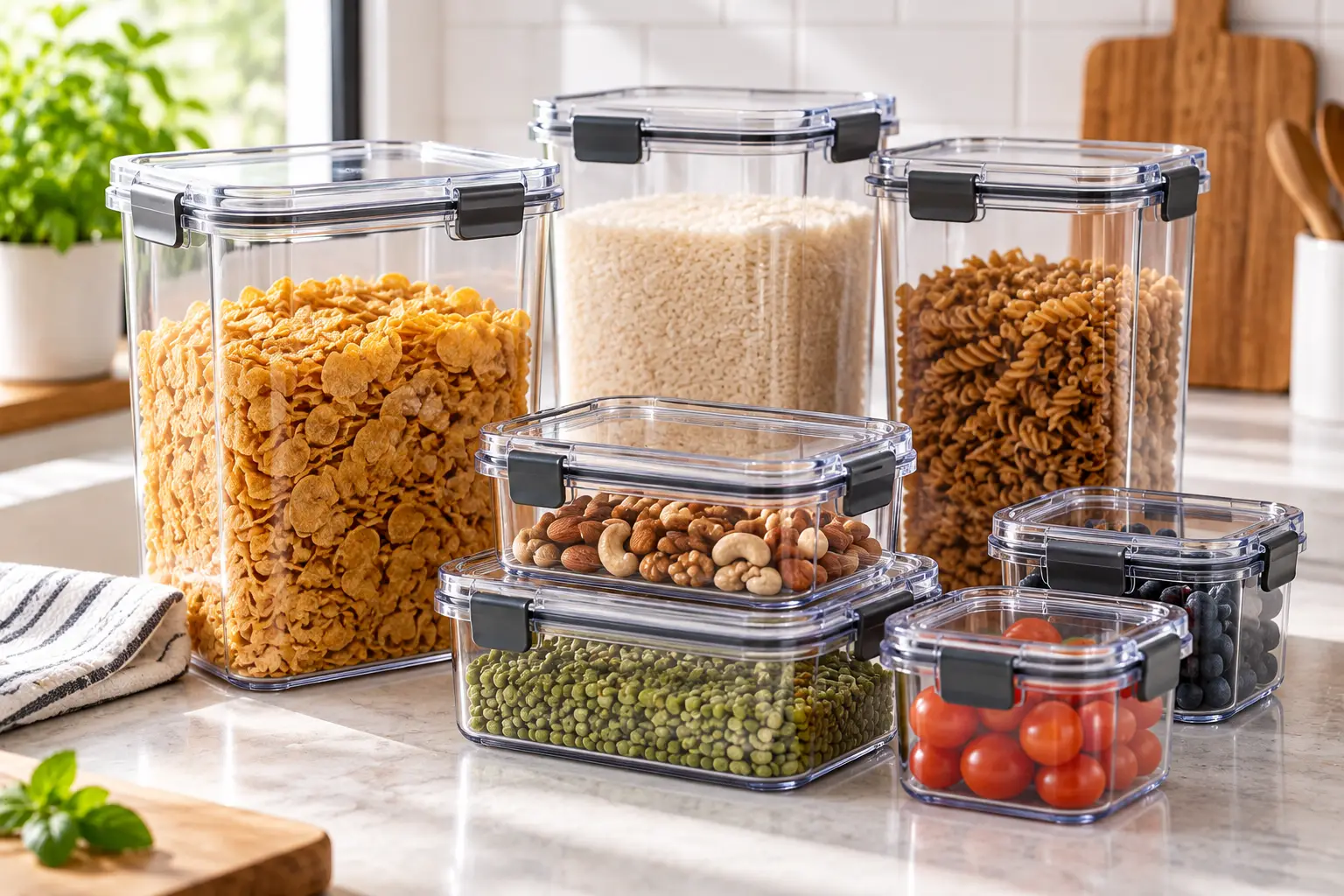
Walk into almost any American restaurant kitchen and you’ll see the same thing on every shelf: rows of crystal-clear square tubs with colored quart markings, stacked like building blocks. That’s not an accident. Polycarbonate storage containers solve three problems at once: you can see what’s inside without opening the lid, you can drop them on a tile floor without hearing that awful crack, and they stack so tightly that a crowded walk-in suddenly has room to breathe.
The material itself is genuinely impressive. As the overview of polycarbonate on Wikipedia explains, PC is the same family of plastic used for safety glasses, bullet-resistant glazing, and machine guards, because it combines optical clarity with remarkable impact strength. In a kitchen, that translates into a container that looks like glass but behaves more like a hockey puck.
Home cooks have caught on too. Meal-preppers, sourdough bakers, home brewers, and anyone who buys flour in 25-pound bags are discovering that these commercial food storage containers outlast most retail plastic sets several times over. They’re also refreshingly honest products: no gimmicky “smart” lids, just a durable tub, clear graduations, and a lid that seals.
That said, polycarbonate isn’t perfect. It contains bisphenol A (BPA), it isn’t meant for the microwave, and it can be damaged by the wrong cleaning chemicals. This guide covers all of that honestly. Below you’ll find seven real, Amazon-available picks from Cambro, Rubbermaid Commercial, and Carlisle, each analyzed against its actual spec sheet, plus practical setup advice, a materials comparison, and the safety context you need before you buy. ✅
Quick Comparison: The 7 Best Polycarbonate Storage Containers at a Glance
Short on time? This table lines up all seven picks by shape, capacity, rated temperature range, and lid situation, which is the detail that trips up the most first-time buyers. Price ranges are approximate at the time of writing; check the current price on Amazon before you buy.
| Product | Shape / Capacity | Rated Temp Range | Lid Included? | Approx. Price | Best for |
|---|---|---|---|---|---|
| Cambro Camwear CamSquare 8 Qt (8SFSCW135) | Square, 8 qt | -40°F to 210°F | No, sold separately | Around $15–$30 each | Best overall: stocks, sauces, bulk prep |
| Rubbermaid Commercial Space Saving 8 Qt (FG630800CLR) | Square, 8 qt | -40°F to 212°F | No, sold separately | Around $14–$30 each | Dual quart/liter graduations, Made in USA |
| Carlisle StorPlus 6 Qt 2-Pack (11952-207) | Square, 6 qt ×2 | -40°F to 212°F (per retailer listing) | Yes, red lids | Around $30–$50 per pack | Buyers who want lids in the box |
| Cambro Camwear Round 12 Qt (RFSCW12135) | Round, 12 qt | -40°F to 210°F | No, sold separately | Around $20–$40 | Dough proofing, brining, liquids |
| Carlisle StorPlus Round 18 Qt (1076807) | Round, 18 qt | -40°F to 212°F | No, sold separately | Around $30–$55 | Big batches, easy scooping |
| Cambro Camwear Food Box 18x26x6 (18266CW135) | Box, 8.75 gal | -40°F to 210°F | No, cover sold separately | Around $35–$75 | Bulk produce, proteins, sheet-pan footprint |
| Cambro Camwear 1/6 Size Food Pan 4″ (64CW135) | Pan, 1.6 qt | -40°F to 210°F | No, sold separately | Around $4–$12 each | Fridge organizing, portioned toppings |
Looking at the table, the two 8-quart squares from Cambro and Rubbermaid Commercial are nearly twins on paper, so your decision comes down to graduation style and which lid ecosystem you’ll commit to. If you hate hunting for lids, the Carlisle StorPlus 6 Qt 2-Pack is the only pick here that ships with them. The round options win when you’re stirring, ladling, or proofing dough, while the Cambro Camwear Food Box is the move for anyone storing volume rather than variety.
💬 One click helps other shoppers make an informed choice too! 😊
Top 7 Polycarbonate Storage Containers: Expert Analysis
Every pick below is a real product you can find on amazon.com, analyzed against its published specs and whatever genuine customer feedback we could verify. Where we couldn’t verify a meaningful pool of reviews, we say so instead of guessing.
1. Cambro Camwear CamSquare 8 Qt (8SFSCW135) — the restaurant-standard all-rounder
If you could only buy one size, this is the container professional kitchens default to, and for good reason. The Cambro Camwear CamSquare 8 Qt is made from Cambro’s Camwear polycarbonate, rated from -40°F to 210°F, NSF listed, and resistant to stains, acids, and odors. In practice, that temperature range means you can pour in warm (not boiling) stock, chill it in the fridge, and later freeze leftovers in the same tub. The acid resistance matters more than it sounds: tomato sauce and turmeric-heavy curries are what usually ghost cheap plastic orange.
The square footprint is the real hero. Square tubs waste far less shelf space than rounds, and the easy-read graduations let you check inventory without lifting a lid. Our honest take: this is the best fit for home cooks who batch-cook soups or sauces and for anyone building a matched system they’ll expand over the years, since Cambro sells the same footprint in 2, 4, 6, 8, 12, 18, and 22 quarts.
Across restaurant-supply retailers, the CamSquare line is widely treated as the benchmark other brands are compared to. We couldn’t verify a meaningful pool of Amazon reviews for this exact 8-quart SKU, so lean on the spec sheet here.
Pros:
- ✅ Square shape maximizes fridge and shelf space
- ✅ Wide -40°F to 210°F rated temperature range
- ✅ Huge size family makes expanding your system easy
Cons:
- ❌ Lid is sold separately and made of polyethylene
- ❌ Not microwave safe, like all polycarbonate tubs
💲 Typically around $15–$30 each: excellent value given its decade-plus service life in many kitchens.
2. Rubbermaid Commercial Space Saving 8 Qt (FG630800CLR) — dual graduations for precise measuring
The Rubbermaid Commercial Space Saving 8 Qt is the closest rival to the Cambro, and it carves out its niche with measurement markings in two colors: English units in red and metric in blue, printed on opposite sides. That sounds trivial until you’re scaling a recipe from a European cookbook and can read liters at a glance.
Rubbermaid rates this break-resistant polycarbonate tub from -40°F to 212°F, lists it as NSF certified and dishwasher safe, and manufactures it in the USA. The company also claims its square design stores up to 25% more on a shelf than round containers in the same space, which squares (pun intended) with the basic geometry. Handle holes let water drain after a wash cycle, so you’re not dumping puddles on your counter.
Who’s it for? Bakers, home brewers, and anyone who measures by volume, plus buyers who prefer a Made in USA label. It’s also a smart pick if you already own Rubbermaid Commercial lids.
We couldn’t verify a large pool of Amazon customer reviews for this specific SKU, so weigh the spec sheet more heavily. The broader Space Saving line, however, is a fixture across US foodservice suppliers.
Pros:
- ✅ English and metric graduations on opposite sides
- ✅ Made in USA with a -40°F to 212°F rating
- ✅ Drain holes in the handles speed up drying
Cons:
- ❌ Container only; you’ll need to buy lids separately
- ❌ Lids don’t reliably cross-fit Cambro containers
💲 Around $14–$30 each depending on seller and pack size: strong value, especially in multi-packs.
3. Carlisle StorPlus 6 Qt 2-Pack (11952-207) — the only pick with lids in the box
Here’s the pick for people who hate the “oh, the lid is extra?” surprise. The Carlisle StorPlus 6 Qt 2-Pack includes two clear polycarbonate square containers plus two red snap-on lids, with red graduations molded in.
Carlisle reinforces the top and bottom corners, which is exactly where square tubs tend to chip after years of being dropped into bus tubs and dish racks. The retailer listing shows a -40°F to 212°F range, NSF listing, and Made in America production. Six quarts is a sweet spot for home use: big enough for a double batch of chili, small enough to fit on a standard refrigerator shelf without hogging it.
Our analysis: this is the easiest entry point for a household that wants commercial durability without building a system piece by piece. The red lids also make a handy color-coding cue, for example reserving them for raw proteins.
On customer sentiment, the limited reviews we found on WebstaurantStore mention lids that close securely and containers that hold cold temperatures well. That’s a small sample, so treat it as encouraging rather than conclusive.
Pros:
- ✅ Lids included, so it’s ready to use immediately
- ✅ Reinforced corners resist the most common chips
- ✅ Six quarts fits standard home refrigerators easily
Cons:
- ❌ Smaller review base than the Cambro equivalents
- ❌ Fewer size options sold as ready-made lidded packs
💲 Roughly $30–$50 per two-pack: fair value once you factor in the included lids.
4. Cambro Camwear Round 12 Qt (RFSCW12135) — best for dough, brine, and liquids
Round containers get dismissed as space-wasters, but the Cambro Camwear Round 12 Qt proves there’s a job only a round tub does well. Liquids pour cleanly from a round rim, whisks and spoons don’t get trapped in corners, and dough rises evenly without wedging itself into four edges.
The specs mirror the CamSquare: Camwear polycarbonate, -40°F to 210°F, stain resistant, NSF listed, dishwasher safe, and explicitly not microwave safe. Twelve quarts is the capacity sourdough bakers and pickle makers tend to love, because it fits a large batch of bread dough or a whole chicken in brine with room to spare. Molded-in handles help when the container is full and slippery.
The trade-off is real: a round tub wastes corner space on a shelf. So buy one or two rounds for specific tasks rather than an entire round system.
On WebstaurantStore, the review summary for this container says most buyers find it reliable for both home and commercial use, and bread storage comes up repeatedly among frequently mentioned terms. That lines up with how bakers actually use it.
Pros:
- ✅ Round shape is ideal for stirring, pouring, and proofing
- ✅ Generous 12-quart capacity for brining whole birds
- ✅ Reviewers report reliable home and commercial use
Cons:
- ❌ Wastes shelf corners compared with square tubs
- ❌ Lid sold separately, adding to the total cost
💲 Around $20–$40: good value for a specialized workhorse you’ll use weekly.
5. Carlisle StorPlus Round 18 Qt (1076807) — spoonable bottom for easy scooping
The Carlisle StorPlus Round 18 Qt solves a small but maddening problem: food stuck in the bottom edge. Its rounded, “spoonable” bottom lets a ladle or scoop reach every last bit, which means less waste when you’re portioning rice, flour, or chopped vegetables.
Specs per the dealer listing: clear polycarbonate, -40°F to 212°F, molded-in capacity indicators, a date indicator, grip handles, stacking with other StorPlus containers, dishwasher safe, NSF listed, and Made in USA. The date indicator is a quietly great feature for anyone practicing FIFO (first in, first out) rotation, because you’re not relying on masking tape that peels off in the fridge.
Eighteen quarts is a lot of container. Practically, it suits a 25-pound bag of sugar or rice, or roughly 20 pounds of flour, large salad batches for events, or a holiday brine. Our honest opinion: it’s overkill for a small apartment kitchen but perfect for big families, caterers, and serious bulk buyers.
We couldn’t verify a meaningful set of Amazon reviews for this exact model, so we’re relying on its published specs and Carlisle’s broader reputation in US foodservice.
Pros:
- ✅ Spoonable bottom reduces stuck-on waste
- ✅ Built-in date indicator supports FIFO rotation
- ✅ Large 18-quart capacity for bulk staples
Cons:
- ❌ Too large for most standard home fridge shelves
- ❌ Fewer verifiable customer reviews than Cambro
💲 Typically around $30–$55: solid value if you genuinely need bulk capacity.
6. Cambro Camwear Food Box 18x26x6 (18266CW135) — bulk storage on a sheet-pan footprint
The Cambro Camwear Food Box 18x26x6 isn’t a tub; it’s a shallow, wide box that matches the footprint of a full sheet pan, so it slides onto standard bakery and refrigerator racks. Capacity is roughly 8.75 gallons.
That shallow 6-inch depth is the clever part. Food stored in shallow layers cools faster, which matters for food safety when you’re chilling large batches of cooked food. The smooth interior makes it easy to wipe clean, and the clear polycarbonate lets you spot spoilage or low stock from across the room. Cambro sells a matching clear polycarbonate cover (1826CCW135) separately.
Who should buy it? Caterers, home canners processing a garden haul, fishermen and hunters handling large cuts, and anyone with a garage fridge or chest freezer. For a typical kitchen refrigerator, it’s simply too large.
We couldn’t verify a meaningful pool of Amazon reviews for this specific box, so the recommendation rests on its specs and its widespread use in commercial kitchens.
Pros:
- ✅ Sheet-pan footprint fits standard commercial racks
- ✅ Shallow depth helps cooked food chill faster
- ✅ Clear walls show inventory without unstacking
Cons:
- ❌ Cover sold separately and adds meaningful cost
- ❌ Won’t fit most home refrigerators
💲 Around $35–$75 for the box alone: worthwhile for true bulk storage.
7. Cambro Camwear 1/6 Size Food Pan 4″ (64CW135) — the budget fridge organizer
The Cambro Camwear 1/6 Size Food Pan 4″ is the smallest and cheapest pick here, and arguably the most underrated for home use. At 1.6 quarts and roughly 6⅜ by 6 15/16 inches, it’s the pan you see holding diced onions and shredded cheese in sandwich-shop prep rails.
At home, that same footprint becomes a modular fridge organizer. Three of them sit side by side on a shelf, holding cut fruit, prepped veggies, and leftover herbs, all visible at once. The specs: Camwear polycarbonate, -40°F to 210°F, NSF listed, dishwasher safe, stackable, and explicitly not microwave or steam-table safe.
This is the pick for meal-preppers, parents packing lunches, and anyone who wants to try commercial polycarbonate food storage containers without a big investment.
Customer sentiment is unusually well documented: at the time of research, WebstaurantStore listed a 4.9-out-of-5 average across more than 200 customer reviews. That’s a strong, verifiable signal for such a simple product.
Pros:
- ✅ Very affordable way to try commercial polycarbonate
- ✅ Modular footprint turns a fridge into a prep rail
- ✅ Strong, verifiable customer ratings on WebstaurantStore
Cons:
- ❌ Small 1.6-quart capacity limits batch storage
- ❌ Lids sold separately, often in a different plastic
💲 Usually around $4–$12 each: outstanding value, especially in six-packs.
✨ Don’t miss these sturdy picks!
🔍 Take your kitchen storage to the next level with this carefully curated lineup. Click a highlighted item to check current pricing and availability. These picks will help you keep food fresher, shelves tidier, and leftovers visible, so nothing gets forgotten in the back of the fridge again!
Getting Started: Your First 30 Days With Polycarbonate Storage Containers
Buying the containers is the easy part. Setting them up so they actually change how your kitchen works takes a little intention. Here’s a simple 30-day plan.
Week 1: Wash, label, and map your shelves 🧽
Wash every new container before first use, either on the top rack of the dishwasher or by hand with a mild dish soap. Then measure your fridge shelves. A standard home refrigerator shelf is usually deep enough for two 8-quart squares side by side, while 1/6 size pans fit three across on most shelves. Knowing this before you buy more prevents the classic “I bought 22-quart tubs that don’t fit anywhere” mistake.
Week 2: Build a labeling habit 🏷️
Use removable masking tape or dissolvable food labels on the container wall, never permanent marker directly on polycarbonate, which can be stubborn to remove. Write the contents and the date. To decide how long things can stay, the FoodSafety.gov cold food storage chart gives conservative refrigerator and freezer limits for leftovers, meats, and more.
Week 3: Start FIFO rotation 🔄
FIFO stands for first in, first out. When you refill flour or rice, empty the remaining old product into a bowl, add the fresh supply to the bottom, and pour the old on top. Clear walls make this painless, because you can see exactly where the old stock sits.
Week 4: Audit and adjust 📋
After a month, notice which sizes you reach for constantly and which sit unused. Most households discover they want more 2–4 quart squares and fewer giant tubs. Expand based on real use, not guesswork.
Common first-month mistakes ❌
- Pouring boiling liquid straight in (let it cool below about 200°F first)
- Microwaving leftovers in the container
- Scrubbing with abrasive pads that leave cloudy scratches
Real-World Scenarios: Matching the Right Container to Your Life
Specs only mean something when they meet a real routine. Here are three common buyer profiles and the picks that fit each, with the reasoning behind them.
🍲 The Sunday meal-prepper (budget around $60–$100)
You cook four or five big batches every weekend and portion them out for the week. Your priorities are fridge space, visibility, and easy stacking. Start with four Cambro Camwear 1/6 Size Food Pan 4″ pans for chopped vegetables and sauces, plus two Cambro Camwear CamSquare 8 Qt tubs for soups and grains. The 1/6 pans turn a fridge shelf into a mini prep line, while the 8-quart squares handle volume. Because everything shares Cambro’s ecosystem, adding lids and sizes later stays simple.
🍞 The weekend sourdough baker (budget around $40–$80)
You mix dough two or three times a week and keep 20 pounds of flour on hand. A Cambro Camwear Round 12 Qt is your dough-proofing vessel, since its round walls let dough rise evenly and its graduations show exactly when it has doubled. For flour, the Rubbermaid Commercial Space Saving 8 Qt is ideal because its metric markings help when you follow recipes by weight-and-volume conversions. Frequency of use is high, so durability justifies the commercial price.
🎣 The big-family bulk buyer (budget around $100–$180)
You shop at warehouse clubs, process hunting or fishing hauls, and have a garage fridge. The Carlisle StorPlus Round 18 Qt handles 25-pound bags of rice or sugar, while the Cambro Camwear Food Box 18x26x6 stores large cuts in shallow layers that chill quickly. Add the Carlisle StorPlus 6 Qt 2-Pack for everyday leftovers, since those lids come included and save you a separate purchase.
Problem → Solution: Fixing the Most Common Container Headaches
Even the toughest polycarbonate food storage containers develop quirks over time. Here’s how to fix the five problems owners run into most.
1. Cloudy or hazy walls 🌫️
Problem: Your crystal-clear tub now looks foggy. Solution: Haze usually comes from mineral deposits or micro-scratches. Soak in a mix of warm water and white vinegar for 15–20 minutes to dissolve hard-water film. If it’s scratching, switch to soft sponges; scratches can’t be polished out without dulling the surface further.
2. Lingering odors from garlic or fish 🧄
Problem: Your Cambro Camwear CamSquare 8 Qt still smells like last week’s kimchi. Solution: Polycarbonate resists odors well, but the polyethylene lids absorb them more readily. Wash lids separately, then leave them in sunlight for a few hours. Baking soda paste works on stubborn smells.
3. Hairline cracks near the rim ⚠️
Problem: A crack appears after years of use. Solution: Polycarbonate can stress-crack when exposed to harsh, high-alkaline detergents or ammonia-based cleaners. Retire any cracked container from food use (it can harbor bacteria) and switch to a mild, pH-neutral detergent.
4. Lids that won’t stay sealed 🔒
Problem: Lids pop off or feel loose. Solution: Make sure lids match the brand. Cambro, Rubbermaid Commercial, and Carlisle lids don’t reliably cross-fit, even at the same quart size.
5. Warped containers after hot use 🔥
Problem: The base no longer sits flat. Solution: It was probably exposed to heat above its rating, such as a microwave or steam table. Stay within the -40°F to 210°F window.
How to Choose Polycarbonate Storage Containers
Choosing well comes down to seven questions. Work through them in order and the right pick usually becomes obvious.
- Measure your shelves first. Container height and footprint matter more than capacity, because a tub that doesn’t fit your fridge just becomes clutter.
- Pick square for storage, round for tasks. Squares store more per shelf; rounds are better for stirring, pouring, and proofing dough.
- Confirm the temperature rating. Most polycarbonate is rated about -40°F to 210°F. That covers freezer and fridge use but rules out microwaves and steam tables.
- Check whether lids are included. Many commercial food storage containers are sold as “container only,” which can add 20–40% to your real cost.
- Commit to one brand ecosystem. Lids rarely cross-fit between Cambro, Rubbermaid Commercial, and Carlisle, so mixing brands means mixing lids.
- Look for NSF listing. It signals the container was evaluated for food-equipment sanitation and material safety in commercial use.
- Decide how you feel about BPA. If you’d rather avoid it entirely, choose polypropylene or Tritan instead (more on that below).
Polycarbonate vs. Polypropylene vs. Tritan vs. Glass
Polycarbonate isn’t the only option, and it isn’t always the best one. Here’s how it stacks up against the alternatives you’ll see side by side on Amazon.
| Material | Clarity | Impact Resistance | Typical Temp Range | Contains BPA? | Best for |
|---|---|---|---|---|---|
| Polycarbonate (PC) | Glass-clear | Excellent | About -40°F to 210°F | Yes | Long-term, high-use storage where visibility matters |
| Polypropylene (PP) | Translucent, cloudy | Good, more flexible | Varies; often higher heat tolerance | No | Budget storage, hot-fill, some microwave-safe lines |
| Polyethylene (PE) | Opaque white | Good, but softer | About -40°F to 160–180°F | No | Cheap bulk bins and lids |
| Tritan copolyester | Glass-clear | Very good | Varies by brand | No (BPA-free) | Clear storage without BPA |
| Glass | Perfectly clear | Poor (shatters) | Oven and microwave safe | No | Reheating and serving at home |
The takeaway: polycarbonate wins on the combination of clarity and toughness, which is why commercial kitchens love it. However, if BPA is a dealbreaker for you, Tritan offers similar clarity, while polypropylene is the budget-friendly, microwave-friendlier route. Glass remains the champion for reheating, but one drop on tile ends its career.
When polypropylene makes more sense
Cambro and Rubbermaid Commercial both sell translucent polypropylene versions of their square containers, usually for less money. They’re slightly cloudy and more flexible, which makes them less prone to cracking from a hard drop but more prone to staining. For dry goods like pasta, or for anyone avoiding BPA, they’re a perfectly sensible choice.
Safety, Regulations, and the BPA Question
Let’s address the elephant in the pantry. Polycarbonate is made using bisphenol A (BPA), and small amounts can migrate into food, especially with heat or worn, scratched surfaces.
What US regulators say
According to the FDA’s questions and answers on BPA in food contact applications, the agency regulates BPA as a food contact substance, has reviewed hundreds of studies, and continues to monitor new research. FDA has historically stated that BPA is safe at the low levels that occur in food. Separately, FDA no longer allows BPA-based polycarbonate in baby bottles and sippy cups, after manufacturers abandoned that use.
Practical guidance that makes sense
FDA’s own consumer advice has included two simple, sensible precautions: avoid putting very hot or boiling liquids you plan to eat into BPA-containing plastic, and discard containers that are badly scratched. Both are easy habits with polycarbonate storage containers.
Other standards worth knowing
- NSF listing: Most commercial picks here are NSF listed, indicating evaluation for food-equipment sanitation in commercial settings.
- California Proposition 65: You’ll often see a Prop 65 warning on polycarbonate products sold online, because BPA is on California’s list.
- Recycling code 7: Polycarbonate falls under resin code 7, but code 7 is a catch-all, so not every “7” item contains BPA.
- International context: The European Union adopted rules in late 2024 phasing out BPA in most food contact materials, with transition periods. That doesn’t change US law, but it’s useful context.
Our honest framing: polycarbonate is legal, widely used, and considered safe by FDA at current exposure levels. If you prefer extra caution, keep it for cold and dry storage, never microwave it, and replace scratched containers.
Long-Term Cost and Maintenance
Here’s where polycarbonate storage containers quietly beat cheap retail sets: cost per year of use.
| Product | Approx. Upfront Cost (with lid) | Realistic Lifespan* | Rough Cost per Year | Best for |
|---|---|---|---|---|
| Cambro Camwear 1/6 Size Food Pan 4″ | Around $6–$15 | 5+ years | Under $3 | Budget fridge organization |
| Cambro Camwear CamSquare 8 Qt | Around $20–$38 | 5–10 years | About $3–$7 | Everyday batch storage |
| Rubbermaid Commercial Space Saving 8 Qt | Around $18–$38 | 5–10 years | About $3–$7 | Measured, metric-friendly storage |
| Cambro Camwear Food Box 18x26x6 | Around $50–$95 | 5–10 years | About $6–$18 | Bulk proteins and produce |
*Lifespan is our estimate for careful home use, not a manufacturer guarantee. Commercial dish-machine use shortens it.
Reading the table, even the priciest pick works out to pennies per week. Compare that with a $20 retail set that cracks or stains within a year, and the math clearly favors commercial-grade containers. The real cost risk isn’t the tub; it’s buying the wrong size and never using it.
Maintenance checklist 🧼
- Wash with mild, pH-neutral dish soap
- Avoid ammonia, bleach-heavy, or highly alkaline cleaners
- Skip abrasive scrubbers; use soft sponges
- Air-dry fully before stacking to prevent trapped moisture
- Inspect monthly for cracks and retire damaged containers
Features That Actually Matter (and Ones That Don’t)
Marketing language can make every container sound revolutionary. Here’s what genuinely affects your daily experience.
✅ Features that matter
- Measurement graduations: They turn your container into a measuring tool and an inventory gauge at once.
- Square footprint: It’s the single biggest factor in how much fits on your shelves.
- Molded handles with drain holes: They make full containers safer to carry and faster to dry.
- Reinforced corners: As on the Carlisle StorPlus 6 Qt 2-Pack, they protect the most fragile spot on a square tub.
- Date indicators: They support FIFO rotation without tape, as seen on the Carlisle StorPlus Round 18 Qt.
❌ Features that matter less than you think
- “Virtually unbreakable” claims: Polycarbonate is tough, but chemical stress still cracks it.
- Color-coded lids alone: They’re helpful only if you actually follow a color system.
- Giant capacity: Bigger isn’t better if it doesn’t fit your fridge.
Common Mistakes to Avoid When Buying Polycarbonate Food Storage Containers
A few predictable mistakes cause most buyer regret. Avoid these and you’ll be happy for years.
Mistake 1: Forgetting the lids 🙈
Most commercial listings say “container only” in small print. Add the lid cost before comparing prices, or choose a lidded pack like the Carlisle StorPlus 6 Qt 2-Pack.
Mistake 2: Mixing brands
A Cambro Camwear CamSquare 8 Qt next to a Rubbermaid Commercial Space Saving 8 Qt looks identical, but their lids don’t reliably interchange. Pick one family and stick with it.
Mistake 3: Expecting microwave use
Polycarbonate storage containers are designed for cold storage, dry goods, and prep, not reheating. Transfer food to a microwave-safe dish first.
Mistake 4: Buying too big
An 18- or 22-quart container sounds efficient, but in a home fridge it’s often a space hog. Most homes get more use from 2–8 quart sizes.
Mistake 5: Using harsh cleaners
Ammonia and strongly alkaline detergents can stress-crack polycarbonate over time. Gentle soap is all you need.
Clear Polycarbonate Containers With Lids for Home Kitchens
Commercial gear can feel intimidating in a home kitchen, but clear polycarbonate containers with lids translate surprisingly well. The trick is choosing sizes that match household quantities.
The ideal starter kit 🏡
For a typical family of four, a balanced starter kit looks like this: four 2-quart squares for leftovers and sauces, two 4-quart squares for prepped vegetables and grains, two 8-quart squares like the Cambro Camwear CamSquare 8 Qt for flour, sugar, and soups, and a few Cambro Camwear 1/6 Size Food Pan 4″ pans for snacks and cut fruit.
Where they shine at home
- Pantry staples: Flour, sugar, rice, oats, and pet food stay visible and protected from pests.
- Meal prep: Graduations let you portion grains and soups precisely.
- Baking: Proofing dough in a clear container shows exactly when it has doubled.
- Kid-friendly organization: Kids can see snacks without rummaging, which means fewer open bags.
Picking the right lids
Lids for clear polycarbonate containers are usually polyethylene or polypropylene, so they’re softer and slightly flexible. That’s intentional: it helps them seal snugly. Buy lids from the same brand and size range, and consider a second color to separate raw proteins from ready-to-eat food.
FAQ: Polycarbonate Storage Containers
❓ Are Cambro polycarbonate containers worth the price for home use?
❓ Can you put polycarbonate storage containers in the dishwasher?
❓ What size polycarbonate container holds a 25-pound bag of flour?
❓ Is it safe to store food in polycarbonate long term?
❓ Which is better to buy: polycarbonate or polypropylene food containers?
Conclusion: The Smartest Way to Upgrade Your Storage
Polycarbonate storage containers earn their reputation honestly. They’re glass-clear, remarkably tough, and built for the kind of daily abuse that destroys ordinary plastic, which is exactly why they’ve become the quiet backbone of professional kitchens across the country.
If you want one pick to start with, the Cambro Camwear CamSquare 8 Qt is the safest all-round choice, thanks to its square footprint, wide temperature range, and enormous size family. Prefer metric markings or a Made in USA label? The Rubbermaid Commercial Space Saving 8 Qt is its near-twin. Tired of buying lids separately? Grab the Carlisle StorPlus 6 Qt 2-Pack. Bakers should add a Cambro Camwear Round 12 Qt, bulk buyers will appreciate the Carlisle StorPlus Round 18 Qt and the Cambro Camwear Food Box 18x26x6, and anyone on a tight budget can start small with the Cambro Camwear 1/6 Size Food Pan 4″.
Whatever you choose, three habits will make them last: stay within the -40°F to 210°F range, skip the microwave, and wash with mild soap. Treat them well and these containers can easily outlive your current refrigerator. 🧊
🚀 Ready to transform your kitchen storage?
🔍 Pick the container that fits your routine from our lineup above. Click any highlighted product to check current pricing and availability on Amazon, and start enjoying a fridge where everything is visible, organized, and fresh!
Recommended for You
- Glass Fridge Storage Containers: 7 Best Picks That Actually Seal (2026)
- OXO Good Grips Smart Seal Glass Container Set Reviews: 7 Best (2026)
- Pint Containers: 7 Best Leakproof Picks for 2026 (Compared)
Disclaimer: This post contains affiliate links. As an Amazon Associate, I earn from qualifying purchases made through these links, at no additional cost to you.
✨ Found this article helpful? Share it with someone who needs it! 💬🤗