
In This Article
Why a Stainless Lunch Box for Kids Beats Another Plastic Container
If you’ve ever fished a warped, stained plastic bento out of the dishwasher in October, you already know why so many parents are switching to a stainless lunch box for kids. Plastic boxes tend to cloud, crack, and hold onto last week’s spaghetti sauce. Steel, on the other hand, shrugs off the dishwasher, the backpack tumble, and the occasional cafeteria floor drop. The catch? Not every stainless lunch box for kids is built the same — and the differences only show up once you start packing real lunches five days a week.
What Is a Stainless Lunch Box for Kids?
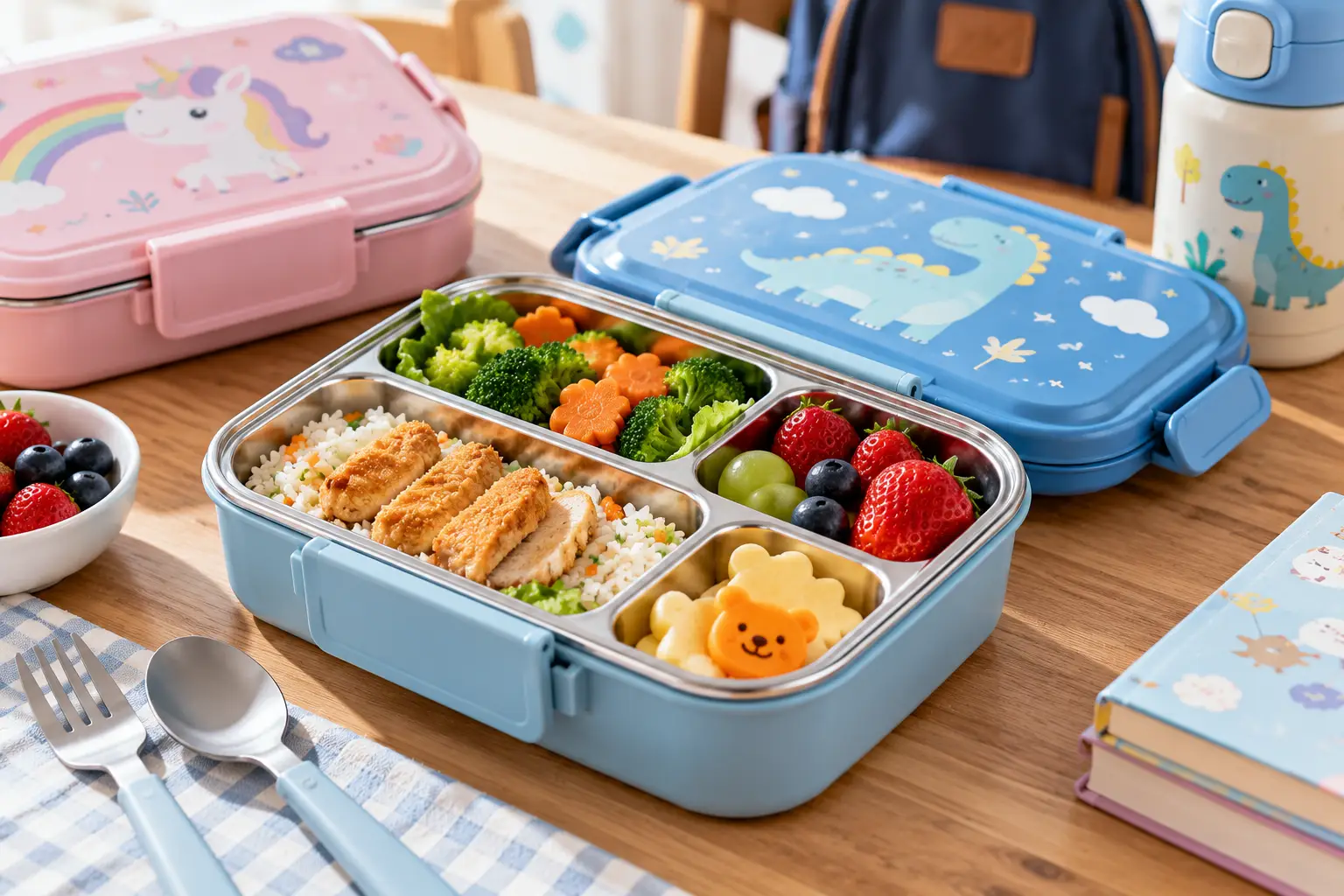
A stainless lunch box for kids is a reusable food container made from food-grade stainless steel — usually 18/8 (also sold as type 304 stainless steel) — often split into bento-style compartments. It replaces plastic boxes and baggies, resists stains and odors, and typically lasts for years.
That definition hides some important trade-offs, though. Some boxes are 100% steel with no seal at all, which means they’re great for dry foods and terrible for yogurt. Others pair a steel tray with a silicone-lined lid for leak resistance, which adds a part to wash but saves you from a soggy sandwich. And if your child wants warm mac and cheese at noon, you’re really shopping for a vacuum-insulated food jar, not a bento.
In this guide, you’ll find seven real products available on amazon.com, from a budget snack container to the premium all-in-one bento many parenting bloggers swear by. Each pick comes with honest analysis based on spec sheets and aggregated customer feedback — not invented test stories — plus practical packing advice you won’t find on a product listing. By the end, you’ll know exactly which metal lunch box for kids fits your child’s age, appetite, and lunch habits. ✅
Quick Comparison: The 7 Best Stainless Steel Lunch Boxes for Kids at a Glance
| Product | Type | Capacity / Layout | Leak Resistance | Price Range | Best for |
|---|---|---|---|---|---|
| PlanetBox Rover | All-in-one bento tray | 5 compartments + 2 lidded dippers | Tray no; dippers yes | $40–$75 (sets vary) | PlanetBox Rover: variety-loving grazers |
| Bentgo Kids Stainless Steel | Sealed bento | 3 compartments + silicone cup | Yes (sealed lid) | Around $35–$45 | Bentgo Kids Stainless Steel: wet foods, ages 3+ |
| LunchBots Large Cinco | Plastic-free bento | 5 compartments, 32 oz | No (dry foods) | Around $30–$45 | LunchBots Large Cinco: plastic-free purists |
| LunchBots Medium Trio | Plastic-free bento | 3 compartments, half-sandwich size | No (dry foods) | Around $20–$30 | LunchBots Medium Trio: preschool appetites |
| ECOlunchbox Three-in-One | Stacking two-tier | 31 oz total, 3 pieces | No | Around $30–$40 | ECOlunchbox Three-in-One: narrow lunch bags |
| Thermos Funtainer 10 oz Food Jar | Insulated food jar | 10 oz, single chamber | Yes | Around $15–$25 | Thermos Funtainer 10 oz Food Jar: hot lunches |
| Kid Basix Safe Snacker 23 oz | Lidded container | 23 oz, single chamber | Yes (silicone seal) | Around $20–$30 | Kid Basix Safe Snacker 23 oz: budget sandwich box |
Looking at the table above, the real dividing line isn’t price — it’s whether a box seals. The Bentgo Kids Stainless Steel, the Thermos Funtainer 10 oz Food Jar, and the Kid Basix Safe Snacker 23 oz can handle yogurt, applesauce, and saucy pasta, while the LunchBots Large Cinco, the LunchBots Medium Trio, and the ECOlunchbox Three-in-One trade leak resistance for a completely plastic-free build. The PlanetBox Rover sits in between: an open steel tray plus small sealed dippers for the wet stuff.
In practice, many families end up pairing two items — a dry-food bento plus a food jar — rather than hunting for one box that does everything. Prices shown are approximate ranges at the time of writing; check current pricing before you buy.
💬 One click helps other shoppers make an informed choice too! 😊
Top 7 Stainless Lunch Box for Kids Picks: Expert Analysis
Every pick below is a real product sold on amazon.com. The commentary is based on manufacturer spec sheets and recurring themes in customer reviews, not on fabricated hands-on tests.
1. PlanetBox Rover — the buy-once bento for grazers
If your child would happily eat ten small things rather than one big sandwich, the PlanetBox Rover is built for that personality. It’s a one-piece 18/8 stainless steel tray with five compartments and a hinged, latching lid — so there’s no separate lid to lose in the cafeteria. What that means in practice: fewer parts, faster packing, and nothing for a six-year-old to misplace.
The tray itself isn’t sealed, but sets typically include small lidded containers (the Little Dipper and Big Dipper) for hummus, yogurt, or ranch. Many sets also come with a carry bag and decorative magnets, which matters more than it sounds: a box your kid thinks is “theirs” tends to come home. Based on comparing the specs, the PlanetBox Rover is the strongest choice for families who want one box from kindergarten through middle school.
Reviews consistently praise how long it lasts — several parenting bloggers report using the same box for years. The most common complaints are the price, the weight for smaller children, and the fact that it really needs its matching bag.
Pros:
- ✅ One-piece tray with an attached lid that can’t get lost
- ✅ Five compartments encourage variety and portion control
- ✅ Long service life reported across many family reviews
Cons:
- ❌ Main tray isn’t leakproof; wet foods need the dippers
- ❌ Heavier and pricier than most competitors
💰 Expect roughly $40–$75 depending on the set; the cost per school year looks far better if it lasts as long as reviewers report.
2. Bentgo Kids Stainless Steel — the leak-resistant all-rounder
The Bentgo Kids Stainless Steel solves the biggest complaint about metal bentos: leaks. Bentgo describes it as the first stainless steel bento-style box with its leak-resistant design, and the key is a lid lined with silicone that’s contoured to seal each compartment individually.
You get three 18/8 stainless steel compartments plus a removable silicone cup, and Bentgo backs it with a 5-year limited warranty. In practice, that sealed lid means applesauce stays out of the crackers — something the all-steel boxes on this list can’t promise. The listed weight is about 1.6 pounds, so it’s sturdy rather than featherlight.
This is the stainless steel bento box for kids that most families should start with, especially if your child eats yogurt, cut fruit, or dressed pasta. Reviews consistently report that it doesn’t warp the way plastic Bentgo boxes can after a year of dishwashing, and many parents call it genuinely leak-resistant. A recurring complaint is that some kindergarteners struggle with the latches; others mention paint peeling on printed lids and a wide, flat footprint that needs a matching bag.
Pros:
- ✅ Sealed lid keeps wet foods in their own compartments
- ✅ Steel tray won’t warp in the dishwasher like plastic
- ✅ Five-year warranty adds long-term peace of mind
Cons:
- ❌ Latches can be tricky for the youngest kids
- ❌ Printed lid designs may chip or peel over time
💰 Usually in the $35–$45 range; strong value if leaks are your number-one worry.
3. LunchBots Large Cinco — 100% steel, zero plastic touching food
The LunchBots Large Cinco is for parents who want no plastic or silicone anywhere near their child’s food. The tray and the lid are both 18/8 food-grade stainless steel, and some retailers note it’s independently lab-certified lead-free.
The specs are refreshingly clear: 8 × 6 × 1.75 inches, 32 fl. oz (940 ml) capacity, about 17 ounces in weight, with two large sections and three smaller ones. That layout fits a wrap or half sandwich plus three small sides — a classic bento balance. The flat, low profile also slides into most standard lunch bags, unlike the PlanetBox Rover.
The honest trade-off is spelled out by LunchBots itself: this box isn’t leakproof, so it’s designed for dry foods only. The spec sheet doesn’t hide this, and reviews echo it — parents love the durability and easy cleaning but warn against juicy fruit or dips without a separate sealed container. An optional snap-on plastic “Dots” cover adds color on the outside only.
Pros:
- ✅ Completely plastic-free inside, including the lid
- ✅ Generous 32 oz capacity for bigger appetites
- ✅ Dishwasher safe and very hard to damage
Cons:
- ❌ Not leakproof; dry foods only without an add-on cup
- ❌ Separate lid can be misplaced at school
💰 Typically around $30–$45; excellent value for a plastic-free, long-lasting box.
4. LunchBots Medium Trio — sized right for little appetites
Not every child needs a full-size bento. The LunchBots Medium Trio is designed around half a sandwich and two small sides, which is exactly what many preschoolers and early elementary kids actually finish.
It measures about 6 × 5 × 1.75 inches and weighs roughly 0.6 pounds, so it won’t drag down a small backpack. Like the LunchBots Large Cinco, it’s 18/8 stainless steel with a snap-on steel lid, and some retailers list a lifetime warranty. What that means for you: smaller portions reduce the “came home half-eaten” problem, and a light box is one a four-year-old can actually open and carry.
Based on comparing the specs, this is the smartest first metal lunch box for kids under six. Aggregated feedback highlights its compact size and portion control, while the most common criticism is the same as its bigger sibling — the compartments aren’t leakproof. One practical note from long-time users: hard water can leave spots on the steel, which a quick towel-dry or a vinegar wipe usually fixes.
Pros:
- ✅ Compact, light build suits preschool hands
- ✅ Portions sized to reduce food waste
- ✅ All-steel construction with no plastic in contact with food
Cons:
- ❌ Too small for older kids with big appetites
- ❌ Not suitable for wet or saucy foods
💰 Often around $20–$30; one of the best entry points into stainless steel.
5. ECOlunchbox Three-in-One — a stacking tower for slim lunch bags
The ECOlunchbox Three-in-One takes a different approach: instead of a wide tray, it stacks. You get a lower container, an upper container, and a small snack pod that nests inside the top layer or travels on its own.
The published capacities are 12 oz bottom, 14 oz top, and 5 oz snack container — 31 oz in total — in a footprint of just 4 × 5.5 × 2.75 inches. That compact base fits narrow bags and backpack side pockets where a flat bento won’t. One spec worth noticing: ECOlunchbox lists 201-grade stainless steel, not 18/8. Grade 201 swaps some nickel for manganese, which generally makes it a little less corrosion-resistant than 304, so drying it promptly matters more.
The brand is a certified B Corp, a plus for eco-minded families. Reviews consistently describe it as durable and easy to clean, with some owners using one for years. The complaints center on the side clips — a few buyers report clips loosening or coming off — and occasional units that don’t sit perfectly flush.
Pros:
- ✅ Small footprint fits narrow bags and side pockets
- ✅ Removable snack pod adds flexibility
- ✅ Plastic-free build from a certified B Corp brand
Cons:
- ❌ Not leakproof, since there are no gaskets
- ❌ Side clips draw durability complaints from some owners
💰 Usually about $30–$40; fair value if a slim, stackable shape is what your bag needs.
6. Thermos Funtainer 10 oz Food Jar — warm lunches without a microwave
None of the bentos above keep food hot, so the Thermos Funtainer 10 oz Food Jar fills that gap. It’s a double-wall vacuum-insulated stainless steel jar rated to keep food hot for up to 5 hours and cold for up to 7 hours.
The kid-focused details are what make it work at school: a push-button lid that small hands can open, a folding spoon stored in the lid, and a wide mouth that’s easy to fill and clean. At roughly 3.5 inches wide and 5.3 inches tall, it fits beside almost any bento in a lunch bag. That 10 oz capacity is right for a child’s portion of soup, pasta, rice, or chili.
Reviews strongly favor it, but the most useful theme is about technique: parents who pre-heat the jar with boiling water report noticeably warmer food at lunch. Several reviews also note food drifting toward room temperature near the 5-hour mark, so if your child eats at 12:30 and you pack at 7:00, plan accordingly. The lid’s rubber gasket needs occasional deep cleaning to avoid odors.
Pros:
- ✅ Vacuum insulation handles soups, pasta, and leftovers
- ✅ Push-button lid and built-in folding spoon
- ✅ Compact enough to pair with any bento box
Cons:
- ❌ Heat fades near five hours without pre-heating
- ❌ Lid gasket needs regular removal and cleaning
💰 Generally around $15–$25; one of the best-value add-ons for any lunch setup.
7. Kid Basix Safe Snacker 23 oz — the budget sealed sandwich box
The Kid Basix Safe Snacker 23 oz is the simplest pick here: one roomy 18/8 stainless steel container with a lid that’s attached on one side, so it can’t wander off. It’s the leak proof stainless steel lunch box option for families who just need a sealed box, not a bento.
The lid is plastic with a silicone seal, which is the trade-off that delivers leak resistance at a lower price. It’s BPA- and phthalate-free, top-rack dishwasher safe, and the lid can be removed for cleaning. The line also comes in 7 oz and 13 oz sizes, so you can build a matching set for snacks. In practice, a 23 oz single chamber fits a full sandwich, or a salad paired with a small cup.
Kid Basix is a family-owned Colorado company known for early stainless steel kids’ products. Reviews describe the container as sturdy and say it locks securely. The recurring complaints: some users find the lid stiff to open, and a few report the plastic lid part breaking after a drop.
Pros:
- ✅ Attached lid can’t get lost at school
- ✅ Silicone seal handles moist foods
- ✅ Available in three sizes for mix-and-match sets
Cons:
- ❌ Plastic lid is the weak point when dropped
- ❌ No compartments, so foods need separate wrapping
💰 Usually around $20–$30; solid value for a basic sealed box.
✨ Don’t miss these top-rated picks!
🔍 Take your school lunch routine to the next level with this carefully curated lineup. Click a highlighted item to check current pricing and availability. These picks will help you pack fresher, waste-free lunches your kids will actually look forward to!
Your First 30 Days With a Stainless Lunch Box for Kids: A Practical Guide
A new box only pays off if your child actually uses it. Here’s a simple four-week plan that turns a shiny new purchase into a daily habit.
Week 1: Practice at Home 🏠
Before the first school day, have your child open and close the box at the kitchen table five or six times. Latches that feel easy to you can be a real struggle for a kindergartner, and you’d rather learn that on a Sunday than from a teacher’s note. Wash the box once before first use to remove any manufacturing residue.
Week 2: Nail the Cold Chain ❄️
Steel holds temperature a little better than thin plastic, but it doesn’t refrigerate anything. The USDA’s guidance on keeping “bag” lunches safe recommends at least two cold sources — for example, two frozen gel packs, or one gel pack plus a frozen juice box — in an insulated bag. Place one under the box and one on top. A trick that works well with stainless steel: chill the empty box in the fridge overnight so it starts cold.
Week 3: Learn Your Box’s Leak Limits 💧
If you chose an unsealed box like the LunchBots Large Cinco or the ECOlunchbox Three-in-One, test it with a wet food on a weekend. Fold a paper towel under juicy fruit, and move dips into a sealed cup. Sealed boxes like the Bentgo Kids Stainless Steel handle this better, but no lid loves thin liquids like soup.
Week 4: Lock In a Cleaning Routine 🧽
Have your child empty leftovers at home, not at school, so you can see what they actually ate. Wash the same evening, pull out silicone seals weekly to clean underneath, and towel-dry the steel right away to prevent water spots. For a food jar like the Thermos Funtainer 10 oz Food Jar, leave the lid off overnight so the gasket fully dries.
Real-World Scenarios: Matching the Right Box to Your Family
Specs only matter once you map them onto a real school day. These three common family profiles show how the same seven products shake out very differently.
👧 Profile 1: The Preschooler With a Small Appetite
Budget: under $35 · Lunch at 11:15 a.m. · Packed at 7:30 a.m.
A four-year-old who eats a few bites of everything needs a light box with small portions. The LunchBots Medium Trio is the natural fit: half a sandwich, a few berries, some cheese cubes. Because lunch comes less than four hours after packing, two cold sources in an insulated bag are plenty. If yogurt is a daily request, add a small sealed cup rather than upgrading the whole box.
🧒 Profile 2: The Second-Grader Who Hates Soggy Food
Budget: $40–$60 · Lunch at 12:00 p.m. · Eats fruit, dips, and pasta salad
This child needs compartments that genuinely stay separate. The Bentgo Kids Stainless Steel is the strongest match thanks to its sealed lid, which keeps cucumber juice away from crackers. On cold days, pairing it with a Thermos Funtainer 10 oz Food Jar for leftover pasta keeps the total cost under $70 and covers both hot and cold menus.
👦 Profile 3: The Fifth-Grader With a Big Appetite
Budget: flexible · Lunch at 12:40 p.m. · Long bus ride · Plastic-free household
An older kid who’s hungry by lunch needs capacity and toughness. The PlanetBox Rover handles a full lunch plus snacks in one tray, while the LunchBots Large Cinco offers 32 oz for less money if your bag fits a flat box. With five-plus hours between packing and eating, follow the cold-chain steps carefully: chill the box overnight and use two frozen sources. If the bag is narrow, the stackable ECOlunchbox Three-in-One is the workaround.
Problem → Solution: Fixing the 5 Most Common Stainless Lunch Box Headaches
Even the best box runs into trouble. These are the issues that come up again and again in parent reviews, with practical fixes.
1. “My kid can’t open the latches.” 🔓 This shows up in reviews of sealed boxes, including the Bentgo Kids Stainless Steel. Practice at home first; many kids get it within a week. If not, a hinged tray like the PlanetBox Rover or a snap lid like the LunchBots Medium Trio asks less of small fingers.
2. “Juice from the fruit soaked the crackers.” 💦 Unsealed boxes such as the LunchBots Large Cinco are designed for dry foods. Put juicy fruit on a folded paper towel, use a small sealed dip cup, or switch to a sealed design for wet-heavy menus.
3. “There are white spots on the steel.” ✨ That’s usually hard-water mineral residue, not rust. Towel-dry right after washing and wipe occasionally with diluted white vinegar. This matters most with 201-grade steel like the ECOlunchbox Three-in-One.
4. “The hot food is lukewarm by lunch.” 🌡️ Pre-heat the Thermos Funtainer 10 oz Food Jar with boiling water for about five minutes, dump it, then add steaming-hot food. Fill it close to the top, since empty air space loses heat faster.
5. “The lunch smells weird after a few weeks.” 👃 Steel itself doesn’t trap odors, but silicone gaskets can. Pop seals out weekly, soak them in warm soapy water, and let everything air-dry fully before reassembling. Reviews of the Kid Basix Safe Snacker 23 oz and the Thermos jar both mention gasket care as the key to fresh-smelling lunches.
How to Choose a Stainless Lunch Box for Kids
Use these seven steps in order; each one narrows the field fast.
- Decide on wet vs. dry foods first. If yogurt, cut fruit, or dressing shows up weekly, you need a sealed lid. This single choice eliminates half the market.
- Match capacity to age. Preschoolers rarely finish more than about 16 oz of food; older kids may need 30 oz or more. An oversized box invites half-eaten lunches.
- Test the opening mechanism against your child’s hands. Latches, clips, and snap lids vary a lot. The youngest kids do best with hinged or simple snap designs.
- Check the steel grade. 18/8 (304) is the common standard for corrosion resistance. Grade 201 works well but needs prompt drying.
- Measure your lunch bag. Flat bentos like the PlanetBox Rover often need a dedicated bag; stacking designs fit narrower spaces.
- Plan for hot meals separately. No bento keeps food hot — budget for an insulated jar if warm lunches matter.
- Read the warranty. A five-year or lifetime warranty signals a brand that expects its product to last.
Stainless Steel vs. Plastic Lunch Boxes: An Honest Comparison
The plastic-free lunch box for kids trend is about more than looks. Here’s how the materials stack up for daily school use.
| Factor | Stainless steel | BPA-free plastic | Best for |
|---|---|---|---|
| Durability | Dents but rarely breaks | Can crack or warp over time | Stainless: multi-year use |
| Dishwasher heat | Handles it well | May warp with repeated hot cycles | Stainless: busy families |
| Stains and odors | Resists both | Tomato and curry often stain | Stainless: saucy menus |
| Weight | Heavier | Lighter | Plastic: very young kids |
| Upfront cost | Higher | Lower | Plastic: tight budgets |
| Microwave use | Never | Often allowed | Plastic: reheating at school |
The table makes the trade-off clear: steel wins on lifespan, cleaning, and staining, while plastic wins on weight, upfront price, and microwave convenience. One parent review of the Bentgo Kids Stainless Steel captures the shift well, noting that their earlier plastic box warped after a year of dishwasher cycles. If your school allows microwave reheating, a steel bento plus a microwave-safe glass container still beats an all-plastic setup.
Safety, Regulations, and Standards for Kids’ Lunch Boxes
In the US, materials that touch food are regulated by the FDA, while products designed primarily for children 12 and under generally fall under the Consumer Product Safety Improvement Act (CPSIA), which limits lead in paint and surface coatings. That’s why painted or printed exteriors deserve a closer look: reputable brands test them, and some, like LunchBots, advertise independent lead-free certification.
A few practical safety points worth knowing:
- ⚠️ Never microwave stainless steel. Metal and microwaves don’t mix; transfer food to a microwave-safe dish.
- 🧪 Nickel sensitivity is rare but real. 18/8 steel contains about 8% nickel. If your child has a diagnosed severe nickel allergy, ask your pediatrician before switching.
- 🧊 Temperature is the bigger risk. According to the USDA’s guidance on insulated lunch bags, perishable food in an uninsulated paper bag isn’t safe after about two hours. A steel box doesn’t change that; ice packs and an insulated bag do.
- 🔍 Check warranty and seller details. Buying from the brand’s official storefront helps you avoid knockoffs with unknown materials.
Long-Term Cost and Maintenance: The Real Price of a Stainless Lunch Box
Upfront price tells only half the story. The more useful number is cost per school year.
| Product | Approx. price range | If it lasts | Rough cost per school year | Best for |
|---|---|---|---|---|
| PlanetBox Rover | $40–$75 | 5+ years | Under $15 | PlanetBox Rover: long-haul value |
| Bentgo Kids Stainless Steel | $35–$45 | 5 years (warranty term) | Under $10 | Bentgo Kids Stainless Steel: warranty-backed |
| LunchBots Medium Trio | $20–$30 | 3–5 years | Under $10 | LunchBots Medium Trio: lowest entry cost |
| Thermos Funtainer 10 oz Food Jar | $15–$25 | 2–4 years | Under $10 | Thermos Funtainer 10 oz Food Jar: hot add-on |
These lifespans are illustrative estimates based on warranty terms and long-term owner reports, not guarantees. Even so, the pattern is clear: once a steel box survives two or three school years, it usually costs less per year than replacing plastic boxes and buying zip-top bags. The ongoing costs are small but real — replacement silicone seals, dip cups, and ice packs — so factor in a few dollars a year.
Features That Actually Matter (and Ones That Don’t)
Matter: ✅ a seal that fits your menu, ✅ a lid your child can open alone, ✅ capacity matched to appetite, and ✅ a warranty you can actually use.
Matter less than marketing suggests: printed designs (they can chip), a huge number of compartments (more corners to scrub), and “all-day” freshness claims, which depend far more on ice packs than on the box. A plain steel box plus a fun lunch bag often delivers the same “wow” for less.
Common Mistakes to Avoid When Buying a Metal Lunch Box for Kids
- ❌ Buying for the box, not the menu. An unsealed bento for a yogurt-every-day kid means daily frustration.
- ❌ Going too big for a small child. A 32 oz box for a preschooler often comes home half full and heavier than needed.
- ❌ Forgetting the bag. Wide, flat boxes don’t fit many standard lunch bags; measure before you buy.
- ❌ Expecting a bento to keep food hot. Only a vacuum-insulated jar does that.
- ❌ Skipping ice packs because steel “stays cold.” It doesn’t stay cold for hours on its own.
FAQ: Stainless Lunch Box for Kids
❓ Is a stainless lunch box for kids worth the higher price?
❓ Can a stainless steel bento box for kids go in the dishwasher?
❓ What size stainless lunch box does a kindergartner need?
❓ Are metal lunch boxes for kids safe from lead?
❓ Where's the best place to buy a stainless lunch box for kids?
Conclusion: Picking the Stainless Lunch Box for Kids That Fits Your Routine
The best stainless lunch box for kids isn’t the most expensive one — it’s the one that matches your child’s menu, hands, and appetite. If leaks are your biggest worry, the Bentgo Kids Stainless Steel is the safest all-around bet. For a box that may outlast elementary school, the PlanetBox Rover earns its premium. Plastic-free purists will be happiest with the LunchBots Large Cinco, or the LunchBots Medium Trio for little ones.
Need something slimmer? The stackable ECOlunchbox Three-in-One fits where flat bentos won’t. Want hot lunches? Add the Thermos Funtainer 10 oz Food Jar to any setup. And if you just need a sealed, affordable container, the Kid Basix Safe Snacker 23 oz does the job without fuss.
Whatever you choose, remember the two habits that matter more than any box: pack two cold sources, and dry the steel after washing. Get those right, and your kid’s new lunch box should come home clean, dent-tolerant, and ready for tomorrow. 🍎
🎒 Ready to upgrade lunchtime for good?
👉 Click any highlighted product above to check current pricing and availability, and pick the box that fits your child’s routine. A smarter lunch box today means fewer leaks, less waste, and happier lunch breaks all year long!
Recommended for You
- Clean Eatz Bulk 2026: 7 Smart Essentials to Stock Up Without Regret
- Keto Hack: 7 Smart Tools That Make Ketosis Easier in 2026
- Glass Fridge Storage Containers: 7 Best Picks That Actually Seal (2026)
Disclaimer: This post contains affiliate links. As an Amazon Associate, I earn from qualifying purchases made through these links, at no additional cost to you.
✨ Found this article helpful? Share it with someone who needs it! 💬🤗