
In This Article
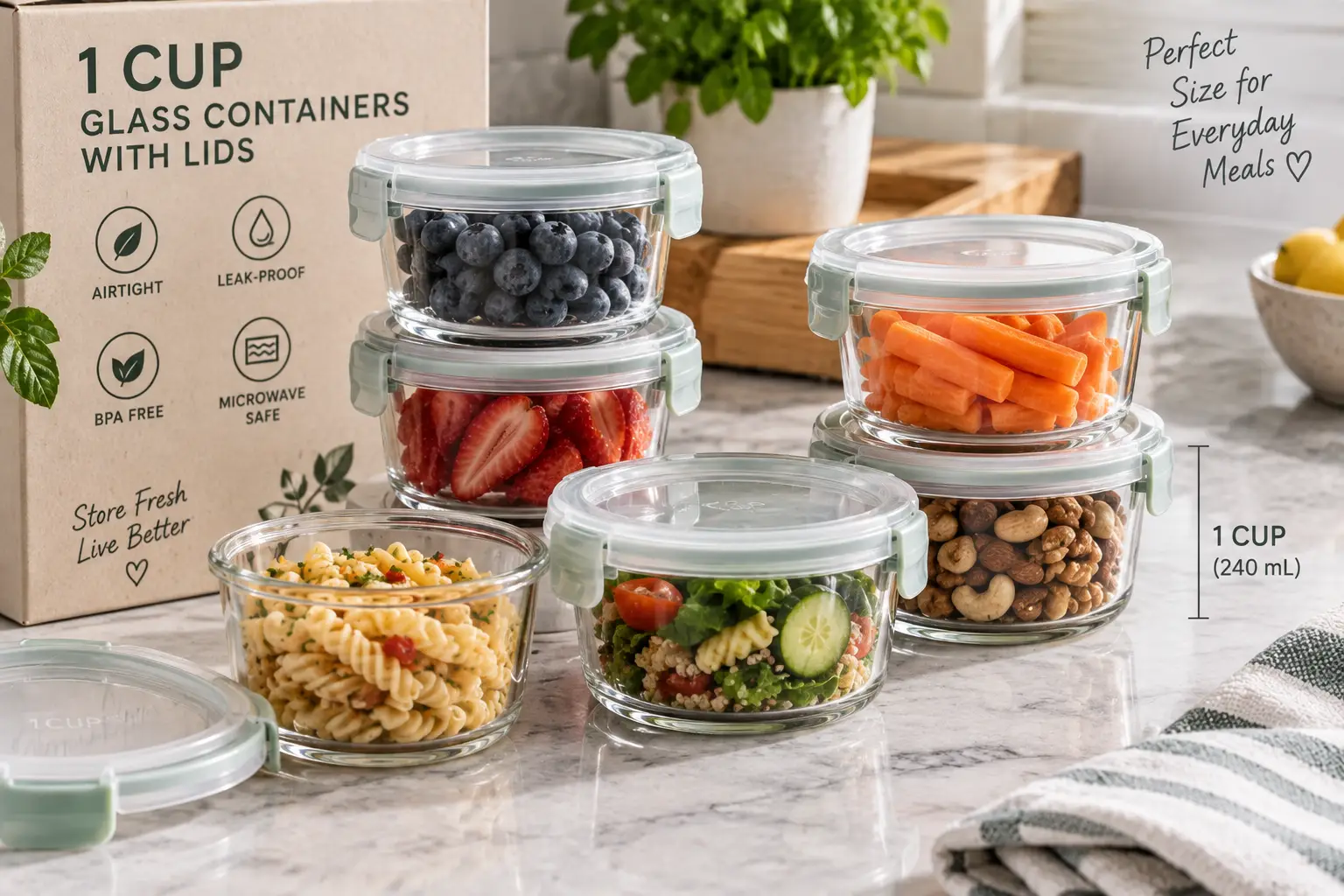
If your fridge door is a graveyard of mismatched lids and cracked plastic tubs, you already know the problem: most “storage solutions” aren’t actually solving anything. 1 cup glass containers with lids are the fix nobody talks about enough — small enough for a single serving of yogurt, salsa, or overnight oats, but sturdy enough to survive a decade of dishwasher cycles without staining, warping, or smelling like last Tuesday’s curry. What is a 1 cup glass container with a lid? It’s a compact, roughly 8-fluid-ounce food storage vessel, typically made from tempered or borosilicate glass, paired with an airtight or snap-fit lid — sized to hold exactly one standard measuring cup of food, making it a favorite for portion control, meal prep, and pantry organization.
We dug through real spec sheets, current Amazon listings, and aggregated customer feedback for seven genuinely available products — not a rehashed list of specs copied from a manufacturer’s page. You’ll find classic American-made options, a couple of import brands with clever latch systems, and one fully plastic-free pick for anyone trying to get every last scrap of plastic away from their food. Whether you’re building a meal-prep system from scratch or just need something better than the yogurt cup you’ve been reusing since March, this guide breaks down which 1 cup glass containers with lids are actually worth your money in 2026 — and, just as importantly, which ones aren’t.
One quick note before we dive in: this post contains Amazon affiliate links, which means we may earn a small commission if you buy through them, at no extra cost to you. That doesn’t change our analysis — we call out real drawbacks below, not just the good stuff.
Quick Comparison: 1 Cup Glass Containers With Lids at a Glance
Before the deep dive, here’s the short version. All seven of these small glass containers with lids are widely available, but they solve slightly different problems — so match the “Best For” column to your actual habits before you commit to a full set.
| Product | Lid Type | Price Range | Best For |
|---|---|---|---|
| Pyrex Simply Store 7202 | Snap-on plastic | Around $4–$6 (single); $15–$37 (multi-pack) | Everyday classic reliability |
| Anchor Hocking SnugFit | Snap-on plastic | Around $8–$15 (4-pack) | Budget bulk buying |
| Snapware Total Solution | 4-latch airtight | Around $5–$6 (single); $27–$39 (set) | Liquids and leakproof needs |
| Rubbermaid Brilliance | Latched, vented | Around $60–$80 (18-piece assorted) | Stacking and organization |
| Glasslock Round | 4-latch, silicone gasket | Around $10–$15 (single); $20–$35 (multi) | Serious leakproof sealing |
| Weck 751 Mold Jar | Glass lid + clamp | Around $6–$10 (single) | Zero-plastic food contact |
| JoyJolt Borosilicate Set | Snap-lock | Around $42–$58 (24-piece set) | Budget multi-size starter kit |
Looking at the table above, the Pyrex Simply Store 7202 remains the safest all-around pick if you just want a reliable single container without overthinking it, while the Snapware Total Solution and Glasslock Round justify their higher price for anyone who regularly stores soups, dressings, or marinades that would otherwise leak. Budget-conscious shoppers building a full set from scratch should note that the JoyJolt Borosilicate Set spreads the cost across more pieces, which usually works out cheaper per container than buying single Pyrex units one at a time.
💬 Found a favorite already? One click helps other shoppers make an informed choice too! 😊
Top 7 1 Cup Glass Containers With Lids: Expert Analysis
We picked these seven specifically to cover the full range: entry-level classics, mid-range latching systems, a premium stacking set, and two lesser-known alternatives worth knowing about. Every product below includes real spec details, honest analysis of who it actually suits, and aggregated review sentiment — never invented quotes or fabricated testing claims.
1. Pyrex Simply Store 7202 — the classic everyone already trusts
The 1-cup round bowl and matching 7202-PC lid are the container most Americans picture when they hear “glass storage,” and for good reason. Made from tempered glass in the USA, the 7202 measures about 4 inches in diameter and 2 inches tall, holds exactly 1 cup, and comes with a 2-year limited warranty from the manufacturer. What that spec sheet doesn’t say plainly enough: tempered glass resists thermal shock far better than cheap soda-lime glass, meaning you can pull it from the freezer and set it straight into a warm oven without the crack-and-shatter risk older glassware carried.
Based on comparing the specs against the rest of this list, the Pyrex Simply Store 7202 is the container to buy if you want interchangeable parts — its lid fits other Pyrex Total Solution containers of the same shape, so a broken lid doesn’t mean a dead container. Reviews consistently report satisfaction with the snug fit and stain resistance, though a recurring complaint across multiple retailer listings is that the plastic lids eventually crack or lose their snap after a few years of daily dishwasher cycles — a wear pattern common to nearly every snap-lid glass container, not unique to Pyrex.
Pros:
- ✅ Interchangeable lids across the Pyrex product line
- ✅ Made in the USA with a 2-year warranty
- ✅ Resists stains and odors better than plastic
Cons:
- ❌ Lids aren’t rated as fully leakproof for liquids
- ❌ Lid tabs can crack after years of dishwasher use
Individual units run around $4 to $6, while multi-packs of four to six land in the $15 to $37 range depending on retailer and lid color. For the reliability on offer, the Pyrex Simply Store 7202 delivers solid value whether you’re buying one replacement bowl or restocking an entire set.
2. Anchor Hocking SnugFit — best value for bulk buyers
Anchor Hocking has made glass in the United States since 1905, and its 1-cup SnugFit containers lean into that heritage with tempered glass rated oven-safe to roughly 425°F. The SnugFit lid line sits a notch below Anchor’s TrueSeal lids in sealing strength, which matters practically: these aren’t marketed as leakproof, just snug enough to keep out fridge odors and casual spills.
What most buyers overlook with this model is how much cheaper it gets per container as set size grows — a 26-piece mixed set (four 1-cup containers included) regularly runs in the low-to-mid $20s to $40s, which works out to a fraction of buying single Pyrex bowls. Reviews consistently praise the stacking design and the fact that glass “won’t warp, stain, retain smells, or leach chemicals,” and Anchor Hocking backs the line with a notably long 5-year limited warranty. The recurring criticism, echoed across several retailer review threads, is that the lids — not the glass — tend to be the weak point, cracking around the edges after repeated dishwasher heat cycles; several reviewers recommend hand-washing lids separately to extend their life.
Pros:
- ✅ American-made glass with a 5-year warranty
- ✅ Excellent per-container price in bulk sets
- ✅ Oven-safe glass base for reheating flexibility
Cons:
- ❌ SnugFit lids aren’t marketed as leakproof
- ❌ Lids can crack with heavy dishwasher use over time
Expect to pay around $8 to $15 for a basic 4-pack, or $24 to $42 for larger mixed-size sets that include a handful of 1-cup pieces. For anyone building a full kitchen’s worth of storage on a budget, the Anchor Hocking SnugFit line is hard to beat on cost per container.
3. Snapware Total Solution — best for liquids and leftovers that leak
The Snapware Total Solution 1-cup square container pairs a genuine Pyrex glass base with a four-latch, BPA-free lid engineered specifically for an airtight and leak-resistant seal — a meaningfully different design goal than the simple snap-on lids on the Pyrex Simply Store or Anchor Hocking lines above. At roughly 8 fluid ounces of usable volume with dimensions of about 4.25 inches wide by 2.25 inches tall, it’s built to travel: pack it with soup or salad dressing and the four locking tabs keep contents contained even on their side in a bag.
Here’s what to weigh: the built-in write-and-erase label on the lid is a small but genuinely useful touch for meal preppers labeling containers by day or contents, something none of the simpler snap-lid competitors offer. Reviews consistently report that the lid provides “a tight seal to prevent spills and air entry,” making it a strong pick for anyone whose past complaint with glass storage has been leaks during transport. The most common criticism is that the four-latch mechanism takes a bit more hand strength to open and close than a simple snap lid, and a handful of reviewers note the latches can wear out faster than the glass itself with daily use.
Pros:
- ✅ Four-latch design genuinely resists leaks
- ✅ Write-and-erase label built into the lid
- ✅ Compatible with other Total Solution containers
Cons:
- ❌ Latches require more hand strength than snap lids
- ❌ Latch mechanism can wear before the glass does
A single unit runs around $5 to $6, while larger mixed multi-packs land between roughly $27 and $39. If your 1 cup glass containers with lids need to survive a backpack, a diaper bag, or a work commute without a spill, the Snapware Total Solution earns its slightly higher price.
4. Rubbermaid Brilliance — the premium stacker’s favorite
Rubbermaid’s Brilliance glass line uses a 1.3-cup container as its smallest glass size — worth flagging honestly rather than rounding down, since it runs a bit larger than the true 1-cup containers elsewhere on this list. What earns it a spot here anyway is the universal lid system: every Brilliance lid, regardless of container size or whether the base is glass or plastic, fits every other Brilliance base of the same footprint, which is a genuinely rare feature in this category.
The glass bases are oven-safe up to 450°F, and the crystal-clear lids include built-in vents for splatter-resistant microwave reheating — a detail that matters if you’ve ever had a lid pop off mid-reheat. Based on comparing feature sets, this is the set that wins head-to-head with modular stacking: the flat-topped, uniformly shaped containers nest and stack far more predictably in a crowded fridge shelf than round bowls do. Reviews consistently rank Brilliance among the best-performing leakproof glass lines available, though the recurring criticism is straightforward — it costs meaningfully more per container than Pyrex or Anchor Hocking, and it’s rarely sold as a true single 1-cup unit, usually bundled into assorted-size sets instead.
Pros:
- ✅ Universal lids fit across the entire Brilliance line
- ✅ Oven-safe glass bases up to 450°F
- ✅ Vented lids designed for safer microwave reheating
Cons:
- ❌ Smallest size (1.3 cups) runs slightly over true 1 cup
- ❌ Higher price per container than most alternatives
Assorted 9-to-18-piece sets that include the 1.3-cup size typically run $60 to $80. If stacking efficiency and lid interchangeability matter more to you than an exact 1-cup measurement, Rubbermaid Brilliance is worth the premium.
5. Glasslock Round 400mL — the serious sealer for soups and sauces
Glasslock, a Korean brand, built its reputation on a silicone-gasket-lined lid with lateral locking clips — a sealing approach one step beyond even the Snapware latch design. The honest caveat first: Glasslock’s smallest widely available round container measures 400mL, or roughly 13.5 fluid ounces (about 1.6 to 1.7 cups), not an exact 1-cup fill, so size-conscious buyers should measure their intended contents before assuming a perfect match. We’re including it here because it’s a genuinely solid near-1-cup alternative for anyone prioritizing the tightest possible seal over an exact capacity match.
The tempered glass is manufactured to a higher shock-resistance spec than standard glass, and the silicone gasket is what separates Glasslock from simple snap-lid competitors — reviewers on multiple retail platforms specifically call out that liquids like soup or dressing genuinely don’t leak, even when a container tips sideways in a bag. What most buyers overlook is that Glasslock’s manufacturer explicitly advises against oven use for this line, unlike the Pyrex and Rubbermaid options above, so it’s best suited to fridge, freezer, and microwave duty rather than reheating a casserole dish. The clearest criticism from aggregated feedback is price: at roughly double the cost of a domestic Pyrex bowl, it’s a harder sell unless the leakproof performance is a genuine priority.
Pros:
- ✅ Silicone-gasket seal outperforms simple snap lids
- ✅ Tempered glass rated for higher shock resistance
- ✅ Genuinely leakproof with liquids in real-world use
Cons:
- ❌ Closer to 1.6 cups than a true 1-cup capacity
- ❌ Not rated for oven use, unlike some competitors
Individual containers run around $10 to $15, with small multi-packs landing between $20 and $35. For dips, marinades, and soup portions that need to survive a commute upright or sideways, Glasslock Round containers are worth the extra cost.
6. Weck 751 Mold Jar — the plastic-free purist’s pick
Weck jars are the odd one out on this list, and deliberately so. The German-made 751 mold jar holds 200mL — about 6.8 fluid ounces, or roughly 0.85 cup, slightly under a full cup — and seals with a glass lid, a rubber gasket, and two stainless-steel clamps. No plastic touches your food at any point, from container to lid to gasket clip. If eliminating plastic contact entirely is your actual goal rather than a secondary nice-to-have, no other product on this list gets you there.
What the spec sheet doesn’t say plainly: Weck’s tapered, wide-mouth shape makes it genuinely easier to fill and empty than narrow-necked jars, and the glass lids are dishwasher and microwave safe (once the metal clamps are removed). Reviews and canning-community feedback consistently praise the aesthetic — these jars look intentional sitting out on a counter or pantry shelf in a way plastic-lidded containers rarely do, and they’re popular for spice storage, dips, and portioned snacks as much as preserving. The trade-off, and it’s a real one: this isn’t a grab-and-go leftovers container. Clamping and unclamping takes a few extra seconds each time, it’s not marketed as leakproof for liquids without careful clamping, and at just under a cup, it’s the smallest true capacity on this list.
Pros:
- ✅ Zero plastic contact with food, lid included
- ✅ Wide-mouth design is easy to fill and clean
- ✅ Doubles as an attractive pantry or gift jar
Cons:
- ❌ Slightly under 1 cup at roughly 6.8 fluid ounces
- ❌ Clamp closure is slower than a snap or latch lid
A single jar typically runs $6 to $10, with per-jar pricing dropping when bought by the case. For pantry organization, spice storage, or anyone specifically trying to remove plastic from food contact, the Weck 751 Mold Jar is the standout — just don’t expect it to replace your everyday leftovers container.
7. JoyJolt Borosilicate Glass Set — best budget starter kit
Rounding out the list is JoyJolt’s borosilicate glass storage set, a newer-generation entrant that’s become a common budget pick in buying-guide roundups alongside Amazon Basics. Borosilicate glass is more resistant to thermal shock than the tempered soda-lime glass used in most of the containers above, meaning a wider safe temperature swing between freezer and oven. A typical 24-piece set (12 containers, 12 snap-lock lids) mixes several sizes, including smaller cup-adjacent pieces that work well for single servings.
Based on comparing this set against name-brand competitors, the main appeal is straightforward: it spreads the cost of building a full kitchen storage system across more pieces than buying Pyrex or Anchor Hocking one at a time, which lowers the effective price per container meaningfully for anyone starting from zero. Aggregated feedback in independent buying-guide comparisons describes the borosilicate build as genuinely durable for the price point, holding up to regular freezer-to-microwave cycling. The honest downside, echoed in multiple roundups of budget glass sets generally, is that with mixed-size sets, the smallest, most-used sizes tend to run out first if you’re a heavy single-portion user — you may end up buying a second small-size set sooner than the larger pieces in the box.
Pros:
- ✅ Borosilicate glass handles wider temperature swings
- ✅ Lower cost per container than name-brand sets
- ✅ Snap-lock lids are simple and beginner-friendly
Cons:
- ❌ Smallest sizes get used up faster in mixed sets
- ❌ Less brand history and warranty support than Pyrex
A full set typically runs $42 to $58. If you’re starting from scratch and don’t yet have brand loyalty, JoyJolt Borosilicate containers are a genuinely reasonable way to build out a full system without the name-brand markup.
✨ Don’t miss these exclusive deals!
🔍 Take your kitchen storage to the next level with this carefully curated lineup. Click a highlighted item to check current pricing and availability. These picks will help you get an organized, leak-free fridge the whole family will actually use!
How to Choose the Best 1 Cup Glass Containers With Lids
Not every container on this list solves the same problem, so work through these criteria in order before you buy:
- Match capacity to your actual use case. A true 1-cup fill (like the Pyrex Simply Store 7202 or Anchor Hocking SnugFit) suits portioned snacks and dips; if you’re storing soup or a full side dish, the 1.3-cup Rubbermaid Brilliance gives a little breathing room.
- Decide how leakproof you actually need it. Snap lids handle solids and semi-solids fine; latch-and-gasket designs like Snapware Total Solution and Glasslock Round are worth the premium only if liquids are involved.
- Check oven compatibility before you buy for baking. Tempered glass bases on Anchor Hocking and Rubbermaid Brilliance tolerate direct oven heat; Glasslock‘s manufacturer specifically advises against it.
- Weigh lid material against your priorities. Plastic lids are lighter and cheaper but wear out first; the Weck 751‘s all-glass lid trades convenience for zero plastic contact.
- Buy sets, not singles, if you’re starting from zero. Per-container cost drops sharply with multi-packs like the JoyJolt Borosilicate Set or Anchor Hocking’s larger mixed sets.
- Confirm lid interchangeability if you already own glassware. Pyrex and Rubbermaid both offer cross-compatible lids within their own product lines, which reduces future waste when a single lid eventually fails.
- Factor in dishwasher habits. If you run a dishwasher daily, expect plastic lids of any brand to need replacing every few years — it’s a wear pattern across the whole category, not a defect specific to one product.
Common Mistakes to Avoid When Buying 1 Cup Glass Containers With Lids
Even experienced shoppers trip over a handful of predictable errors in this category. First, buying based on the container alone without checking lid replacement availability — a cracked lid on a discontinued color or size effectively kills an otherwise fine glass bowl, so stick to major brands like Pyrex or Anchor Hocking where replacement lids are easy to source separately.
Second, assuming “glass” automatically means “oven-safe.” As the product breakdown above shows, that’s brand- and line-specific — Glasslock’s round line explicitly isn’t rated for oven use, while Anchor Hocking and Rubbermaid Brilliance both are. Third, running plastic lids through the dishwasher’s heated dry cycle out of habit; that single setting is responsible for a large share of the lid-cracking complaints in aggregated reviews across every brand on this list, and skipping it (air-dry instead) meaningfully extends lid life. Fourth, buying a single container when you actually need a full week’s worth — the per-unit price drops so much in multi-packs that buying singles repeatedly usually ends up more expensive within a few months. Finally, ignoring capacity labeling nuances: as covered above, “1 cup” containers from different brands can range from roughly 6.8 to nearly 14 fluid ounces depending on how the manufacturer rounds, so always check the fluid-ounce spec if precision matters for your recipe or portion plan.
Small Glass Containers With Lids for Meal Preppers and Portion Control
If your main goal is portion control rather than general food storage, small glass containers with lids solve a specific problem plastic rarely does well: visibility. According to guidance from the National Institutes of Health on measuring recommended serving sizes, using a consistent, correctly sized container is one of the simplest ways to avoid the creeping portion sizes that make eyeballing meals unreliable over time. A clear glass container that holds exactly 1 cup does that math for you automatically — no guessing, no measuring cup pulled out mid-meal.
For meal preppers specifically, the Snapware Total Solution and Glasslock Round options are worth prioritizing here since their latch-and-gasket lids tolerate being packed, transported, and reheated daily without the seal degrading as fast as a basic snap lid. Batch cookers portioning out overnight oats, cut fruit, hummus, or salad dressing for the week benefit most from buying identical containers in bulk (the Anchor Hocking SnugFit or JoyJolt Borosilicate Set multi-packs) rather than a mismatched collection, since uniform containers stack predictably and make grab-and-go mornings faster. If you’re specifically trying to standardize dairy, grain, or protein portions against a nutrition plan, pairing a true 1-cup container like the Pyrex Simply Store 7202 with a kitchen scale gives a more reliable baseline than plastic containers whose interior volume can vary by a surprising margin between manufacturers.
What to Expect: Everyday Performance
On paper, every container on this list looks similar — glass bowl, plastic or glass lid, dishwasher safe. In daily use, the differences show up fast. Snap-lid containers like the Pyrex Simply Store 7202 and Anchor Hocking SnugFit open and close in about a second, which matters more than it sounds like when you’re packing five lunches before 7 a.m. Latch-style lids on the Snapware Total Solution and Glasslock Round take a beat longer to seal properly on all four sides, but that extra second buys real leakproof performance you’ll notice the first time you pack soup without a plastic bag as backup insurance.
Temperature transitions are where tempered and borosilicate glass genuinely earn their keep over standard glass: pulling a Rubbermaid Brilliance or JoyJolt Borosilicate container straight from the freezer into a hot oven doesn’t produce the hairline cracking that cheaper glassware risks. Stacking performance varies more than most buyers expect going in — round containers like Pyrex and Anchor Hocking nest reasonably well but leave more dead space in a packed fridge shelf than the flat-sided, modular Rubbermaid Brilliance line, which was specifically engineered for stacking density. And the Weck 751‘s clamp system, while the slowest to operate daily, is also the only one in this lineup that never develops the faint plastic-lid smell some reviewers report after a year or two of use — a small but real point in its favor for anyone sensitive to that.
Getting Started: Your First 30 Days With 1 Cup Glass Containers
Bringing home a new set of 1 cup glass containers with lids is simple, but a few habits in the first month will meaningfully extend how long they last. Start by hand-washing lids for the first several uses rather than running them through a heated dishwasher dry cycle — this is the single biggest factor in premature lid cracking across every plastic-lid brand covered above, and it costs you nothing but a slightly longer sink session.
Avoid extreme temperature swings until you know your specific container’s rating: even oven-safe lines like Anchor Hocking and Rubbermaid Brilliance shouldn’t go directly from a hot oven onto a cold countertop or into ice water, since rapid, uneven cooling is what actually causes glass to crack, not heat exposure alone. Label lids immediately if your set includes the Snapware write-and-erase feature, or use painter’s tape and a marker on any other brand — this single habit prevents the most common early-adoption mistake: forgetting what’s inside and letting food go to waste past its safe window. According to the U.S. Department of Agriculture, leftovers should be refrigerated within two hours of cooking and are generally safe for three to four days when properly sealed, so a labeled container removes the guesswork that leads to either wasted food or, worse, eating something past its safe window. Finally, resist the urge to stack containers of different brands together right away — mismatched lid heights are the most common cause of a toppled fridge shelf in the first month of ownership, so group by brand until you’ve learned how your specific set nests.
Real-World Scenarios: Who Actually Needs 1 Cup Glass Containers With Lids
The Sunday batch-cooker. If you prep five days of lunches every weekend, prioritize uniform capacity and stacking density over any single fancy feature — a bulk set like Anchor Hocking SnugFit or JoyJolt Borosilicate at $30–$50 for a dozen-plus pieces will save more time and money over a year than a handful of premium single units. Budget for a second matching set within the first year, since batch-cooking is genuinely hard on lids.
The commuting professional packing liquids. Soup, dressing, overnight oats with milk — anyone regularly transporting food that could spill needs the latch-and-gasket security of the Snapware Total Solution or Glasslock Round, even at roughly double the per-unit cost of basic snap-lid alternatives. The math works out in fewer ruined bags and fewer replaced containers from leak-related tossing.
The plastic-conscious home cook. If your actual priority is eliminating plastic contact rather than convenience, the Weck 751 Mold Jar is worth the slower clamp mechanism and slightly-under-1-cup capacity — no other option on this list gets food storage this close to fully plastic-free, lid included.
The budget-first newlywed or first apartment stocker. Starting a kitchen from scratch on a tight budget favors the JoyJolt Borosilicate Set or a larger Anchor Hocking mixed set — spreading cost across more pieces beats buying premium singles one at a time while you’re still figuring out how much storage you actually need.
Problem → Solution: Fixing the Most Common 1 Cup Glass Container Complaints
Problem: Lids crack or warp within a year or two. Solution — hand-wash lids instead of running them through the dishwasher’s heated dry cycle, and consider a latch-based design like Snapware Total Solution if you’re hard on containers, since the mechanism distributes stress differently than a simple snap lid.
Problem: Mismatched lids pile up after a few break. Solution — stick to a single product line, ideally Pyrex Simply Store 7202 or Rubbermaid Brilliance, both of which sell compatible replacement lids separately rather than forcing you to discard a perfectly good glass bowl.
Problem: Containers don’t actually hold “1 cup” consistently across brands. Solution — check the fluid-ounce spec before buying if precision matters; as covered above, true 1-cup capacity varies from roughly 6.8 fluid ounces (Weck 751) to nearly 14 fluid ounces (Glasslock Round), so don’t assume the label alone guarantees an exact match.
Problem: Liquids leak during transport. Solution — upgrade specifically for that use case to the Snapware Total Solution or Glasslock Round, both built with locking, gasket-backed lids rather than simple snap closures; don’t expect a basic Pyrex or Anchor Hocking lid to perform the same job.
Problem: Glass shatters from sudden temperature change. Solution — never move a container directly from freezer to oven or from oven to cold water; the U.S. Consumer Product Safety Commission has documented recalls tied to glass containers breaking unexpectedly under stress, and gradual temperature transitions are the simplest way to avoid that risk entirely regardless of brand.
Glass vs. Plastic 1 Cup Containers: Which Wins for Everyday Storage?
| Factor | Glass Containers | Plastic Containers |
|---|---|---|
| Stain/odor resistance | Excellent — doesn’t absorb tomato sauce or garlic | Poor to fair — stains and retains smells over time |
| Oven safety | Yes, on tempered/borosilicate lines | No |
| Weight | Heavier, less ideal for kids’ lunches | Lighter, easier for small hands |
| Longevity | 5–10+ years typical for the glass itself | Often replaced every 1–2 years |
| Upfront cost | Higher per container | Lower per container |
| Food-contact material | Glass only (plus lid material) | Plastic touches food directly |
The table above tells most of the story: glass wins decisively on longevity, stain resistance, and food-contact material, while plastic still wins on upfront price and weight. Per the U.S. Food and Drug Administration’s current safety review, BPA in approved food-contact uses is considered safe at current exposure levels, so the choice between glass and plastic bases isn’t primarily a safety question for most shoppers — it’s a durability and cost-over-time question, and on that measure, 1 cup glass containers with lids pay for themselves within the first year or two of regular use for anyone tired of replacing warped, stained plastic tubs.
💬 Ready to make the switch? One click helps other shoppers make an informed choice too! 😊
Advantages Over Traditional Plastic Storage
Beyond the head-to-head table above, glass containers solve a handful of specific frustrations that plastic never fully resolves. Microwave reheating is the clearest example: plastic containers, even BPA-free ones, are more prone to warping under repeated microwave heat, while tempered glass bases like Pyrex Simply Store 7202 and Anchor Hocking SnugFit handle it indefinitely without deforming. Visibility is another underrated advantage — clear glass makes it immediately obvious what’s inside and how fresh it looks, cutting down on the “mystery tub” problem that leads to forgotten, wasted food in the back of the fridge.
| Consideration | Glass (e.g., Rubbermaid Brilliance) | Plastic |
|---|---|---|
| Microwave warping risk | None on rated lines | Moderate over time |
| Stackability when full of hot food | Safe once cooled | Often not oven-safe at all |
| Resale/reuse value | High — glass rarely needs replacing | Low — plastic degrades visibly |
This isn’t to say plastic has no place — it’s lighter for kids’ lunchboxes and cheaper for one-time or high-loss situations like potlucks. But for anyone building a durable, long-term storage system, the advantages of glass compound over years of use in a way the lower upfront plastic price doesn’t offset.
Long-Term Cost and Maintenance: Are Glass Containers Worth It?
Run the actual numbers and the value case for 1 cup glass containers with lids becomes clearer than the sticker price alone suggests. A basic plastic storage set in the $15–$20 range typically needs full replacement every 12 to 24 months as lids warp and bases stain and crack — meaning a household relying on plastic for five years might spend $40–$60 replacing sets, plus the ongoing frustration of mismatched surviving pieces. A comparable glass set from Anchor Hocking or Pyrex, purchased once for $25–$40, routinely lasts 5 to 10 years for the glass bases themselves, with only occasional lid replacements needed along the way.
Maintenance costs stay low across the board: hand-washing lids instead of running them through a dishwasher’s heated dry cycle is free and extends lid life meaningfully, based on the recurring feedback pattern across nearly every brand reviewed above. Replacement lids for major brands like Pyrex and Rubbermaid typically run just a few dollars each when purchased separately, letting you keep a glass bowl in service well past its original lid’s lifespan — something a fully sealed plastic container rarely allows. Factor in that glass containers also double as microwave-safe serving dishes and freezer containers without needing a separate purchase for each function, and the effective cost per use drops even further over a multi-year ownership window.
Safety, Regulations, and Standards for Glass Food Storage
Glass food storage containers sold in the United States fall under general FDA food-contact material rules, which require that anything touching food — glass, plastic lids, silicone gaskets — meet safety standards before it can be marketed for that use. As noted above, BPA-based materials used in approved food-contact applications, including many storage container lids, are currently classified as safe by the FDA at typical exposure levels, though shoppers who prefer to avoid the compound entirely can look for lids explicitly labeled BPA-free, which covers every product reviewed in this guide.
The more practical safety concern with glass specifically is thermal shock — sudden, uneven temperature change that can cause even tempered glass to crack or, in rare cases documented in CPSC recall records, shatter unexpectedly. Tempered glass (used in Pyrex and Anchor Hocking) and borosilicate glass (used in JoyJolt and similar sets) both resist this significantly better than standard soda-lime glass, but no glass is fully immune, so gradual temperature transitions remain the safest practice regardless of brand or price point. On the lid side, look for dishwasher-safe ratings specific to the top rack rather than the bottom, since most manufacturers — including every brand covered here — warn that bottom-rack heat exposure accelerates plastic lid degradation and warping.
FAQ: 1 Cup Glass Containers With Lids
❓ Are 1 cup glass containers with lids actually microwave safe?
❓ What's the difference between snap lids and latch lids on glass containers?
❓ Can 1 cup glass containers go from the freezer straight to the oven?
❓ How long do glass container lids typically last?
❓ Are small glass containers with lids worth it for portion control?
Conclusion
There’s no single “best” 1 cup glass container with a lid — there’s a best one for how you actually cook, pack, and store food. If you want the safest, most broadly trusted starting point, the Pyrex Simply Store 7202 remains hard to beat for everyday reliability. Anyone building a full kitchen system on a budget should look at Anchor Hocking SnugFit or the JoyJolt Borosilicate Set for the best per-container value. If liquids and leaks are your actual pain point, spend the extra few dollars on the Snapware Total Solution or Glasslock Round — the latch-and-gasket difference is real, not marketing.
For stacking-obsessed organizers, Rubbermaid Brilliance justifies its premium price with genuinely interchangeable, space-efficient design, even at 1.3 cups rather than an exact 1-cup fill. And if plastic-free food contact is a non-negotiable priority rather than a nice-to-have, the Weck 751 Mold Jar is the only container on this list that fully delivers on that promise. Whichever you choose, the core case for switching from plastic to 1 cup glass containers with lids holds up under real scrutiny: better stain and odor resistance, longer usable life, and — for most households — real savings once you stop replacing warped plastic tubs every year or two.
Recommended for You
- Take Out Trays: 7 Best Picks for 2026 (Pros & Cons)
- 7 Best Togo Container Picks for 2026 (Reusable & Disposable)
- Square Canning Jars: 7 Best Picks for Smart Pantry Storage (2026)
Disclaimer: This post contains affiliate links. As an Amazon Associate, I earn from qualifying purchases made through these links, at no additional cost to you.
✨ Found this article helpful? Share it with someone who needs it! 💬🤗