
In This Article
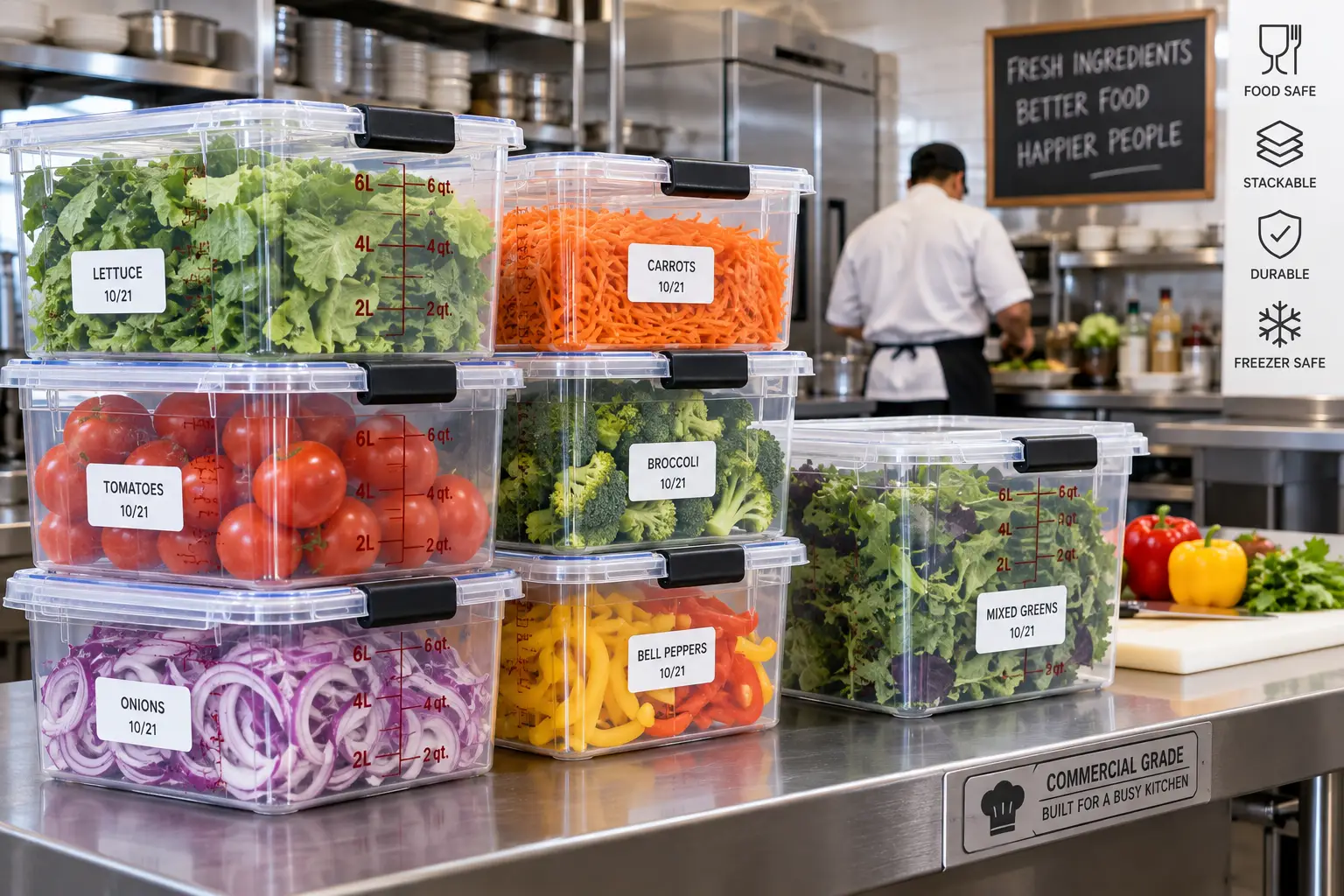
Walk into any busy restaurant’s walk-in cooler and you’ll see the same thing on every shelf: rows of big rectangular tubs filled with shredded lettuce, marinating chicken, pizza dough, and sliced onions. Those tubs are commercial food storage boxes, and they quietly decide whether your inventory stays fresh, organized, and inspection-ready, or whether it turns into a guessing game of “what’s in this and when did we make it?”
What are commercial food storage boxes? They are heavy-duty, food-safe rectangular containers, usually 18″ x 26″ (full size) or 12″ x 18″ (half size), built to hold bulk ingredients in coolers, freezers, and dry storage. They stack on standard racks, survive commercial dishwashers, and usually carry NSF certification for food contact.
Here’s the thing most first-time buyers miss: the box itself is only half the decision. The material (clear polycarbonate vs. opaque polyethylene or polypropylene), the temperature rating, the lid system, and the stacking design all change how well a box performs over years of daily abuse. A container that cracks in the freezer or warps in the dish machine isn’t a bargain at any price.
This guide focuses on real, widely sold models from Cambro, Rubbermaid Commercial, Carlisle, and Winco, all orderable on amazon.com. The analysis below is built from manufacturer spec sheets, retailer listings, and aggregated customer review sentiment rather than invented test results. It also connects each choice to the practical storage rules found in the FDA Food Code, the model code most state and local health departments base their inspections on.
Whether you run a food truck, a school cafeteria, a bakery, or a 200-seat restaurant, you’ll leave with a clear shortlist, a sizing plan, and a setup routine that keeps your storage system working for years.
Quick Comparison: Commercial Food Storage Boxes at a Glance
Before diving into each product, here’s a snapshot of the seven boxes covered in this guide. All are full-size 18″ x 26″ models unless noted, and prices are approximate ranges for the box alone (lids are typically sold separately).
| Product | Material | Depth / Capacity | Temp Range (per listings) | Approx. Price (box only) | Best for |
|---|---|---|---|---|---|
| Cambro Camwear 18266CW135 | Clear polycarbonate | 6″ / 8.75 gal | -40°F to 210°F | $30–$55 | Cambro Camwear 18266CW135: all-around premium workhorse |
| Rubbermaid FG330800CLR | Clear polycarbonate | 6″ / 8.5 gal | -50°F to 212°F | $55–$75 | Rubbermaid FG330800CLR: date-controlled inventory |
| Carlisle StorPlus 1062107 | Clear polycarbonate | 6″ / 8.5 gal | Freezer-safe (check spec sheet) | $25–$45 | Carlisle StorPlus 1062107: value clear storage |
| Winco PFSF-6 | Clear polycarbonate | 6″ / full size | -40°F to 212°F | $20–$35 | Winco PFSF-6: tight budgets needing visibility |
| Rubbermaid FG350800WHT | White polyethylene | 6″ / 8.5 gal | Freezer and dishwasher safe | $20–$35 | Rubbermaid FG350800WHT: rugged, low-cost bulk storage |
| Winco PFFW-6 | White polypropylene | 6″ / 9 gal | -40°F to 160°F | $15–$30 | Winco PFFW-6: cheapest way to outfit a walk-in |
| Cambro Camwear 18266CW464 | Yellow polycarbonate | 6″ / 8.75 gal | -40°F to 210°F | $35–$60 | Cambro Camwear 18266CW464: color-coded raw poultry storage |
Looking at the table, the clearest dividing line is material: the four clear polycarbonate boxes let you see contents without opening the lid, while the Rubbermaid FG350800WHT and Winco PFFW-6 trade visibility for lower cost and better impact tolerance at cold temperatures. If you want one box that handles hot product, freezer storage, and daily dish-machine cycles, the Cambro Camwear 18266CW135 and Rubbermaid FG330800CLR have the widest published temperature ranges. Budget-focused buyers outfitting an entire walk-in will stretch their dollars furthest with the Winco PFFW-6, as long as nothing hot goes into it.
💬 One click helps other shoppers make an informed choice too! Tap a highlighted product name to check today’s price and availability. 😊
Top 7 Commercial Food Storage Boxes for 2026: Expert Analysis
Each pick below includes what the specs actually mean in a working kitchen, who the box suits, what real customers consistently report, and where it falls short.
1. Cambro Camwear 18266CW135 — the benchmark every kitchen compares against
Cambro’s Camwear line is the box most chefs picture when they hear “food storage box,” and for good reason: it combines clarity, heat tolerance, and durability in one familiar package.
The box is made of clear polycarbonate rated from -40°F to 210°F, which means you can drop in product straight from the blast chiller, park it in a freezer, or run it through a high-temperature dish machine without worrying about warping. The textured bottom reduces visible scratching, so the box stays readable longer, and the molded-in handles give you a real grip when it’s loaded with 30-plus pounds of wet produce. It holds about 8.75 gallons and is made in the USA with NSF certification.
Based on comparing the specs, this is the right box for operators who want one standard across the whole kitchen. It fits standard 18″ x 26″ racks and sheet-pan carts, and Cambro sells flat, sliding, and hinged lids plus colander and drain-tray inserts, so you can build a system around one footprint.
Customer reviews consistently describe the boxes as sturdy, easy to clean, and useful for everything from walk-in organization to sous vide, while a recurring complaint is that lids occasionally don’t snap closed on the first try.
Pros:
- ✅ Widest heat tolerance of any clear box here
- ✅ Huge ecosystem of lids, colanders, and drain trays
- ✅ Textured bottom hides scuffs and keeps contents visible
Cons:
- ❌ Lids sold separately, raising the real cost
- ❌ Some lids need a firm press to seat fully
Expect roughly $30 to $55 for the box alone at the time of writing, and given its lifespan, it’s strong value for high-volume kitchens.
2. Rubbermaid FG330800CLR — built for inventory control and rotation
Rubbermaid’s clear food/tote box stands out because it treats labeling and rotation as a built-in feature rather than an afterthought.
This 8.5-gallon box uses clear, break-resistant polycarbonate, and reseller spec sheets list a temperature range of -50°F to 212°F, the widest in this roundup. Molded date control panels on the box (and matching lids) give you a dedicated place to write prep and discard dates, which directly supports first-in, first-out rotation. An interlocking ridge system keeps stacked boxes from sliding, and the box is certified to NSF Standard 2 and listed by the USDA Meat & Poultry Equipment Group, a detail that matters for meat and poultry processors.
What most buyers overlook is the ProSave system compatibility: this box works with Rubbermaid’s dual-action lid, which lets staff access contents from the front without unstacking. For kitchens that stack three or four boxes high, that can save real time during service.
Aggregated customer reviews on Amazon for this specific SKU are relatively thin, so broad sentiment is hard to verify; retailer descriptions and distributor listings consistently emphasize its stain resistance and durability.
Pros:
- ✅ Widest published temperature range in this guide
- ✅ Built-in date panels support FIFO rotation
- ✅ Interlocking ridges make tall stacks more stable
Cons:
- ❌ Typically the priciest box in its size class
- ❌ Limited verified customer reviews on Amazon
Plan on roughly $55 to $75 for the box alone; it’s worth it mainly if date control and stacking stability are priorities.
3. Carlisle StorPlus 1062107 — clear polycarbonate at a friendlier price
Carlisle’s StorPlus line delivers the core benefits of a clear polycarbonate box for noticeably less money than the category leaders.
The 1062107 holds 8.5 gallons in the standard 18″ x 26″ x 6″ footprint and features reinforced top and bottom corners, the spots where boxes usually crack after being dropped on tile. The smooth interior wipes clean quickly, and the polycarbonate resists staining from acidic foods like tomato sauce and oils. It’s made in the USA, NSF certified, and stacks with other StorPlus boxes and similar full-size units.
One honest caution: published temperature ratings for StorPlus polycarbonate boxes vary across retailer listings (some sizes show an upper limit near 180°F, while this size is listed lower), so check the current spec sheet before putting hot product inside. On paper, this makes it best for cold and dry storage rather than hot holding.
Customer reviews frequently mention using these boxes for ice baths, cupcakes, and bulk produce like potatoes and onions, while some buyers note the matching lid rests on rather than tightly seals the box.
Pros:
- ✅ Lower cost than Cambro and Rubbermaid clear boxes
- ✅ Reinforced corners resist drop damage
- ✅ Stacks with other standard full-size boxes
Cons:
- ❌ Lids cover rather than seal airtight
- ❌ Inconsistent heat ratings across listings
Expect around $25 to $45 for the box, making it a smart value pick for cold storage.
4. Winco PFSF-6 — the budget route to clear storage
Winco has built a reputation as the value brand for restaurant smallwares, and the PFSF-6 brings that approach to the full-size clear food box.
Made from heavy-duty polycarbonate with a reinforced rim and corners, this 18″ x 26″ x 6″ box is listed for use from -40°F to 212°F, matching the premium brands on paper. Rounded interior corners mean fewer crevices where food residue hides, which translates into faster cleaning and fewer missed spots during inspections. It’s NSF listed and dishwasher safe, with lids sold separately.
This box makes the most sense for new restaurants, food trucks, and ghost kitchens that need a dozen or more clear boxes without blowing the smallwares budget. If you’re building from scratch, the savings per box add up fast across a full walk-in.
Reliable aggregated review data for this exact model is limited, so it’s fair to say durability over many years is less documented than it is for Cambro; the specs themselves are competitive with far more expensive options.
Pros:
- ✅ Among the lowest prices for clear polycarbonate
- ✅ Published heat range rivals premium brands
- ✅ Rounded corners simplify daily cleaning
Cons:
- ❌ Fewer accessories than Cambro or Rubbermaid
- ❌ Long-term durability data is limited
At roughly $20 to $35, it’s the strongest value for kitchens that want visibility on a budget.
5. Rubbermaid FG350800WHT — tough, opaque, and budget-friendly
Not every ingredient needs to be on display, and this white polyethylene box focuses on toughness and cost instead of clarity.
The box holds 8.5 gallons in the 26″ x 18″ x 6″ footprint and uses polyethylene with reinforced corners, a material that tends to flex rather than crack when dropped. Date control panels help with rotation, and the box stacks securely in walk-in or reach-in refrigerators. It’s NSF listed, made in the USA, and both freezer and dishwasher safe.
Based on the material alone, this is the better choice for high-abuse settings such as hauling ice, moving produce between prep areas, or storing dry goods in a busy back of house. The trade-off is that you can’t see inside, so labeling discipline becomes essential.
Specific aggregated Amazon review sentiment for this SKU is difficult to verify; the product is widely stocked by US foodservice distributors, and retailer descriptions emphasize its resistance to breaking, staining, and cracking.
Pros:
- ✅ Polyethylene flexes instead of shattering on impact
- ✅ Date panels help with rotation
- ✅ Low cost for a name-brand NSF box
Cons:
- ❌ Opaque walls hide contents
- ❌ Can absorb stains from strongly colored foods over time
Expect roughly $20 to $35, which makes it a practical value for bulk and dry storage.
6. Winco PFFW-6 — the cheapest way to fill a walk-in
If you need a lot of boxes and your storage is mostly cold, the PFFW-6 delivers the most capacity per dollar in this lineup.
This white polypropylene box holds 9 gallons, slightly more than most 6-inch competitors, in the standard 18″ x 26″ footprint. It’s rated from -40°F to 160°F, BPA free, NSF certified, stackable, and dishwasher safe. The lower upper limit means it isn’t designed for hot product, but it’s perfectly suited to refrigerated and ambient storage.
This is the box to buy in bulk for produce, bread, prepped vegetables, and dry-goods overflow. Catering operations and commissaries often keep a stack of cheap white boxes as “transport and staging” containers alongside their clear boxes, and the PFFW-6 fits that role well.
Verifiable aggregated review data for this specific model is limited, so it’s best judged on its published specs; the key limitation to keep in mind is the 160°F ceiling rather than any widely reported defect.
Pros:
- ✅ Lowest cost per gallon in this guide
- ✅ BPA-free polypropylene construction
- ✅ Slightly larger 9-gallon capacity
Cons:
- ❌ Not suitable for hot foods above 160°F
- ❌ Opaque design requires diligent labeling
Look for roughly $15 to $30 per box; it’s excellent value when you need quantity over clarity.
7. Cambro Camwear 18266CW464 — color-coded to keep raw poultry separate
This yellow version of Cambro’s Camwear box exists for one smart reason: making cross-contamination mistakes visibly harder to make.
It shares the same core specs as the clear Camwear box: polycarbonate construction, about 8.75 gallons, dishwasher safe, freezer safe, made in the USA, and a -40°F to 210°F range. The difference is the tinted yellow body, which Cambro positions as a way to separate raw meats from other foods. Many kitchens follow a common color convention (yellow for raw poultry, red for raw meat, blue for seafood, green for produce), though it’s a house practice rather than a legal requirement.
This box is ideal for kitchens that handle a lot of raw chicken and want a visual rule that new staff can follow without memorizing shelf maps. Pair it with a colored lid and a bottom-shelf placement for a system inspectors will appreciate.
Review sentiment for the Camwear line broadly praises durability and easy cleaning, with the same occasional note that lids can take a firm press to close; color-specific reviews are sparse.
Pros:
- ✅ Color coding reduces cross-contamination errors
- ✅ Same heat tolerance as clear Camwear
- ✅ Works with standard Camwear lids and inserts
Cons:
- ❌ Tint slightly reduces content visibility
- ❌ Usually costs more than clear versions
Expect roughly $35 to $60, a fair price for a food-safety tool that doubles as storage.
✨ Don’t miss the right fit for your walk-in!
🔍 Take your kitchen organization to the next level with this carefully curated lineup. Click a highlighted product to check current pricing and availability, and build a storage system your whole crew will actually enjoy using!
How to Set Up a Commercial Food Storage Box System in Your First 30 Days
Buying the boxes is the easy part. Getting a crew to use them consistently is where storage systems succeed or fail. Here’s a practical rollout plan that doesn’t appear on any product listing.
Week 1: Map your shelves before you buy
Measure your walk-in, reach-in, and dry-storage shelving. Full-size 18″ x 26″ boxes match standard sheet-pan racks, but many reach-in coolers are too shallow, so half-size 12″ x 18″ boxes may fit better there. Count how many ingredients you store in bulk, then add 20% for prep overflow and for boxes sitting in the dish pit.
Week 2: Standardize labels and zones
Pick one labeling method (dissolvable labels or dry-erase marker on clear polycarbonate both work) and require the item name, prep date, and discard date. Assign zones by risk: ready-to-eat foods on top shelves, raw seafood and whole cuts of beef below, and raw poultry on the bottom shelf. This order follows the Food Code’s logic of storing foods with the highest required cooking temperature lowest.
Week 3: Train the “lid on, label on” habit
Uncovered boxes pick up drips and odors, and unlabeled ones are an easy inspection write-up. Make a quick end-of-shift check part of closing duties.
Week 4: Fix cooling and cleaning routines
Never pack hot food into a deep box and slide it into the walk-in. Use shallow 3.5″–6″ boxes or pans for cooling so product moves out of the USDA’s 40°F–140°F “Danger Zone” as quickly as possible. For cleaning, run boxes through the dish machine, air-dry them upside down on a rack, and avoid abrasive scrubbers on polycarbonate.
Common first-month mistakes
- ❌ Stacking boxes without lids, which crushes product below
- ❌ Overfilling boxes so lids bow and don’t seat
- ❌ Mixing brands in one stack without checking lid compatibility
Real-World Scenarios: Matching Restaurant Food Storage Boxes to Your Operation
Specs only matter in context, so here’s how the picks line up against three common operations.
Scenario 1: The independent pizzeria (budget around $400)
A 60-seat pizzeria stores dough balls, shredded cheese, sliced toppings, and produce. Dough needs space and cold, even storage, so a set of Carlisle StorPlus 1062107 boxes with lids keeps proofing dough visible without paying top dollar. For bulk onions, peppers, and bread, a handful of Winco PFFW-6 boxes keep costs down. At a moderate volume (two deliveries a week), 12 to 16 boxes typically cover everything, including spares cycling through the dish pit.
Scenario 2: The full-service restaurant with heavy protein prep (budget $800–$1,200)
A kitchen breaking down chicken, beef, and seafood daily benefits most from color coding and heat tolerance. Stock the Cambro Camwear 18266CW135 as the house standard for prepped items and use the Cambro Camwear 18266CW464 strictly for raw poultry on the bottom shelf. The high-temperature rating means boxes survive hundreds of dish-machine cycles, which matters when they’re washed twice a day.
Scenario 3: The school or hospital cafeteria (large-volume, inspection-heavy)
Institutional kitchens face frequent inspections and high staff turnover. The Rubbermaid FG330800CLR with its date control panels makes rotation almost self-explanatory, while the Rubbermaid FG350800WHT handles dry goods and transport. Consistency across a single brand simplifies ordering, lid matching, and training for part-time staff.
The common thread in all three: buy for your highest-risk ingredient first, then fill in with cheaper boxes for low-risk storage.
Problem → Solution: Fixing the Most Common Food Box Headaches
Even good commercial food storage containers cause frustration if they’re used the wrong way. Here are five problems operators run into, with specific fixes.
1. Lids won’t snap on. This is the most common complaint in Camwear and StorPlus reviews. Often the cause is overfilling or slight warping from stacking heavy boxes on unsupported shelves. Fill boxes no higher than about half an inch below the rim, and store empty boxes nested and flat. If you need a truly tight seal, Rubbermaid’s snap-on lids are designed for a firmer fit than lids that simply rest on top.
2. Boxes crack in the freezer. Polycarbonate is strong but can become more brittle at very low temperatures if dropped. For frequent freezer handling, choose boxes with reinforced corners like the Carlisle StorPlus 1062107, or switch to a polyethylene option like the Rubbermaid FG350800WHT, which tends to flex under impact.
3. Cloudy or scratched clear boxes. Abrasive pads, harsh chemicals, and stacking without lids all dull polycarbonate. Use soft sponges, follow the chemical guidance on the manufacturer’s spec sheet, and store boxes nested to limit rubbing.
4. Produce turning slimy. Standing water accelerates spoilage. Add a colander insert or drain tray, available for the Cambro Camwear 18266CW135 and the StorPlus line, to lift leafy greens and berries above the moisture.
5. Mystery containers. If staff can’t identify contents quickly, product gets wasted. Clear boxes help, but only paired with consistent date labels.
How to Choose Commercial Food Storage Boxes
Choosing commercial food storage boxes comes down to seven decisions. Work through them in order and your shortlist will almost write itself.
- Confirm the footprint. Full size (18″ x 26″) fits sheet-pan racks and large walk-ins; half size (12″ x 18″) suits reach-ins and smaller shelving. Measure shelf depth before ordering.
- Pick the depth by ingredient. Shallow 3.5″ boxes suit cooling and delicate items; 6″ boxes are the all-purpose default; 9″–15″ boxes hold bulky items like lettuce or dough but become heavy fast.
- Choose the material. Clear polycarbonate gives visibility and higher heat tolerance; polyethylene and polypropylene cost less and handle rough treatment better. More on this in the material comparison below.
- Check the temperature range. If you ever store product above 160°F or run very hot dish cycles, stay with a box rated to 210°F or higher.
- Verify NSF certification. NSF International develops the food equipment standards health inspectors look for, and NSF/ANSI 2 covers food equipment such as storage containers. Look for the NSF mark on the box or spec sheet.
- Budget for lids and accessories. Almost every box here sells lids separately, which can add a significant amount to the per-box cost. Colanders and drain trays add more.
- Standardize on one or two brands. Mixing brands causes stacking and lid-fit problems. Pick a primary brand for your critical storage and a budget brand for overflow.
Polycarbonate Food Storage Box vs. Polyethylene and Polypropylene
The material decision shapes almost everything else about how a box performs, so it’s worth understanding what each plastic actually does.
A polycarbonate food storage box is the clear, glass-like option. Polycarbonate is a tough, transparent thermoplastic known for high impact strength and heat resistance, which is why Camwear, StorPlus polycarbonate, the Winco PFSF-6, and the Rubbermaid FG330800CLR all list upper limits around 210°F or higher. The main drawbacks are cost and scratching over time. Polycarbonate is also made from bisphenol A (BPA), and some listings carry California Proposition 65 warnings; operators who prefer to avoid BPA-based plastics often choose polyethylene or polypropylene instead.
Polyethylene, used in the Rubbermaid FG350800WHT, is opaque and softer. It flexes rather than cracks, resists many chemicals, and costs less, but it can stain and doesn’t show contents.
Polypropylene, used in the Winco PFFW-6, sits in between: affordable, BPA free, and fine for cold storage, but with a lower heat ceiling.
| Factor | Polycarbonate | Polyethylene | Polypropylene |
|---|---|---|---|
| Visibility | Crystal clear | Opaque white | Opaque or translucent |
| Typical heat ceiling | ~210°F–212°F | Varies; check listing | ~160°F (per Winco listing) |
| Impact behavior | Strong, but can crack if dropped when frozen | Flexes, very forgiving | Moderately forgiving |
| Stain resistance | Excellent | Fair | Good |
| Typical cost | Highest | Low | Lowest |
| Best for | Cambro Camwear 18266CW135, Rubbermaid FG330800CLR: visible, hot-tolerant storage | Rubbermaid FG350800WHT: rough handling and dry goods | Winco PFFW-6: bulk cold storage |
The table shows why many kitchens run a mixed fleet: polycarbonate for high-value, frequently checked items, and cheaper opaque boxes for bulk and transport. If you only buy one type, polycarbonate is the more versatile choice, but polypropylene wins on pure cost per gallon for cold storage.
Commercial Food Storage Boxes vs. Cardboard Cases, Hotel Pans, and Household Bins
Plenty of kitchens still leave product in shipping cartons or grab consumer bins from a big-box store. Here’s how purpose-built commercial food storage boxes compare.
| Option | Food safety | Durability | Stacking on racks | Cleanability | Best for |
|---|---|---|---|---|---|
| Commercial food storage boxes | NSF-certified options | Years of daily use | Designed for 18″ x 26″ racks | Commercial dishwasher safe | Cambro Camwear 18266CW135: primary storage system |
| Cardboard shipping cases | Absorb moisture, can harbor pests | Single use | Collapse when wet | Can’t be cleaned | Receiving only |
| Hotel/steam table pans | NSF-certified options | Good | Fit steam tables, less ideal for racks | Dishwasher safe | Service line and hot holding |
| Household storage bins | Often not NSF certified | Variable | Irregular sizes | Often not dishwasher safe | Non-food storage |
The biggest takeaway is that cardboard should leave the walk-in on delivery day: once wet, it loses strength and can’t be sanitized, which is why transferring product into cleanable boxes is standard practice. Hotel pans are excellent on the line but less efficient for bulk storage, while household bins rarely carry NSF certification, a gap an inspector may notice.
Long-Term Cost and Maintenance
Sticker price tells only part of the story. The real cost of commercial food storage boxes includes lids, accessories, replacement frequency, and wasted food.
Estimated cost per box system
| Product | Box (approx.) | Lid (approx.) | Expected lifespan with care | Value verdict | Best for |
|---|---|---|---|---|---|
| Cambro Camwear 18266CW135 | $30–$55 | $15–$30 | Many years | Premium, long payback | Cambro Camwear 18266CW135: high-volume kitchens |
| Rubbermaid FG330800CLR | $55–$75 | $20–$35 | Many years | Premium for date control | Rubbermaid FG330800CLR: institutions |
| Carlisle StorPlus 1062107 | $25–$45 | $15–$25 | Several years | Strong mid-range value | Carlisle StorPlus 1062107: cold storage |
| Winco PFFW-6 | $15–$30 | $10–$20 | Several years in cold use | Lowest upfront cost | Winco PFFW-6: bulk overflow |
Lifespan estimates above are general expectations based on material and construction, not measured test results, and prices vary. The pattern is clear, though: a premium polycarbonate box that lasts twice as long as a budget one often costs less per year, especially in kitchens that wash boxes daily. Budget boxes make the most sense where abuse is low and heat isn’t a factor.
Maintenance habits that extend life
- ✅ Wash with neutral detergents and soft sponges
- ✅ Air-dry inverted to prevent trapped moisture
- ✅ Replace cracked or deeply scratched boxes promptly
- ✅ Inspect lid rims monthly for warping
Deep scratches aren’t just cosmetic; they can trap food residue and make cleaning less effective. Budgeting to replace roughly 10% of your fleet each year keeps the system reliable without big one-time expenses.
Common Mistakes to Avoid When Buying Commercial Food Storage Containers
Even experienced buyers make these errors when ordering commercial food storage containers.
Buying boxes without lids. Most listings sell boxes and lids separately. Ordering 20 boxes and zero lids is surprisingly common, and uncovered storage invites cross-contamination.
Ignoring the temperature rating. A 160°F-rated box isn’t meant for hot product or very hot dish cycles. Match the rating to your real workflow.
Going too deep. A 15″ box full of wet produce can exceed 50 pounds. Heavy boxes get dropped, and deep boxes cool food slowly. Most kitchens are better served by more 6″ boxes than fewer 15″ ones.
Mixing brands in the same stack. Boxes from different manufacturers share the 18″ x 26″ footprint but not always the same stacking ridges or lid profiles.
Skipping NSF verification on cheap imports. Plenty of generic bins look similar but aren’t certified for commercial food contact. Check the listing and packaging for the NSF mark.
Forgetting accessories. Colanders, drain trays, and dollies are what turn a stack of boxes into a working system. Budget for them upfront.
Safety, Regulations, and Standards for NSF Food Storage Containers
For US foodservice operations, storage containers sit at the center of several food safety rules. While requirements vary by state and county, most are based on the FDA Food Code.
Key rules to know
- Covered and protected storage. The Food Code expects stored food to be protected from contamination, which in practice means covered containers kept off the floor (commonly at least 6 inches).
- Date marking. Ready-to-eat, time/temperature control for safety (TCS) foods held more than 24 hours generally must be date marked and used within 7 days when held at 41°F or below. Date panels and clear labels make this easy to prove.
- Cooling. Cooked TCS foods must cool from 135°F to 70°F within 2 hours and to 41°F or below within the next 4 hours. Shallow boxes help you hit those targets.
- Storage order. Raw animal foods belong below ready-to-eat items, with raw poultry lowest.
Certification basics
NSF food storage containers are evaluated for materials, design, and cleanability. The NSF mark signals that a box is designed to be cleaned and sanitized properly, which is exactly what inspectors want to see. Buyers in California will also see Proposition 65 warnings on some polycarbonate products; these are disclosure requirements rather than bans, but they’re worth understanding when choosing materials.
Check with your local health department for the specific version of the Food Code your jurisdiction has adopted, since adoption dates and local amendments vary.
FAQ: Commercial Food Storage Boxes
❓ Are commercial food storage boxes dishwasher safe?
❓ Where can I buy commercial food storage boxes with lids included?
❓ What size food storage box fits a standard sheet pan rack?
❓ Can you store hot food in commercial food storage boxes?
❓ How long do commercial food storage boxes last in a restaurant?
Conclusion: Build a Storage System, Not Just a Shelf of Tubs
The best commercial food storage boxes aren’t necessarily the most expensive ones; they’re the ones that match your temperatures, your shelves, and your crew’s habits. For most kitchens, the Cambro Camwear 18266CW135 remains the safest all-around standard thanks to its wide temperature range and deep accessory lineup. If rotation and inspections keep you up at night, the Rubbermaid FG330800CLR and its date panels earn their premium. Value-minded operators get clear polycarbonate for less with the Carlisle StorPlus 1062107 or the Winco PFSF-6.
For bulk, transport, and dry storage, the Rubbermaid FG350800WHT and Winco PFFW-6 stretch your budget without sacrificing NSF certification. And if raw poultry is a big part of your menu, adding a few Cambro Camwear 18266CW464 boxes turns a food-safety rule into something staff can see.
Whatever you choose, remember the system around the boxes: lids on every container, clear date labels, raw proteins on the bottom shelves, shallow boxes for cooling, and gentle cleaning to protect the plastic. Start with your highest-risk ingredients, standardize on one or two brands, and expand as your menu grows. Do that, and your walk-in will stay organized, your food will last longer, and your next health inspection will feel a lot less stressful.
🚀 Ready to upgrade your walk-in?
🛒 Click any highlighted box above to check current pricing and availability on Amazon, and start building a storage system that saves food, time, and money every single shift!
Recommended for You
- 1 Cup Glass Containers With Lids: 7 Best Picks for 2026
- WW Lunches: 7 Best Products to Nail Your Points in 2026
- Take Out Trays: 7 Best Picks for 2026 (Pros & Cons)
Disclaimer: This post contains affiliate links. As an Amazon Associate, I earn from qualifying purchases made through these links, at no additional cost to you.
✨ Found this article helpful? Share it with someone who needs it! 💬🤗