
In This Article
What Is a Glass Dressing Container?
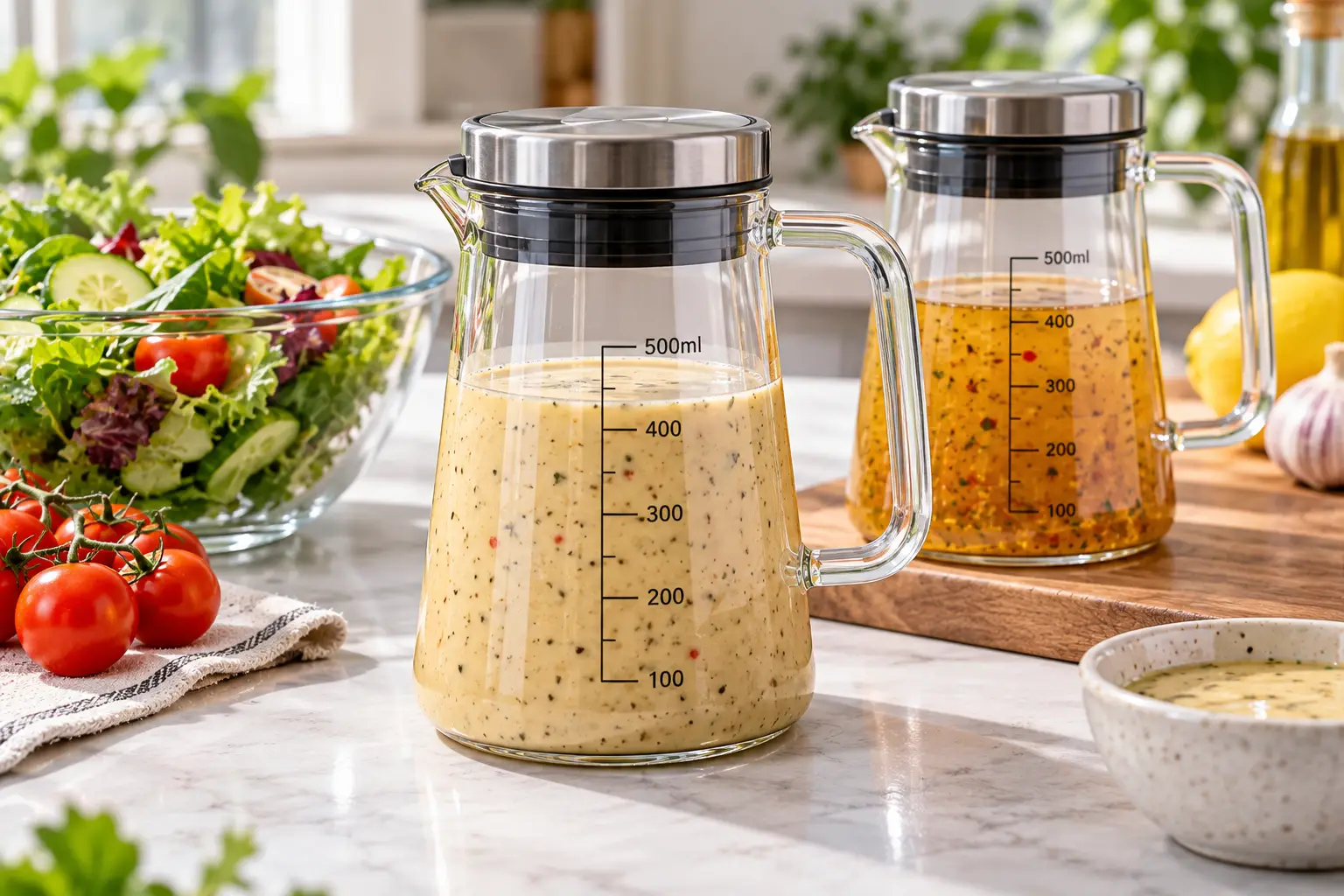
A glass dressing container is a reusable glass bottle, jar, or shaker designed to mix, store, and pour homemade salad dressings, vinaigrettes, and marinades. Most include a leakproof lid, a pour spout, and printed measurement lines, so you can measure, shake, serve, and refrigerate everything in one vessel.
Here’s a small kitchen truth nobody tells you: the best vinaigrette you’ll ever make costs less than a store-bought bottle, takes about 90 seconds, and has maybe five ingredients you can actually pronounce. The catch? You need something decent to make it in. A coffee mug and a fork will technically work — right up until the oil separates, the garlic sinks, and half your dressing ends up on the counter.
That’s where a glass dressing container earns its spot on the shelf. Glass doesn’t hold onto last week’s garlic smell, doesn’t stain orange from paprika, and lets you see at a glance whether your emulsion has broken. Many of the better models use borosilicate glass, the same heat-resistant family of glass used in lab flasks and bakeware, which handles temperature swings far better than ordinary soda-lime glass.
But not every glass dressing container is built for the same job. Some are recipe-printed shakers for the home cook who wants guardrails. Others are sleek pour bottles for the table. And some are tiny 2.7 oz jars that ride along in a lunch bag. In this guide, we compare seven real options available on amazon.com, translate their specs into everyday meaning, and help you match the right one to how you actually eat. Prices are given as ranges only — always check the current price, since listings change frequently.
Quick Comparison: The 7 Best Glass Dressing Containers at a Glance
| Product | Capacity | Glass Type | Closure / Pour | Price Range | Best for |
|---|---|---|---|---|---|
| Leifheit Dressing Shaker | 10 oz (300 ml) | Glass | Anti-drip spout + plastic cap | $15–$25 | Leifheit Dressing Shaker: drip-free everyday pouring |
| Kolder Mixer Bottle | 13 oz | Glass (made in USA) | Leakproof screw cap | $10–$20 | Kolder Mixer Bottle: beginners who want printed recipes |
| KITCHENDAO Glass Shaker | 12 oz (355 ml) | Borosilicate | Stainless sliding lock + silicone plug | $15–$25 | KITCHENDAO Glass Shaker: the tightest fridge seal |
| NiHome Glass Shaker | 16 oz | Borosilicate | Locking lid + mixing ball | $15–$25 | NiHome Glass Shaker: creamy dressings and big batches |
| kitchentoolz 16 oz Bottles | 16 oz × 4 | Glass | Silicone lids / pour spouts | $20–$35 (4-pack) | kitchentoolz 16 oz Bottles: meal preppers rotating several sauces |
| Fox Run Glass Shaker | 10.15 oz (300 ml) | Glass | Screw-on plastic lid | $10–$18 | Fox Run Glass Shaker: budget recipe shaker |
| VITEVER 2.7 oz Containers | 2.7 oz × 6 | Glass | Gasket-sealed plastic lids | $12–$20 (6-pack) | VITEVER 2.7 oz Containers: packed lunches |
Looking at the table, the split is really about where your dressing lives. If it lives on the dinner table, the Leifheit Dressing Shaker and its anti-drip spout justify the slightly higher price. If it lives in your fridge for a week, the KITCHENDAO Glass Shaker‘s dual seal matters more. And if it travels in a backpack, only the VITEVER 2.7 oz Containers are sized for the job.
💬 One click helps other shoppers make an informed choice too! 😊
Top 7 Glass Dressing Containers: Expert Analysis for 2026
Below, each pick is analyzed on the things that actually matter day to day: how cleanly it pours, how reliably it seals, how easy it is to wash, and who it genuinely suits. Review sentiment is summarized only where we could verify it from real listings and published roundups; where review history is thin, we say so.
1. Leifheit Glass Salad Dressing Bottle (10 oz) — cleanest pour of the bunch
The Leifheit Dressing Shaker solves the most annoying dressing problem of all: the drip that runs down the side of the bottle after every pour.
Leifheit, a large German housewares brand, built this 300 ml (about 10 oz) bottle around an anti-drip spout that sits under a snug plastic cap. In practice, that means you can shake with the cap on, flip it open, and pour without a sticky ring forming on your table or fridge shelf. The glass is printed with both ml and fluid-ounce scales plus five recipe guides (yogurt, Caesar, vinaigrette, French, and Italian), and the printing is rated dishwasher safe — a detail cheaper printed bottles often skip.
Based on comparing the specs, this is the best all-rounder for couples and small families who make a fresh batch every few days and serve straight from the bottle. The tapered body and ridged base are practical touches: the bottle is easier to grip with oily fingers and less likely to skate across a smooth counter.
Customer feedback we could find — including on Amazon’s European storefronts — consistently highlights the drip-free pour and a neck wide enough to add ingredients without a funnel.
Pros:
- ✅ Anti-drip spout genuinely keeps surfaces clean
- ✅ Dishwasher-safe glass and recipe printing
- ✅ Dual ml and fl oz measurement scales
Cons:
- ❌ Recipes lean European, with metric-first measurements
- ❌ No mixing ball for thick, creamy dressings
At roughly $15–$25 (check the current price), it’s a fair premium for a bottle that stays clean on the table.
2. Kolder Salad Dressing Mixer Bottle (13 oz) — best recipe guide for beginners
The Kolder Mixer Bottle is the glass dressing container for anyone who says, “I’d make my own dressing if I knew how.”
Made in the USA exclusively for HIC Kitchen, this 13 oz glass bottle (about 2.5 × 2.5 × 8 inches) has eight classic recipes printed directly on the glass: Caesar, French, Italian, Greek, vinaigrette, balsamic vinaigrette, honey mustard, and Asian. Each recipe uses fill-to-the-line markings, so you pour oil to one line, vinegar to the next, and skip the measuring spoons entirely. HIC states the markings are permanent and that both the bottle and cap are dishwasher safe, and the listing notes Prop 65 compliance.
What most buyers overlook is the “Light” version, which prints lower-fat takes on the same eight recipes — worth choosing if you’re watching calories. A set-of-two option also exists, which is handy for keeping one vinaigrette and one creamy dressing on rotation.
Published review roundups praise the screw-top for preventing leaks and the printed recipes as a genuine time-saver. The recurring criticisms: the busy printed design can be distracting if you’re making your own recipe, and at least one roundup notes the cap is the weak point and pouring from the wide mouth can get messy.
Pros:
- ✅ Eight printed recipes remove all guesswork
- ✅ Made in the USA with permanent markings
- ✅ Bottle and cap are dishwasher safe
Cons:
- ❌ Wide mouth pours less precisely than a spout
- ❌ Printed graphics clutter the look for custom recipes
Usually in the $10–$20 range, it’s one of the best values for new home cooks.
3. KITCHENDAO Glass Salad Dressing Shaker (12 oz) — tightest seal for fridge storage
The KITCHENDAO Glass Shaker is built for people who make dressing on Sunday and want it to taste fresh on Thursday.
Instead of a simple flip cap, KITCHENDAO uses a sliding 304 stainless steel lock plus a built-in silicone sealing plug. That’s two barriers between your vinaigrette and the fridge air, which matters because oils pick up odors and oxidize faster when exposed. The 12 oz (355 ml) body is borosilicate glass, which resists staining and odor retention, and the drip-free spout is designed for steady, controlled pours. KITCHENDAO also sells 250 ml and 350 ml versions with oz/ml marks if you want a different size.
On paper, the dual seal makes this the strongest choice for batch prep, infused oils, and anyone who stores the bottle on its side in a crowded fridge door. The stainless slider also means no small plastic cap to lose.
This glass model is relatively new to Amazon, so at the time of writing there isn’t a long, verifiable track record of aggregated reviews. KITCHENDAO’s plastic shakers have a longer history, but that sentiment shouldn’t be assumed to transfer to the glass design.
Pros:
- ✅ Dual stainless lock and silicone plug seal
- ✅ Borosilicate glass resists stains and smells
- ✅ Available in three sizes
Cons:
- ❌ Limited long-term review history so far
- ❌ Silicone plug needs regular cleaning to stay fresh
Typically $15–$25; strong value if storage life is your top priority.
4. NiHome Glass Salad Dressing Shaker (16 oz) — best for creamy dressings
The NiHome Glass Shaker tackles the job most glass bottles quietly fail: emulsifying thick, creamy dressings.
The standout feature is a stainless steel wire mixing ball — the same idea as a protein-shaker whisk — that breaks up clumps of mustard, tahini, yogurt, or mayo as you shake. Without one, creamy dressings tend to leave stubborn blobs clinging to the glass. The 16 oz borosilicate body is the largest single bottle in this lineup, and it carries three measuring scales plus a locking, airtight lid that the brand says can be inverted without leaking.
Here’s what to weigh: 16 oz is a lot of dressing. It suits families of four or more, weekly meal preppers, or anyone who also uses the bottle for marinades. For a solo cook making vinaigrette twice a week, it’s more glass than you need — and a larger, heavier bottle is a bigger loss if it slips.
Like the KITCHENDAO model, this is a newer listing, so we couldn’t verify a meaningful body of aggregated customer reviews at the time of writing. Judge it on its specs, and check the latest reviews before buying.
Pros:
- ✅ Wire mixing ball blends creamy dressings smoothly
- ✅ Largest capacity for families and batch prep
- ✅ Borosilicate glass with three measurement scales
Cons:
- ❌ Heavy and tall for small fridge doors
- ❌ Newer product with limited verified reviews
Generally $15–$25; the mixing ball alone justifies it for ranch and Caesar fans.
5. kitchentoolz 16 oz Glass Salad Dressing Bottles (4-Pack) — best multi-bottle system
The kitchentoolz 16 oz Bottles are less a single shaker and more a small dressing pantry.
This set gives you four 16 oz glass bottles with non-metal silicone lids, and kitchentoolz sells related versions with silicone pour spouts and tamper-evident caps. The wide mouth is the practical win here: you can spoon in minced shallots, herbs, or honey without a funnel, and you can get a bottle brush all the way to the bottom. Non-metal lids also mean no rust spots forming where vinegar touches the closure — a common failure on cheap metal-capped jars.
Based on the design, this set suits meal preppers, households with different dressing preferences, and anyone who also stores cold brew concentrate, simple syrup, or marinades. Four matching bottles also look tidy in the fridge. The trade-off is that there are no printed recipes and no mixing insert — these are plain, versatile vessels.
kitchentoolz products appear on Amazon’s Salad Shakers best-seller list, which signals steady demand, but we couldn’t verify detailed aggregated review themes for this specific 4-pack, so we won’t characterize them further.
Pros:
- ✅ Four large bottles for rotating several sauces
- ✅ Wide mouth makes filling and cleaning easy
- ✅ Non-metal lids won’t rust from vinegar
Cons:
- ❌ No recipe markings or mixing ball
- ❌ Takes real fridge space as a set
At around $20–$35 for four, the per-bottle cost is among the lowest here.
6. Fox Run Glass Salad Dressing Shaker Bottle (10.15 oz) — budget pick with eight recipes
The Fox Run Glass Shaker offers the recipe-on-the-bottle concept at a gentler price.
This 300 ml (10.15 oz) bottle measures about 2.38 × 2.38 × 7.75 inches, which makes it slim enough for most fridge doors. It includes eight printed recipes — vinaigrette, balsamic vinaigrette, honey mustard, Asian, Caesar, French, Greek, and Italian — with fill lines for each ingredient, plus a screw-on plastic lid designed to stay put while you shake.
The important footnote: Fox Run lists this bottle as hand wash only to preserve the printed measurements and recipes. That’s a meaningful difference from the Kolder Mixer Bottle and Leifheit Dressing Shaker, whose printing is rated dishwasher safe. If you run the dishwasher daily and hate hand-washing, that detail should weigh heavily. If you don’t mind a quick rinse and a bottle brush, you get almost the same recipe experience for less.
This is a recent listing on amazon.com, so a substantial body of aggregated customer reviews wasn’t available for us to verify at the time of writing.
Pros:
- ✅ Eight printed recipes at a budget price
- ✅ Slim profile fits most fridge doors
- ✅ Screw-on lid resists leaks during shaking
Cons:
- ❌ Hand wash only to protect the printing
- ❌ No pour spout for precise drizzling
Usually $10–$18, it’s the lowest-cost way into recipe-guided dressings.
7. VITEVER 6-Pack Glass Salad Dressing Containers (2.7 oz) — best for packed lunches
The VITEVER 2.7 oz Containers exist for one reason: to stop soggy lunch salads.
Each of the six glass cups holds 2.7 oz (80 ml) and measures about 3 × 1.7 inches, small enough to tuck into a bento box or the corner of a lunch bag. The BPA-free plastic lids have rubber gasket rings for a tighter seal, and each lid comes in a different muted color, so you can tell balsamic from ranch at a glance. VITEVER lists the glass as dishwasher, fridge, and freezer safe. There’s also a smaller 1.7 oz version if 2.7 oz is more than you use.
The analysis here is simple: dressing a salad in the morning guarantees wilted greens by noon. Portioning dressing separately keeps leaves crisp and also controls portions — 2.7 oz is roughly five tablespoons, which is plenty for a large salad. These pair naturally with a larger shaker at home: mix in the big bottle, portion into the small jars.
These containers appear in several published 2026 salad-dressing roundups, but we couldn’t verify detailed aggregated review themes, so check recent reviews on seal durability.
Pros:
- ✅ Gasket lids designed to stop lunch-bag leaks
- ✅ Color-coded lids separate different sauces
- ✅ Glass won’t stain or absorb odors
Cons:
- ❌ Too small for mixing — portioning only
- ❌ Small lids are easy to misplace
Typically $12–$20 for six; excellent value for daily lunch packers.
✨ Don’t miss these kitchen upgrades!
🔍 Take your homemade dressings to the next level with this carefully curated lineup. Click a highlighted item to check current pricing and availability. These picks will help you make fresher, healthier salads the whole family will enjoy!
How to Use a Glass Dressing Container: Getting Started and Care
Owning a good bottle is half the battle; using it well is the other half. Here’s a practical first-month routine that no product listing will spell out for you.
Your first batch
Start with a classic 3:1 vinaigrette — three parts oil to one part acid — which is also the ratio most printed recipes use. Add the acid, salt, and mustard first, shake briefly to dissolve the salt, then add the oil and shake hard for 15–20 seconds. Salt doesn’t dissolve well in oil, so adding it first prevents gritty dressing. Mustard or a little honey acts as an emulsifier and keeps the mixture from separating as quickly.
Weekly maintenance
- Rinse the spout and cap right after the last pour of a batch. Dried dressing in a spout is far harder to remove later.
- Use a bottle brush once a week, especially on tall bottles like the Kolder Mixer Bottle and Fox Run Glass Shaker.
- Pull out silicone plugs and gaskets (like those on the KITCHENDAO Glass Shaker and VITEVER 2.7 oz Containers) and wash them separately. Oil residue trapped under a gasket is what causes that stale smell.
Common mistakes in the first 30 days
The biggest one is overfilling. Leave at least an inch of headspace; dressing needs room to move, or it won’t emulsify. Second, don’t pour cold dressing straight into a hot-from-the-dishwasher bottle — even durable glass appreciates gradual temperature changes. Third, label and date each batch with a piece of masking tape. It sounds fussy, but when you have two similar-looking vinaigrettes in the fridge, you’ll thank yourself.
Real-World Scenarios: Matching the Right Bottle to Your Routine
Specs are abstract until you picture them in someone’s actual week. Here are three realistic profiles and the reasoning behind each match.
The busy commuter: salads at the office, five days a week
Picture someone who packs a salad every workday and has a budget of about $35. The ideal setup is the VITEVER 2.7 oz Containers paired with the Fox Run Glass Shaker. Mix one batch of balsamic vinaigrette on Sunday in the shaker, then portion it into five small jars. Total cost stays in budget, and every lunch gets fresh-tasting dressing on crisp greens. Frequency of use is high, so the gasket lids earn their keep daily.
The family of four: dinner salads most nights
A household that serves salad four or five nights a week needs volume and an easy pour. The NiHome Glass Shaker handles a family-sized batch of creamy ranch or Caesar thanks to its mixing ball, while the Leifheit Dressing Shaker covers the lighter vinaigrette for the adults. Budget: roughly $30–$50 for both. Because kids often grab the bottle themselves, the drip-free spout on the Leifheit Dressing Shaker saves real cleanup time.
The weekend meal prepper: sauces for the whole week
Someone who preps grain bowls, marinades, and dressings every Sunday benefits most from the kitchentoolz 16 oz Bottles. Four matching bottles mean one for vinaigrette, one for a tahini sauce, one for marinade, and one spare. Add the KITCHENDAO Glass Shaker for the dressing that needs to stay freshest longest. Budget: about $40–$60 total, and every piece is reusable for years.
Problem → Solution: Fixing Common Dressing Container Frustrations
Even the best glass salad dressing container can misbehave. Here are the problems buyers most often run into, and how to fix them.
Problem 1: The dressing separates within minutes. Solution: Add an emulsifier — about half a teaspoon of Dijon mustard or honey per cup of dressing — and shake longer. For creamy recipes, a bottle with a mixing ball like the NiHome Glass Shaker does most of the work for you.
Problem 2: Olive oil turns solid and cloudy in the fridge. Solution: That’s normal; extra virgin olive oil can partially solidify when chilled. Take the bottle out 10–15 minutes before serving, or run the outside under warm (not hot) tap water. A narrow-neck bottle clogs more easily, so wide-mouth options like the kitchentoolz 16 oz Bottles handle this better.
Problem 3: The cap leaks when you shake. Solution: Check that the gasket or plug is seated correctly — most “leaky lid” complaints come from a gasket that shifted during washing. If leaks persist, choose a model with a locking closure, such as the KITCHENDAO Glass Shaker.
Problem 4: A lingering garlic smell in the lid. Solution: The glass itself rarely holds odors; plastic parts and silicone do. Soak lids in warm water with a spoonful of baking soda for 30 minutes.
Problem 5: Printed measurements are fading. Solution: Switch to hand washing immediately. Bottles like the Fox Run Glass Shaker are hand wash only by design, while the Kolder Mixer Bottle and Leifheit Dressing Shaker have dishwasher-rated printing.
How to Choose a Glass Dressing Container: 7 Steps
Choosing the right glass dressing container comes down to a handful of practical questions. Work through them in order:
- Decide where the dressing will be used. Table serving calls for a spout; lunch packing calls for small jars. This single question eliminates half the options.
- Match capacity to household size. Around 8–10 oz suits one or two people making fresh batches; 12–16 oz suits families or weekly prep. Oversized bottles leave dressing sitting longer than it should.
- Check the glass type. Borosilicate handles temperature swings better than soda-lime glass, which matters if you rinse bottles in hot water straight from the fridge.
- Look closely at the seal. Screw caps are simple and reliable; locking sliders and silicone plugs add a second barrier for longer storage.
- Decide if you want printed recipes. Great for beginners, cluttered for experienced cooks who improvise.
- Confirm dishwasher compatibility. Printed bottles vary — some are dishwasher-rated, others hand wash only.
- Consider what you’ll put in it. If you plan to make infused oils or garlic-heavy dressings, storage time matters more than the bottle. Oregon State University Extension advises that homemade oils flavored with herbs or vegetables be refrigerated and used within about four days, or frozen for longer storage — so a smaller bottle you’ll finish quickly is often the safer choice.
Glass Salad Dressing Container vs. Plastic and Stainless Steel
Glass isn’t the only material on the shelf, so it’s worth understanding the trade-offs before committing. A glass salad dressing container wins on purity of taste and cleanliness; plastic wins on weight and breakage; stainless steel wins on durability but hides what’s inside.
| Feature | Glass | Plastic (Tritan/BPA-free) | Stainless Steel |
|---|---|---|---|
| Odor and stain resistance | Excellent | Fair — can absorb garlic and turmeric | Excellent |
| Visibility of contents | Full | Full | None |
| Breakage risk | Moderate | Very low | Very low |
| Weight | Heaviest | Lightest | Moderate |
| Acid resistance (vinegar, citrus) | Excellent | Good | Good, but lids can corrode if low-grade |
| Best for | Leifheit Dressing Shaker and KITCHENDAO Glass Shaker for home use | Kids and outdoor picnics | Rugged lunch packing |
The table shows why glass dominates home kitchens: it’s the only material that’s both non-absorbent and transparent, so you can see separation or spoilage before you pour. Plastic still makes sense for households with toddlers or for poolside use, where a dropped bottle is inevitable. Stainless steel is a solid lunchbox alternative, but for most people the VITEVER 2.7 oz Containers offer the same leak resistance while letting you see which dressing is which.
One more nuance: vinegar and citrus are acidic, and glass is essentially inert to them. That’s why many cooks who switched from plastic shakers notice that their dressings simply taste “cleaner” — there’s nothing in the container interacting with the acid or carrying over flavor from last month’s batch.
Features That Actually Matter (and Ones That Don’t)
Marketing copy on dressing bottles is full of promises. Here’s how to separate the useful from the fluff.
Features that genuinely matter
- A real anti-drip spout. It sounds minor, but the difference between the Leifheit Dressing Shaker and a plain-mouth bottle shows up every single time you pour.
- Replaceable or removable seals. A silicone plug or gasket you can pull out and wash is the difference between a bottle that stays fresh for years and one that starts to smell after a few months.
- Measurement lines in both ounces and milliliters. Useful if you follow recipes from different sources.
- Wide mouth. Makes adding minced shallots or herbs painless and lets a brush reach the bottom.
Features that matter less than you’d think
- “Leakproof” in the title. Nearly every listing says it. What matters is the closure mechanism — screw cap, locking slider, or gasket — not the adjective.
- Large recipe counts. Eight recipes versus five is a small difference once you’ve made each one twice. After that, you’ll improvise.
- Decorative colors. Nice for the table, but they don’t affect performance.
The honest takeaway: prioritize the pour and the seal. Nearly everything else is a nice-to-have. A glass dressing container with a great spout and a cleanable seal will outperform a feature-packed bottle with a flimsy cap.
Salad Dressing Container to Go: Packing Dressing for Work and School
A salad dressing container to go has a completely different job than a kitchen shaker. It needs to survive being jostled in a bag, sit upright in a lunchbox, and open easily with one hand at your desk.
What makes a good travel container
Size is the first filter. Anything larger than about 3 oz is overkill for a single salad and wastes lunchbox space. The VITEVER 2.7 oz Containers hit that sweet spot, and their gasket lids address the second requirement: a seal that holds even when the container tips sideways.
Packing tips that prevent disasters
- Fill only about three-quarters full. Air space reduces pressure on the lid if the jar warms up during your commute.
- Place the jar upright in a corner of your lunch bag, wedged by a fruit or snack container.
- Add a small ice pack if your dressing contains dairy, eggs, or mayonnaise.
- Pack the jar inside a small zip-top bag for the first week, until you trust the seal.
Who benefits most
Students, office workers, nurses on long shifts, and anyone doing portion-controlled eating will get the most value here. For kids’ lunches, consider that glass adds weight and a small breakage risk; older kids and teens handle glass jars fine, but younger children may be better served by plastic.
Long-Term Cost and Maintenance of a Glass Dressing Bottle
A glass dressing bottle is one of the rare kitchen purchases that genuinely pays for itself. Let’s run the numbers honestly.
| Scenario | Upfront Cost | Ongoing Cost | Best for |
|---|---|---|---|
| Store-bought dressing (no container) | $0 | Roughly $3–$6 per bottle, repeated | Occasional salad eaters |
| Fox Run Glass Shaker | $10–$18 | Pantry staples only | Fox Run Glass Shaker: budget beginners |
| Kolder Mixer Bottle | $10–$20 | Pantry staples only | Kolder Mixer Bottle: dishwasher-dependent households |
| kitchentoolz 16 oz Bottles (4-pack) | $20–$35 | Pantry staples only | kitchentoolz 16 oz Bottles: heavy meal preppers |
If your household goes through one bottle of store-bought dressing a week, even a mid-range bottle pays for itself within a few weeks, since a basic vinaigrette uses oil and vinegar you likely already stock. The larger savings come from control: you choose the oil quality, salt level, and sugar, which is often the real reason people switch.
Maintenance costs are minimal. The parts most likely to wear out are plastic caps and silicone seals, not the glass. That’s why brands with replaceable or durable closures offer better long-term value. A glass bottle, handled carefully, can easily last many years; a cracked cap, on the other hand, is the most common reason owners replace one. When comparing prices, think of the cap as the lifespan limiter, and factor that into which model you trust.
Safety, Food Storage, and Standards for Homemade Dressings
The container is only half of food safety; how you store what’s inside matters just as much.
Refrigerate fresh ingredients promptly
Dressings containing fresh garlic, herbs, shallots, dairy, or eggs should always go straight into the fridge. Oil can create a low-oxygen environment, and low-acid ingredients like fresh garlic submerged in oil are a known botulism risk if left at room temperature. The University of Maine Cooperative Extension recommends washing, sanitizing, and thoroughly drying glass containers before making flavored oils at home — for example, by placing glass bottles in boiling water for 10 minutes and letting them air-dry. Note the word glass: only heat-tolerant glass should go into boiling water, and borosilicate is the safer bet for this.
Materials and compliance
In the U.S., materials that contact food are regulated by the FDA, and many listings in this category specify BPA-free plastic lids. The Kolder Mixer Bottle also notes Prop 65 compliance, referring to California’s chemical-disclosure law. These statements come from the manufacturers, so they’re worth reading on each listing rather than assuming.
Glass handling tips
- Never pour boiling liquid into a cold glass bottle, even borosilicate.
- Inspect bottles for chips around the neck; a chipped rim can shed tiny glass fragments.
- Store glass bottles upright on a fridge shelf rather than lying on a door shelf where they can knock together.
FAQ: Glass Dressing Container Questions Answered
❓ Can you put a glass dressing container in the dishwasher?
❓ How long does homemade dressing last in a glass bottle?
❓ Is a glass salad dressing shaker better than plastic?
❓ What size glass dressing container should I buy?
❓ Can I store olive oil in a glass dressing container?
Conclusion: The Right Glass Dressing Container Makes Homemade the Easy Choice
A glass dressing container isn’t a glamorous purchase, but it quietly changes how you eat. When mixing a vinaigrette takes less time than finding the store-bought bottle in the fridge door, homemade dressing stops being a weekend project and becomes a habit.
To recap the lineup: the Leifheit Dressing Shaker is the best all-rounder, thanks to its genuinely drip-free spout. The Kolder Mixer Bottle is the friendliest start for beginners, with eight printed recipes and a made-in-USA build. The KITCHENDAO Glass Shaker offers the most secure seal for longer fridge storage, while the NiHome Glass Shaker is the pick for creamy dressings and big families. Meal preppers will get the most from the kitchentoolz 16 oz Bottles, budget shoppers from the Fox Run Glass Shaker, and lunch packers from the VITEVER 2.7 oz Containers.
Whichever you choose, focus on the two features that matter most — how it pours and how it seals — and match the size to how quickly you’ll use each batch. Store fresh-ingredient dressings in the fridge, make smaller batches when in doubt, and your glass bottle will serve you well for years.
🥗 Ready to make every salad taste better?
🛒 Click any highlighted product above to check current pricing and availability, and pick the glass bottle that fits your kitchen routine. Your future self — and your salad — will thank you!
Recommended for You
- Commercial Food Storage Boxes: 7 Best Picks That Last (2026)
- Restaurant Plastic Containers: 7 Best Picks That Last (2026)
- 7 Best Anchor Storage Containers for Boats in 2026 (Reviewed)
Disclaimer: This post contains affiliate links. As an Amazon Associate, I earn from qualifying purchases made through these links, at no additional cost to you.
✨ Found this article helpful? Share it with someone who needs it! 💬🤗