
In This Article
Why Glass Flour Storage Containers Beat the Paper Bag
Heads-up: this post contains affiliate links. As an Amazon Associate, I earn from qualifying purchases, at no extra cost to you.
Open the paper bag, roll the top down, clip it, shove it back on the shelf. It’s the most common flour storage system in America, and honestly, one of the worst. Paper breathes, it splits at the corners, and it offers about as much protection against a hungry pantry moth as a screen door offers against fog. Every scoop sends up a little white cloud, and every humid week lets the flour soak up a bit more moisture and whatever smells are drifting around your cupboard.
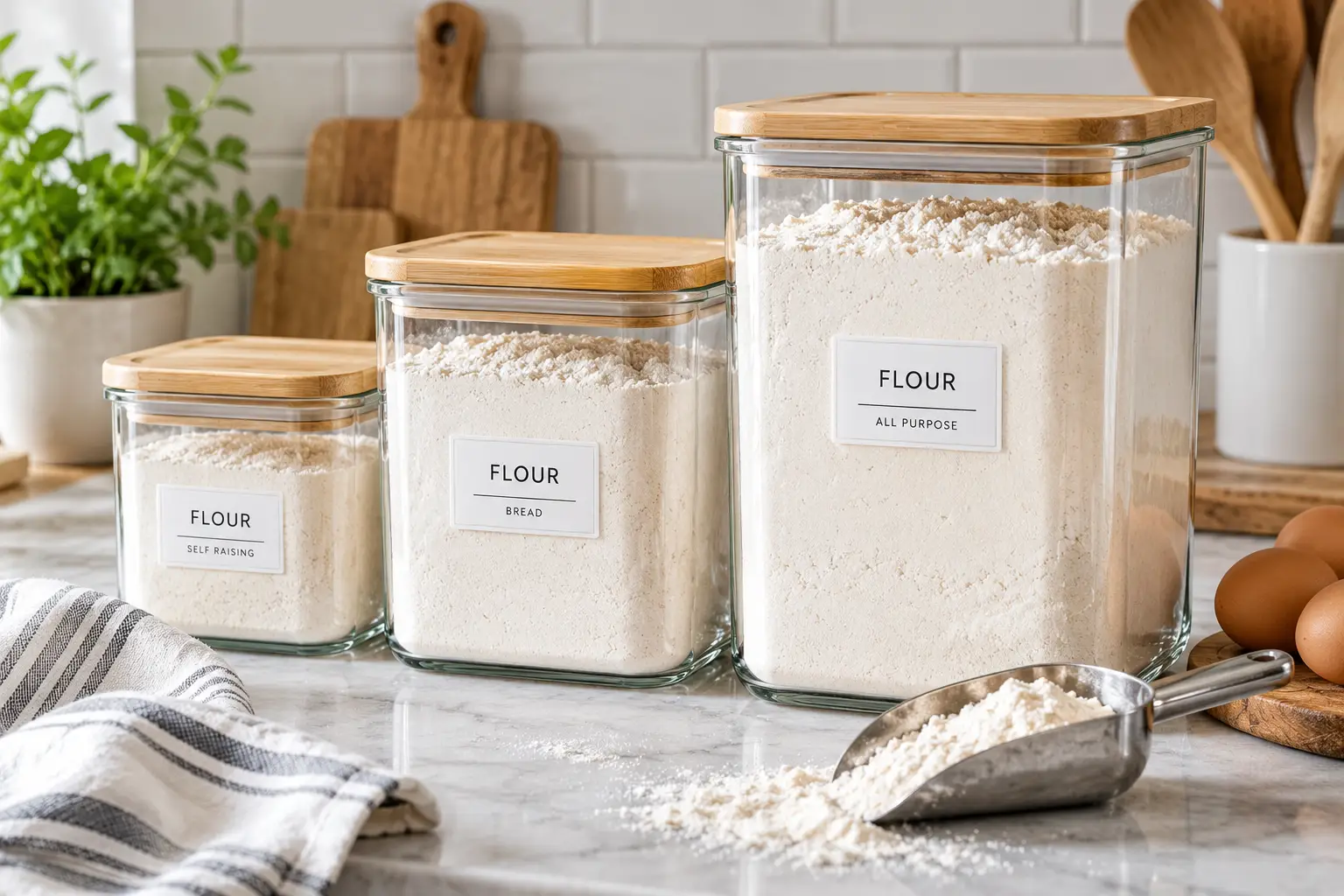
That’s exactly why so many home bakers are switching to glass flour storage containers. Glass doesn’t absorb odors, it doesn’t stain, and it lets you see at a glance that you’re down to your last two cups before a weekend of cookie baking. Pair that glass with a proper gasket seal and you’ve built a real barrier against the three things that ruin flour fastest: moisture, oxygen, and insects.
There’s a food-safety angle, too, that most people never think about. The FDA reminds consumers that flour is a raw food and that milling grain into flour doesn’t kill harmful bacteria like E. coli or Salmonella. A sealed, washable jar won’t make raw flour safe to eat (only cooking does that), but it keeps flour cleaner, easier to track, and away from the spills and crumbs of a crowded shelf.
In this guide, you’ll find seven real options currently listed on amazon.com, from budget clamp-lid sets to Italian-made classics. Each one is analyzed for capacity, seal design, scooping comfort, and long-term value. After that, we’ll cover setup tips, real-world buyer scenarios, pest-proofing, and the sizing math that tells you whether a 5-pound bag will actually fit. Let’s find the jar that matches the way you bake.
What Are Glass Flour Storage Containers?
Glass flour storage containers are sealable jars or canisters made from soda-lime or borosilicate glass, typically sized to hold 2 to 10 pounds of flour. The best ones pair the glass body with a silicone or rubber gasket and a clamp, lever, or screw lid, creating an airtight barrier against moisture, odors, and pantry pests.
In practice, you’ll run into four main lid styles, and the lid matters far more than the glass:
- ✅ Clamp (bail) lids: a wire clamp presses a glass lid onto a rubber gasket. Old-school, very tight, slightly fiddly.
- ✅ Lever or switch lids: a flip-down lever compresses a silicone ring. Faster for daily use.
- ✅ Screw lids with silicone inner seals: familiar mason-jar logic, scaled up to a gallon.
- ✅ Glass-on-glass apothecary lids: gorgeous, heavy, and usually not airtight because there’s no gasket.
The glass itself comes in two flavors. Soda-lime glass is the standard for most jars; it’s durable and inexpensive but dislikes sudden temperature swings. Borosilicate glass handles thermal shock better, which only really matters if you plan to move a glass flour canister between the freezer and a warm kitchen. For a pantry shelf, a thick soda-lime jar with a great gasket beats a thin borosilicate jar with a flimsy lid every single time.
Quick Comparison: Top Glass Flour Storage Containers at a Glance
| Product | Capacity | Lid & Seal | Approx. Price Range* | Best For |
|---|---|---|---|---|
| Caraway 4 Qt Glass Airtight Container | 4 qt (3.8 L) | Lever switch + silicone gasket | Around $40–$60 | Style-first everyday baking |
| ComSaf 1.1 Gallon Square Glass Jars (2-Pack) | 1.1 gal (~4 L) each | Wire clamp + silicone gasket | Around $30–$45 per set | Best value for two bulk flours |
| Bormioli Rocco Fido 5L Jar | 169 oz (5 L) | Wire clamp + rubber gasket | Around $25–$45 | A full 5 lb bag with headroom |
| Anchor Hocking Heritage Hill 1-Gallon Jar (2-Pack) | 1 gal each | Glass lid, no gasket | Around $30–$50 per set | Fast-turnover countertop display |
| Qianfenie 1.1 Gallon Wide Mouth Glass Jar (2-Pack) | 1.1 gal each | Hinged clamp + silicone gasket | Around $30–$45 per set | Easiest scooping |
| Kilner Square Clip Top Jar 3L | 3 L | Stainless clip + rubber seal | Around $20–$35 | Smaller households |
| Vtopmart 78 oz Glass Jars (3-Pack) | 78 oz each | Clamp + rubber gasket | Around $25–$40 per set | Organizing specialty flours |
*Prices change often. Ranges reflect the time of writing; check the current price on Amazon.
Looking at the table, the real dividing line isn’t price; it’s the seal. Six of the seven use a gasket, while the Anchor Hocking Heritage Hill 1-Gallon Jar (2-Pack) relies on a heavy glass-on-glass lid, which makes it beautiful on a counter but less protective in humid kitchens. If you bake with one flour, the Bormioli Rocco Fido 5L Jar or Caraway 4 Qt Glass Airtight Container covers you; if you keep all-purpose and bread flour, the two-pack sets from ComSaf 1.1 Gallon Square Glass Jars (2-Pack) and Qianfenie 1.1 Gallon Wide Mouth Glass Jar (2-Pack) deliver more capacity per dollar.
💬 Found a favorite already? One click on a highlighted product helps other bakers compare too! 😊
Top 7 Glass Flour Storage Containers: Expert Analysis
1. Caraway 4 Qt Glass Airtight Container — best-looking jar that still seals tight
If you want a container that looks styled on a countertop yet still behaves like a serious storage tool, this is the first one to shortlist.
The 4-quart (3.8-liter) body measures roughly 6 x 6 x 9 inches, and Caraway says it’s intentionally sized to fit a 5-pound bag of flour or sugar. That square footprint matters more than it sounds: square jars waste far less shelf space than round ones, so two or three sit flush in a cabinet. The lid combines a silicone gasket with a lever-style “Airtight Switch,” and both parts come out for washing, which is important because flour paste loves to hide in gasket grooves.
Based on the specs, this suits a baker who goes through all-purpose flour weekly and wants one hero container rather than a mismatched collection. At about 2.5 pounds empty, it’s manageable to lift one-handed. Keep in mind, though, that you’re paying for design and a polished lid mechanism, not extra capacity.
Review data is newer and thinner than for decades-old brands. An Apartment Therapy writer who stored flour in the set reported no visible gaps around the lids but said it was too early to judge long-term freshness, which is a fair summary of where feedback stands.
Pros:
- ✅ Square shape saves pantry and cabinet space
- ✅ Gasket and switch disassemble for thorough cleaning
- ✅ Sized by the brand for a 5 lb bag
Cons:
- ❌ Premium price for a single container
- ❌ Limited long-term durability feedback so far
💲 Expect roughly $40–$60 at the time of writing; worth it if countertop looks matter as much as the seal.
2. ComSaf 1.1 Gallon Square Glass Jars (2-Pack) — most capacity per dollar
This set is the practical workhorse pick: two big square jars for about what some brands charge for one.
Each jar holds about 1.1 gallons (roughly 4 liters), and the lids pair a stainless wire clamp with a silicone gasket, the same basic sealing principle European canning jars have used for generations. For you, that means a genuinely compressive seal rather than a lid that just sits on top. ComSaf sells several variations of this jar (some with scoops, labels, or measurement marks, and at least one listing mentions thick walls and removable gaskets for venting ferments), so read the specific listing before you buy.
On paper, 1.1 gallons is the sweet spot for a standard 5-pound bag: ComSaf’s own 4-quart listing rates that size for about 4.4 pounds of flour, so the extra volume here gives you room to scoop without spilling. That makes the pair ideal for someone who keeps all-purpose and bread flour side by side.
Here’s an honest caveat: because ComSaf offers so many near-identical versions, review sentiment gets spread across listings, and it’s harder to pin down long-term feedback for one exact model. The consistent themes across listings are praise for the capacity and wide opening, with the usual glass-shipping breakage worries.
Pros:
- ✅ Two large jars for a moderate price
- ✅ Clamp-and-gasket lid seals firmly
- ✅ Square footprint stacks neatly on shelves
Cons:
- ❌ Many listing variants make comparison confusing
- ❌ Wire clamps take two hands to operate
💲 Typically around $30–$45 for the pair; strong value for multi-flour households.
3. Bormioli Rocco Fido 5L Jar — room for a full 5 lb bag, with space to spare
Made in Italy by a glassmaker dating back to 1825, the Fido is the classic clamp jar that half the budget brands are imitating.
The 169-ounce (5-liter) capacity is the key spec. It’s noticeably larger than the 3.8-liter jars in this guide, so a full 5-pound bag of all-purpose flour goes in with real headroom, meaning you can plunge a measuring cup without a flour avalanche. The rubber gasket is replaceable, the wire clamp creates a firm seal, and Bormioli rates the glass freezer-safe down to about -4°F. One practical note: the jar stands around 11 inches tall, and the mouth is narrower than the round body, so measure your pantry shelf height first.
This jar is ideal if you buy one type of flour in 5-pound bags and want the most proven sealing design in the lineup. Care-wise, the glass can go in the dishwasher, but Bormioli recommends hand-washing the gasket and metal clamp.
Buyer feedback on the Fido line is broadly positive about glass quality and seal, while complaints tend to center on shipping: at least one review on Bormioli’s own US site describes a jar arriving broken and a frustrating customer-service follow-up. Inspect yours right away.
Pros:
- ✅ Largest single-jar capacity in this roundup
- ✅ Replaceable gasket extends the jar’s lifespan
- ✅ Proven Italian clamp design, freezer-rated glass
Cons:
- ❌ Round shape wastes some shelf space
- ❌ Tall profile may not fit shorter shelves
💲 Usually around $25–$45; excellent value for a single, large, long-lasting jar.
4. Anchor Hocking Heritage Hill 1-Gallon Jar (2-Pack) — made-in-USA countertop classic
This is the jar you’ve probably seen in bakeries and diners: thick glass, oversized knob, pure Americana.
Each jar holds one gallon, the side walls are notably thick for stability, and the wide mouth makes scooping and refilling easy. Both jar and lid are dishwasher-safe, and Anchor Hocking glass is made in the USA. The critical detail, though, is what’s missing: there’s no gasket. The glass lid simply rests in the opening. For flour, that means decent dust protection but not a true airtight seal.
So who should buy it? Bakers who go through flour fast, live in drier climates, and want a display piece on the counter. University of Maryland Extension notes that many pantry pests are tiny enough to crawl under loose-fitting lids, so if you’ve ever had moths, pick a gasketed jar instead, or look for the aftermarket silicone rings some sellers make specifically for Heritage Hill jars.
Reviews are overwhelmingly positive about looks and heft (one retailer lists a 4.7-star average for a Heritage Hill set), while the recurring complaints are exactly what the specs predict: no seal in humid weather, plus occasional lids arriving cracked from shipping. One reviewer also reports that the 2-gallon size holds a 10-pound bag of flour, useful if you buy in bulk.
Pros:
- ✅ Very thick, stable, made-in-USA glass
- ✅ Fully dishwasher-safe with no gasket to clean
- ✅ Timeless look that suits any kitchen
Cons:
- ❌ Not airtight, so less protection from humidity and pests
- ❌ Some buyers report lids cracked in transit
💲 Often around $30–$50 for the pair; good value if style and fast turnover matter more than a hermetic seal.
5. Qianfenie 1.1 Gallon Wide Mouth Glass Jar (2-Pack) — easiest jar to scoop from
If your biggest daily annoyance is banging a measuring cup against a narrow jar neck, this pair fixes that.
The standout spec is the roughly 4.3-inch mouth, which the listing says fits a 1-cup measuring scoop and is wide enough for an adult hand to reach in for cleaning. Translation: no tilting the jar, no flour dust on the counter. The hinged stainless clamp compresses a replaceable silicone gasket (some versions include a spare), and molded measurement marks let you see at a glance how much flour is left before a big bake.
Based on comparing the specs, this is the best fit for frequent bakers who scoop-and-level rather than weigh, and for anyone with larger hands or limited wrist mobility. Because the lid stays attached on its hinge, you’ll never misplace it, though that also means the lid hangs over the counter while you scoop.
Customer feedback highlighted on the listing consistently mentions thick jars, sturdy hinges, and gaskets that are easy to clean, with the main caution being to wash around the attached lid carefully. Qianfenie is a younger brand than Kilner or Bormioli, so long-term track records are shorter.
Pros:
- ✅ Extra-wide mouth fits a full measuring cup
- ✅ Replaceable gasket, often with a spare included
- ✅ Measurement marks help track remaining flour
Cons:
- ❌ Attached lid can get in the way while scooping
- ❌ Newer brand with shorter durability history
💲 Commonly around $30–$45 per two-pack; strong value for scooping comfort.
6. Kilner Square Clip Top Jar 3L — compact heritage pick for smaller households
Kilner has been making preserving jars in England since the 1840s, and this square 3-liter model is the brand’s most sensible size for flour.
A 3-liter jar holds roughly 3 pounds of all-purpose flour, depending on how settled it is. That sounds small until you consider how many households use flour only for occasional pancakes, gravy, and holiday cookies. For them, a smaller jar means fresher flour, because you’re refilling more often instead of keeping the same 5 pounds around for eight months. Kilner uses a stainless clip engineered for consistent seal tension, the soda-lime glass is dishwasher-safe, and the brand warns against pouring boiling water directly into the jar.
Here’s what to weigh: this is the right jar for a couple, a studio-apartment baker, or anyone storing a specialty flour like rye or cake flour in a modest quantity. It is not the right jar if you want to dump in a whole 5-pound bag.
Verified, aggregated US review data for this exact 3L square version is limited, so rather than guess, it’s fairer to say this: Kilner’s reputation rests on its clip-seal design, and the listing itself emphasizes even wall thickness and a tension-engineered clamp.
Pros:
- ✅ Compact size keeps small batches fresher
- ✅ Square shape wastes little shelf space
- ✅ Heritage clip-top seal with consistent tension
Cons:
- ❌ Won’t hold a full 5 lb bag
- ❌ Limited verifiable US review data for this size
💲 Usually around $20–$35; fair value for light or occasional bakers.
7. Vtopmart 78 oz Glass Jars (3-Pack) — best starter kit for specialty flours
Three matching jars and a set of chalkboard labels make this the easiest way to bring order to a crowded baking shelf.
Each square jar holds 78 ounces (about 2.3 liters), or roughly 2 to 2.5 pounds of flour. That’s deliberately modest, and for specialty flours it’s a feature: bread flour, whole wheat, and rye rarely get used at all-purpose speed, and smaller jars keep less flour exposed to air every time you open them. The clamp lid presses onto a rubber gasket, the square shape stacks efficiently, and eight chalkboard labels help you mark contents and dates.
This set suits the enthusiastic weekend baker whose pantry holds four or five flour types in partial bags. Put your all-purpose in a larger jar from this list, then use these for the supporting cast.
Aggregated feedback summarized by reviewers leans positive on sturdiness and seal, though at least one roundup notes the brand recommends hand-washing to protect the jars. Rather than invent star ratings, the honest takeaway is this: it’s a well-known Amazon organizing brand, and the main trade-off is care, not performance.
Pros:
- ✅ Three matching jars for the price of many singles
- ✅ Labels included for dates and flour types
- ✅ Square, stackable design maximizes shelf space
Cons:
- ❌ Too small for a full bag of all-purpose flour
- ❌ Hand-washing recommended rather than dishwasher
💲 Often around $25–$40 for three; excellent value as a specialty-flour system.
How the Top 7 Glass Flour Storage Containers Stack Up
| Product | Approx. Flour Capacity | Airtight? | Dishwasher | Shape | Best For |
|---|---|---|---|---|---|
| Caraway 4 Qt Glass Airtight Container | ~4–5 lb | Yes (gasket) | Glass yes; lid parts removable | Square | Caraway 4 Qt: design lovers |
| ComSaf 1.1 Gallon Square Glass Jars (2-Pack) | ~5 lb each | Yes (gasket) | Check listing | Square | ComSaf 1.1 Gallon: two-flour pantries |
| Bormioli Rocco Fido 5L Jar | 5 lb + headroom | Yes (gasket) | Glass yes; hand-wash gasket | Round | Fido 5L: single bulk flour |
| Anchor Hocking Heritage Hill 1-Gallon Jar (2-Pack) | ~4–4.5 lb each | No | Yes | Round | Heritage Hill: fast-use countertops |
| Qianfenie 1.1 Gallon Wide Mouth Glass Jar (2-Pack) | ~5 lb each | Yes (gasket) | Yes, per brand | Round | Qianfenie 1.1 Gallon: easy scooping |
| Kilner Square Clip Top Jar 3L | ~3 lb | Yes (seal) | Yes | Square | Kilner Square 3L: light bakers |
| Vtopmart 78 oz Glass Jars (3-Pack) | ~2–2.5 lb each | Yes (gasket) | Hand-wash advised | Square | Vtopmart 78 oz: specialty flours |
Capacities are estimates based on volume; flour density varies with how settled it is.
The pattern is clear once it’s laid out: square jars win on shelf efficiency, round jars win on heritage and gasket longevity. The Bormioli Rocco Fido 5L Jar is the only single container that comfortably swallows a 5-pound bag with scooping room, while the Vtopmart 78 oz Glass Jars (3-Pack) and Kilner Square Clip Top Jar 3L are better thought of as freshness tools for smaller quantities. If “airtight” is non-negotiable, cross the Anchor Hocking Heritage Hill 1-Gallon Jar (2-Pack) off your list or budget for an aftermarket gasket.
✨ Ready to retire the paper bag for good?
🔍 Click any highlighted jar above to check current pricing and availability on Amazon. The right airtight home for your flour means fewer surprises, fewer bugs, and better bakes all year long!
How to Set Up a New Glass Flour Canister (First 30 Days)
Buying the jar is step one; setting it up correctly is what actually keeps flour fresh. Here’s a practical routine that most product listings skip.
Day 1: Wash, then dry completely. Hand-wash the jar and gasket in warm, soapy water, then let everything air-dry for several hours. Even a faint film of water inside a glass flour canister turns the first layer of flour into glue.
Day 1: Save the bag’s details. Before you pour, cut out or photograph the brand, lot code, and best-by date. The CDC’s advice during a past flour recall was blunt: if flour was stored in another container and you can’t remember the brand or date, throw it out. A photo on your phone or a label on the jar solves that.
Day 1: Freeze first if you’re worried about pests. Many bakers pop a new bag in the freezer for a few days before decanting, a common extension-service tactic for killing any eggs that slipped through packaging.
Week 1: Test the seal. Close the empty jar, then press gently on the lid or clamp. A good gasket feels springy and uniform. If one corner lifts, reseat the gasket.
Weeks 2–4: Never top off. Don’t pour new flour on top of old. Use the jar down, wash it, then refill. Layering creates a stale bottom inch that never gets used.
Ongoing: Keep it cool and dark. Clear glass looks great in sunlight, but light and warmth speed up spoilage. A cabinet beats a sunny windowsill.
Real-World Scenarios: Matching the Jar to the Baker
Specs only matter in context, so here are three common baker profiles and the picks that fit them best.
🧁 The weekly cookie baker in a small apartment. She bakes most Sundays, uses one 5-pound bag of all-purpose every six to eight weeks, and has one short cabinet. Budget: around $50. The Caraway 4 Qt Glass Airtight Container fits perfectly: square to save space, sized for a 5-pound bag, and attractive enough to live on the counter if the cabinet fills up. If budget is tighter, the Kilner Square Clip Top Jar 3L works too, as long as she’s fine with keeping a small backup bag in the freezer.
🍞 The sourdough hobbyist. He keeps all-purpose, bread flour, whole wheat, and rye, and he bakes three or four loaves a week. The winning combination is the ComSaf 1.1 Gallon Square Glass Jars (2-Pack) for the two high-volume flours plus the Vtopmart 78 oz Glass Jars (3-Pack) for whole wheat, rye, and a spare. Total spend lands somewhere around $55–$85, and every flour gets a gasketed seal.
🥧 The holiday-season bulk buyer. This household buys 10-pound bags in November and bakes nonstop through December, then slows down. The Bormioli Rocco Fido 5L Jar handles half a bag with headroom, and the rest can stay sealed in the freezer. Alternatively, the Qianfenie 1.1 Gallon Wide Mouth Glass Jar (2-Pack) splits a 10-pound bag across two jars, and the wide mouths speed up marathon scooping sessions.
The logic behind all three: size the jar to your usage rate, not to the largest bag you ever buy.
Problem → Solution: Fixing Common Flour Storage Headaches
❌ Problem: Tiny moths or webbing in the pantry. ✅ Solution: Assume the infestation has spread beyond one package. The UC Statewide IPM Program’s pantry pest guide recommends inspecting all opened packages, using pheromone traps labeled for pantry pests to monitor activity, and storing food in containers with tight-fitting lids rather than bags. Discard infested flour, vacuum shelf crevices, then move everything into gasketed jars like the ComSaf 1.1 Gallon Square Glass Jars (2-Pack).
❌ Problem: Flour clumps or smells musty. ✅ Solution: Moisture got in. Check the gasket for cracks or flattening, make sure the jar was fully dry before filling, and move it away from the stove or dishwasher vent. Musty or sour flour should be discarded.
❌ Problem: Flour dust everywhere when scooping. ✅ Solution: Your jar is too narrow or too full. Leave a couple of inches of headroom, or switch to a wide-mouth design like the Qianfenie 1.1 Gallon Wide Mouth Glass Jar (2-Pack).
❌ Problem: The clamp lid is hard to open. ✅ Solution: Gaskets stiffen when flour dust packs into them. Wipe the gasket and rim with a dry cloth after each refill, and replace the gasket if it no longer springs back.
❌ Problem: You can’t remember when the flour was bought. ✅ Solution: Label every jar with the flour type and best-by date the moment you fill it. The chalkboard labels bundled with the Vtopmart 78 oz Glass Jars (3-Pack) exist for exactly this reason.
How to Choose Glass Flour Storage Containers
Follow these steps and you’ll avoid 90% of buyer’s remorse:
- Match capacity to your bag size. A 5-pound bag of all-purpose flour needs roughly 4 to 5 quarts; go bigger if you want room to scoop.
- Insist on a gasket. University of Maryland Extension notes that glass jars that pressure-seal with rubber gaskets are best, because tiny pests can crawl under loose lids.
- Check the mouth width. A 1-cup measure is about 3.5 inches across; anything narrower means tilting and spilling.
- Pick square for shelves, round for counters. Square jars pack tighter; round jars are often easier to clean.
- Confirm replaceable parts. A gasket you can buy again turns a 3-year jar into a 15-year jar.
- Measure your shelf height. Tall jars like the Bormioli Rocco Fido 5L Jar need about 11 inches of clearance, plus room for your hand.
- Consider weight. A full gallon jar can top 7 pounds; if lifting is tough for you, choose two smaller jars.
The takeaway: seal quality and fit matter far more than brand name or aesthetics.
Airtight Glass Flour Container vs. Plastic Canisters
The honest truth is that a good plastic canister and a good airtight glass flour container both keep flour fresh. The differences are in the details, and they add up over years.
| Factor | Airtight Glass | Plastic Canister | Paper Bag |
|---|---|---|---|
| Odor and stain resistance | Excellent | Fair; can absorb odors | Poor |
| Pest barrier | Excellent with gasket | Good with gasket | Poor |
| Breakage risk | Moderate | Very low | N/A |
| Weight when full | Heavy | Light | Light |
| Lifespan | Decades with gasket swaps | Years; may scratch or cloud | Single use |
| Best for | Bormioli Rocco Fido 5L Jar, Caraway 4 Qt Glass Airtight Container | Families with kids, high shelves | Short-term only |
Reading the table, glass wins on longevity and cleanliness, while plastic wins on weight and shatter resistance. If you store flour on a high shelf or have small kids pulling things out of cabinets, a lightweight plastic canister is the safer choice there. On the counter or at waist height, though, an airtight glass flour container like the Caraway 4 Qt Glass Airtight Container won’t scratch, cloud, or hold onto the smell of last year’s coffee beans.
There’s also a cleaning advantage: glass doesn’t develop the fine scratches where oily whole-grain flour residue can linger. When you wash a glass jar, it’s genuinely clean, which makes airtight glass flour container sets especially appealing for bakers who rotate between flours and don’t want flavors crossing over.
Sizing Guide: Choosing a Large Glass Jar for Flour
Flour volume is trickier than it looks, because flour in a sealed bag is compressed, while scooped flour is fluffy. That’s why one brand can advertise a 4-quart jar for a 5-pound bag, while you find yourself struggling to fit the last cup.
Here’s a practical rule of thumb. Bagged, settled all-purpose flour runs roughly 1 pound per quart of container space. So:
- ✅ 2 to 2.5 quarts: 2 to 2.5 pounds, great for specialty flours (Vtopmart 78 oz Glass Jars (3-Pack)).
- ✅ 3 quarts: about 3 pounds, good for light bakers (Kilner Square Clip Top Jar 3L).
- ✅ 4 to 4.5 quarts: a snug 5-pound bag (Caraway 4 Qt Glass Airtight Container, ComSaf 1.1 Gallon Square Glass Jars (2-Pack)).
- ✅ 5+ quarts: a 5-pound bag with comfortable headroom (Bormioli Rocco Fido 5L Jar).
- ✅ 2 gallons: around 10 pounds, based on user reports for large Heritage Hill jars.
Bread flour and whole wheat flour pack a little differently than all-purpose, so leave extra room when in doubt. When choosing a large glass jar for flour, it’s almost always better to size up slightly: an overfilled jar spills, compresses the gasket unevenly, and makes leveling a measuring cup nearly impossible. A large glass jar for flour that’s 80% full is the sweet spot.
Features That Actually Matter (and Ones That Don’t)
Product listings love to pile on features. Here’s how to separate the useful from the fluff when you’re shopping for a flour storage jar with lid.
Features that matter:
- ✅ A compressible gasket. This single part determines whether a flour storage jar with lid is truly airtight.
- ✅ Replaceable seals. Gaskets wear out; a jar you can re-seal lasts far longer.
- ✅ Wide mouth. It saves time and mess every single bake.
- ✅ Thick, even walls. Thicker glass handles bumps and heavy loads better.
Features that matter less than you’d think:
- ❌ Borosilicate vs. soda-lime for pantry use. Thermal shock resistance barely matters on a shelf at room temperature.
- ❌ Included scoops. Nice, but most bakers already own measuring cups they prefer.
- ❌ Bamboo lids for flour. They look great, but wood can absorb moisture and odors over time, and the seal depends entirely on a thin silicone ring.
- ❌ “100% airtight” marketing claims. Every gasket seal eventually needs maintenance.
The bottom line: judge a flour storage jar with lid by its gasket and its mouth, not by its accessories.
Storing Whole Wheat, Bread, and Specialty Flours
Not all flour ages the same way, and your container strategy should reflect that.
White all-purpose and bread flours are refined, so the fatty germ has been removed. Stored airtight in a cool, dark spot, they stay fresh for months. Whole wheat, rye, and nut flours are different: the natural oils in the germ or nut begin oxidizing after milling, which eventually produces a bitter, rancid flavor. According to King Arthur Baking’s flour storage guide, whole grain and nut flours always have a shorter shelf life than white flour, and freezing is the best way to extend it.
What does this mean for your glass flour storage containers? Keep a smaller jar, such as the Kilner Square Clip Top Jar 3L or one of the Vtopmart 78 oz Glass Jars (3-Pack), for the whole wheat you’ll use within a month or two, and freeze the rest of the bag sealed tightly. If you store a glass jar in the freezer, choose one rated for it (Bormioli rates its Fido glass down to about -4°F), leave headroom, and let the jar sit closed at room temperature before opening so condensation forms on the outside instead of in your flour.
For self-rising flour, smaller jars are smart too: the leavening can lose strength after the best-by date, so buy in amounts you’ll actually use.
Common Mistakes to Avoid When Buying Glass Flour Containers
Even careful shoppers fall into these traps:
- Buying for looks alone. Apothecary-style jars without gaskets look stunning but aren’t airtight. If pest protection matters, the Anchor Hocking Heritage Hill 1-Gallon Jar (2-Pack) needs an aftermarket seal.
- Ignoring the mouth. A 5-liter jar with a narrow opening can be more frustrating than a 3-liter jar with a wide one.
- Underestimating weight. Glass plus 5 pounds of flour is heavy. Plan to store big jars at waist height, not above your head.
- Forgetting shelf clearance. Measure before buying; tall jars plus a clamp lid need extra inches.
- Mixing old and new flour. Topping off buries old flour at the bottom, where it goes stale.
- Skipping labels. Without a date, you can’t rotate stock or respond to a recall.
- Choosing one giant jar for multiple flours. If you rotate flours, several medium jars beat one enormous container.
Most of these mistakes come from shopping by photo. Before clicking “buy,” check the capacity, mouth diameter, gasket type, and height, the four specs that decide whether you’ll love the jar or quietly shove it to the back of the cabinet.
Long-Term Cost, Care, and Safety
Glass flour containers are one of those rare kitchen buys that can genuinely last decades, if you maintain them.
Cost of ownership. Spread across ten years, even a premium jar in the $40–$60 range costs just a few dollars a year. The real recurring cost is gaskets. Brands like Bormioli and Qianfenie offer replaceable seals, which is why they score well on long-term value. By contrast, flour lost to moisture or moths, often a whole 5-pound bag at a time, adds up quickly.
Maintenance schedule.
- ✅ Every refill: wash, dry completely, and wipe the gasket.
- ✅ Every 6 months: inspect gaskets for cracks, flattening, or stiffness.
- ✅ Every 1–3 years: replace gaskets as needed, depending on use.
Safety notes. Several manufacturers, including Kilner and ComSaf, warn against pouring boiling water into cold glass or exposing jars to sudden temperature swings, which can crack soda-lime glass. Check listings for lead-free, food-grade glass claims, and hand-wash gaskets and metal clamps when the manufacturer recommends it, as Bormioli does for the Fido. Finally, remember the food-safety basics: flour is raw, so wash hands, bowls, and counters after handling it, and keep flour sealed away from ready-to-eat foods.
FAQ: Glass Flour Storage Containers
❓ Can I put a glass flour jar in the freezer?
❓ What size glass jar do I need for 10 pounds of flour?
❓ Do glass flour containers really keep bugs out?
❓ How often should I wash my flour jar?
❓ Are glass jars with bamboo lids airtight enough for flour?
Conclusion: Picking the Right Glass Flour Storage Containers for Your Kitchen
The best glass flour storage containers aren’t the prettiest or the most expensive; they’re the ones sized to your baking habits and sealed with a gasket that actually compresses. For most home bakers, that comes down to three decisions: how much flour you use per month, how many flour types you keep, and where the jar will live.
If you bake weekly with all-purpose and want one standout jar, the Caraway 4 Qt Glass Airtight Container balances looks and seal. Need the most room for a single 5-pound bag? The Bormioli Rocco Fido 5L Jar is the proven classic. Two-flour households will get the best value from the ComSaf 1.1 Gallon Square Glass Jars (2-Pack) or, if scooping comfort is your priority, the Qianfenie 1.1 Gallon Wide Mouth Glass Jar (2-Pack). Lighter bakers and specialty-flour collectors should look at the Kilner Square Clip Top Jar 3L and the Vtopmart 78 oz Glass Jars (3-Pack), while the Anchor Hocking Heritage Hill 1-Gallon Jar (2-Pack) remains the countertop showpiece for fast-moving flour in dry climates.
Whichever you choose, wash and dry it well, label the date, never top off old flour, and keep it cool and dark. Do that, and your flour will taste as fresh on the last scoop as it did on the first.
🚀 Give your flour the home it deserves!
🛒 Click any highlighted jar in this guide to check current pricing and availability. A few minutes of setup today means fresher bakes, a tidier pantry, and zero surprise moths for years to come!
Recommended for You
- Glass Dressing Container: 7 Best Leakproof Picks for 2026
- Commercial Food Storage Boxes: 7 Best Picks That Last (2026)
- Restaurant Plastic Containers: 7 Best Picks That Last (2026)
Disclaimer: This post contains affiliate links. As an Amazon Associate, I earn from qualifying purchases made through these links, at no additional cost to you.
✨ Found this article helpful? Share it with someone who needs it! 💬🤗