
In This Article
Half-pint jars are the workhorses of a small-batch kitchen, and if you’ve started hunting for 8 oz canning jars with lids, you’ve probably noticed the options multiply fast: regular mouth, wide mouth, quilted glass, hexagonal favor jars, and everything in between. That variety is a good thing once you know what you’re looking at, but it’s easy to grab the wrong jar for the job — a decorative gift jar that isn’t rated for water bath processing, or a wide-mouth jar that won’t take the lids you already own.
This guide breaks down seven real, currently available half-pint jars, from budget-friendly basics to premium reusable-lid systems, and explains what actually matters when you’re comparing them: mouth width, glass thickness, lid compatibility, and long-term cost. According to the National Center for Home Food Preservation, using jars specifically manufactured for home canning — with the correct headspace and a matching two-piece lid — is one of the most overlooked safety factors in home preserving, and it’s exactly where a lot of shoppers get tripped up.
Whether you’re canning your first batch of strawberry jam, portioning out pepper jelly for holiday gifts, or just need small jars for spice storage, you’ll find a clear recommendation below. We’ll also cover how to choose between 8 oz jelly jars and other half-pint mason jars with lids and bands, common buying mistakes, and the maintenance habits that make a set of jars last for a decade instead of a season.
What Are 8 oz Canning Jars With Lids?
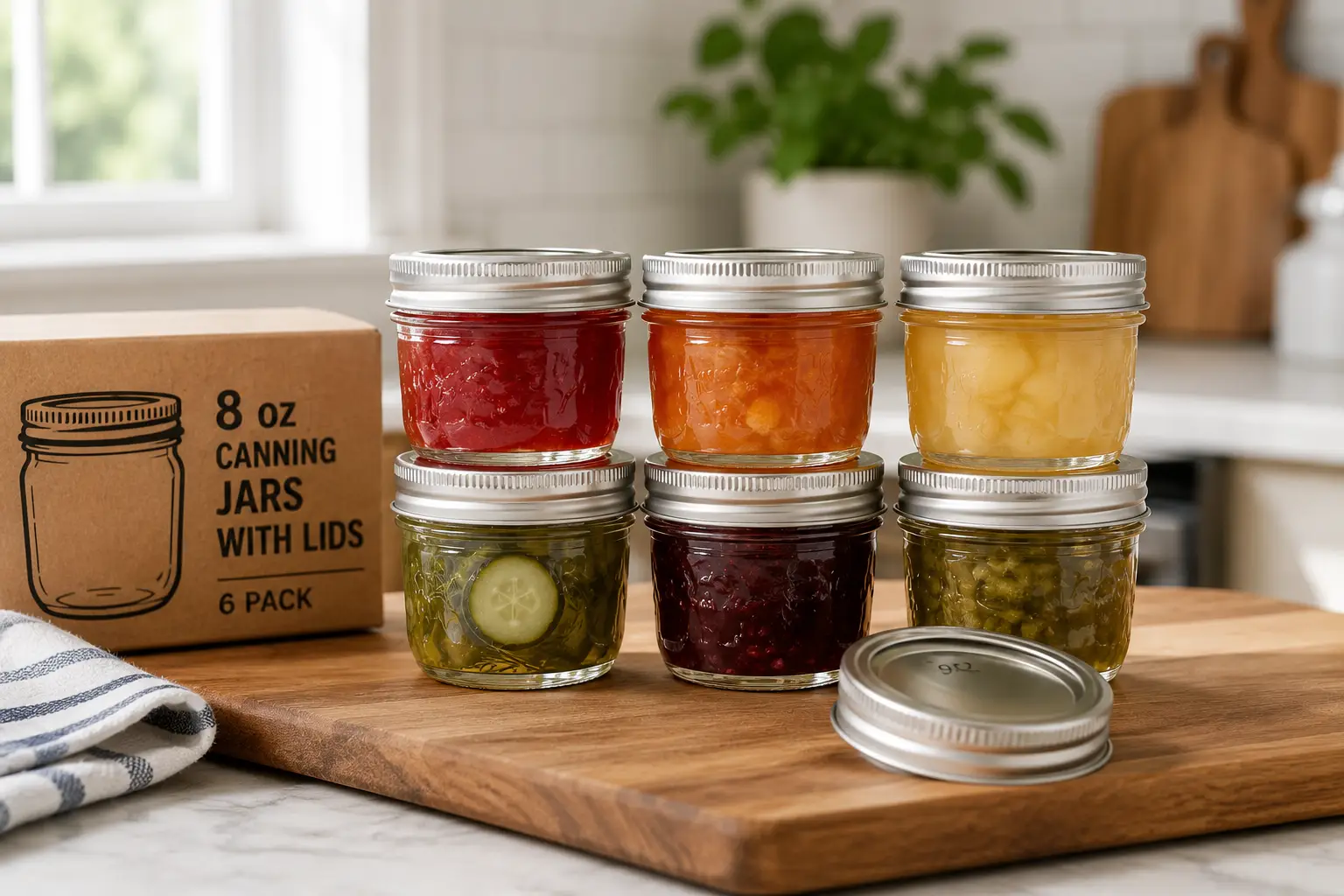
8 oz canning jars with lids — often called half-pint jars or jelly jars — are small glass preserving jars holding roughly one cup of product, sold with a flat metal lid and a screw band (or, on premium jars, a reusable glass lid and gasket). They’re the standard size for jams, jellies, condiments, and gift-sized preserves.
Quick Comparison: 7 Best 8 oz Canning Jars With Lids
| Jar | Mouth Type | Glass/Origin | Best For | Price Range* |
|---|---|---|---|---|
| Ball Quilted Crystal Jelly Jar | Regular | USA tempered glass | Classic canning & gifting | around $12–$18 per 12-pack |
| Kerr Wide Mouth Half-Pint | Wide | USA tempered glass | Easy filling, chunky preserves | around $14–$20 per 12-pack |
| Golden Harvest Half-Pint Jelly Jar | Regular | Imported tempered glass | Budget-conscious batch canning | around $10–$14 per 12-pack |
| Anchor Hocking Half-Pint | Regular | USA heritage glass | Everyday reliability | around $11–$16 per 12-pack |
| Bormioli Rocco Quattro Stagioni 8.5 oz | Regular | Italian thick glass | Premium fridge storage & gifting | around $20–$28 per 12-pack |
| Weck Tulip Jar 763 | Wide (glass lid) | German glass | Zero-waste reusable sealing | around $28–$38 per 6-pack |
| Nutley’s Hexagonal 8 oz Jam Jars | Regular | UK decorative glass | Wedding favors & no-cook jam | around $14–$20 per 6-pack |
Prices fluctuate; always check the current listing before buying.
Looking at the table, the split comes down to how you’ll use the jars: Ball Quilted Crystal Jelly Jar and Anchor Hocking Half-Pint are the safest defaults for actual water bath canning, while Weck Tulip Jar 763 and Bormioli Rocco Quattro Stagioni 8.5 oz cost more but double as attractive reusable storage once the food is gone. Nutley’s Hexagonal 8 oz Jam Jars, by contrast, is built more for presentation than for heat processing — worth knowing before you fill a canner with them.
💬 One click helps other shoppers make an informed choice too! 😊
Top 7 8 oz Canning Jars With Lids: Expert Analysis
1. Ball Quilted Crystal Jelly Jar — the recognizable canning-aisle standard
The Ball Quilted Crystal Jelly Jar is the jar most US home canners picture when they hear “jelly jar,” and that familiarity buys real convenience at checkout and at the farmers market table. Its diamond-quilted glass pattern isn’t just decorative — the embossing adds surface rigidity, which is part of why these jars tolerate repeated trips through a boiling water canner without the stress cracks that plague thinner import glass. Each 12-pack ships with two-piece lids and bands sized to Ball’s regular-mouth opening, so if you already own a Ball or Kerr regular-mouth funnel, everything you buy going forward will just fit.
Based on comparing specs against the rest of this list, this jar earns its reputation less from any single standout feature and more from consistency: predictable headspace, a reliable seal rate, and wide retail availability so you’re never stuck mid-batch waiting on a restock. Reviews consistently report that the quilted texture also gives labels something to grip, which matters if you’re gifting jars over the holidays.
Pros:
- ✅ Widely stocked, so restocking mid-canning-season is easy
- ✅ Quilted texture helps labels and twine grip the glass
- ✅ Reliable seal performance reported across aggregated reviews
Cons:
- ❌ Regular mouth opening makes chunky fillings slower to pack
- ❌ Lids are single-use for a true vacuum-sealed canning batch
Typically priced around $12–$18 for a 12-pack, it’s a fair value pick if you want a dependable jar without paying a premium for it.
2. Kerr Wide Mouth Half-Pint — best for easy filling and cleanup
The Kerr Wide Mouth Half-Pint trades the classic quilted look for a roughly 3-inch wide-mouth opening, and that half-inch of extra clearance changes the whole filling experience. A wide funnel drops straight in without wedging, which cuts down on drips and makes ladling thicker mixtures like pepper jelly or fruit butter noticeably less messy. The straighter jar walls also mean a bottle brush reaches every corner during cleanup, something regular-mouth jars can’t always claim.
What most buyers overlook with wide-mouth half-pints is lid interchangeability: Kerr’s SureTight lids fit any standard wide-mouth jar, including many Ball wide-mouth products, so your lid supply isn’t locked to one brand. Reviews aggregated across major retailers describe consistent sealing performance, with occasional notes that wide-mouth lids run slightly more expensive per dozen than regular-mouth equivalents.
Pros:
- ✅ Wide opening speeds up filling and reduces spills
- ✅ Straight walls make hand-washing and inspection easier
- ✅ Lids cross-compatible with other wide-mouth jar brands
Cons:
- ❌ Wide-mouth replacement lids typically cost a bit more
- ❌ Slightly bulkier footprint than regular-mouth jars in storage
Expect to pay in the $14–$20 range for a 12-pack, which is reasonable given the added convenience during active canning sessions.
3. Golden Harvest Half-Pint Jelly Jar — the budget-first option
The Golden Harvest Half-Pint Jelly Jar is the jar to reach for when you need volume without spending Ball-level money, and it’s a legitimate option rather than a corner-cutting one — the glass is still food-grade tempered glass rated for hot-fill and water bath processing. Its regular-mouth opening and standard two-piece lid system match the dimensions most US home canners already expect, so recipes and lid stock transfer over without adjustment.
Here’s what the spec sheet doesn’t say, but aggregated buyer feedback suggests: quality control on Golden Harvest cases can be slightly less consistent batch-to-batch than the two legacy brands above, with occasional reports of a chipped rim in a case of twelve. That’s a real trade-off for the lower price, not a dealbreaker, but it’s worth inspecting jars before your first fill. For anyone canning in volume — a big garden harvest, a batch of 40 jars of salsa — the savings add up fast enough to justify a quick rim check.
Pros:
- ✅ Noticeably lower cost per jar than name-brand equivalents
- ✅ Standard regular-mouth sizing works with common lids and funnels
- ✅ Rated for hot-fill and water bath processing like premium brands
Cons:
- ❌ Occasional reports of minor rim chips in a case
- ❌ Less consistent retail availability than Ball or Kerr
At roughly $10–$14 per 12-pack, it’s the strongest pick here for anyone canning at scale on a budget.
4. Anchor Hocking Half-Pint — the heritage American glass option
Anchor Hocking Half-Pint jars come from a US glassmaker with roots stretching back over a century, and the jar itself reflects that legacy: a simple, round-shouldered shape without the square sides some competitors use for stackability. That rounded profile actually distributes stress more evenly around the jar during rapid temperature changes, which is one reason this jar shows up repeatedly in canning-community recommendations for beginners nervous about breakage.
Based on comparing this jar to squared alternatives, the trade-off is modest: round jars use marginally more shelf space than square-sided designs, but the difference is only noticeable if you’re storing dozens at once. Independent testing from outlets like TechGearLab has praised Anchor Hocking’s pint-size jars as a “decent,” dependable option, and that utilitarian consistency carries over to the half-pint size. Aggregated customer sentiment echoes this: buyers describe the jars as unremarkable in the best sense — they simply work, batch after batch.
Pros:
- ✅ Rounded shoulders handle thermal stress well during processing
- ✅ Backed by a century-plus American glassmaking heritage
- ✅ Consistent seal reliability noted across aggregated reviews
Cons:
- ❌ Round shape is slightly less space-efficient than square jars
- ❌ Less decorative than quilted or hexagonal alternatives
Priced around $11–$16 for a dozen, this is a safe, no-surprises choice for everyday canning.
5. Bormioli Rocco Quattro Stagioni 8.5 oz — premium glass built to be reused
The Bormioli Rocco Quattro Stagioni 8.5 oz jar is Italian-made and it shows in hand: the glass runs noticeably thicker than most American mass-market jars, and the square-sided body is designed as much for permanent kitchen storage as for a single canning run. The gold-lacquered metal lid uses a rubber-free sealing compound that resists corrosion better than plain tin over repeated dishwasher cycles, which matters if you plan to reuse these jars as spice or pantry containers long after the preserves are gone.
What most buyers overlook with this jar is that it’s genuinely dual-purpose: TechGearLab’s testing specifically called out the Quattro Stagioni line for its “thick glass and secure seals” among pint-size jars, and that build quality scales down cleanly to the half-pint version. Reviews consistently describe the jars as looking more expensive than they are, which makes them a popular pick for gift-giving. The trade-off is straightforward — replacement lids cost more than generic tin lids, and you’re paying a premium for aesthetics as much as function.
Pros:
- ✅ Thicker glass than most mass-market American jars
- ✅ Dishwasher-safe metal lid resists corrosion over time
- ✅ Doubles as attractive long-term pantry storage after canning
Cons:
- ❌ Higher price than domestic regular-mouth alternatives
- ❌ Replacement lids cost more than generic tin lids
Typically running $20–$28 per 12-pack, it’s a strong value pick specifically for buyers who want jars that outlive the canning season.
6. Weck Tulip Jar 763 — the zero-waste reusable sealing system
The Weck Tulip Jar 763 breaks from the two-piece metal lid entirely. Instead, it seals with a flat glass lid, a natural rubber gasket, and stainless steel clamping clips — a German design that’s been in continuous production for decades. Because nothing but glass touches your food during storage, there’s no metal lid to rust, dent, or discolor over time, and the tapered “tulip” walls make it genuinely one of the widest openings in this size class for a jar that still tapers to a secure rim.
Here’s the honest trade-off: reviewers testing similar Weck mold jars have flagged that the stainless clips are small and easy to misplace, and the glass lids, while reusable indefinitely, can chip if dropped on a hard floor. That’s a real maintenance consideration compared to a $0.30 tin lid you simply replace. What the spec sheet doesn’t say, but long-term users report, is that the rubber gasket needs replacing every year or two of heavy use to maintain a reliable seal — a small recurring cost that’s still cheaper than buying new lids every canning season.
Pros:
- ✅ Fully reusable glass-and-clip system with zero disposable parts
- ✅ Wide tulip-shaped opening simplifies filling and packing
- ✅ No metal ever touches food, even in long-term storage
Cons:
- ❌ Glass lids can chip and clips are easy to lose
- ❌ Rubber gaskets need periodic replacement for reliable sealing
At around $28–$38 for a set of six, this is the priciest option here, best justified if you’re committed to reducing single-use canning lid waste long-term.
7. Nutley’s Hexagonal 8 oz Jam Jars — decorative favors, not a canner’s workhorse
Nutley’s Hexagonal 8 oz Jam Jars stand out immediately for their six-sided silhouette, a shape that photographs beautifully on a gift table and gives ribbon or twine a natural edge to sit against. These UK-imported jars ship with printed “fruity” tin lids designed for visual appeal rather than industrial-grade sealing hardware, and that distinction matters more than it might seem.
Honest analysis here matters more than marketing: while these jars are marketed broadly as “jam jars,” their thinner glass and decorative lid coating make them a better fit for no-cook freezer jam, refrigerator preserves, dry goods, or wedding and baby-shower favors than for full water bath or pressure canning. Reviews aggregated from buyers largely confirm this — praise centers on the look and gift-ability, while a smaller number of reviewers note the glass feels noticeably thinner than a Ball or Kerr jar when compared side by side. If shelf-stable preserving is your goal, pair this jar with a verified home-canning recipe and inspect the lid’s manufacturer guidance before processing; if gifting or no-cook jam is the goal, it’s an excellent choice.
Pros:
- ✅ Distinctive hexagonal shape stands out for gifting
- ✅ Decorative printed lids need no extra labeling
- ✅ Compact size is ideal for favors and samples
Cons:
- ❌ Thinner glass than dedicated canning-brand jars
- ❌ Not explicitly rated for high-heat pressure canning
Priced around $14–$20 for six, it’s best valued as a presentation jar rather than a heavy-duty canning workhorse.
How to Fill, Process, and Seal 8 oz Jars the Right Way
Getting a reliable seal starts before the jar ever touches your canner. Wash jars in hot, soapy water (or run them through a dishwasher cycle) and keep them warm until you’re ready to fill — a cold jar filled with hot preserves can crack from thermal shock. Warm your lids in a small pot of simmering (not boiling) water for about 10 minutes; this softens the sealing compound without damaging it.
Fill each jar to the headspace your recipe specifies — usually 1/4 inch for jams and jellies — using a canning funnel to keep the rim clean, since any residue on the sealing surface can prevent a vacuum seal from forming. Wipe the rim with a clean, damp cloth, center the lid, and screw the band on to “fingertip tight,” not wrench-tight; overtightening can trap air and cause seal failure during processing.
Process filled jars in a boiling water canner for the time your specific recipe calls for, adjusting upward for altitude if you’re above 1,000 feet, per Iowa State University Extension’s guidance on canning lids. After processing, remove jars and let them sit undisturbed for 12–24 hours; you should hear a distinct “ping” as each lid seals. Press the center of each cooled lid — if it doesn’t flex, you’re sealed and ready to label and store.
Real-World Scenarios: Who Actually Needs 8 oz Jars
If you’re a first-time canner testing a single batch of strawberry jam from a farmers market flat, a 12-pack of Golden Harvest Half-Pint Jelly Jar gives you room to experiment without a big financial commitment, and any mistakes cost you a jar, not a set. If you’re prepping holiday gifts for a dozen coworkers, Ball Quilted Crystal Jelly Jar or Bormioli Rocco Quattro Stagioni 8.5 oz both photograph well and feel like a genuine present rather than a repurposed food container.
If you host a wedding, baby shower, or milestone birthday and want favor jars guests will actually keep, Nutley’s Hexagonal 8 oz Jam Jars is purpose-built for that moment — just fill with no-cook jam, honey, or candy rather than pressure-processed preserves. Committed zero-waste households who can several times a year and want to permanently retire disposable metal lids should budget for Weck Tulip Jar 763; the upfront cost pays back over several seasons of reuse. And if you simply need dependable, functional jars for a big harvest — pickled peppers, herb jellies, chutneys — Anchor Hocking Half-Pint or Kerr Wide Mouth Half-Pint cover that use case without asking you to pay for aesthetics you don’t need.
Common Canning Problems With Small Jars, Solved
Problem: Lids won’t seal. This is almost always residue on the rim or an overtightened band trapping air. Re-wipe the rim, use a fresh lid (never reuse a metal lid that’s already sealed once), and tighten only to fingertip-tight before reprocessing within 24 hours.
Problem: Jars crack during processing. Sudden temperature swings are the usual culprit — a cold jar going into a boiling canner, or a hot jar set on a cold countertop. Keep jars warm from wash to fill to canner, and always set hot jars on a towel or cooling rack, never directly on a cold stone or metal surface.
Problem: Headspace looks wrong after cooling. Some liquid loss during processing is normal, but if a jar loses significant volume, check that you didn’t overfill originally or that the seal held properly; underfilled jars can still be safe if they sealed correctly.
Problem: Labels won’t stay stuck for gifting. Textured jars like Ball Quilted Crystal Jelly Jar hold adhesive labels better than smooth glass; for smooth jars like Bormioli Rocco Quattro Stagioni 8.5 oz, a chalkboard-style tag tied with twine avoids the peeling that happens in humid pantries.
How to Choose 8 oz Canning Jars With Lids: 7 Steps
- Decide your processing method first. Water bath and pressure canning both require jars specifically rated for it — check the manufacturer’s guidance rather than assuming any glass jar with a lid qualifies.
- Pick regular or wide mouth based on your fillings. Chunky preserves and thick fruit butters go in faster through a wide mouth; classic jellies and syrups are fine in regular mouth.
- Match lids to jars you already own. If your kitchen is full of Ball or Kerr regular-mouth jars, buying a matching brand keeps your lid inventory simple.
- Weigh reusable versus disposable lid systems. Metal two-piece lids are cheap but single-use for true canning seals; glass-and-gasket systems like Weck Tulip Jar 763 cost more upfront but eliminate that recurring purchase.
- Consider the jar’s second life. If you plan to reuse jars as spice or pantry containers afterward, thicker glass and a dishwasher-safe lid, like on Bormioli Rocco Quattro Stagioni 8.5 oz, will hold up longer.
- Factor in your budget per jar, not per case. A cheaper 12-pack can still cost more per jar than a larger case from a budget brand like Golden Harvest Half-Pint Jelly Jar.
- Buy a few extra. Rim chips and lid failures happen even with quality jars; having two or three spares on hand avoids a mid-batch supply run.
Common Mistakes to Avoid When Buying 8 oz Canning Jars With Lids
The single most common mistake is assuming every attractive glass jar with a metal lid is rated for heat processing. Decorative or favor-style jars, including options like Nutley’s Hexagonal 8 oz Jam Jars, are often built for refrigerator or no-cook use rather than a boiling water canner, and using them outside their design intent risks seal failure or jar breakage.
A second mistake is buying wide-mouth jars without checking your existing lid and funnel inventory, which forces you to maintain two separate lid supplies. A third is skipping a rim inspection on budget cases before use — a hairline chip on a sealing surface, more likely on lower-cost jars like Golden Harvest Half-Pint Jelly Jar, will prevent a proper seal no matter how carefully you process the batch. Finally, many first-time buyers underestimate how many jars a single canner load needs and end up short mid-session; buying a full case rather than a small sampler avoids that scramble.
Regular Mouth vs Wide Mouth: Which 8 oz Jar Is Right for You
| Feature | Regular Mouth 8 oz | Wide Mouth 8 oz |
|---|---|---|
| Opening diameter | About 2 3/8 in | About 3 in |
| Filling speed | Moderate; funnel recommended | Faster; less spillage |
| Lid/band compatibility | Regular-mouth only | Wide-mouth only, cross-brand |
| Best fillings | Jellies, syrups, thin jams | Chunky jam, relish, baby food |
| Jars featured here | Ball Quilted Crystal Jelly Jar, Golden Harvest Half-Pint Jelly Jar, Anchor Hocking Half-Pint, Bormioli Rocco Quattro Stagioni 8.5 oz, Nutley’s Hexagonal 8 oz Jam Jars | Kerr Wide Mouth Half-Pint, Weck Tulip Jar 763 |
The practical difference comes down to what you’re ladling. Thin, pourable liquids like jelly or syrup slide easily into a regular-mouth jar, so paying extra for a wider opening doesn’t buy you much. Chunkier mixtures, on the other hand, genuinely fill faster and cleaner through a wide mouth, which is why Kerr Wide Mouth Half-Pint tends to be the pick for salsa-adjacent recipes even at the smaller half-pint size.
What to Expect: Everyday Performance
In daily use, the biggest performance difference between these jars isn’t sealing reliability — assuming correct technique, all seven can seal properly within their intended use case — it’s handling and durability over repeated cycles. Thicker-glass jars like Bormioli Rocco Quattro Stagioni 8.5 oz and Weck Tulip Jar 763 feel noticeably more substantial in hand and tend to resist chipping better through years of dishwasher cycles and pantry shuffling. Budget jars like Golden Harvest Half-Pint Jelly Jar perform just as well fresh out of the box, but the thinner glass shows wear — small chips, cloudiness — sooner after heavy repeated use.
Lid performance varies too: metal two-piece lids on jars like Anchor Hocking Half-Pint give you the classic audible “ping” confirmation, which many canners find reassuring, while Weck Tulip Jar 763‘s gasket-and-clip system seals silently, so you’ll need to check the gasket’s grip by hand rather than listening for a pop. Neither is objectively better performance-wise; it’s a matter of what feedback you personally trust.
Long-Term Cost and Maintenance
| Cost factor | Glass jars | Metal 2-piece lids | Bands/rings | Weck gasket + clips |
|---|---|---|---|---|
| Reusable indefinitely? | Yes, if undamaged | No, single-use for a true seal | Yes, if rust-free | Gasket: 1–2 seasons; clips: yes |
| Typical replacement cost | Rarely needed | Roughly $4–$7 per dozen | Roughly $4–$6 per dozen | Roughly $5–$8 per set of gaskets |
| Annual cost, moderate canner | Low | Recurring each season | Low | Low to moderate |
The math favors reusable-lid systems the more seasons you plan to can. A household running a dozen jars of Kerr Wide Mouth Half-Pint through two or three batches a year will spend a small but real amount annually replacing metal lids, since home canning guidance generally recommends against reusing metal lids for a fresh vacuum seal. Over five or more years, that recurring cost can approach or exceed the higher upfront price of a Weck Tulip Jar 763 set, whose gasket replacement is both cheaper and less frequent.
Safety, Regulations, and Standards
Home canning safety in the US isn’t governed by a single federal glass standard the way, say, electronics face UL or FCC certification — instead, guidance comes primarily from land-grant university extension programs and the USDA’s published canning research, and it explicitly recommends using jars manufactured specifically for home canning, discarding any jar with a chip or crack on the sealing surface, and never reusing a metal lid that has already achieved a vacuum seal once.
The Federal Trade Commission also requires that any content recommending products through affiliate links clearly disclose that relationship, per its Endorsement Guides — which is why you’ll see a disclosure both near the top of this article and again below. On the product side, tempered soda-lime glass, the material used across all seven jars featured here, is standard for food-contact canning jars in the US and EU alike; the practical safety variable isn’t the glass composition but whether a specific jar and lid combination is explicitly rated by its manufacturer for water bath or pressure processing, which is the key distinction between a jar like Anchor Hocking Half-Pint and a decorative option like Nutley’s Hexagonal 8 oz Jam Jars.
✨ Don’t miss these exclusive deals!
🔍 Take your home canning setup to the next level with this carefully curated lineup. Click a highlighted item to check current pricing and availability. These picks will help you preserve a season’s worth of flavor the whole family will enjoy!
Frequently Asked Questions
❓ Can I reuse 8 oz canning jars with lids year after year?
❓ Are 8 oz canning jars with lids safe for water bath canning?
❓ How many 8 oz canning jars with lids do I need for a batch of jam?
❓ What's the difference between regular mouth and wide mouth 8 oz canning jars with lids?
❓ Where can I buy 8 oz canning jars with lids in bulk?
Conclusion
Picking the right 8 oz canning jars with lids really comes down to matching the jar to the job rather than chasing a single “best” option. For dependable, everyday water bath canning, Ball Quilted Crystal Jelly Jar, Kerr Wide Mouth Half-Pint, and Anchor Hocking Half-Pint are the safest, most established choices, and Golden Harvest Half-Pint Jelly Jar stretches your budget further without sacrificing basic safety ratings. If you want jars that double as long-term kitchen storage or gifts, Bormioli Rocco Quattro Stagioni 8.5 oz and Weck Tulip Jar 763 justify their higher price with thicker glass and reusable sealing systems that pay off over several seasons.
Just remember that not every attractive half-pint jar is built for the canner — Nutley’s Hexagonal 8 oz Jam Jars shines for favors and no-cook jam, but check any decorative jar’s manufacturer guidance before processing a full batch through boiling water. Whichever set you choose, warm your jars, respect your headspace, and check every seal before you tuck the jars away on the shelf — that habit, more than any single product feature, is what actually keeps a season’s worth of preserves safe to eat.
Recommended for You
- Cook Unity vs Factor: 7 Meal-Prep Picks to Try in 2026
- Healthy Lunch Bowls: 7 Best Picks to Simplify Meal Prep in 2026
- Glassware Made in USA: 7 Best American Brands (2026 Guide)
Disclaimer: This post contains affiliate links. As an Amazon Associate, I earn from qualifying purchases made through these links, at no additional cost to you.
✨ Found this article helpful? Share it with someone who needs it! 💬🤗