
In This Article
How Long Does Meal Prep Last in Fridge? The Honest Answer
You spent three hours on Sunday roasting chicken, steaming rice, and lining up a perfect row of containers. By Thursday, you open the fridge, stare at container number five, and wonder: is this still lunch, or is it a science experiment? 🤔
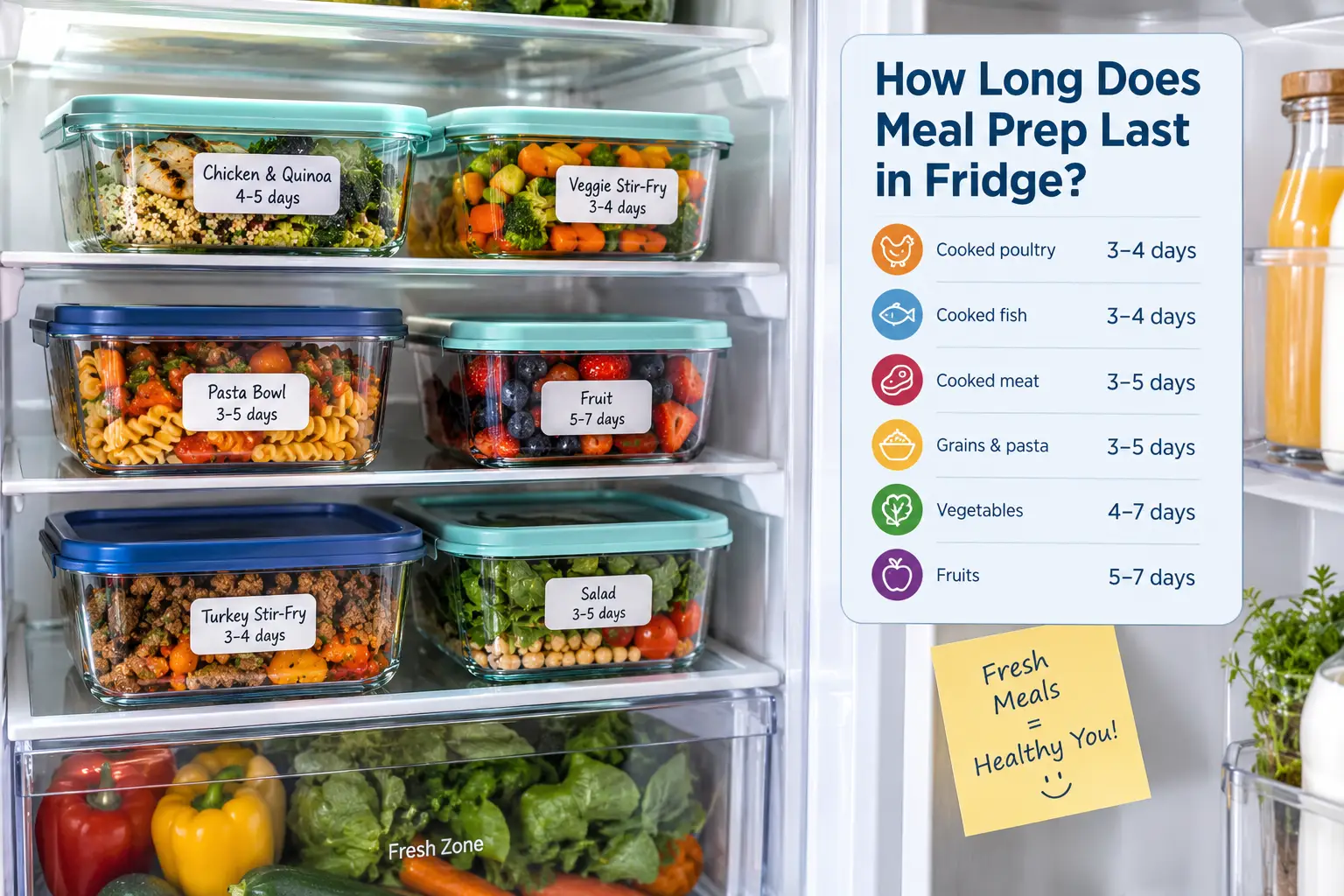
If you’ve ever asked how long does meal prep last in fridge, you’re asking the right question — and the answer is shorter than most meal prep influencers admit. According to the USDA, cooked leftovers stay safe in the refrigerator for 3 to 4 days at 40°F or below. That’s it. Not a full work week, not “until it smells funny.” The USDA Food Safety and Inspection Service’s leftovers guide also says leftovers keep 3 to 4 months in the freezer, and it stresses cooling food fast in shallow containers.
Here’s the catch most people miss: that 3-to-4-day window assumes three things go right. Your fridge actually holds 40°F (many don’t), your food went into the fridge within two hours of cooking, and your containers are sealed well enough to keep air and cross-contamination out. Break any one of those, and your window shrinks — quietly, because harmful bacteria often don’t change how food looks or smells.
So this guide does two jobs. First, it gives you a clear, food-by-food answer to how long does meal prep last in fridge, grounded in federal guidance rather than guesswork. Second, it walks through seven real tools — containers, thermometers, and a vacuum sealer — that help you actually hit that safe window every week, plus practical systems for stretching your prep into a full five-day plan without gambling on Friday’s lunch. ⚡
What Is the Safe Fridge Life of Meal Prep?
Short answer: The safe fridge life of meal prep is the number of days cooked, portioned food can be refrigerated at 40°F or below before bacterial growth makes it risky to eat. For most cooked meals — proteins, grains, soups, casseroles — federal guidance puts that limit at 3 to 4 days.
That definition hides an important nuance: “safe” and “tasty” are two different clocks. The safety clock is driven by pathogens like Listeria, Salmonella, and Clostridium perfringens, which can multiply even in a cold fridge and usually give no visual warning. The quality clock is driven by spoilage organisms and oxidation — the stuff that turns rice dry, makes salad greens slimy, and gives reheated fish that unmistakable aroma. Spoilage bacteria are actually the “honest” ones; they tell you something is wrong. Pathogens don’t.
Practically, that means your nose is a poor food-safety tool. A container of chicken and rice can look and smell perfect on day six and still carry enough bacteria to make you sick. The meal prep shelf life rule exists precisely because you can’t check safety by inspection.
Two more things affect how long is meal prep good for in real life:
- Starting point. The clock starts when the food finishes cooking, not when you put it in the fridge. Food that sat on the counter for two hours already used up part of its margin.
- Handling. Every time you open a shared container, scoop out a portion, and put it back, you introduce new bacteria. Single-serve containers are not just convenient — they’re a food safety feature.
Quick Comparison: 7 Tools That Help Meal Prep Last Safely
| Product | Type | Key Strength | Approx. Price Range | Best For |
|---|---|---|---|---|
| Rubbermaid Brilliance Glass | Glass containers, latching lids | Leak-resistant seal, universal lids | $40–$60 (set) | Saucy meals, commuters |
| Pyrex Simply Store | Tempered glass, snap-on lids | Size variety, stain resistance | $35–$50 (set) | Mixed portions, families |
| Prep Naturals Glass Meal Prep Containers | Borosilicate glass, locking lids | Oven-to-table, compartments | $25–$45 (5-pack) | Portion-controlled prep |
| Bentgo Prep 60-Piece Kit | BPA-free plastic trays | 30 containers, lightweight | $25–$35 | Beginners, big households |
| FoodSaver V4400 | Vacuum sealer | Airtight freezer storage | $150–$250 | Batch cooks, freezer prep |
| Taylor 5924 | Fridge/freezer dial thermometer | Confirms 40°F zone | Under $15 | Every kitchen |
| TempPro TP19H (formerly ThermoPro) | Instant-read thermometer | Verifies 165°F reheat | $15–$30 | Reheating safely |
Looking at the table above, notice that only four of these seven tools are containers — and that’s deliberate. The Taylor 5924 and TempPro TP19H cost less than a single takeout lunch, yet they control the two variables that decide whether your meal prep fridge life is really 4 days or quietly closer to 2: fridge temperature and reheat temperature. If your budget only covers two purchases, a solid container set like the Pyrex Simply Store plus the Taylor 5924 will do more for food safety than any premium container alone.
💬 One click helps other shoppers make an informed choice too! 😊
Top 7 Meal Prep Tools: Expert Analysis
1. Rubbermaid Brilliance Glass — most leak-resistant for commuters
The Rubbermaid Brilliance Glass set earns its spot because a tight seal is the first line of defense for fridge life, and this line is built around one. Its four-latch lids use a silicone gasket, so the container closes airtight rather than just “sitting on top” — which matters when you’re storing saucy curries or chili that would otherwise absorb fridge odors and dry out at the edges.
The clear lids are a quieter advantage: you can see exactly what’s inside, which makes a first-in, first-out rotation effortless. Built-in vents let you microwave with the lid on (vented), and the glass base is oven-safe without the lid. Because lids are universal across sizes within the line, a lost lid doesn’t strand an entire container.
Based on comparing the specs, this is the pick for anyone who carries lunch in a bag every day — the latches resist accidental pops in a tote, and the glass won’t stain from tomato sauce. Reviews and independent buying guides consistently highlight its leak resistance as the standout trait, while common complaints focus on weight and the care needed for the gasket.
Pros:
- ✅ Four-latch lid seals tightly against leaks
- ✅ Clear lids make fridge rotation easy
- ✅ Glass base resists stains and odors
Cons:
- ❌ Heavier than plastic in a work bag
- ❌ Gaskets need regular removal and drying
At around $40–$60 for a multi-piece set (check the current price), it’s a mid-to-premium buy that justifies itself if leaks have ever ruined your laptop bag.
2. Pyrex Simply Store — best size variety for mixed meals
The Pyrex Simply Store set is the workhorse choice, mixing 1-, 2-, and 3-cup containers so you can portion mains, sides, and sauces separately — which genuinely extends quality, since dressing stored apart from greens keeps salads crisp longer.
The bases are tempered glass, which resists stains and doesn’t hold odors, so last week’s garlic shrimp doesn’t flavor this week’s oatmeal. The lids are snap-on plastic rather than latching, which makes them faster to open but less leak-proof in transit. One practical note: tempered glass dislikes sudden temperature swings, so don’t move a container straight from the freezer into a hot oven.
What most buyers overlook is how useful the small 1-cup containers are for food safety. Smaller portions cool faster, which is exactly what the USDA recommends for getting food below 40°F quickly. Families who batch-cook will appreciate that versatility. Buying guides frequently describe this set as the best all-around value, and aggregated reviews praise durability, while the most common criticism is that lids can crack or warp after many dishwasher cycles.
Pros:
- ✅ Three sizes cover mains, sides, and sauces
- ✅ Glass resists stains and lingering odors
- ✅ Trusted brand with easy replacement lids
Cons:
- ❌ Snap-on lids aren’t fully leak-proof
- ❌ Lids may wear out before the glass
In the $35–$50 range for a 12-container set, it’s one of the strongest value-per-container options in glass.
3. Prep Naturals Glass Meal Prep Containers — best for portion-controlled plates
The Prep Naturals Glass Meal Prep Containers are built specifically for the classic “protein, carb, veggie” meal, with options for one, two, or three compartments — handy for keeping wet and dry foods apart.
They’re made of borosilicate glass, which handles temperature changes better than standard tempered glass, and the bases are listed as oven, microwave, freezer, and dishwasher safe (lids excluded from the oven). On paper, that means you can freeze a portion, then reheat it in the same dish — fewer transfers, fewer chances for contamination. The locking lids help limit air exposure, which slows drying and flavor transfer.
Here’s what to weigh: compartments are great for keeping roasted vegetables from going soggy next to sauced chicken, but they cap how much of any one food you can pack. If you prep big bowls of pasta or soup, a single-compartment version is the smarter pick. Reviews consistently report thick, sturdy glass and long-term durability, while a recurring complaint is that some lids don’t latch or seal as reliably as others.
Pros:
- ✅ Borosilicate glass tolerates freezer-to-oven use
- ✅ Compartments keep wet and dry foods apart
- ✅ Uniform sizes simplify weekly portioning
Cons:
- ❌ Lid seal quality varies between units
- ❌ Compartments limit large single servings
At roughly $25–$45 for a five-pack (prices may vary), it’s a strong mid-range buy for structured meal plans.
4. Bentgo Prep 60-Piece Kit — best budget starter for big batches
The Bentgo Prep 60-Piece Kit solves the most common beginner problem — not having enough containers — with 30 trays and 30 matching lids in one box.
The set includes ten each of one-, two-, and three-compartment trays (roughly 3- to 4-cup capacity), made from BPA- and PFAS-free plastic that’s microwave, freezer, and top-rack dishwasher safe. Each container weighs just a few ounces, so it’s ideal for anyone who walks or bikes to work. Bentgo advises opening a lid corner before microwaving so steam can vent.
Based on comparing the specs, this kit fits households prepping for three or four people, or anyone who wants spare containers so meal prep doesn’t stall when dishes pile up. That said, plastic stains with tomato and turmeric and holds odors more than glass, so it’s better suited to a “use, wash, rotate” routine than long-term heirloom storage. Aggregated reviews praise the value and quantity, while common complaints mention lids that feel thin and trays that eventually warp under heavy microwave use.
Pros:
- ✅ Thirty containers cover a full family week
- ✅ Lightweight and easy to carry daily
- ✅ Very low cost per container
Cons:
- ❌ Stains and holds odors over time
- ❌ Lids are thinner than glass-set lids
At about $25–$35 for the full kit (check current pricing), it’s the lowest-cost way to build a complete rotation.
5. FoodSaver V4400 — best for stretching batches through the freezer
The FoodSaver V4400 is the tool for anyone who wants to cook once and eat for weeks — not by extending fridge life, but by moving extra portions into the freezer in airtight bags.
Its automatic bag detection starts vacuuming as soon as the bag is inserted, and moisture detection switches modes for wet foods like marinated chicken or stews. Built-in roll storage and a cutter let you make custom-size bags, and a removable drip tray catches liquid. Removing air dramatically reduces freezer burn, so a portion frozen on Sunday tastes far better when you thaw it three weeks later.
Here’s an important honest caveat: the manufacturer markets refrigerated prep-ahead meals as staying fresh “for weeks,” but vacuum sealing does not change the 3-to-4-day safety guidance for cooked food in the fridge. Some dangerous bacteria thrive in low-oxygen conditions. Treat this as a freezer tool, and it’s excellent. Reviews consistently praise its ease of use and reliable seals on wet foods, while a frequent complaint is that the automatic mode wastes bag material.
Pros:
- ✅ Automatic bag and moisture detection
- ✅ Greatly reduces freezer burn on portions
- ✅ Custom bag sizes from built-in roll
Cons:
- ❌ Uses more bag material than needed
- ❌ Bulky and pricey for occasional use
In the $150–$250 range, it pays off only if you batch-freeze regularly.
6. Taylor 5924 — cheapest insurance for your whole fridge
The Taylor 5924 answers a question most people never ask: is my fridge actually at 40°F? Your fridge’s dial or digital display often isn’t measuring where your food sits.
This analog thermometer has a 3-inch dial with color-coded safe zones, reads from -20°F to 80°F, and can hang from a shelf or stand on its own. It’s stainless steel and NSF listed, the same type commonly used in commercial kitchens. Because it responds slowly (over minutes, not seconds), it shows your fridge’s average temperature — exactly the number that determines meal prep fridge life.
Based on comparing the specs, this is the single highest-impact purchase in this guide. A fridge running at 44°F instead of 38°F can quietly shrink your safe window, and you’d never know. Reviews consistently report that owners discovered their fridge was running several degrees warmer than its setting; one recurring criticism is that some units read a few degrees off, so verifying it against an ice-water bath is smart.
Pros:
- ✅ Large, color-coded dial reads at a glance
- ✅ Hangs or stands anywhere in the fridge
- ✅ NSF listed, stainless steel construction
Cons:
- ❌ Some units read a few degrees off
- ❌ Slow response hides brief temperature spikes
At under $15, it’s the best value-for-money item here by a wide margin.
7. TempPro TP19H — fastest way to confirm a safe reheat
The TempPro TP19H (sold previously under the ThermoPro name) closes the loop on meal prep safety: it confirms that leftovers hit 165°F when you reheat them, as the USDA recommends.
Its folding 4.3-inch probe reads in about 3–4 seconds with a listed accuracy of ±0.9°F. The 2-inch backlit display auto-rotates for left- or right-handed use, and it wakes when you open the probe. It has an IP65 rating, so you can rinse it under the tap, plus a calibration function and a magnetic back for sticking it to your fridge door.
What the spec sheet doesn’t say, but microwave physics does: microwaves heat unevenly, leaving cold spots in the center of dense meals like casseroles and rice bowls. Checking the center of a reheated container is the only way to know it’s actually hot all the way through. Reviews consistently praise its speed and readability for the price, while some reviewers note the plastic body feels less premium than high-end brands.
Pros:
- ✅ Fast, accurate readings for the price
- ✅ Rinse-safe IP65 design cleans easily
- ✅ Calibration keeps readings trustworthy
Cons:
- ❌ Plastic body feels less premium
- ❌ Name change can confuse shoppers searching
At about $15–$30 (check the current price), it’s an inexpensive way to make every reheated meal safer.
How to Meal Prep So Food Lasts the Full 4 Days 🥡
Knowing how long does meal prep last in fridge is only half the battle — the other half is making sure your food actually gets the full 3-to-4-day window. Here’s a practical workflow.
Step 1: Check your fridge before you cook
Put the Taylor 5924 on the middle shelf a day before prep day. If it reads above 40°F, adjust the setting and recheck the next day. The FDA recommends keeping your refrigerator at 40°F or below and using an appliance thermometer to confirm it, because built-in controls aren’t always accurate.
Step 2: Cool fast, not slow
Never let a big pot of chili cool on the stove for hours. Portion food into shallow containers like the Pyrex Simply Store or Prep Naturals Glass Meal Prep Containers while it’s still warm, leave lids slightly ajar for a few minutes, then refrigerate — always within 2 hours of cooking (1 hour if your kitchen is above 90°F).
Step 3: Split the week into two zones
Fridge for days 1–3, freezer for days 4–5. Freeze Thursday’s and Friday’s portions on Sunday, then move them to the fridge to thaw the night before. This single habit solves the “five-day meal prep” problem safely.
Step 4: Label everything
Write the cook date on masking tape. The 4-day count starts at cooking, not purchase.
Step 5: Reheat to 165°F
Stir halfway through microwaving, then check the center with the TempPro TP19H.
Common mistakes in your first 30 days
- Packing containers so full that cold air can’t circulate
- Storing food in the fridge door, the warmest spot
- Mixing dressings into salads on day one
Real-World Meal Prep Scenarios: Matching Tools to Your Week 🗓️
Different lives need different systems. Here are three common profiles and the setup that fits each.
Scenario 1: The solo office worker on a $60 budget
Maya preps five lunches every Sunday and commutes 40 minutes by train. Her biggest risks are leaks in her bag and day-five lunches pushing past the safe window. The best fit: a Rubbermaid Brilliance Glass set for lunches that travel, plus a Taylor 5924 to confirm her small apartment fridge actually holds temperature. She freezes Thursday and Friday portions on Sunday and moves them to the fridge Wednesday night. Total spend sits in the $55–$75 range, and the “fridge three, freeze two” plan keeps every lunch inside federal guidance.
Scenario 2: The family of four cooking twice a week
The Johnsons cook on Sunday and Wednesday, prepping lunches and dinners for two adults and two teens. Their problem isn’t quality — it’s volume and dishwashing. The Bentgo Prep 60-Piece Kit gives them enough containers that a full dishwasher never stalls the plan, while a few Pyrex Simply Store pieces handle tomato-based sauces that would stain plastic. The twice-weekly cooking rhythm naturally keeps every meal within 3 days, so they rarely need the freezer.
Scenario 3: The fitness-focused batch cook
Derek cooks 20 pounds of chicken and rice once every two weeks to hit protein targets. He can’t eat that within 4 days, so the freezer does the heavy lifting. The FoodSaver V4400 seals single portions to prevent freezer burn, Prep Naturals Glass Meal Prep Containers hold the current 3-day fridge supply, and the TempPro TP19H confirms each reheated portion hits 165°F. His per-meal cost drops significantly, and nothing sits in the fridge longer than it should.
The common thread: nobody in these scenarios keeps cooked food in the fridge for 5 days. They use the freezer strategically instead.
🍱 Build your safest meal prep week yet!
🔍 Take your meal prep to the next level with this carefully curated lineup. Click a highlighted item to check current pricing and availability. These picks will help you get fresher, safer lunches the whole family will enjoy!
Problem → Solution: Fixing Common Meal Prep Fridge Problems 🛠️
Problem 1: Rice turns hard and dry by day 3. Solution: Rice dries out from air exposure. Store it in an airtight container like the Rubbermaid Brilliance Glass, and add a teaspoon of water before reheating with the lid vented. Cooked rice also deserves extra care: cool it quickly and don’t leave it on the counter, since Bacillus cereus spores can survive cooking.
Problem 2: Salads get soggy and slimy. Solution: Keep dressing and wet toppings separate. The small 1-cup Pyrex Simply Store containers are ideal for dressings; add them right before eating.
Problem 3: Everything smells like last week’s curry. Solution: Plastic absorbs odors over time. Move strong-smelling meals into glass, and reserve plastic like the Bentgo Prep 60-Piece Kit for milder foods.
Problem 4: Food spoils faster than expected. Solution: Your fridge may be running warm. Check it with the Taylor 5924; if it reads above 40°F, lower the setting and avoid overpacking shelves, which blocks airflow.
Problem 5: Frozen portions taste stale or icy. Solution: That’s freezer burn from trapped air. Vacuum-seal portions with the FoodSaver V4400, or press out as much air as possible from freezer bags, and aim to use frozen leftovers within 3 to 4 months for best quality.
Meal Prep Shelf Life by Food Type
Not every food on your plate follows the same clock. The FoodSafety.gov Cold Food Storage Chart is the official reference, and here’s how its guidance applies to typical meal prep components.
| Food (refrigerated at 40°F or below) | Fridge Life | Freezer (quality) | Meal Prep Tip |
|---|---|---|---|
| Cooked meat, poultry, and fish dishes | 3–4 days | 2–6 months, depending on dish | Freeze days 4–5 |
| Soups, stews, chili | 3–4 days | 2–3 months | Cool in shallow portions |
| Chicken, tuna, egg, and pasta salads | 3–4 days | Does not freeze well | Prep twice weekly |
| Hard-cooked eggs | 1 week | Does not freeze well | Great protein “anchor” |
| Raw chicken or ground meat (marinating) | 1–2 days | Several months | Cook within 2 days |
Reading this chart, the pattern is clear: almost every cooked component lands at 3 to 4 days, so your meal prep shelf life is set by the most perishable item in the container, not the sturdiest. Hard-cooked eggs are the useful exception, which is why they’re a smart protein for end-of-week lunches. And if you marinate raw chicken on Sunday to cook later, you have just 1 to 2 days — cook it early, then let the cooked clock begin.
How to Choose Meal Prep Containers That Extend Fridge Life
The right container won’t make food last longer than USDA guidance, but the wrong one can make it last less. Here’s how to choose:
- Prioritize an airtight seal. Gasketed or latching lids, like those on the Rubbermaid Brilliance Glass, keep air out, slowing drying and odor transfer.
- Pick shallow over deep. Shallow containers cool food faster, which is the USDA’s top recommendation for safe leftovers.
- Match material to food. Glass handles tomato, curry, and oily foods without staining; plastic is fine for dry, mild foods.
- Choose portion-size containers. Single servings mean you never reopen and re-expose a shared batch.
- Check temperature ratings. If you freeze and reheat in the same dish, borosilicate glass like Prep Naturals Glass Meal Prep Containers tolerates temperature changes better.
- Buy more than you think. Spare containers keep the system running when dishes pile up — the core advantage of the Bentgo Prep 60-Piece Kit.
- Confirm dishwasher safety for lids. Lids usually wear out first; replaceable lids extend the set’s life.
Common Mistakes to Avoid With Meal Prep in the Fridge
Even experienced meal preppers make these errors, and each one quietly shortens how long is meal prep good for.
Cooking on Sunday for Friday. This is the big one. Day 5 lunch falls outside the 3-to-4-day window, so freeze those portions instead.
Trusting the smell test. Pathogens that cause foodborne illness usually don’t produce off odors. “Smells fine” isn’t the same as “safe.” When in doubt, throw it out.
Cooling large batches in one pot. A deep pot of rice or soup can stay in the danger zone (40°F–140°F) for hours in its center. Divide it first.
Overloading the fridge. A packed fridge blocks circulation, creating warm pockets. Leave space around containers, especially right after adding warm food.
Storing prep in the door. The door swings through warmer temperatures every time it opens. Keep meal prep on interior shelves.
Reheating once and refrigerating again. Every warm-up and cool-down cycle adds risk. Reheat only the portion you’ll eat right away — single-serve containers make this automatic.
Ignoring the fridge thermometer. Built-in displays often reflect air near the sensor, not your food. A standalone thermometer like the Taylor 5924 removes the guesswork.
Glass vs Plastic vs Zip-Top Bags for Meal Prep
Traditional zip-top bags and takeout containers still fill plenty of fridges, so how do modern containers compare?
| Feature | Glass (Pyrex Simply Store, Rubbermaid Brilliance Glass) | BPA-Free Plastic (Bentgo Prep 60-Piece Kit) | Zip-Top Bags / Takeout Tubs |
|---|---|---|---|
| Airtight seal | Excellent with latching lids | Good | Fair to poor |
| Stain and odor resistance | Excellent | Fair | Poor |
| Weight to carry | Heavy | Light | Very light |
| Microwave reheating | Excellent | Good (vent lids) | Not recommended |
| Lifespan | Many years | 1–3 years with care | Single or few uses |
| Best for | Saucy, strong-flavored meals | Everyday lunches, big batches | Short-term or freezer use |
The takeaway: glass wins on seal quality, hygiene, and longevity, which makes it the better choice for meals that will sit in the fridge the full 4 days. Plastic like the Bentgo Prep 60-Piece Kit earns its place through portability and price, especially for families. Zip-top bags remain useful for freezing flat portions but are a poor primary system for fridge storage.
In everyday use, many meal preppers land on a hybrid approach: glass for anything with sauce, tomato, or strong spices, and plastic for dry foods like grilled chicken strips, roasted potatoes, or snack boxes. That split protects your plastic containers from staining while keeping your heavier glass load lighter on commute days.
Long-Term Cost and Value of a Safe Meal Prep System 💰
Meal prep saves money only if food gets eaten instead of tossed. Every container of chicken and rice you throw away on day five is a lost meal — so tools that prevent waste pay for themselves.
| Product | Approx. Price Range | Expected Lifespan | Value Verdict | Best For |
|---|---|---|---|---|
| Taylor 5924 | Under $15 | Years | Highest ROI | Everyone |
| TempPro TP19H | $15–$30 | Years | High | Safe reheating |
| Bentgo Prep 60-Piece Kit | $25–$35 | 1–3 years | High per container | Families, beginners |
| Pyrex Simply Store | $35–$50 | Many years (glass) | High long-term | Mixed portions |
| FoodSaver V4400 | $150–$250 + bags | Several years | High only for batch cooks | Freezer prep |
Looking at total cost of ownership, the two thermometers deliver the strongest return because they protect every meal, not just one container. Glass sets cost more upfront than the Bentgo Prep 60-Piece Kit, but they rarely need replacing beyond the occasional lid. The FoodSaver V4400 carries ongoing bag costs, so it makes financial sense mainly if you batch-freeze regularly — for occasional use, good freezer bags are enough.
Safety, Regulations, and Standards for Meal Prep Storage 🧪
Meal prep at home isn’t regulated the way restaurants are, but the same science applies, and borrowing a few professional standards makes your kitchen safer.
Temperature rules. The USDA and FDA agree on the core numbers: refrigerator at 40°F or below, freezer at 0°F or below, and leftovers reheated to 165°F. The “danger zone” between 40°F and 140°F is where bacteria multiply fastest, so food shouldn’t sit at room temperature longer than 2 hours.
NSF listing. The Taylor 5924 is NSF listed, meaning it’s certified to standards used in commercial food service. That’s a useful signal that a thermometer is built for food environments.
Electrical safety. Countertop appliances like the FoodSaver V4400 are tested and certified by recognized labs such as UL or ETL, which confirms electrical safety — not food safety claims.
Food-contact materials. “BPA-free” labels on plastics like the Bentgo Prep 60-Piece Kit refer to the material formulation. The FDA regulates food-contact substances, but “microwave safe” still means following the manufacturer’s directions: vent lids and avoid overheating plastic.
Vacuum sealing caveat. Low-oxygen packaging does not replace refrigeration. Some bacteria, including Clostridium botulinum, grow without oxygen, so vacuum-sealed cooked food still follows normal fridge timelines.
Higher-risk groups. Pregnant people, older adults, young children, and anyone with a weakened immune system should be especially strict about the 3-to-4-day limit and thorough reheating, since Listeria can grow at refrigerator temperatures.
FAQ: How Long Does Meal Prep Last in Fridge?
❓ Can you meal prep for 5 days safely?
❓ How long does meal prep chicken and rice last in the fridge?
❓ Do glass containers make meal prep last longer?
❓ What is the best thermometer for checking fridge temperature?
❓ Is it worth buying a vacuum sealer for meal prep?
Conclusion: Plan for 4 Days, Freeze the Rest
So, how long does meal prep last in fridge? For nearly all cooked meals, the answer is 3 to 4 days at 40°F or below — and that window only holds if you cool food quickly, seal it well, and keep your fridge genuinely cold. Smell and appearance won’t warn you about the bacteria that actually make people sick, which is why a simple, repeatable system beats guesswork every time.
The smartest setup isn’t the most expensive one. A Taylor 5924 confirms your fridge is doing its job, and a TempPro TP19H makes sure every reheated lunch reaches 165°F. From there, pick containers that fit your life: the Rubbermaid Brilliance Glass for leak-free commuting, the Pyrex Simply Store for versatile portions, Prep Naturals Glass Meal Prep Containers for structured plates, or the Bentgo Prep 60-Piece Kit for big households on a budget. If you cook in large batches, the FoodSaver V4400 turns your freezer into a reliable second pantry.
Above all, adopt the “fridge three, freeze two” rhythm. It lets you enjoy the time savings of Sunday meal prep without ever gambling on Friday’s lunch. Your future self — the one opening container number five — will thank you. 🥗
✨ Don’t miss these smart meal prep upgrades!
🔍 Take your meal prep to the next level with this carefully curated lineup. Click a highlighted item to check current pricing and availability. These picks will help you get safer, fresher meals the whole family will enjoy!
Recommended for You
- Glass Containers with Silicone Lids: 7 Best Leak-Proof Picks (2026)
- Plastic Pint Containers: 7 Durable Options for Food Storage
- 1 gallon food container: 7 Best Airtight Picks (2026 Guide)
Disclaimer: This post contains affiliate links. As an Amazon Associate, I earn from qualifying purchases made through these links, at no additional cost to you.
✨ Found this article helpful? Share it with someone who needs it! 💬🤗