
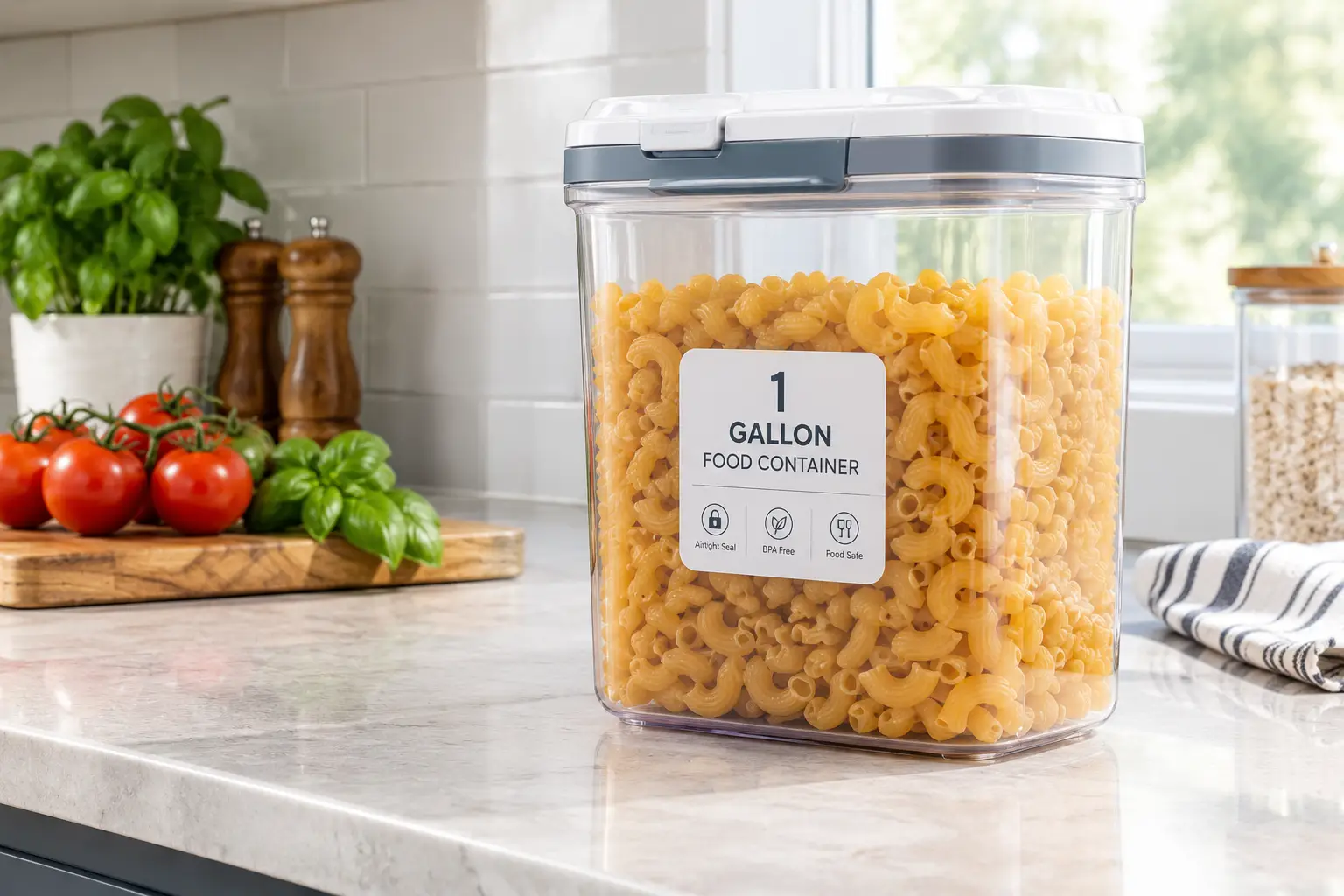
Why the 1 Gallon Food Container Is the Pantry’s Sweet Spot
Here’s a kitchen truth nobody puts on a label: most food storage problems are really size problems. Containers that are too small leave you with half a bag of flour folded over and clipped shut. Containers that are too big eat a whole shelf and turn into dust-collecting caves. The 1 gallon food container sits right in the middle — and that’s exactly why it’s become the workhorse of organized pantries, meal-prep fridges, and freezer drawers across the US.
A gallon is the quantity American groceries are built around. A standard 5-pound bag of all-purpose flour, a family-size box of cereal, a big batch of chili, or a bulk bag of rice all land in roughly this range. So when you pick the right 1 gallon food container, you aren’t just buying a box — you’re buying a system that matches how you actually shop and cook.
The catch? “One gallon” on Amazon covers wildly different products: latching Tritan canisters, push-button pantry containers, restaurant-grade square tubs, heavy glass jars, US-made PET jars, and food-grade HDPE buckets. They don’t seal the same way, they don’t handle heat the same way, and they don’t fit on the same shelves.
This guide cuts through that. Rather than rewording product listings, we compared real spec sheets, manufacturer documentation, and the customer feedback we could actually verify, then translated all of it into practical advice: who each container is for, what its specs mean in your kitchen, and where it falls short. You’ll also find setup and care tips, real-world scenarios, a problem-solving section, and a straight answer on safety standards like BPA-free materials and NSF certification.
By the end, you’ll know exactly which 1 gallon food container belongs in your pantry — and which one would quietly frustrate you six months from now.
What Is a 1 gallon food container?
A 1 gallon food container is a reusable food storage vessel that holds about 128 US fluid ounces — equal to 16 cups, 4 quarts, or roughly 3.8 liters. It’s sized for bulk dry goods like flour, sugar, and rice, as well as soups, brines, and freezer batches.
That conversion matters more than it sounds. A US liquid gallon is legally defined as 231 cubic inches, which is smaller than the imperial gallon used in the UK — so a container sold as “4 liters” or “4.2 liters” is actually a touch over a US gallon. When a listing says “16-cup,” “4-quart,” “128 oz,” or “1 gallon,” it’s describing the same target size, give or take a little headspace.
In practice, the category splits into four families:
- 🥫 Pantry canisters (latching or push-button lids) for daily-access dry goods.
- 🍲 Commercial-style square containers with measurement graduations, borrowed from restaurant kitchens.
- 🫙 Jars in glass or PET plastic, with screw-on or lift-off lids.
- 🪣 Food-grade buckets with press-fit or screw lids for freezing, bulk storage, and prepping.
Each family solves a different problem, which is why the “best” 1 gallon food storage container depends on what you’re storing and how often you open it.
Quick Comparison: The 7 Best 1 Gallon Food Container Picks at a Glance
| Product | Material | Seal Type | Capacity | Best For |
|---|---|---|---|---|
| Rubbermaid Brilliance Pantry 16-Cup | Tritan plastic | Gasket + 2 latches | 16 cups (1 gal) | Rubbermaid Brilliance Pantry 16-Cup: best all-around pantry pick |
| OXO POP 4.4 Qt | SAN/ABS plastic | Push-button gasket | 4.4 qt | OXO POP 4.4 Qt: one-handed daily baking access |
| Cambro CamSquares 4 Qt | Polypropylene | Snap-on lid | 4 qt (1 gal) | Cambro CamSquares 4 Qt: budget multi-pack, measuring at a glance |
| Rubbermaid Commercial FG630400 | Polycarbonate | Separate snap lid | 4 qt (1 gal) | Rubbermaid Commercial FG630400: hot/cold prep, brining, sous vide |
| Anchor Hocking Heritage Hill | Glass | Glass lid (no gasket) | 1 gal | Anchor Hocking Heritage Hill: countertop display, cookies, snacks |
| kitchentoolz 1 Gallon PET Jar | PET plastic | Screw lid + foam liner | 1 gal | kitchentoolz 1 Gallon PET Jar: shatterproof screw-top jar, US-made |
| EconoHome 1 Gallon Bucket | HDPE plastic | Press-fit tear-tab lid | 1 gal | EconoHome 1 Gallon Bucket: freezer batches and bulk value |
Looking at the table, the real dividing line isn’t capacity — every pick lands within a few ounces of a gallon — it’s the seal type. The Rubbermaid Brilliance Pantry 16-Cup, OXO POP 4.4 Qt, and kitchentoolz 1 Gallon PET Jar are the true airtight options for daily-access dry goods, while the Anchor Hocking Heritage Hill trades airtightness for looks. Meanwhile, the Cambro CamSquares 4 Qt and Rubbermaid Commercial FG630400 are built for kitchens where measuring and temperature range matter more than a pantry-perfect seal.
💬 One click helps other shoppers make an informed choice too! 😊
Top 7 1 Gallon Food Container Picks: Expert Analysis
1. Rubbermaid Brilliance Pantry 16-Cup — best all-around airtight pantry canister
If you want one container that does almost everything well, this is it. The Rubbermaid Brilliance Pantry 16-Cup (model 1994228) holds exactly 16 cups — a true US gallon — in a crystal-clear, BPA-free Tritan body measuring about 7.9 x 5.4 x 9.4 inches.
The key feature is the lid: a gasket plus two snap latches. In practice, that means you hear and feel the seal close, rather than guessing whether a press-fit lid is fully seated. The rectangular footprint is narrower than square canisters, so three of them line up across a standard 18-inch cabinet shelf with room to spare. Rubbermaid lists it as freezer-safe and top-rack dishwasher-safe, but not microwave-safe — this is the pantry version, not the leftovers line.
Based on comparing the specs, this is the smartest default for families who buy flour, sugar, rice, or pet food in standard grocery sizes and open containers several times a week. Tritan resists clouding and staining better than budget polypropylene, which matters when clarity is half the reason you bought a clear canister.
At the time of research, Amazon flagged this listing as a Best Seller in its Cereal Containers category, which signals broad adoption; we couldn’t verify a representative sample of individual reviews, so we’re relying on spec analysis rather than review quotes. Rubbermaid backs it with a limited lifetime warranty.
Pros:
- ✅ Exact 16-cup capacity matches a true US gallon
- ✅ Latching gasket lid gives a confident, visible seal
- ✅ Narrow footprint fits more units per shelf
Cons:
- ❌ Not microwave-safe, unlike Brilliance leftover containers
- ❌ Latches add a step for one-handed scooping
Typically in the $12–$20 range for a single (check the current price) — excellent value given the Tritan build and warranty.
2. OXO Good Grips POP Big Square Medium (4.4 Qt) — fastest one-handed access for bakers
The OXO POP 4.4 Qt (SKU 11233500) is built around a single idea: open and close with one press. Push the button and the silicone gasket expands to seal; push again and the button pops up to become a handle.
That mechanism sounds like a gimmick until you’re mid-recipe with butter on one hand. OXO sizes this container specifically for a 5-pound bag of flour or sugar, and the 4.4-quart capacity (about 4.2 liters) gives you roughly 10% more room than a strict gallon — useful headspace so you can scoop without spilling over the rim. It measures about 6.5 x 6.5 x 9.5 inches, BPA-free, with top-rack dishwasher-safe parts and a fill line on the side.
Here’s what to weigh: the square footprint is wider than the Rubbermaid Brilliance Pantry 16-Cup, but it stacks and tiles perfectly with the rest of the POP family, which is why serious bakers often build an entire shelf around POP sizes. OXO explicitly warns not to carry the container by the lid — the button mechanism isn’t designed to bear a full load.
Owner feedback widely associates the POP line with convenience; a recurring theme in retailer reviews is that the lid needs occasional disassembly cleaning to keep the gasket working smoothly. We couldn’t verify review counts for this specific listing.
Pros:
- ✅ True one-handed open and close
- ✅ Extra headspace for a full 5-lb flour bag
- ✅ Modular system with dozens of matching sizes
Cons:
- ❌ Pricier per gallon than most competitors
- ❌ Can’t be lifted by the lid when full
Usually around $25–$35 for a single; the premium is justified if you bake weekly.
3. Cambro CamSquares 4 Qt (3-Pack with Lids) — restaurant toughness on a budget
Walk into almost any US restaurant kitchen and you’ll see Cambro’s square tubs. The Cambro CamSquares 4 Qt 3-pack (4SFSPPSW3190) brings that commercial standard home: three translucent polypropylene containers with snap-on green lids.
Each container measures 7-1/4 x 7-1/4 x 7-3/8 inches and carries printed graduations in both quarts and liters. That’s more useful than it sounds — you can see at a glance whether you have enough rice left for Sunday’s batch without pulling the container down. Cambro rates the polypropylene from -40°F to 160°F, and the line is NSF-listed, meaning it’s designed for professional food-contact use. Retailers note the 4-quart size holds a full 5-pound bag of flour.
On paper, this is the best cost-per-container in the airtight-adjacent category. The snap lid is tight but isn’t a gasketed seal, so it’s ideal for fridge storage, prepping, and dry goods you rotate quickly, but less ideal for coffee beans or brown sugar that you want truly sealed for months. If you need more heat tolerance, Cambro’s polycarbonate Camwear version (4SFSCW135) handles up to 210°F, though its lid is sold separately.
Professional-supply retailers show strong ratings across the CamSquares line, and buyers frequently mention using them for home pantries; individual Amazon review volume varies by listing.
Pros:
- ✅ Three containers with lids in one pack
- ✅ Quart and liter graduations for instant inventory
- ✅ NSF-listed commercial durability
Cons:
- ❌ Snap lid isn’t a gasketed airtight seal
- ❌ Utilitarian look won’t win countertop beauty contests
Typically $25–$40 for the 3-pack — standout value per container.
4. Rubbermaid Commercial FG630400 4 Qt Space Saving Container — widest temperature range for prep
The Rubbermaid Commercial FG630400 is the pick for cooks who use a gallon container as a tool, not just storage. This clear polycarbonate square measures roughly 8-3/4 x 8-5/16 x 4-3/4 inches — wider and lower than most picks here.
That low, wide shape is the whole point. It’s ideal for marinating chicken thighs in a single layer, brining a pork tenderloin, proofing dough, or holding a sous vide bath, a use Rubbermaid markets directly. The temperature range runs from -40°F to 212°F, the widest in this roundup, so it goes from freezer to boiling-water rinse without drama. Red quart and blue liter graduations help with measuring brines, and molded handles with drain holes make it easier to carry and dry. Distributors list it as NSF 2-certified, BPA-free, and made in the USA.
Honest caveat: the lid is sold separately (Rubbermaid’s compatible lid is the FG650900), so factor that into your budget. Also, Rubbermaid notes the square shape holds up to 25% more than a same-footprint round container — but that’s a shelf-efficiency claim, not extra capacity beyond 4 quarts.
Customer feedback on Amazon for this listing is limited compared with consumer brands; the line’s reputation rests mainly on decades of commercial kitchen use.
Pros:
- ✅ Handles -40°F to 212°F
- ✅ Low, wide shape suits marinades and sous vide
- ✅ US-made, NSF-certified polycarbonate
Cons:
- ❌ Lid costs extra
- ❌ Wide footprint eats deep shelf space
Container generally runs $10–$20, plus roughly $5–$10 for the lid — strong value for heavy-duty prep.
5. Anchor Hocking Heritage Hill 1 Gallon Jar — classic countertop glass
The Anchor Hocking Heritage Hill jar is the one you leave out on the counter because it looks good. It’s all glass, including the lid, with a wide mouth and an oversized knob.
Specs vary slightly by retailer, but expect roughly 7 to 7.4 inches in diameter and about 9.5 to 10 inches tall, weighing around 4 to 5 pounds. That heft is a feature on a busy counter — it doesn’t tip when kids grab cookies. Both jar and lid are dishwasher-safe, and glass won’t absorb odors or stain, so it can go from holding coffee to holding cookies without “ghost” flavors.
Here’s what most buyers overlook: the Heritage Hill uses a glass-on-glass lid with no gasket. That makes it easy to open, but it is not airtight. For cookies you’ll finish in a week, crackers, candy, or decorative pantry staples, that’s fine. For brown sugar, coffee, or anything prone to humidity, you’ll want a sealed option — or one of the third-party silicone replacement lids sold for this jar on Amazon.
The listing for the two-pack showed “700+ bought in past week” at the time of research, reflecting how popular this design remains; we didn’t verify individual review texts.
Pros:
- ✅ Timeless look that doubles as decor
- ✅ Nonporous glass resists stains and odors
- ✅ Heavy base resists tipping
Cons:
- ❌ No gasket, so not airtight
- ❌ Heavy and breakable when full
Single jars typically run $15–$30; two-packs around $30–$50 — fair for decades-long durability.
6. kitchentoolz 1 Gallon PET Plastic Jar — shatterproof screw-top made in the USA
Want the classic jar look without glass anxiety? The kitchentoolz 1 Gallon PET Jar delivers a clear, tall, wide-mouth jar made from BPA-free, food-grade PET plastic, manufactured in the US.
Its seal comes from a screw-on ribbed lid with a PE foam liner. That liner matters: it compresses against the rim to create the airtight closure that a glass-on-glass lid like the Anchor Hocking Heritage Hill can’t provide. PET is the same family of plastic used for many food and beverage packages, and it’s dramatically lighter and more drop-tolerant than glass — a real advantage on a high shelf or in a household with kids.
Based on comparing the specs, this is the best pick for protein powder, rice, dried beans, pet treats, or bulk candy where you want visibility and a screw-down seal. The trade-off is heat: PET isn’t designed for hot fills, and the listing positions it for storage rather than cooking, so check the care instructions on your specific listing and default to hand-washing if unsure.
One theme visible in customer comments on this listing is that buyers appreciate the US manufacturing; we couldn’t verify a large enough review pool to summarize durability trends.
Pros:
- ✅ Foam-lined screw lid seals airtight
- ✅ Shatter-resistant and lightweight
- ✅ Made in the USA
Cons:
- ❌ Not for hot foods or heavy heat
- ❌ Round shape wastes some shelf corners
Typically $12–$25 depending on pack size — great value for a sealed, unbreakable jar.
7. EconoHome 1 Gallon Food Grade Round Plastic Bucket — freezer and bulk workhorse
The EconoHome 1 Gallon Bucket is the least glamorous pick here — and one of the most useful. It’s a round, food-grade HDPE pail with a handle and lid, sold in 5-, 10-, and 25-packs.
HDPE (resin code #2) is one of the most widely used food-grade plastics, and it stays tough in the freezer where some plastics get brittle. At roughly 7 inches wide and 6.5 inches tall, it’s the shortest container in this roundup, so it slides into chest freezers and lower fridge shelves easily. The tear-tab, press-fit lid is designed for a tight, tamper-evident seal — ideal for soups, stocks, homemade ice cream, berries, or a bulk bag of oats.
Honest analysis: this is a “seal and store” container, not a “pop open daily” container. One verified buyer report described needing a rubber mallet to fully seat the lid and a lid opener to remove it — exactly how commercial pails of this style typically behave. If you plan to access contents daily, a screw-lid bucket or one of the canisters above will be less frustrating.
Amazon listed an EconoHome multipack as the #1 Best Seller in Industrial Pails at the time of research, which says a lot about how many home cooks use these for batch storage.
Pros:
- ✅ Lowest cost per gallon in this roundup
- ✅ Freezer-tough HDPE with carry handle
- ✅ Tamper-evident lid for long storage
Cons:
- ❌ Lid can require a mallet to seal
- ❌ Not convenient for daily access
Multipacks commonly run $20–$35 for five, making it the clear budget champion.
✨ Don’t miss these top-rated storage picks!
🔍 Take your pantry organization to the next level with this carefully curated lineup. Click a highlighted product to check current pricing and availability. These picks will help you keep food fresher, cut waste, and finally see what’s on your shelves!
Feature-by-Feature: Comparing the Top 7 1 Gallon Food Storage Container Options
| Product | Temp Range | Airtight? | Dishwasher | Footprint (approx.) | Price Range | Best For |
|---|---|---|---|---|---|---|
| Rubbermaid Brilliance Pantry 16-Cup | Freezer-safe; no microwave | Yes | Top rack | 7.9″ x 5.4″ | $12–$20 | Rubbermaid Brilliance Pantry 16-Cup: family pantries |
| OXO POP 4.4 Qt | Room temp/pantry | Yes | Top rack | 6.5″ x 6.5″ | $25–$35 | OXO POP 4.4 Qt: frequent bakers |
| Cambro CamSquares 4 Qt | -40°F to 160°F | Tight snap | Yes | 7.25″ x 7.25″ | $25–$40 (3) | Cambro CamSquares 4 Qt: budget multi-use |
| Rubbermaid Commercial FG630400 | -40°F to 212°F | With lid (sold separately) | Yes | 8.75″ x 8.3″ | $15–$30 w/ lid | Rubbermaid Commercial FG630400: prep and brining |
| Anchor Hocking Heritage Hill | Room temp | No | Yes | ~7.4″ round | $15–$30 | Anchor Hocking Heritage Hill: display |
| kitchentoolz 1 Gallon PET Jar | Room temp/cool | Yes | Check listing | Round, tall | $12–$25 | kitchentoolz 1 Gallon PET Jar: shatterproof jars |
| EconoHome 1 Gallon Bucket | Freezer-tough | Tight press-fit | Yes (typical HDPE) | ~7″ round | $20–$35 (5) | EconoHome 1 Gallon Bucket: freezer batches |
The pattern here is clear: no single 1 gallon food container wins every column. The Rubbermaid Commercial FG630400 dominates temperature range, the OXO POP 4.4 Qt wins convenience, and the EconoHome 1 Gallon Bucket wins cost per gallon by a wide margin. For most households, pairing one airtight canister for daily dry goods with a cheaper multipack for freezer or prep duty gives you better results than buying seven of the “best” single model.
Getting Started: How to Set Up and Care for Your 1 Gallon Food Container
Buying the right container is half the job; using it well is the other half. Here’s a practical first-30-days routine that Amazon listings rarely mention.
🧼 Before first use
Wash every new container in warm, soapy water — manufacturing residue and dust from shipping are common. For latching or push-button lids like the Rubbermaid Brilliance Pantry 16-Cup and OXO POP 4.4 Qt, check that the gasket is seated evenly all the way around. A twisted gasket is the number-one reason “airtight” containers aren’t.
📦 Decanting dry goods
- Fill to about 90%, not to the brim — headspace lets you scoop without spilling and helps the lid close without compressing contents against the seal.
- Cut the “best by” date from the original bag and tape it inside the lid, or write it on a removable label on the side.
- Never top off old flour with new flour. Use up what’s in the container, wash and dry it, then refill. Mixing batches hides staleness.
❄️ Freezer and fridge use
For soups and stocks, cool food before sealing and leave about an inch of headspace in containers like the EconoHome 1 Gallon Bucket, since liquids expand as they freeze. The federal cold food storage chart from FoodSafety.gov is a reliable reference for how long leftovers, soups, and meats keep in the fridge and freezer — tape a copy inside a cabinet door.
🔧 Monthly maintenance
- Remove and clean gaskets (the POP lid is designed to come apart).
- Dry containers completely before refilling; trapped moisture invites clumping and mold in flour and sugar.
- Inspect lids on budget containers for cracks at the snap points, which is where wear usually starts.
⚠️ Common first-month mistakes
Storing hot food in containers not rated for it, carrying a full OXO POP 4.4 Qt by the lid, and assuming the Anchor Hocking Heritage Hill jar is airtight are the three most avoidable errors.
Real-World Scenarios: Matching the Right Container to Your Kitchen
Specs are abstract; your kitchen isn’t. Here are three common US household profiles and the picks that fit them best.
👩🍳 Scenario 1: The weekend baker (budget: $60–$100)
Maria bakes bread or cookies two to three times a week and buys 5-pound bags of flour and sugar. She needs fast access with messy hands. The best fit is two OXO POP 4.4 Qt containers for flour and sugar, because the one-press lid and extra headspace make scooping painless. For whole wheat flour, which goes stale faster, she can store a second Rubbermaid Brilliance Pantry 16-Cup in the freezer — its latching seal holds up well in cold storage.
👨👩👧👦 Scenario 2: The busy family of five (budget: $40–$70)
The Johnsons shop at warehouse clubs, batch-cook on Sundays, and freeze soup in big portions. They need volume and value more than elegance. The Cambro CamSquares 4 Qt 3-pack covers rice, oats, and pasta with visible graduations, so anyone can tell when supplies run low. A five-pack of EconoHome 1 Gallon Bucket handles the freezer: one bucket of chili, one of stock, one of frozen fruit for smoothies.
🏡 Scenario 3: The small-apartment cook who loves to prep (budget: $30–$60)
Devin has a tiny kitchen but marinates proteins, brines a turkey breast for holidays, and experiments with sous vide. The Rubbermaid Commercial FG630400 plus its lid is the core tool — the low profile fits under a shelf, and the 212°F rating handles hot water. For dry goods on display, one kitchentoolz 1 Gallon PET Jar stores rice without the risk of breaking glass on a cramped counter.
Notice the pattern: nobody needs seven identical containers. Matching each gallon container to a job is what makes a small investment feel like a full kitchen upgrade.
Problem → Solution: Fixing Common 1 Gallon Food Container Frustrations
Problem 1: “My brown sugar turns into a brick.”
Solution: Brown sugar loses moisture through imperfect seals. Move it into a gasketed container like the Rubbermaid Brilliance Pantry 16-Cup or kitchentoolz 1 Gallon PET Jar, and add a terra-cotta sugar saver. Avoid the Anchor Hocking Heritage Hill for this job unless you add a silicone replacement lid.
Problem 2: “Pantry bugs keep showing up.”
Solution: Pantry moths and weevils can chew through paper and thin plastic bags, but not through rigid sealed containers. Decant flour, grains, and pet food into airtight canisters right after shopping. Some cooks freeze newly bought flour for a few days before decanting as an extra precaution.
Problem 3: “Frozen soup containers crack or bulge.”
Solution: Leave headspace for expansion and choose freezer-tough materials. The EconoHome 1 Gallon Bucket in HDPE and the Cambro CamSquares 4 Qt in polypropylene are both rated for freezer use. The USDA’s guidance on freezing and food safety explains why storage times in the freezer are about quality, not safety — useful context when labeling batches.
Problem 4: “I can’t tell what’s inside or how much is left.”
Solution: Clear materials plus graduations. The Cambro CamSquares 4 Qt and Rubbermaid Commercial FG630400 print quart and liter markings, which turn every shelf into an inventory system.
Problem 5: “My shelf is full of round containers and wasted corners.”
Solution: Switch to squares. Rubbermaid notes square containers fit up to 25% more on the same shelf compared with round ones — reserve round jars for countertop display.
How to Choose a 1 gallon food container
- Define the food first. Dry goods want airtight seals; soups want freezer-tough plastic; marinades want wide, low shapes.
- Check true capacity. 16 cups, 4 quarts, and 128 oz all equal a gallon; “4.2 L” is slightly more.
- Match the seal to access frequency. Daily use favors push-button or latching lids; long storage favors press-fit or screw lids.
- Confirm temperature ratings. Look for specific numbers (like -40°F to 212°F), not vague “freezer friendly” claims.
- Measure your shelf. Height is the hidden deal-breaker — most picks here stand 9–10 inches tall.
- Verify food-safe materials. Look for BPA-free claims and, for commercial picks, NSF certification.
- Price per gallon, not per box. A 3-pack or 5-pack often beats a single premium canister for secondary storage.
Every step above narrows the field fast. Most buyers skip step 5 — and end up with beautiful canisters that won’t fit between shelves.
Gallon Food Storage Containers with Lids: Glass vs Plastic vs Buckets
The phrase “gallon food storage containers with lids” covers three materials that behave very differently. Here’s how they stack up against each other — and against the “traditional” alternative of leaving food in its original packaging.
1 Gallon Glass Jar with Lid
A 1 gallon glass jar with lid, like the Anchor Hocking Heritage Hill, is nonporous, odor-proof, and endlessly reusable. It won’t stain from turmeric or retain the smell of coffee. The trade-offs are weight (around 4–5 pounds empty), breakability, and — for glass-on-glass designs — a lack of true airtightness.
Plastic Canisters
Tritan and SAN canisters like the Rubbermaid Brilliance Pantry 16-Cup and OXO POP 4.4 Qt offer glass-like clarity at a fraction of the weight, with engineered gaskets. Polypropylene and polycarbonate options like the Cambro CamSquares 4 Qt and Rubbermaid Commercial FG630400 add temperature tolerance and durability.
Food-Grade Buckets
HDPE buckets like the EconoHome 1 Gallon Bucket are cheap, tough, and freezer-friendly, but they’re opaque and less convenient to open.
| Storage Method | Airtight | Pest Protection | Visibility | Best For |
|---|---|---|---|---|
| Original bags/boxes | No | Poor | None | Short-term only |
| Zip-top bags | Partial | Fair | Good | Small portions, freezer flat-packs |
| Anchor Hocking Heritage Hill (glass) | No | Good | Excellent | Anchor Hocking Heritage Hill: countertop snacks |
| Rubbermaid Brilliance Pantry 16-Cup (plastic canister) | Yes | Excellent | Excellent | Rubbermaid Brilliance Pantry 16-Cup: daily pantry staples |
| EconoHome 1 Gallon Bucket (HDPE) | Tight seal | Excellent | Poor | EconoHome 1 Gallon Bucket: bulk and freezer storage |
The takeaway: original packaging is the weakest link in almost every column, which is why decanting into a rigid 1 gallon food container pays off so quickly. Glass wins on aesthetics and odor resistance, gasketed plastic wins on everyday freshness, and buckets win on cost and freezer durability — so most well-organized kitchens end up using two of the three.
Features That Actually Matter (and Ones That Don’t) in a 1 Gallon Airtight Container
Marketing copy loves buzzwords. Here’s what deserves your attention when shopping for a 1 gallon airtight container — and what you can ignore.
✅ Features that matter
- A real gasket. “Airtight” should mean silicone or foam that compresses against the rim. The kitchentoolz 1 Gallon PET Jar‘s foam liner and the Rubbermaid Brilliance Pantry 16-Cup‘s gasket are good examples.
- Specific temperature ratings. A number you can check, like the Rubbermaid Commercial FG630400‘s 212°F upper limit, beats “heat resistant.”
- Wide mouth. If a 1-cup measuring cup can’t fit through the opening, you’ll pour instead of scoop — and spill.
- Graduations. They turn a container into a measuring and inventory tool.
- Replaceable parts. Lids wear out first; containers with available replacement lids last longer.
❌ Features that matter less than you think
- “Leakproof” on pantry canisters. Dry-goods canisters aren’t meant to hold liquids sideways in a bag; don’t pay extra for it.
- Included labels and chalk markers. Nice, but a $5 label maker does the same job better.
- Giant matching sets. A 20-piece set with three gallon-size units often costs more per useful container than buying exactly what you need.
- “Vacuum” claims on budget lids. Unless there’s a pump or a mechanical seal, it’s a press-fit lid with a fancy name.
The honest rule: pay for the seal and the material; skip the accessories.
Safety, Regulations, and Standards for Food-Grade 1 Gallon Containers
Food storage is one of the few kitchen categories where material safety genuinely matters, so here’s what the labels mean in the US market.
BPA-Free Claims
Bisphenol A (BPA) has historically been used in some polycarbonate plastics. The FDA maintains an overview of its review of BPA in food-contact applications, and many US manufacturers now market BPA-free materials to address consumer preferences. Every container in this roundup is marketed as BPA-free or is made of glass, which contains no BPA.
Food Grade 1 Gallon Bucket Standards
When shopping for a food grade 1 gallon bucket, look for HDPE (resin code #2) or polypropylene (#5) and an explicit “food grade” or “FDA-compliant materials” claim. Avoid repurposing paint or hardware-store buckets for food unless they’re clearly labeled food-safe — the plastic may look identical but may not be made for food contact.
NSF Certification
NSF/ANSI 2 is a widely used standard for commercial food equipment. The Cambro CamSquares 4 Qt and Rubbermaid Commercial FG630400 are listed as NSF-certified by their manufacturers or distributors, which signals they’re designed to withstand commercial cleaning and food-contact use. Consumer pantry canisters usually aren’t NSF-certified — that doesn’t make them unsafe, it just means they weren’t built for commercial kitchens.
Temperature Safety
Never exceed a container’s rated temperature. The Cambro CamSquares 4 Qt polypropylene version tops out at 160°F, so don’t pour boiling stock into it. Keep your refrigerator at 40°F or below and your freezer at 0°F or below, as federal food-safety guidance recommends.
Common Mistakes to Avoid When Buying a 1 gallon food container
Even experienced cooks trip over these. Avoiding them saves money and frustration.
- Buying by “gallon” label alone. Listings round freely; a “1 gallon” bucket and a “16-cup” canister may differ by a few ounces and dramatically in shape. Compare dimensions, not just capacity.
- Ignoring shelf height. The OXO POP 4.4 Qt and Anchor Hocking Heritage Hill both stand about 9.5 inches or taller. Measure your shelves before you buy.
- Assuming all clear plastic is the same. Tritan resists clouding; budget polypropylene may cloud or stain with tomato sauce and turmeric over time.
- Choosing a press-fit bucket for daily use. The EconoHome 1 Gallon Bucket is excellent for storage, but a mallet-sealed lid isn’t fun to open every morning.
- Forgetting the lid cost. The Rubbermaid Commercial FG630400 and Cambro’s polycarbonate version sell lids separately; budget for them.
- Overbuying identical containers. A mix of one or two daily-access canisters and a cheaper multipack covers more needs than seven matching premium units.
- Skipping the dry-out step. Refilling a freshly washed container that’s still damp is the fastest way to get clumpy flour.
Each of these mistakes is cheap to avoid and expensive to fix after the fact — especially the shelf-height one.
Long-Term Cost and Maintenance of a 1 Gallon Food Storage Container
The sticker price is only part of the story. Here’s how cost of ownership plays out over years of use.
| Product | Upfront Cost (approx.) | Cost per Gallon Unit | Expected Wear Point | Value Verdict |
|---|---|---|---|---|
| Rubbermaid Brilliance Pantry 16-Cup | $12–$20 | $12–$20 | Latches | Rubbermaid Brilliance Pantry 16-Cup: strong long-term value |
| OXO POP 4.4 Qt | $25–$35 | $25–$35 | Button gasket | OXO POP 4.4 Qt: premium for convenience |
| Cambro CamSquares 4 Qt | $25–$40 (3) | ~$8–$13 | Lids | Cambro CamSquares 4 Qt: best per-unit value |
| EconoHome 1 Gallon Bucket | $20–$35 (5) | ~$4–$7 | Lid fit after reuse | EconoHome 1 Gallon Bucket: lowest cost per gallon |
Over five years, the math gets interesting. A premium canister like the OXO POP 4.4 Qt costs more upfront but replaces dozens of zip-top bags and reduces waste from stale or bug-infested flour — food waste quietly costs far more than containers. On the flip side, the EconoHome 1 Gallon Bucket delivers the lowest cost per gallon, though press-fit lids may lose tightness after many open-close cycles, so plan on eventually replacing a few.
Maintenance-wise, glass like the Anchor Hocking Heritage Hill is nearly maintenance-free and can last decades if it doesn’t get dropped. Plastic canisters benefit from top-rack washing and occasional gasket cleaning, while commercial polycarbonate tolerates hot commercial dishwashers best. If a container’s lid becomes the weak point, check whether replacement lids are sold before tossing the whole thing.
FAQs
❓ Is a 1 gallon food container big enough for a 5 lb bag of flour?
❓ Can I put a 1 gallon food container in the freezer?
❓ Which 1 gallon food container is best for rice?
❓ Are 1 gallon glass jars airtight?
❓ How many cups are in a 1 gallon food container?
Conclusion: Pick the Right 1 gallon food container for the Job
The right 1 gallon food container isn’t the one with the most features — it’s the one matched to what you store and how often you reach for it. For most households, the Rubbermaid Brilliance Pantry 16-Cup is the safest all-around buy: true gallon capacity, a confident latching seal, and a lifetime warranty. Frequent bakers will appreciate the one-press convenience of the OXO POP 4.4 Qt, while value-focused families get the most containers per dollar from the Cambro CamSquares 4 Qt 3-pack.
If you prep, marinate, or cook sous vide, the Rubbermaid Commercial FG630400 brings the widest temperature range in this roundup. The Anchor Hocking Heritage Hill remains the countertop classic for snacks and display, the kitchentoolz 1 Gallon PET Jar offers a shatterproof, airtight jar made in the USA, and the EconoHome 1 Gallon Bucket is the budget hero for freezer batches and bulk storage.
The smartest strategy? Mix and match. One or two airtight canisters for daily staples plus a multipack for freezer and bulk duty will cover nearly every kitchen scenario — and pay for itself in reduced food waste.
🛒 Ready to transform your pantry today?
✨ Click any highlighted product above to check current pricing and availability on Amazon. Choose the 1 gallon food container that fits your kitchen, and enjoy fresher food, fewer spills, and shelves you’ll actually love opening!
Recommended for You
- Dash Diet Food Delivery: 7 Best Low-Sodium Picks for 2026
- Clean Eatz Protein Powder Review 2026: 7 Smart Picks Compared
- Food Tins: 7 Best Picks That Keep Treats Fresh in 2026
Disclaimer: This post contains affiliate links. As an Amazon Associate, I earn from qualifying purchases made through these links, at no additional cost to you.
✨ Found this article helpful? Share it with someone who needs it! 💬🤗