
In This Article
Why Black Take Out Containers Took Over Your Fridge (and Your Favorite Restaurant)
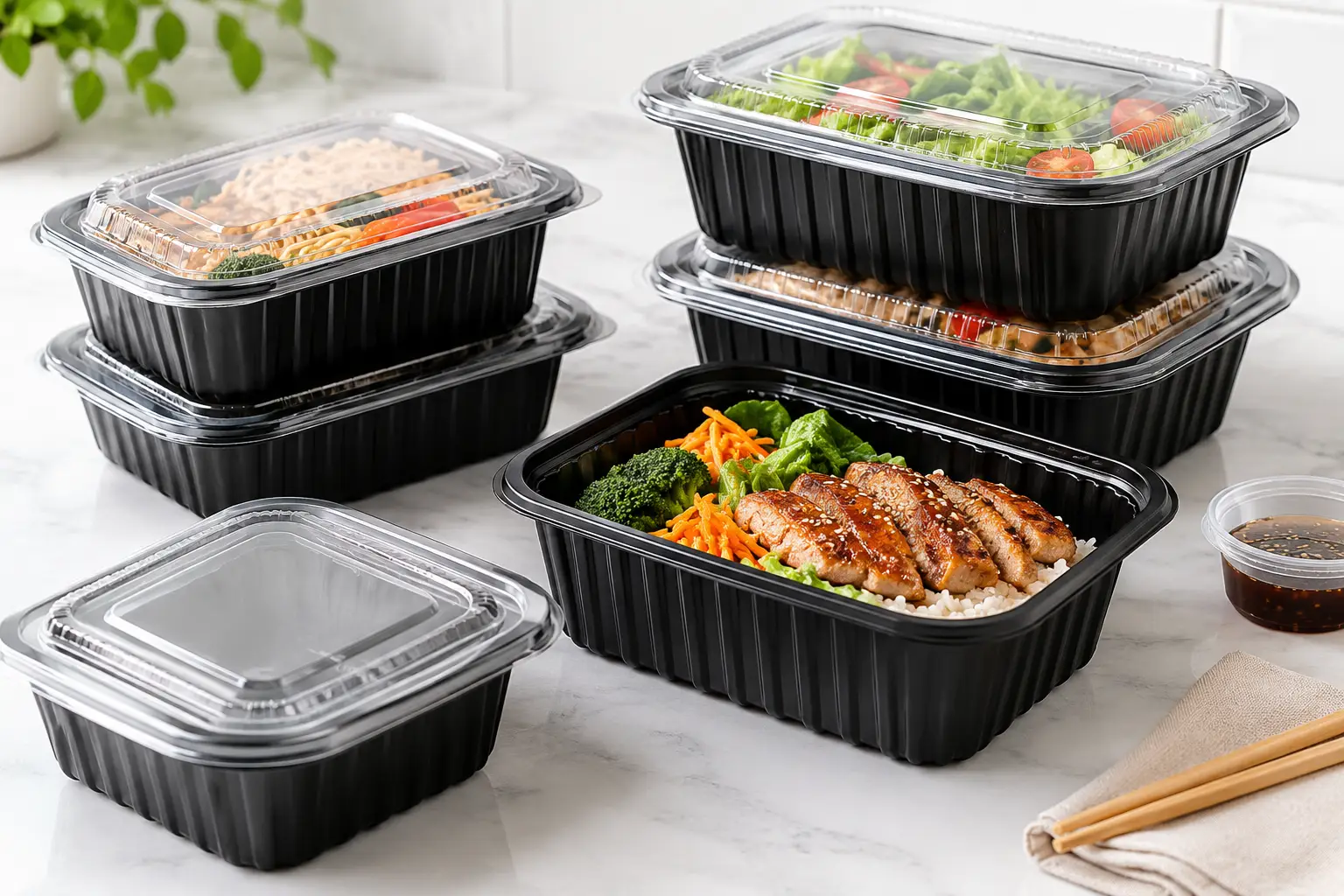
Open any restaurant’s back door at 6 p.m. and you’ll see the same thing: towers of black take out containers waiting to be filled with pad thai, burrito bowls, and chicken parm. Open a meal prepper’s fridge on Sunday night and you’ll see the same towers, just stacked with chicken and rice. There’s a reason black take out containers became the default: the black base hides sauce stains and grease, the clear lid shows off the food, and most are rated for the microwave and freezer.
But here’s the catch. Not every black box is built the same. Some flex like a paper plate the moment you lift a full one. Some lids pop off in the delivery bag. And since late 2024, plenty of shoppers have wondered whether black plastic is safe to heat at all. This guide sorts all of that out.
What Are Black Take Out Containers?
Black take out containers are food containers with a black plastic base and a fitted lid, usually clear, sold in multi-packs for takeout, delivery, leftovers, and meal prep. Most are made of polypropylene, a heat-tolerant plastic, which is why many are labeled microwave-safe, freezer-safe, and sometimes dishwasher-safe.
What follows is not a reworded product listing. We compared real spec sheets, listing claims, available customer review data, and the latest research on black plastic, then translated all of it into plain advice. You’ll find seven real options sold on amazon.com, from a 12 oz sauce-and-sides box to a 150-count catering case, plus cost-per-container math, reheating rules, and the mistakes that turn a cheap container into a soggy mess.
We haven’t personally run these containers through a test kitchen, so we tell you exactly where our analysis comes from. Ready? Let’s find the box that actually fits how you eat.
Quick Comparison: 7 Black Take Out Containers at a Glance
Short on time? This table puts the seven picks side by side. Prices are approximate ranges at the time of writing and change often, so always check the current price on Amazon.
| Product | Capacity | Shape / Style | Pack Size | Approx. Price Range | Best for |
|---|---|---|---|---|---|
| PACTOGO 12 oz | 12 oz | Small rectangle, clear lid | 25 sets | Under $20 | PACTOGO 12 oz: sides, sauces, snack portions |
| Geisoun 28 oz | 28 oz | Rectangle, easy-open lid | 50 sets | $20–$30 | Geisoun 28 oz: first-time meal preppers |
| Dealusy 32 oz | 32 oz | Rectangle, easy-open lid | 50 sets | $20–$35 | Dealusy 32 oz: bigger appetites, full dinners |
| SafePro 28 oz | 28 oz | Rectangle, clear lid | 100 sets | $35–$55 | SafePro 28 oz: small food businesses |
| YANGRUI 3-Compartment | 34 oz | 8″ hinged clamshell, 3 sections | 55 pieces | $25–$45 | YANGRUI 3-Compartment: plate lunches, no-mix meals |
| Restaurantware Asporto 38 oz | 38 oz | Wide rectangle, clear lid | 100 sets | $40–$60 | Restaurantware Asporto 38 oz: entrées and pasta |
| AmerCare 38 oz | 38 oz | 7″ round, clear lid | 150 sets | $60–$90 | AmerCare 38 oz: caterers and bulk buyers |
Looking at the table, the real split isn’t brand, it’s job. The Geisoun 28 oz and Dealusy 32 oz are home-kitchen meal prep packs, while the SafePro 28 oz, Restaurantware Asporto 38 oz, and AmerCare 38 oz come in case counts built for food service. The YANGRUI 3-Compartment is the odd one out: its hinged lid means you can’t lose the top, which matters more than you’d think during a busy lunch rush.
💬 One click helps other shoppers make an informed choice too! 😊
Top 7 Black Take Out Containers: Expert Analysis for 2026
Each pick below is a real product listed on amazon.com. For every one, we explain what the specs mean in practice, who should buy it, and what the available review data says. Where we couldn’t verify a review pattern, we say so instead of guessing.
1. PACTOGO 12 oz Rectangular Black Containers — best for small sides and sauces
Not every portion needs a 32 oz tub, and the PACTOGO 12 oz is built for the small stuff that big containers waste space on.
The listing gives a top-out size of 5-1/2″ x 4-1/2″ x 1-1/2″, with a narrower bottom of about 4-3/8″ x 3-1/4″. That taper is the practical detail: empty boxes nest tightly, and a filled one is shallow enough to cool quickly in the fridge. It’s BPA-free and sold as matching base-and-lid sets in packs of 25 (a 10-set version also exists).
This is the container for rice sides, salsa, cut fruit, a kid’s snack portion, or a single serving of mac and cheese. Restaurants use this size for sides and desserts; at home, it pairs well with a larger main-dish container. Don’t expect it to carry a full meal, and don’t try to stretch it into one.
We couldn’t verify a large, detailed review breakdown for this specific listing. The manufacturer highlights secure-fitting lids and good stacking, so check recent reviews for lid-fit comments before you buy.
Pros:
- ✅ Right-sized for sides, sauces, and snack portions
- ✅ Tapered shape nests compactly when empty
- ✅ Shallow depth helps leftovers cool faster
Cons:
- ❌ Far too small for a full entrée
- ❌ Limited verifiable review data for this listing
💲 Typically under $20 for 25 sets at the time of writing; solid value as a companion size, not a main container.
2. Geisoun 28 oz Meal Prep Containers (Black) — easiest everyday starter pack
If you want one pack that handles lunches, leftovers, and the occasional takeout transfer, the Geisoun 28 oz is the low-risk starting point.
Geisoun lists this 50-pack as microwave-, freezer-, and dishwasher-safe, BPA-free, with easy-open lids. Those labels matter: a dishwasher-safe rating means you can realistically reuse these for weeks instead of tossing them after one meal. The 28 oz size fits a standard protein-plus-carb lunch without leaving a lot of dead air for food to slide around.
Based on comparing the specs, this is the pick for students, office workers, and anyone testing whether meal prep fits their routine. At 50 sets, you can prep two weeks of lunches without washing midweek. If you regularly eat big portions, jump to the 32 oz size instead.
Geisoun sells several sizes and colors under similar names, so review data is spread across variants. Confirm you’re reading reviews for the black 28 oz version, especially comments on lid fit after dishwasher cycles.
Pros:
- ✅ Microwave, freezer, and dishwasher ratings on the listing
- ✅ Easy-open lid is friendly for quick lunches
- ✅ 50 sets cover two weeks of meal prep
Cons:
- ❌ Lighter build than food-service-grade options
- ❌ Reviews are split across many look-alike variants
💲 Usually in the $20–$30 range for 50 sets; strong everyday value for home cooks.
3. Dealusy 32 oz Meal Prep Containers (Black) — roomier pick for full dinners
Four extra ounces sounds minor, but the Dealusy 32 oz is the difference between a lunch box and a real dinner portion.
This 50-pack (100 pieces counting lids) is listed as leakproof, food-safe, and microwave-, freezer-, and dishwasher-safe, with easy-open lids. It carried an Amazon’s Choice badge when we researched it, which reflects strong sales and ratings, not an independent quality test. In practice, 32 oz holds a full plate of pasta with sauce or a generous grain bowl with room for toppings.
Who’s it for? Bigger eaters, families portioning dinner leftovers, and anyone packing saucy dishes. Here’s what to weigh: “leakproof” on a snap lid usually means drip-resistant when upright, not soup-proof when tipped sideways in a bag.
We couldn’t verify a detailed theme breakdown of this listing’s reviews, so treat the leakproof claim with healthy skepticism until you’ve seen how it handles your saucier recipes.
Pros:
- ✅ 32 oz fits full dinner-size portions
- ✅ Listed safe for microwave, freezer, and dishwasher
- ✅ Easy-open lid for reheating at work
Cons:
- ❌ Takes more fridge space than 24–28 oz sizes
- ❌ Leakproof claim unverified for thin liquids
💲 Generally in the $20–$35 range for 50 sets; good value if you portion big.
4. SafePro 28 oz Black Rectangular Container — restaurant-style bento at home
SafePro is a food-service supplier, and the SafePro 28 oz shows it: a case of 100 sold the way restaurants buy, not the way gift shops package.
The listing rates it freezer-friendly, odor-resistant, and dishwasher-safe, with a clear lid over the black base. Odor resistance is the sleeper feature. Containers that hold onto curry or garlic smells get thrown out early, so this rating stretches how many reuses you’ll get. SafePro also sells a 48 oz round black container rated from 0 to 250°F, a useful spec benchmark for this brand family.
This is the pick for home bakers selling at farmers’ markets, small caterers, and food trucks that want a professional look without a restaurant-supply account. Home users can buy it too, but 100 containers is a lot of cabinet space.
We found limited verifiable review detail for this exact 28 oz case, so we’re leaning on the listed specs here rather than review sentiment.
Pros:
- ✅ Case of 100 suits small food businesses
- ✅ Odor-resistant and dishwasher-safe per the listing
- ✅ Clean black-and-clear look for retail display
Cons:
- ❌ Case quantity is overkill for most households
- ❌ Thin verifiable review data for this size
💲 Roughly $35–$55 per case at the time of writing; strong per-unit value for small sellers.
5. YANGRUI 8″ 3-Compartment Black Clamshell — hinged lid, no lost tops
The YANGRUI 3-Compartment solves the most annoying takeout problem of all: the lid that disappears the second you need it.
It’s an 8″ x 8″ hinged clamshell, about 34 oz, made of mineral-filled polypropylene (PP blended with calcium carbonate). That filler stiffens the walls, so a loaded box is less likely to buckle when you lift it from one side. The three sections keep a main, a starch, and a vegetable apart, which is exactly what plate lunches need. The 55-pack arrives shrink-wrapped, so you can fill it straight from the box.
What most buyers overlook: temperature claims vary across YANGRUI listings, from roughly 248°F to higher figures. Plan around the conservative number and use short reheating bursts.
YANGRUI’s clamshell line showed roughly 4.6 out of 5 stars across several thousand ratings at the time of research, and reviews consistently mention thickness, durability, and reuse.
Pros:
- ✅ Attached hinged lid can’t go missing
- ✅ Mineral-filled walls feel stiffer under load
- ✅ Three sections keep sauces from mixing
Cons:
- ❌ Square footprint stacks less tightly in fridges
- ❌ Heat ratings vary between listings
💲 Usually $25–$45 depending on pack and seller; excellent value for plate-lunch style meals.
6. Restaurantware Asporto 38 oz Black Containers — flat footprint for plated entrées
Some food looks terrible piled deep. The Restaurantware Asporto 38 oz spreads it out instead.
It measures about 8.7″ x 6.1″ x 1.9″ with 38 oz of capacity, and it’s listed as BPA-free and microwavable, with clear lids that form a secure seal. The low 1.9″ height is the point. A chicken cutlet with sides, a lasagna slab, or a fish fillet lies flat instead of getting stacked and squished, so it arrives looking like a plate rather than a pile.
This is the pick for restaurants and caterers selling entrées, and for home cooks who freeze whole dinners. Because it’s wide and shallow, food also reheats more evenly than in a deep round tub.
We couldn’t confirm a clear review pattern for this specific listing, so lid-seal performance with heavy sauces is worth checking in recent customer reviews.
Pros:
- ✅ Wide, shallow shape presents entrées well
- ✅ Low profile reheats food more evenly
- ✅ 100-count pack suits restaurant volume
Cons:
- ❌ Wide footprint eats more fridge shelf space
- ❌ Not ideal for soups or deep stews
💲 Typically $40–$60 per 100 at the time of writing; fair value for presentation-focused businesses.
7. AmerCare 38 oz 7″ Round Black Containers — bulk value for caterers
When you’re feeding a crowd, the AmerCare 38 oz lowers the cost of every single box.
This 7″ round container holds 38 oz and comes 150 to a pack with clear lids, rated for microwave and freezer use. Round shapes have no corners for food to hide in, so they’re easier to scrape and rinse, and they suit noodles, rice dishes, and saucy curries. AmerCare also lists a 9″ round 48 oz version in the same 150-count format for family-size orders.
Here’s who should buy it: caterers, church kitchens, fundraiser organizers, and families who batch-cook big pots. Most households won’t use 150 containers before the cabinet overflows.
AmerCare’s listing describes the containers as insulating, helping food stay cold out of the freezer or warm out of the microwave. We couldn’t verify a consistent review theme on that claim, so treat it as the manufacturer’s description.
Pros:
- ✅ Lowest per-container cost in this lineup
- ✅ Round shape is easy to clean
- ✅ 48 oz sibling covers family portions
Cons:
- ❌ 150-count is too many for small households
- ❌ Round tubs waste corner space in fridges
💲 Generally $60–$90 per 150 sets; the best per-unit value for high-volume buyers.
Top 7 Comparison: Features That Separate Them
| Product | Material Note | Lid Style | Microwave | Dishwasher (per listing) | Best for |
|---|---|---|---|---|---|
| PACTOGO 12 oz | Black plastic, BPA-free | Separate clear lid | Yes | Not specified | PACTOGO 12 oz: sides |
| Geisoun 28 oz | Black plastic, BPA-free | Separate easy-open lid | Yes | Yes | Geisoun 28 oz: starters |
| Dealusy 32 oz | Black plastic | Separate easy-open lid | Yes | Yes | Dealusy 32 oz: big portions |
| SafePro 28 oz | Black plastic | Separate clear lid | Yes | Yes | SafePro 28 oz: small sellers |
| YANGRUI 3-Compartment | Mineral-filled PP | Hinged, attached | Yes | Yes | YANGRUI 3-Compartment: plate lunches |
| Restaurantware Asporto 38 oz | Black plastic, BPA-free | Separate clear lid | Yes | Not specified | Restaurantware Asporto 38 oz: entrées |
| AmerCare 38 oz | Black plastic | Separate clear lid | Yes | Not specified | AmerCare 38 oz: catering |
The table shows that every pick handles the microwave, so the real decision points are lid style and reuse. If you plan to wash and reuse, the dishwasher-rated Geisoun 28 oz, Dealusy 32 oz, SafePro 28 oz, and YANGRUI 3-Compartment make the most sense. The YANGRUI 3-Compartment is also the only one that removes lid-matching from your life entirely.
✨ Don’t miss these top-rated picks!
🔍 Take your meal prep and takeout game to the next level with this carefully curated lineup. Click a highlighted container to check current pricing and availability. These picks will help you serve meals that arrive hot, tidy, and ready to enjoy!
How to Use and Reuse Black Take Out Containers the Smart Way
Buying the right box is half the job. Using it well is the other half, and it’s the part no product listing explains.
Your first-week checklist 🧽
- Wash before first use unless the pack is shrink-wrapped and sealed, like the YANGRUI 3-Compartment. Warehouse dust is real.
- Test one lid with water. Fill a container halfway, snap the lid, and tilt it over the sink. Now you know how far to trust it with soup.
- Label the base, not the lid. Lids get swapped; bases stay with the food. A strip of masking tape and a marker works fine.
- Vent before microwaving. Lift one corner of the lid so steam can escape. A sealed lid can warp or pop under pressure.
- Heat in short bursts. Two 60-second rounds with a stir in between beat one long blast that scorches the edges.
Food safety timing that actually matters ⏱️
The container keeps food tidy, but timing keeps it safe. According to the USDA’s leftovers and food safety guidance, most leftovers keep 3 to 4 days in the fridge and 3 to 4 months in the freezer for best quality. Refrigerate within 2 hours of cooking, or 1 hour if it’s above 90°F outside. Reheat to 165°F.
Shallow containers, like the Restaurantware Asporto 38 oz, cool food faster than deep tubs, which is exactly what you want after a big cook.
When to retire a container 🗑️
Toss it when you see cracks, a warped rim, a lid that no longer snaps, or a cloudy, rough interior. Those surfaces trap food residue and won’t seal reliably. Reusable doesn’t mean forever: think weeks or a few months of regular use, not years.
Which Black Take Out Container Fits You? 3 Real-World Scenarios
Specs only help when you can picture them in your own kitchen. Here are three common buyer profiles, each matched to a container with clear reasoning.
🎓 The commuting student on a $25 budget
Maya eats lunch on campus five days a week and cooks twice on weekends. She needs microwave reheating in a shared break room, quick cleanup, and a pack that won’t run out mid-semester. The Geisoun 28 oz fits best. Fifty sets cover ten weeks of weekday lunches even with no washing, and dishwasher-safe ratings mean she can rotate them much longer. If she wants a snack box too, a pack of PACTOGO 12 oz adds fruit and dip portions for under $20.
👨👩👧 The family batch-cooking on Sundays
The Ramirez family makes a big pot of chili and a tray of enchiladas every weekend, then freezes portions for busy weeknights. They need bigger servings and freezer durability. The Dealusy 32 oz handles adult portions with room for toppings, while the AmerCare 38 oz in its 48 oz sibling size works for whole-family casserole portions. Round tubs are easier to scrape clean after sticky sauces.
🚚 The weekend food vendor
Darnell sells Caribbean plate lunches at two farmers’ markets, roughly 120 plates a weekend. He needs fast service, separated sides, and no fumbling for lids. The YANGRUI 3-Compartment is the clear match: hinged lids stay attached, and three sections keep rice, greens, and jerk chicken apart. For sides and extra sauce, the SafePro 28 oz case or a smaller companion container covers add-on orders.
Common Takeout Container Problems (and How to Fix Them)
Even good containers misbehave. Here are five frequent headaches, with fixes that use the picks above.
❌ Problem 1: Lids pop off in the delivery bag. ✅ Fix: Don’t overfill. Leave about half an inch of headspace so the lid seats on the rim, not on the food. For heavy delivery volume, a hinged clamshell like the YANGRUI 3-Compartment eliminates loose lids entirely.
❌ Problem 2: Sauce leaks onto everything. ✅ Fix: Pack sauce separately in a small container like the PACTOGO 12 oz, and transport upright. Snap-fit lids are drip-resistant, rarely soup-proof.
❌ Problem 3: The container warps in the microwave. ✅ Fix: Microwave in short bursts and vent the lid. Oily or sugary foods get much hotter than water-based foods, so they’re the usual cause of soft spots.
❌ Problem 4: Fried food turns soggy. ✅ Fix: Crack the lid for the first few minutes so steam escapes. A shallow container like the Restaurantware Asporto 38 oz spreads food out and traps less steam.
❌ Problem 5: Containers smell like last week’s curry. ✅ Fix: Wash promptly, soak with a baking-soda paste, and air-dry with lids off. Choose odor-resistant options like the SafePro 28 oz if you cook with strong spices often.
How to Choose Black Take Out Containers: 6 Steps
Choosing well comes down to matching the box to the food and the trip it takes. Work through these steps in order.
- Start with portion size. 12 oz suits sides, 24–28 oz suits a lunch, and 32–38 oz suits a full dinner. Buying too big wastes fridge space and lets food slide around.
- Match the shape to the food. Wide, shallow rectangles flatter entrées; round tubs suit noodles and curries; compartments keep plate lunches separated.
- Decide between a loose lid and a hinged lid. Loose lids stack flatter and reheat easily. Hinged clamshells never go missing, which speeds up busy service.
- Read the heat rating, not just the word “microwavable.” Look for a stated temperature range. Without one, use short bursts and vent the lid.
- Check reuse ratings. Dishwasher-safe and odor-resistant labels tell you whether a container is built for several rounds or one trip.
- Calculate cost per container. Divide the pack price by the count, then think about how many times you’ll reuse each one.
Black Plastic vs. Clear, Fiber, and Aluminum Containers
Black plastic take out containers aren’t the only option, so it helps to see where they win and where they don’t.
| Container Type | Microwave | Freezer | Leak Resistance | Reusable | Best for |
|---|---|---|---|---|---|
| Black PP base + clear lid | Usually yes, check rating | Yes | Good | Yes, often dishwasher-safe | Geisoun 28 oz-style meal prep and takeout |
| All-clear plastic (PET) | Often no | Yes | Good | Limited | Cold salads and desserts |
| Molded fiber / bagasse | Often yes, short reheats | Limited | Fair; can soften with sauces | No | Single-use, compostable where accepted |
| Aluminum pans | No | Yes | Fair with foil lids | Limited | Oven reheating and catering trays |
The table makes the trade-off clear: black PP containers are the only common type that reliably handles microwave, freezer, and reuse in one box. Fiber wins on end-of-life where composting exists, and aluminum wins in the oven. If reheating at work is your main use, black PP still makes the most practical sense.
The black color itself is mostly practical. It hides stains, looks upscale under a clear lid, and makes food colors pop. It has a downside too, covered next.
Are Black Plastic Containers Safe? Safety, Regulations, and the 2024 Study
This is the question most shoppers now ask, so here is the honest, sourced version.
What the study found ⚠️
In fall 2024, the journal Chemosphere published research from Toxic-Free Future and Vrije Universiteit Amsterdam that tested 203 black plastic household products. The researchers found flame retardants in most products that tested positive for bromine, including some kitchen utensils and food-service items. Their explanation: plastic from recycled electronics, which contains flame retardants, can end up in household goods.
What the correction changed 🔍
In December 2024, the authors corrected a math error. As Live Science reported on the correction, the estimated exposure from utensils turned out to be well below the EPA reference dose, roughly a tenth of it rather than near it. The paper later received a second correction, documented by Retraction Watch. The core finding, that recycled e-waste plastic can contaminate food-contact items, still stands.
What it means for you ✅
The study measured chemicals in products, not health outcomes in people. Many black containers use virgin polypropylene colored with carbon black, but listings rarely state the plastic’s source, so you can’t verify it from Amazon alone. Practical steps: choose BPA-free, microwave-rated containers from established brands; avoid microwaving cracked or warped boxes; and if you’d rather skip the question, transfer food to glass or ceramic before reheating.
One more fact: black plastic is hard to recycle because many optical sorting machines can’t detect it. Canada has gone further and banned single-use takeout containers made with carbon black. In the US, check your local recycling rules rather than assuming the bin accepts them.
Long-Term Cost: What Each Container Really Costs Per Meal
Sticker price misleads. What matters is cost per container and how many meals you get out of each one.
| Product | Approx. Pack Price | Count | Approx. Cost per Container | Best for |
|---|---|---|---|---|
| PACTOGO 12 oz | Under $20 | 25 | ~$0.60–$0.80 | PACTOGO 12 oz: occasional side portions |
| Geisoun 28 oz | $20–$30 | 50 | ~$0.40–$0.60 | Geisoun 28 oz: reuse-heavy home prep |
| YANGRUI 3-Compartment | $25–$45 | 55 | ~$0.45–$0.80 | YANGRUI 3-Compartment: vendors who value speed |
| AmerCare 38 oz | $60–$90 | 150 | ~$0.40–$0.60 | AmerCare 38 oz: bulk catering |
Per-unit costs land in a surprisingly tight band, so reuse is the real money lever. A 50-cent Geisoun 28 oz washed and reused ten times costs about five cents per meal. By contrast, the PACTOGO 12 oz costs more per unit but only makes sense when you genuinely need small portions.
Common Mistakes to Avoid When Buying Black To Go Containers With Lids
Most bad purchases come from a handful of predictable errors. Here’s what to watch for.
- Buying by count alone. A 150-pack is no bargain if half of it sits in the garage for two years. Buy what you’ll use in a few months.
- Ignoring the lid style. Black to go containers with lids come in loose-lid and hinged versions, and the wrong one slows you down. Vendors usually prefer hinged; meal preppers usually prefer loose.
- Trusting “leakproof” on soup. Snap lids resist drips. They aren’t screw-top jars, so pack liquids in deli cups instead.
- Mixing up look-alike listings. Many brands sell near-identical containers in several sizes and colors, so double-check capacity and color before checkout.
- Skipping the heat rating. If a listing gives no temperature range, treat the container as microwave-light: short bursts only.
Features That Actually Matter (and Ones That Don’t)
Listings love buzzwords. Here’s how to separate the useful specs from the marketing.
Features that matter ⚡
- A stated temperature range. Microwavable black takeout containers with a published range, like SafePro’s 0–250°F rating on its round line, give you a real limit to work with.
- Wall stiffness. Mineral-filled PP, as in the YANGRUI 3-Compartment, resists buckling under heavy food.
- Dishwasher and odor ratings. These decide whether disposable black food containers become reusable ones.
- Accurate dimensions. Measured sizes, like the Restaurantware Asporto 38 oz at about 8.7″ x 6.1″ x 1.9″, tell you what will fit your fridge and delivery bags.
Features that don’t matter much 🙅
- Huge compression or drop-test numbers. Unless an independent lab is named, treat them as marketing.
- Vague “eco” labels. Ask what the claim means: less plastic, compostable, or recyclable where you live.
- Fancy lid textures. Fit and seal matter; looks don’t.
FAQ: Black Take Out Containers
❓ Can you put black take out containers in the oven?
❓ What size black take out containers do restaurants use most?
❓ Can you freeze soup in black plastic take out containers?
❓ Where's the best place to buy black take out containers in bulk?
❓ Are black take out containers worth it compared to glass meal prep containers?
Conclusion: Pick the Box That Fits the Job
The best black take out containers aren’t the cheapest or the biggest. They’re the ones matched to your food, your fridge, and how often you’ll reuse them.
For most home cooks, the Geisoun 28 oz is the easiest place to start, and the Dealusy 32 oz steps up when portions get bigger. If you need sides and sauces, add the PACTOGO 12 oz. Small sellers get professional-looking results from the SafePro 28 oz, while plate-lunch vendors will love that the YANGRUI 3-Compartment keeps its lid attached. For entrées that should look plated, choose the Restaurantware Asporto 38 oz, and for catering volume, the AmerCare 38 oz delivers the lowest cost per box.
Whatever you pick, use the habits that make any container perform: vent before microwaving, heat in short bursts, follow USDA timing for leftovers, and retire boxes that crack or warp. And if the 2024 black plastic study left you uneasy, the honest takeaway is simple: buy from established brands and reheat in glass if you prefer extra peace of mind.
Your leftovers deserve a box that keeps up. Now you know which one to grab.
🛒 Ready to upgrade your takeout game?
🚀 Pick the container that fits your kitchen or food business, then click a highlighted product to check current pricing and availability on Amazon. Tidier fridges, faster service, and happier customers start here!
Recommended for You
- Aluminum Lunch Box: 7 Best Lightweight Picks That Last (2026)
- Menu Cardiac Diet: 7 Best Heart-Smart Picks That Work (2026)
- Bento Stainless Steel Lunch Containers: 7 Brilliant Picks for 2026
Disclaimer: This post contains affiliate links. As an Amazon Associate, I earn from qualifying purchases made through these links, at no additional cost to you.
✨ Found this article helpful? Share it with someone who needs it! 💬🤗