
In This Article
Introduction: Why a Body Recomposition Meal Plan Beats Another Crash Diet
You’ve probably lived this cycle: cut calories hard, lose eight pounds, feel flat and weak in the gym, then watch half the weight creep back the minute life gets busy. A body recomposition meal plan breaks that loop. Instead of chasing a smaller number on the scale, you eat to lose fat and build (or at least keep) muscle at the same time — so the mirror changes even when the scale barely moves.
Here’s the catch: recomposition is less forgiving than a classic “eat less, move more” plan. The margins are thin. Your protein has to be consistently high, your calories have to sit near maintenance or in a small deficit, and you need a lifting program that actually gives muscle a reason to grow. Miss any of those three and you’re just dieting slowly.
That’s exactly why the right tools matter. A reliable food scale removes the guesswork from portions. A good protein powder closes the daily protein gap without blowing your calorie budget. Glass containers and a batch-cooking appliance turn Sunday prep into a week of on-plan meals.
In this guide, you’ll get a clear definition of recomposition, the macro math, a sample day of eating, and an honest, spec-by-spec breakdown of seven Amazon-available products that make a recomp diet easier to stick to. No fabricated testimonials, no hype — just research-grounded analysis of what each pick does well, where it falls short, and who it’s really for.
Whether you’re a beginner who just bought a gym membership, a busy parent with 30 minutes to cook, or a lifter who has plateaued after years of bulking and cutting, you’ll find a plan here that fits your life. Let’s get into it. 💪
What Is a Body Recomposition Meal Plan?
A body recomposition meal plan is an eating strategy designed to reduce body fat while building or preserving lean muscle at the same time. It pairs high daily protein, calories at or slightly below maintenance, and consistent resistance training, so your body composition improves even if your total weight barely changes.
That definition hides a lot of nuance, so let’s unpack it. Traditional dieting treats the body like a bank account: spend more than you deposit and the balance drops. Recomposition is more like reallocating your portfolio. You’re shifting the ratio of fat mass to lean mass rather than shrinking the whole thing.
Three levers make it work:
- ✅ Protein intake — the raw material for muscle repair. The International Society of Sports Nutrition’s position stand on protein and exercise concludes that most exercising people do well on roughly 1.4–2.0 grams of protein per kilogram of body weight per day, with resistance training and protein working synergistically.
- ✅ Energy balance — a small deficit or true maintenance. Large deficits push the body to sacrifice muscle along with fat.
- ✅ Training stimulus — progressive resistance training. Without it, extra protein simply gets burned for energy.
Who benefits most? Beginners, people returning after a layoff, and anyone carrying moderate body fat tend to see the fastest recomp results. Very lean, highly trained lifters can still recomp, but progress is slower and the plan needs to be tighter.
Quick Comparison: 7 Tools for Your Body Recomposition Meal Plan
| Product | Category | Key Spec | Approx. Price Range | Best for |
|---|---|---|---|---|
| Optimum Nutrition Gold Standard 100% Whey | Whey blend | 24 g protein/scoop | $55–$95 (2–5 lb) | Optimum Nutrition Gold Standard 100% Whey: best all-round value |
| Dymatize ISO100 | Hydrolyzed whey isolate | 25 g protein, ~110–120 cal | $75–$110 (5 lb) | Dymatize ISO100: tight calorie budgets, sensitive stomachs |
| Orgain Organic Protein | Plant-based blend | 21 g protein/2 scoops | $25–$45 (~2 lb) | Orgain Organic Protein: dairy-free eaters, occasional use |
| Thorne Creatine | Creatine monohydrate | 5 g/serving, NSF Certified for Sport | $35–$50 (90 servings) | Thorne Creatine: strength support with verified purity |
| Escali Primo P115C | Digital food scale | 11 lb capacity, 1 g increments | Under $35 | Escali Primo P115C: accurate portions on a budget |
| Prep Naturals Glass Meal Prep Containers | Storage | Borosilicate glass, snap-lock lids | $30–$50 (5-pack) | Prep Naturals Glass Meal Prep Containers: weekly batch prep |
| Instant Pot Duo 7-in-1 (6-Quart) | Multi-cooker | 1000W, 13 programs | $80–$150 | Instant Pot Duo 7-in-1 (6-Quart): hands-off protein cooking |
Looking at the table, the three protein powders solve the same problem in different ways: Optimum Nutrition Gold Standard 100% Whey wins on cost per gram, Dymatize ISO100 wins on protein per calorie, and Orgain Organic Protein is the dairy-free route with an important safety caveat you’ll read about below. The four non-supplement tools — Thorne Creatine, the Escali Primo P115C, Prep Naturals Glass Meal Prep Containers, and the Instant Pot Duo 7-in-1 (6-Quart) — are where most people actually win or lose a recomp, because they make consistency easy.
💬 One click helps other shoppers make an informed choice too! 😊
Top 7 Picks for a Body Recomposition Meal Plan: Expert Analysis
1. Optimum Nutrition Gold Standard 100% Whey — best value per gram of protein
Optimum Nutrition Gold Standard 100% Whey earns its spot because it makes hitting a high protein target affordable week after week. Each rounded scoop delivers 24 grams of protein from a blend of whey isolate, concentrate, and hydrolyzed whey, plus about 5.5 grams of naturally occurring BCAAs, at roughly 120–130 calories depending on flavor.
What does that mean in practice? One scoop covers about a quarter of the daily protein needs of a 160-pound person aiming for roughly 0.7–0.8 grams per pound. It also carries Informed Choice certification, which means batches are screened for banned substances — a meaningful assurance in an industry where supplements aren’t approved before sale.
Based on comparing the specs, this is the default pick for beginners and budget-conscious lifters. It isn’t the leanest powder per calorie, but on a recomp you’re usually near maintenance, so a few extra carbs per scoop rarely matter. What most buyers overlook is flavor fatigue: with nearly 20 flavors available, rotating tubs helps you stay consistent for months.
Reviews across major US retailers consistently praise the taste and how easily it mixes with just a shaker bottle, while a recurring complaint is that prices have crept up over the past couple of years.
Pros:
- ✅ Strong cost per gram of protein among major brands
- ✅ Mixes smoothly without a blender
- ✅ Third-party screened through Informed Choice
Cons:
- ❌ Contains sucralose and acesulfame potassium
- ❌ Whey concentrate may bother very lactose-sensitive users
Expect to pay around $55 to $95 depending on tub size and flavor, which makes it the strongest value-for-money pick on this list.
2. Dymatize ISO100 — leanest scoop for tight calorie budgets
Dymatize ISO100 is the powder to reach for when every calorie counts. A single scoop provides 25 grams of hydrolyzed whey protein isolate for about 110–120 calories, with carbs and fat each sitting around a gram or less.
Translated into real life, that ratio — over 20 grams of protein per 100 calories — lets you add a full protein feeding without denting your daily budget. The hydrolyzed isolate is pre-broken into smaller peptides and contains very little lactose, which is why it’s often recommended for people whose stomachs rebel against standard whey concentrate.
Here’s what to weigh: if you’re a smaller person running a modest deficit, or a lean lifter whose calorie ceiling is low, Dymatize ISO100 buys you room for real food elsewhere. If you’re at maintenance with calories to spare, the premium over Optimum Nutrition Gold Standard 100% Whey is harder to justify, since both deliver comparable protein.
Customer reviews on major retailers frequently highlight smooth mixing and easier digestion; the most common criticisms are a very sweet flavor profile and occasional reports that tubs yield slightly fewer servings than labeled.
Pros:
- ✅ Excellent protein-to-calorie ratio for deficits
- ✅ Very low lactose suits sensitive stomachs
- ✅ Dissolves quickly with minimal foam
Cons:
- ❌ Noticeably more expensive per serving than whey blends
- ❌ Sweetness can feel overpowering for some palates
At roughly $75 to $110 for a 5-pound tub, it’s a premium buy that pays off mainly for calorie-restricted plans.
3. Orgain Organic Protein — dairy-free option with an honest caveat
Orgain Organic Protein gives vegans and dairy-avoiders a USDA Organic route to more protein. A two-scoop serving (about 46 grams of powder) provides 21 grams of protein from organic pea, brown rice, and chia seed, forming a complete amino acid profile.
Practically, that’s less protein per serving and a larger scoop than the whey options, so you’ll spend more calories to hit the same target. Plant blends also tend to be lower in leucine, the amino acid most closely tied to triggering muscle protein synthesis, so pairing a shake with another protein-rich food makes sense.
Now the caveat. In a Consumer Reports investigation of lead in protein powders and shakes, plant-based products averaged far higher lead levels than dairy-based ones, and this Orgain powder was categorized as okay only for occasional use rather than daily. If you’re dairy-free, treat it as a supplement to whole-food protein, not a daily staple.
Customer feedback is genuinely mixed: some reviewers love the texture in smoothies, while others report grittiness, a strong sweetener aftertaste, and containers that look half full on arrival.
Pros:
- ✅ Certified USDA Organic and plant-based
- ✅ Complete protein from a pea, rice, and chia blend
- ✅ Blends well into fruit smoothies
Cons:
- ❌ Consumer Reports advises occasional rather than daily use
- ❌ Lower protein per serving with larger scoops
Priced around $25 to $45 for roughly 2 pounds, it’s fair value if you use it sparingly.
4. Thorne Creatine — clean strength support you can trust
Thorne Creatine isn’t food, but it’s one of the few supplements with strong research behind it for lifters. Each scoop delivers 5 grams of micronized creatine monohydrate — the most studied form — with no other ingredients, flavors, or fillers.
Why does that matter for recomposition? Creatine helps your muscles regenerate energy during short, intense efforts, which can translate to an extra rep or two per set. Over weeks, more quality training volume is exactly the stimulus that tells your body to keep muscle while you trim fat. The micronized powder dissolves easily into water, coffee, or your protein shake.
The standout feature is NSF Certified for Sport status, which involves batch testing for contaminants and banned substances. Creatine monohydrate is chemically the same molecule across brands, so you’re mostly paying for verification. For tested athletes or anyone who values purity assurance, that’s worth it; budget shoppers can find cheaper monohydrate with less rigorous certification.
Reviews generally describe it as clean-tasting and easy to mix, though some long-time users noted they preferred the texture before a past reformulation.
Pros:
- ✅ Single-ingredient, clinically dosed 5 g serving
- ✅ NSF Certified for Sport batch testing
- ✅ Unflavored powder disappears into any drink
Cons:
- ❌ Costs more than generic creatine monohydrate
- ❌ Expect slight water-weight gain on the scale early
At about $35 to $50 for 90 servings, it’s a premium-but-reasonable buy for a long-term plan.
5. Escali Primo P115C — accurate portions without the fuss
Escali Primo P115C is the least glamorous product here and arguably the most important. It weighs up to 11 pounds (5,000 grams) in 1-gram increments, switches between grams and ounces, and includes a tare button to zero out bowls and containers.
Why should you care? Eyeballed portions are notoriously unreliable, and on a recomp your margin for error is a few hundred calories. Weighing your rice, oats, peanut butter, and chicken for even two or three weeks recalibrates your eye permanently. The sealed buttons and display protect against spills, which matters when you’re portioning sauces and oils.
Based on the specs, it’s ideal for beginners who want something simple: two buttons, an automatic shut-off after four minutes of inactivity to save its two AA batteries, and a compact footprint of roughly 8.5 by 6 inches. Advanced trackers who weigh supplements or spices may want a separate scale with sub-gram precision.
Reviewers consistently point to its reliability and simplicity, with the main complaint being that very large bowls can hide the display.
Pros:
- ✅ Accurate 1-gram readings up to 11 pounds
- ✅ Sealed control panel survives kitchen spills
- ✅ Dead-simple two-button operation
Cons:
- ❌ No sub-gram precision for tiny measurements
- ❌ Auto shut-off can interrupt slow portioning sessions
At under $35, it’s the highest-impact purchase per dollar in this guide.
6. Prep Naturals Glass Meal Prep Containers — oven-to-desk batch prep
Prep Naturals Glass Meal Prep Containers turn one cooking session into a week of portion-controlled meals. The bases are borosilicate glass, which handles freezer-to-oven temperature swings better than standard glass, and the snap-lock lids seal to keep food fresh and prevent leaks.
In practice, borosilicate means you can cook, freeze, reheat, and eat from the same container (with the lid removed for the oven and microwave). Multi-compartment versions also act as a built-in portion guide: protein in the large section, carbs and vegetables in the smaller ones. Unlike plastic, glass doesn’t absorb curry stains or garlic smells.
Here’s what to weigh: glass is heavier to carry in a work bag, and it can chip if dropped on tile. If you commute on foot or by bike, a mix of glass at home and lighter containers on the go may suit you better.
Customer reviews frequently praise the sturdy glass and the secure snap lids for portion control; a common minor gripe is that the containers don’t nest well, so they take up cabinet space.
Pros:
- ✅ Borosilicate glass resists stains and odors
- ✅ Freezer, microwave, oven, and dishwasher friendly bases
- ✅ Compartments double as portion guides
Cons:
- ❌ Lids must come off before heating
- ❌ Heavier and bulkier than plastic alternatives
Expect around $30 to $50 for a 5-pack, solid value for something you’ll use daily.
7. Instant Pot Duo 7-in-1 (6-Quart) — hands-off protein cooking for busy weeks
Instant Pot Duo 7-in-1 (6-Quart) solves the biggest recomp obstacle: having lean protein ready when you’re tired and hungry. It combines pressure cooking, slow cooking, sautéing, steaming, rice cooking, yogurt making, and warming in one 1000-watt unit with 13 one-touch programs.
What this means day to day: you can sauté chicken thighs, add broth, and pressure cook a batch of shredded chicken without watching a stove. Dried beans and lentils — cheap, fiber-rich protein — cook without overnight soaking. The stainless-steel inner pot with a tri-ply bottom avoids nonstick coatings and goes straight into the dishwasher.
On paper, the 6-quart size suits one to four people or a single person prepping for the week. Note that it takes roughly 10–15 minutes to come to pressure, so it’s an unattended cooker more than a fast one. Families of five or more should look at the 8-quart.
Reviews broadly describe it as a time-saver for meal prep, while a recurring complaint involves “burn” warnings and scorching when there isn’t enough liquid in the pot.
Pros:
- ✅ Seven appliances in one countertop footprint
- ✅ Stainless inner pot is dishwasher safe
- ✅ Over ten built-in safety mechanisms
Cons:
- ❌ Pressurizing adds 10–15 minutes to recipes
- ❌ Scorches thick sauces without enough liquid
At roughly $80 to $150 depending on timing, it’s a strong long-term value for batch cookers.
🔥 Ready to make meal prep effortless?
🛒 The right tools turn a good plan into a habit. Click any highlighted product above to check current pricing and availability — and start building a kitchen that does half the work for you!
Protein Powder Head-to-Head: Which Fits Your Body Recomposition Diet?
| Feature | Optimum Nutrition Gold Standard 100% Whey | Dymatize ISO100 | Orgain Organic Protein |
|---|---|---|---|
| Protein per serving | 24 g | 25 g | 21 g |
| Approx. calories | 120–130 | 110–120 | ~150 (2 scoops) |
| Protein source | Whey isolate/concentrate/hydrolysate | Hydrolyzed whey isolate | Pea, brown rice, chia |
| Third-party note | Informed Choice | Varies by product line | USDA Organic; CR: occasional use |
| Review sentiment | Great taste, easy mixing | Smooth, gentle on stomach | Mixed taste and texture |
| Best for | Optimum Nutrition Gold Standard 100% Whey: most lifters | Dymatize ISO100: lean deficits | Orgain Organic Protein: dairy-free |
The numbers make the trade-off clear: Dymatize ISO100 delivers the most protein for the fewest calories, while Optimum Nutrition Gold Standard 100% Whey gets you within a gram of that at a noticeably lower cost. Orgain Organic Protein is the only dairy-free choice, but its lower protein density and lead findings mean it works best as an occasional supplement. For most people on a body recomposition diet, a whey option plus whole-food protein is the simplest path.
How to Build Your First Body Recomposition Diet Week (Step-by-Step)
This is the transformation section — the part an Amazon listing will never give you. Follow these steps in order.
Step 1: Estimate maintenance calories
Track your normal eating for 7–10 days while weighing yourself each morning. If your weight is stable, that average intake is your maintenance. Online TDEE calculators are a starting point, but real data beats formulas.
Step 2: Set your calorie target
Most beginners recomp well at maintenance or a small deficit of roughly 200–400 calories. Leaner lifters should stay closer to maintenance to protect muscle.
Step 3: Lock in protein first
Aim for roughly 0.7–1.0 grams per pound of body weight (or per pound of goal weight if you carry significant fat). Split it across 3–5 meals of about 25–40 grams each.
Step 4: Fill the rest with carbs and fats
Keep fat around 25–35% of calories for hormonal health and spend the rest on carbs, prioritizing them around training.
Step 5: Batch cook twice a week
Use the Instant Pot Duo 7-in-1 (6-Quart) for chicken, beans, or chili, portion everything with the Escali Primo P115C, and pack meals into Prep Naturals Glass Meal Prep Containers.
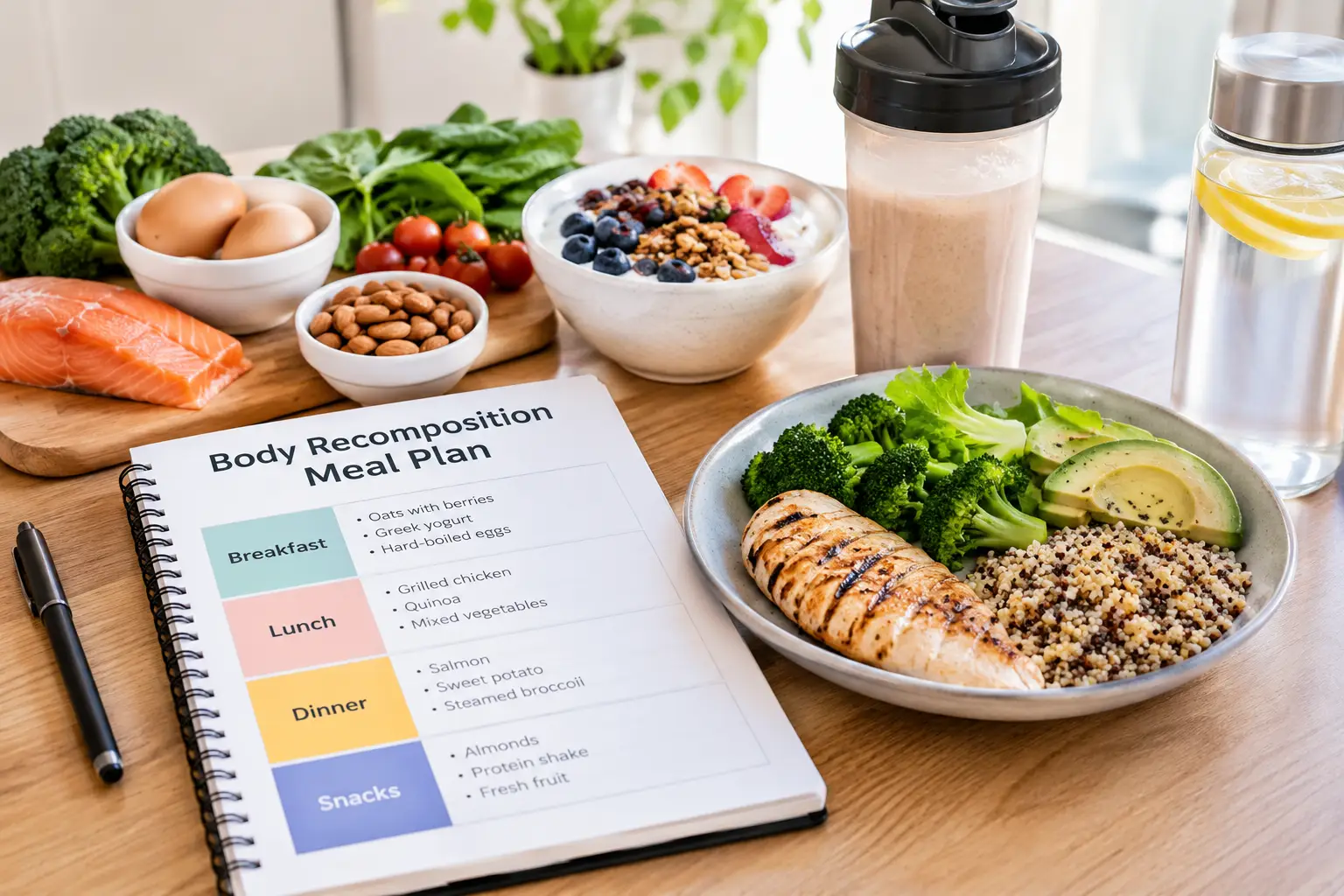
🍽️ Sample day (~2,200 calories, ~170 g protein)
- Breakfast: Greek yogurt, berries, oats, and one scoop of Optimum Nutrition Gold Standard 100% Whey stirred in
- Lunch: Shredded chicken, rice, black beans, salsa, and roasted peppers
- Snack: Two hard-boiled eggs and an apple
- Dinner: Salmon, sweet potato, and a large green salad with olive oil
- Evening: Cottage cheese with a handful of walnuts
Common first-30-day mistakes: weighing yourself only once a week (daily averages are far more reliable), dropping calories after one “bad” weigh-in, and skipping vegetables because they’re “not protein.”
Real-World Recomp Scenarios: Matching Tools to Your Life
Theory is nice; your schedule is what decides success. Here are three profiles and the reasoning behind each setup.
🎓 Profile 1: The college beginner (budget around $100, lifting 3x/week)
Maya is 20, new to lifting, and eats in a dining hall most days. She doesn’t need a full kitchen arsenal. A tub of Optimum Nutrition Gold Standard 100% Whey closes her protein gap cheaply, and an Escali Primo P115C helps her learn portion sizes for the meals she does cook. As a true beginner, Maya has the best odds of any profile to recomp quickly — “newbie gains” make simultaneous fat loss and muscle gain very realistic.
👨👩👧 Profile 2: The busy parent (budget around $250, lifting 3–4x/week)
Marcus works full-time, has two kids, and has about 30 minutes on weeknights. His bottleneck is time, not knowledge. The Instant Pot Duo 7-in-1 (6-Quart) lets him cook family-sized batches of lean protein the whole household eats, while Prep Naturals Glass Meal Prep Containers hold his portioned lunches. Thorne Creatine adds a low-effort performance boost to his limited gym time.
🏋️ Profile 3: The experienced lifter stuck on a plateau (budget flexible, lifting 5x/week)
Priya has trained for six years and alternates bulks and cuts. Recomp is slower for her, so precision matters. Dymatize ISO100 maximizes protein inside a tight calorie budget, the Escali Primo P115C keeps tracking honest, and Thorne Creatine supports training volume. She should expect slow, steady changes measured by tape and photos rather than the scale.
Problem → Solution: Fixing the Most Common Recomp Roadblocks
❌ Problem: “The scale hasn’t moved in three weeks.”
✅ Solution: That may be success, not failure. Recomposition often holds weight steady while fat drops and muscle rises. Track waist measurements and monthly photos. If both are flat for four or more weeks, trim intake by roughly 150–200 calories.
❌ Problem: “I can’t hit my protein target.”
✅ Solution: Anchor every meal with 25–40 grams of protein and use one shake of Optimum Nutrition Gold Standard 100% Whey or Dymatize ISO100 as a gap-filler rather than a meal replacement.
❌ Problem: “Whey upsets my stomach.”
✅ Solution: Try a hydrolyzed isolate like Dymatize ISO100, which is very low in lactose. If dairy is off the table entirely, use Orgain Organic Protein occasionally and lean on tofu, tempeh, lentils, and seitan for daily protein.
❌ Problem: “Meal prep falls apart by Wednesday.”
✅ Solution: Cook twice weekly instead of once. A Sunday and Wednesday session in the Instant Pot Duo 7-in-1 (6-Quart) keeps food fresher and tastier, and Prep Naturals Glass Meal Prep Containers make grab-and-go easy.
❌ Problem: “My lifts are stalling.”
✅ Solution: Check sleep and carbs before blaming the program. Adding carbs around workouts and a daily 3–5 g of Thorne Creatine often restores training quality.
How to Choose a Body Recomposition Meal Plan That Fits You
- Match calories to your starting point. Higher body fat? A small deficit works well. Already lean? Stay near maintenance so muscle isn’t sacrificed.
- Set protein before anything else. It’s the non-negotiable variable that most strongly separates recomposition from ordinary dieting.
- Pick foods you’ll actually eat for months. A “perfect” plan you abandon in two weeks loses to a good plan you follow all year.
- Plan around your training days. More carbs on lifting days support performance; slightly fewer on rest days keeps weekly calories in check.
- Choose a tracking method you can sustain. Weighing food with a scale like the Escali Primo P115C is most accurate; hand-portion estimates work once your eye is calibrated.
- Build in prep systems. Containers and a batch cooker reduce daily decisions, which is where plans usually fail.
- Decide how you’ll measure progress. Waist tape, photos, and gym logs every 2–4 weeks tell a truer story than daily weigh-ins alone.
Body Recomp Macros: How Much Protein, Carbs, and Fat Do You Need?
Getting body recomp macros right is about ranges, not magic ratios. Here’s how the research frames it.
🥩 Protein
Protein is the anchor. A study of older women doing resistance training found that participants with moderate and higher protein intakes achieved better body recomposition than those eating less protein — a useful reminder that low protein undermines even a well-designed lifting program. For most people, roughly 0.7–1.0 grams per pound of body weight per day is a practical target.
🍚 Carbohydrates
Carbs fuel training quality. Since your lifting sessions are the signal for muscle growth, cutting carbs too aggressively can backfire. After setting protein and fat, carbs fill the remaining calories — often 35–50% of intake for active people.
🥑 Fat
Dietary fat supports hormone production and absorbs fat-soluble vitamins. Around 25–35% of calories is a sensible range; going much lower tends to hurt satiety and adherence.
Putting it together
For a 180-pound person at 2,400 calories, a sample split might be 160 grams of protein (640 calories), 75 grams of fat (675 calories), and about 270 grams of carbs (1,085 calories). Treat this as a starting point, then adjust every 2–4 weeks based on measurements, energy, and gym performance — not daily scale swings.
Meal Plan for Body Recomposition vs. Traditional Cutting and Bulking
| Approach | Calories | Typical Speed | Muscle Outcome | Best for |
|---|---|---|---|---|
| Meal plan for body recomposition | Maintenance to small deficit | Slow, steady | Gain or preserve | Beginners, returners, moderate body fat |
| Traditional cut | Larger deficit | Fast fat loss | Risk of some muscle loss | Event deadlines, higher body fat |
| Traditional bulk | Surplus | Fast weight gain | Faster muscle gain, plus fat | Very lean lifters chasing size |
The table shows why a meal plan for body recomposition appeals to so many people: you avoid the yo-yo of gaining fat to build muscle and losing muscle to shed fat. The trade-off is patience — changes are slower and harder to see on a scale. If you have a hard deadline or want maximum size, classic cutting and bulking cycles can still be the more efficient route.
In practice, recomp shines when you’re starting out or returning after time off, because your body responds strongly to new training. It also suits anyone who dislikes the psychological whiplash of switching between “eat everything” and “eat nothing” phases. Experienced lifters can recomp too, but they need patience and tighter tracking, which is exactly where a food scale and consistent protein sources become non-negotiable.
Common Mistakes to Avoid on a Recomp Meal Plan
Even well-researched plans fail for predictable reasons. Avoid these:
- ❌ Cutting calories too hard. A big deficit shifts you from recomposition to plain dieting, and muscle becomes fair game.
- ❌ Treating protein shakes as meals. Shakes are gap-fillers. Whole foods bring fiber, micronutrients, and satiety that powders can’t.
- ❌ Ignoring progressive overload. Without gradually heavier weights or more reps, there’s no signal for muscle to grow, no matter how much protein you eat.
- ❌ Judging progress by the scale alone. Recomp can look like “nothing” on a scale while your waist shrinks.
- ❌ Skipping sleep. Short sleep raises hunger and blunts recovery. Seven or more hours is a realistic goal.
- ❌ Buying every supplement. Beyond protein and creatine, most products have weak evidence. Spend that money on food quality instead.
- ❌ Defaulting to a single plant powder daily. Given Consumer Reports’ lead findings, rotate sources and lean on whole foods if you’re dairy-free.
Each of these mistakes is quietly common because it feels productive in the moment. Cutting harder feels disciplined; buying supplements feels proactive. The smarter move is boring consistency: steady protein, honest tracking, and training you can repeat for months.
Long-Term Cost and Maintenance of a High Protein Meal Plan for Recomp
| Item | Upfront Cost Range | Ongoing Cost | Lifespan / Usage | Best for |
|---|---|---|---|---|
| Escali Primo P115C | Under $35 | AA batteries | Years | Escali Primo P115C: everyone |
| Prep Naturals Glass Meal Prep Containers | $30–$50 | Occasional lid replacement | Years with care | Prep Naturals Glass Meal Prep Containers: weekly preppers |
| Instant Pot Duo 7-in-1 (6-Quart) | $80–$150 | Sealing ring replacement | Several years | Instant Pot Duo 7-in-1 (6-Quart): batch cooks |
| Optimum Nutrition Gold Standard 100% Whey | $55–$95 per tub | Monthly repurchase | ~1–2 months per 5 lb | Optimum Nutrition Gold Standard 100% Whey: budget protein |
| Thorne Creatine | $35–$50 | Every ~3 months | 90 servings | Thorne Creatine: strength support |
The pattern is simple: the kitchen tools are one-time investments that pay for themselves within weeks by cutting takeout, while supplements are the recurring cost. A high protein meal plan for recomp built mostly around whole foods — eggs, chicken thighs, Greek yogurt, canned tuna, lentils — and only one daily shake keeps monthly spending manageable.
Maintenance is minimal but worth doing. Replace the Instant Pot’s silicone sealing ring when it holds odors, hand-wash container lids to keep gaskets tight, and swap the scale’s batteries before readings drift.
Safety, Regulations, and Standards for Supplements
Here’s something many shoppers don’t realize: in the US, dietary supplements — protein powders and creatine included — are not approved by the government for safety or effectiveness before they hit shelves. The FDA’s dietary supplements overview explains that manufacturers are responsible for ensuring their products are safe and properly labeled, while the agency mainly acts after problems surface.
That’s why third-party certifications matter:
- ✅ NSF Certified for Sport (held by Thorne Creatine) involves testing for contaminants and screening for banned substances.
- ✅ Informed Choice (on Optimum Nutrition Gold Standard 100% Whey) screens for banned substances in sport.
- ✅ USDA Organic (on Orgain Organic Protein) verifies farming and processing practices — but it says nothing about heavy metal content.
Heavy metals deserve special attention. Consumer Reports’ testing found plant-based powders carried much higher lead on average than dairy-based options, which is why we recommend occasional use of plant powders and a food-first approach.
A few health notes: very high protein intakes are generally considered safe for healthy, active adults, but anyone with kidney disease, who is pregnant or breastfeeding, or who takes prescription medications should check with a doctor or registered dietitian before changing their diet or adding creatine. If you have a history of disordered eating, a professional can help you build a recomp approach that doesn’t rely on strict tracking.
Features That Actually Matter (and Ones That Don’t)
Marketing loves to sell you extras. Here’s what genuinely moves the needle on a recomp:
✅ Matters:
- Protein per calorie in powders — it decides how much room you have for real food.
- Third-party testing — the only meaningful quality signal in a lightly regulated industry.
- 1-gram scale accuracy and a tare button — enough precision for every food you’ll weigh.
- Oven- and freezer-safe glass — fewer dishes and longer-lasting prep.
- Batch capacity — a 6-quart cooker feeds a week of lunches for one or several days for a family.
❌ Doesn’t matter much:
- “Anabolic” or “muscle-building” blends with long ingredient lists — total protein matters far more.
- Exotic creatine forms — monohydrate remains the most researched and cost-effective.
- Bluetooth-connected food scales — nice for logging, but a basic scale plus a free app does the same job.
- Perfect protein timing — research suggests total daily intake and even distribution beat a strict “anabolic window.”
- Fancy compartment counts — two compartments are plenty for portioning protein and sides.
The pattern here is that boring fundamentals outperform clever features. If a product’s main selling point is a buzzword rather than a measurable spec, it’s probably not worth a premium.
FAQ: Body Recomposition Meal Plan Questions
❓ Is a body recomposition meal plan good for women over 40?
❓ Should I buy whey isolate or concentrate for recomp?
❓ Do I need creatine for body recomposition?
❓ What's the best food scale for meal prep on a budget?
❓ Can I do a recomp on a vegan diet?
Conclusion: Your Body Recomposition Meal Plan, Simplified
A body recomposition meal plan isn’t a secret formula — it’s three habits done consistently: eat plenty of protein, keep calories near maintenance, and train with progressive overload. Everything else is about making those habits easier to keep.
That’s where the right tools come in. Optimum Nutrition Gold Standard 100% Whey is the best everyday protein value, while Dymatize ISO100 shines when your calorie budget is tight or your stomach is sensitive. Orgain Organic Protein serves dairy-free eaters, best used occasionally. Thorne Creatine adds research-backed strength support with verified purity. And the kitchen trio — the Escali Primo P115C, Prep Naturals Glass Meal Prep Containers, and the Instant Pot Duo 7-in-1 (6-Quart) — turns good intentions into a repeatable weekly system.
If you’re just starting, don’t buy everything at once. Start with a scale and one protein source, track honestly for a month, and add tools as you discover where your plan breaks down. Measure progress with a tape and photos, be patient with the scale, and adjust in small steps.
Recomposition rewards consistency far more than perfection. Give your plan 12 weeks of honest effort, and the changes will show up — in the mirror, in your lifts, and in how your clothes fit.
🚀 Start your recomp journey today!
✨ Take your nutrition to the next level with this carefully curated lineup. Click any highlighted product to check current pricing and availability — these picks will help you build a stronger, leaner body you’ll be proud of!
Recommended for You
- Aluminum Lunch Box: 7 Best Lightweight Picks That Last (2026)
- Menu Cardiac Diet: 7 Best Heart-Smart Picks That Work (2026)
- Bento Stainless Steel Lunch Containers: 7 Brilliant Picks for 2026
Disclaimer: This post contains affiliate links. As an Amazon Associate, I earn from qualifying purchases made through these links, at no additional cost to you. This article is for informational purposes only and is not medical advice.
✨ Found this article helpful? Share it with someone who needs it! 💬🤗