
In This Article
Introduction: Why the Black Food Container Is Everywhere
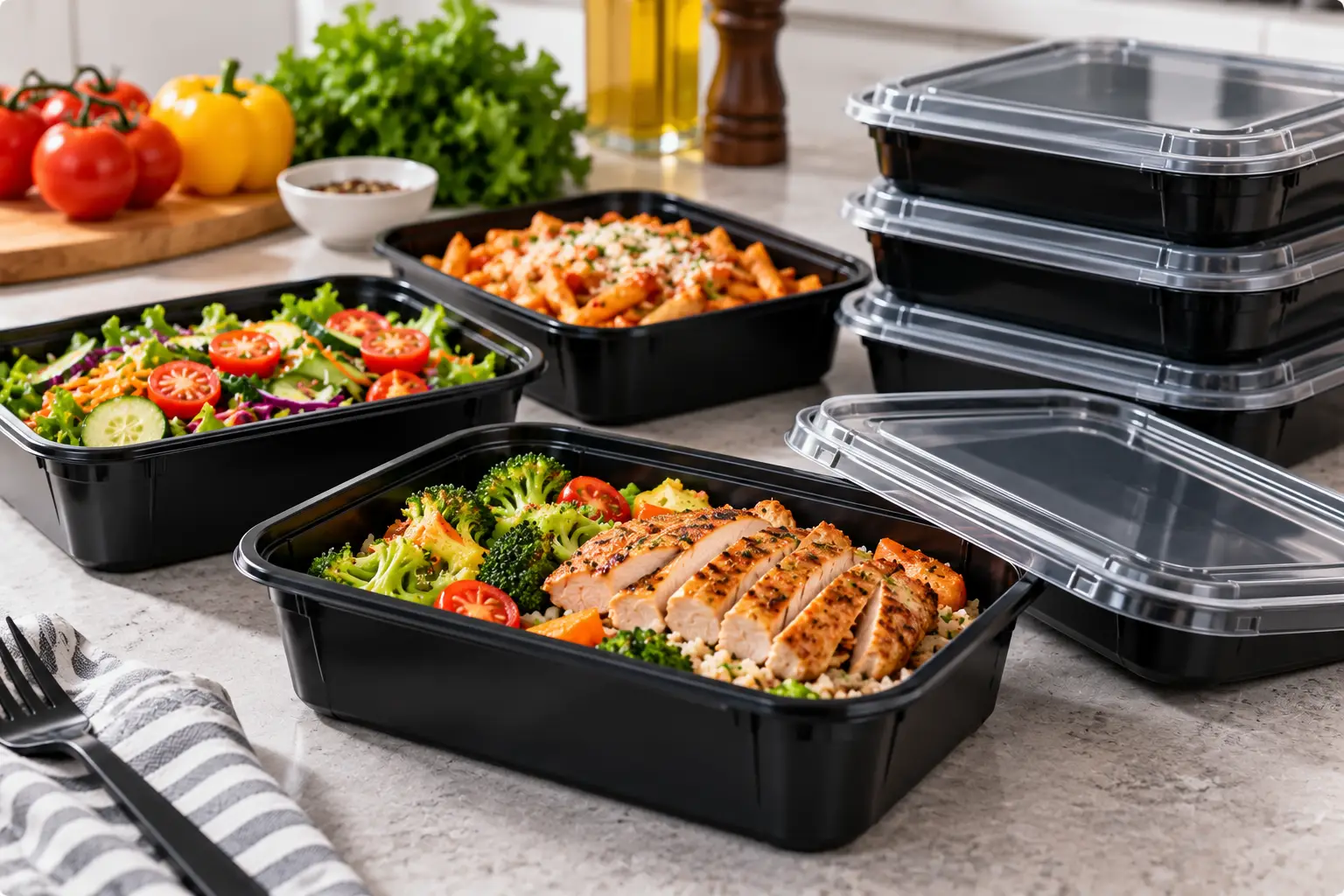
Open a busy fridge on a Sunday night and you’ll probably spot one: a black food container with a clear lid, stacked five high and holding chicken, rice, and broccoli for the week ahead. Black bases have quietly become the default for meal preppers, takeout kitchens, and lunch packers — and not just because they look sleek. A dark base hides the orange halo that tomato sauce and turmeric leave on clear plastic, so your containers still look presentable after their fortieth trip through the dishwasher.
But “black” covers a surprisingly wide range of products. Some black meal prep containers are thin bulk-pack bento trays meant for a few dozen uses. Others are thick, rigid workhorses. And a few are matte-black stainless steel food jars that keep soup hot until mid-afternoon — no microwave required. On top of that, a widely shared 2024 study raised real questions about recycled black plastic food containers, so it pays to know exactly what you’re buying.
This guide breaks down seven real options available on amazon.com, translates their specs into everyday performance, and gives you a clear framework for choosing — whether you’re prepping macros, feeding a family, or packing hot lunches for a job site. 🍱
What Is a Black Food Container?
A black food container is a food storage, meal prep, or takeout vessel with a black base — usually polypropylene plastic paired with a clear or black lid, though black-finished stainless steel food jars count too. The dark color hides stains, makes food look appetizing, and dominates bento-style meal prep and restaurant to-go packaging.
Black Food Container Quick Comparison (2026)
| Product | Type | Capacity | Compartments | Microwave | Price range | Best for |
|---|---|---|---|---|---|---|
| Freshware 3-Compartment Meal Prep Containers | Plastic bento, 21-pack | 24 oz (12/6/6) | 3 | Yes | Around $15–$25 | Freshware: best overall value |
| Enther 36 oz Meal Prep Containers | Plastic bento, 20-pack | 36 oz | 3 | Yes | Around $25–$35 | Enther: bigger appetites |
| Igluu 28 oz Meal Prep Containers | Plastic, 10-pack | 28 oz | 1 | Yes | Around $15–$30 | Igluu: stain-proof single meals |
| Retrocular 20 oz Bento Boxes | Lightweight plastic, 30-pack | 20 oz | 3 | Short reheats only | Around $15–$25 | Retrocular: parties and events |
| Anchor Packaging Culinary Squares | Commercial, 150-count case | 21 + 6 + 6 oz | 3 | Yes | Around $150–$225 per case | Anchor: small food businesses |
| Thermos Stainless King 16 oz Food Jar | Insulated stainless steel | 16 oz | 1 | No | Around $25–$35 | Thermos: hot lunches anywhere |
| Zojirushi SW-EAE50 Food Jar | Insulated stainless steel | 17 oz | 1 | No | Around $35–$55 | Zojirushi: premium heat retention |
Prices are approximate ranges at the time of writing — check the current price, as prices may vary.
Looking at the table above, the split is clear: the five plastic options are built for the fridge-to-microwave routine, while the two stainless jars are built for days when there’s no microwave at all. Within the plastic group, the Freshware 3-Compartment Meal Prep Containers offer the lowest cost per meal with built-in portion control, but if your lunches look more like dinners, the Enther 36 oz Meal Prep Containers give you 50% more room for only a modest step up in price. Budget-conscious buyers who care more about longevity than pack count should note that the Igluu 28 oz Meal Prep Containers trade quantity for a thicker, more rigid build.
The less obvious takeaway is what the “Microwave” column hides. A black takeout tray from a restaurant and a black meal prep container may look nearly identical, yet only one of them is designed and labeled for reheating. That’s why every plastic pick in this list carries an explicit microwave rating — and why the Retrocular 20 oz Bento Boxes, with a 266°F reheating ceiling, are flagged for short bursts only. If heating food inside plastic makes you uneasy, the Thermos Stainless King 16 oz Food Jar and Zojirushi SW-EAE50 Food Jar remove that question entirely.
💬 One click helps other shoppers make an informed choice too! 😊
Top 7 Black Food Containers: Expert Analysis
1. Freshware 3-Compartment Meal Prep Containers — best value for weekly bento prep
If you want a full week of portioned lunches without spending much, this 21-pack is the easiest place to start. Each black base splits into a 12 oz main compartment and two 6 oz side wells, for 24 oz total. In real terms, that keeps a protein, a grain, and a vegetable apart, so your roasted broccoli doesn’t spend three days soaking up chicken juice. Freshware lists the set as BPA-free and microwave-, freezer-, and dishwasher-safe, and the empty bases nest tightly — which matters more than you’d think in a crowded cabinet.
Based on comparing the specs, this is the right buy for beginners, students, and anyone on a portion-controlled plan where the compartments do the measuring for you. The 24 oz total is modest, though, so active adults or anyone eating for muscle gain may find the main well tight. The snap-on lids are designed for the fridge-to-microwave routine, not for carrying soup in a backpack.
Customer reviews for the Freshware line consistently highlight value, sensible portion sizes, and easy stacking. The criticism that recurs across thin bento-style sets like this one centers on lid fit and long-term durability, so treat these as a one- to two-year purchase rather than an heirloom.
Pros:
- ✅ Three compartments make portion control almost automatic
- ✅ Very low cost per container in the 21-pack
- ✅ Nests compactly for easy cabinet storage
Cons:
- ❌ 24 oz total runs small for big appetites
- ❌ Not built for soups or liquid-heavy dishes
💲 Price & value: Typically around $15–$25 for 21 containers (check the current price) — outstanding value for everyday black meal prep containers.
2. Enther 36 oz Meal Prep Containers — roomiest bento for big appetites
When a 24 oz tray leaves you hungry by 2 p.m., Enther’s 36 oz three-compartment design gives you 50% more room in a similar bento format. It’s sold in 12- and 20-packs, made from BPA-free plastic, and listed as microwave-, freezer-, and dishwasher-safe. That extra volume is the difference between “a lunch” and “a dinner-sized plate,” which is exactly what you want when you batch-cook full meals rather than snack boxes.
Here’s what to weigh: this is a value-first container, and the trade-off is wall thickness. For bulkers, shift workers who eat two meals on the clock, or families prepping dinners ahead, the capacity per dollar is hard to beat. For saucy curries or dressed salads, though, plan on a separate small cup for the liquids.
Aggregated customer feedback is genuinely mixed. Plenty of buyers praise the size and say one pack covers a full week of meals with containers to spare. On the other side, reviews mention thin walls, lids that are tricky to seal on some units, occasional pinhole leaks, and at least one report of a base deforming in the microwave. The practical takeaway: water-test each container the day it arrives, and reheat with the lid vented on medium power.
Pros:
- ✅ 36 oz holds a true dinner-sized portion
- ✅ Strong capacity per dollar in the 20-pack
- ✅ Three wells keep mains and sides separate
Cons:
- ❌ Thinner walls than premium meal prep brands
- ❌ Some units reported leaking with liquids
💲 Price & value: Usually around $25–$35 for 20 at the time of writing — great value if you inspect each unit on arrival.
3. Igluu 28 oz Meal Prep Containers — sturdiest single-compartment pick
Not every meal wants dividers. Igluu’s 28 oz single-compartment containers give you one open well for pasta bakes, burrito bowls, chili and rice, or stir-fries — dishes that compartments only get in the way of. The 10-pack is listed as BPA-free, airtight, and safe for the microwave, freezer, and dishwasher. Fitness Volt’s 2026 meal prep roundup ranked this exact container its best overall pick, which matches its reputation for being more rigid than bulk bento trays.
The black base earns its keep here. One reviewer specifically noted that the dark tub doesn’t pick up the orange tint from tomato- or spice-heavy food — and if you rotate the same curry through a container every week, that’s a real quality-of-life upgrade. The 28 oz volume also hits a sweet spot: enough for an adult lunch, not so big that it tempts you to overfill.
Customer reviews generally praise the size, the reliable seal with solid foods, and microwave convenience. The recurring negatives are minor: an occasional container arriving with a cracked corner, and lids some users find snug at first. As with any lid without a gasket, keep liquid-heavy meals upright.
Pros:
- ✅ Thicker build than most bulk bento packs
- ✅ Black base resists tomato and turmeric staining
- ✅ 28 oz suits most adult lunch portions
Cons:
- ❌ No dividers for keeping sides separate
- ❌ Occasional units arrive with cracked corners
💲 Price & value: Roughly $15–$30 per 10-pack depending on the bundle — solid mid-range value for a longer-lasting container.
4. Retrocular 20 oz Bento Boxes — lightest option for parties and events
Sometimes you need 30 containers for one Saturday, not 10 for a year. Retrocular’s black three-compartment boxes come in a 30-pack and measure roughly 7.87 x 4.33 x 1.38 inches, with 20 oz of total capacity. That slim 1.38-inch profile slides into a laptop bag or cooler without stealing space, and the three wells handle a small main plus two sides — think graduation-party plates or a bake-sale lunch combo.
The key spec to read carefully is heat: the listing allows short microwave reheats up to 266°F (130°C). In practice, oily or sugary foods can develop hot spots beyond that, so warm food in short bursts or move it to a plate. Retrocular describes these black takeout containers as disposable yet reusable, which is the honest framing — they shine for potlucks, sending leftovers home with guests, or kids’ lunches where containers tend to vanish.
We couldn’t verify a large body of customer reviews for this specific pack. The feedback that is visible is positive about the size for multi-course portions, but expect a lighter-gauge plastic than the Igluu 28 oz Meal Prep Containers or Enther 36 oz Meal Prep Containers.
Pros:
- ✅ 30-pack covers events and potlucks cheaply
- ✅ Slim profile fits bags and coolers easily
- ✅ Three wells suit small main-plus-sides meals
Cons:
- ❌ Short microwave reheats only, capped at 266°F
- ❌ Lighter build isn’t meant for years of reuse
💲 Price & value: Typically around $15–$25 for 30 — excellent per-container value for short-term use.
5. Anchor Packaging Culinary Squares — restaurant-grade pick for food businesses
If you sell meals — a meal prep side hustle, a food truck, a church fundraiser — consumer 10-packs get expensive fast. Anchor Packaging’s Culinary Squares (model 4118523) are commercial black-base containers with clear lids, sold 150 to a case. Each has a 21 oz main compartment plus two 6 oz side compartments in an 8.46 x 8.46 x 2.5-inch footprint, and they’re rated microwavable.
What that spec sheet means in practice: a square shape packs more efficiently into delivery bags than long rectangles, and the 2.5-inch depth fits a full entrée like lasagna or a loaded rice plate without crushing toppings under the lid. A clear lid over a black base is also the classic foodservice presentation trick — colors pop, and customers see exactly what they paid for.
Here’s the honest caveat: this is a commercial product, so there isn’t a meaningful pool of consumer reviews to summarize, and the case price is a business purchase rather than a household one. Anchor Packaging is a long-established foodservice packaging brand, and it’s the logical choice when you need consistency across hundreds of orders. For home cooks, the per-unit cost is fair, but 150 containers is a lot of cabinet space.
Pros:
- ✅ Generous 21 oz main plus two side wells
- ✅ Square footprint stacks well in delivery bags
- ✅ Clear lid shows off food to customers
Cons:
- ❌ Sold only in large 150-count cases
- ❌ Few consumer reviews on long-term reuse
💲 Price & value: Cases have listed in roughly the $150–$225 range — about $1–$1.50 per container, strong value for businesses.
6. Thermos Stainless King 16 oz Food Jar — best for hot lunches without a microwave
No microwave at work? No problem. The Stainless King (model SK3000BK in matte black) is an insulated black food container that uses double-wall vacuum insulation and 18/8 stainless steel to keep food hot for up to 9 hours or cold for up to 14 hours, according to Thermos. Some retailer listings still quote older 7-hour/9-hour figures, so treat the higher rating as a best case with a full, preheated jar. A full-size folding stainless spoon tucks into the lid, and the lid itself doubles as a small serving bowl.
What that means day to day: chili, ramen, oatmeal, or stew packed at 7 a.m. is still genuinely hot at lunch, even on a cold job site or a long school day. The wide mouth makes it easy to fill and clean, and the exterior stays cool to the touch. Steel also sidesteps the black-plastic chemical debate entirely — the black is a matte finish on metal, not pigment in plastic.
Customer reviews are overwhelmingly positive about heat retention. The most useful tip that keeps surfacing: prime the jar with boiling water for about 10 minutes, dump it, then add your hot food.
Pros:
- ✅ Keeps soup hot well past lunchtime
- ✅ Stainless interior resists stains and odors
- ✅ Folding spoon stores neatly inside the lid
Cons:
- ❌ Not microwave-safe, so no reheating inside
- ❌ 16 oz may feel small for big eaters
💲 Price & value: Generally around $25–$35 — excellent value for a container that should last years.
7. Zojirushi SW-EAE50 Food Jar — premium heat retention in a compact jar
Zojirushi publishes unusually specific performance numbers, and they’re impressive: starting with 203°F water in a 68°F room, the 17 oz (0.5 L) SW-EAE50 is rated to still be 147°F after six hours, with cold contents holding at 50°F over the same span. It’s built from 18/8 stainless steel with a gasketed lid, a 2½-inch opening you can eat straight from, and BPA-free plastic parts, in a compact 3⅝ x 3⅝ x 6-inch body offered in black among other finishes.
Here’s why that 147°F figure matters: food-safety guidance treats 140°F as the upper edge of the bacterial “danger zone,” so a jar that stays above it for six hours keeps lunch both pleasant and in the safer range — provided you start with piping-hot food and a preheated jar. That makes it a smart pick for long workdays, daycare lunches, or anyone who simply hates lukewarm soup.
Customer reviews consistently praise its heat retention and build quality, with several longtime Zojirushi owners citing their flasks as the reason they trusted the brand. The common gripes are price and modest capacity.
Pros:
- ✅ Published heat retention of 147°F at six hours
- ✅ Gasketed lid minimizes leaks in transit
- ✅ Compact enough for small lunch bags
Cons:
- ❌ Costs more than most insulated food jars
- ❌ 17 oz is snug for hearty eaters
💲 Price & value: Usually between $35 and $55 depending on finish and seller — worth it if hot lunches are a daily habit.
✨ Don’t miss these top-rated black food container picks!
🔍 Take your meal prep to the next level with this carefully curated lineup. Click a highlighted item to check current pricing and availability. These picks will help you get fresh, perfectly portioned meals the whole family will enjoy!
How to Get Started With Your Black Food Container: The First 30 Days
Your containers are only as good as the habits around them. Here’s a simple four-week routine that keeps food safe and helps your containers last longer. 🗓️
Week 1 — Inspect and test. Wash everything before first use. Then fill each container with water, snap the lid on, and tip it over the sink for 30 seconds. Any container that drips becomes your “dry foods only” box. This one test catches the pinhole and lid-fit issues that reviews flag in budget packs — and it’s far easier to request a replacement in week one than in month three.
Week 2 — Build your prep rhythm. Cook in batches, then portion food while it’s still warm. According to FoodSafety.gov’s leftover guidance, leftovers belong in covered, shallow containers and in the fridge promptly — you don’t need to wait for them to cool to room temperature — and refrigerated leftovers keep for three to four days. In practice, a Sunday prep covers you through Wednesday; freeze Thursday and Friday’s meals and move them to the fridge the night before.
Week 3 — Reheat smarter. Vent or remove the lid, reheat on medium power in short bursts, stir, and confirm food reaches 165°F with a thermometer. Microwaves have cold spots, so let the food rest a minute before you test. For insulated jars like the Thermos Stainless King 16 oz Food Jar or the Zojirushi SW-EAE50 Food Jar, preheat with boiling water for about 10 minutes before filling.
Week 4 — Maintain. Wash plastic on the dishwasher’s top rack, skip heated dry when you can, and retire any base that’s warped, cracked, or deeply scratched. Store lids separately so snap rims and gaskets don’t stay compressed for weeks.
Real-World Scenarios: Which Black Food Container Fits Your Life?
Specs only matter when they meet a real routine. Here are three common profiles and the containers that match them best.
🎓 Profile 1: The budget meal prepper
Maya is a nursing student with about $25 to spend on kitchen gear, and she preps 10 lunches every Sunday. She needs portion control and volume, not luxury. The Freshware 3-Compartment Meal Prep Containers fit perfectly: 21 containers mean she always has clean ones while a batch sits in the dishwasher, and the 12/6/6 oz layout keeps protein, rice, and vegetables balanced without a food scale. Frequency: five days a week, so she should expect to replace the set after a year or two of heavy use.
🏭 Profile 2: The hungry shift worker
Marcus works 12-hour warehouse shifts, eats two meals on the clock, and has a break-room microwave. He’ll get the most from the Enther 36 oz Meal Prep Containers for dinner-sized portions, plus a few Igluu 28 oz Meal Prep Containers for saucier one-dish meals like chili mac. Budget: roughly $45–$60 for both sets. Because he uses them daily, the arrival water test matters most for him.
👩👧 Profile 3: The parent with no microwave access
Jen packs hot lunches for her second grader and herself, and neither the school nor her job site has a microwave. Two insulated jars solve it: the Thermos Stainless King 16 oz Food Jar for her child, with its built-in folding spoon, and the Zojirushi SW-EAE50 Food Jar for her own longer day, where the six-hour heat-retention rating matters. Budget: about $60–$90 total, but both jars should last for years — which makes them cheaper per meal than they first appear.
Problem → Solution: Fixing Common Black Food Container Headaches
Even the best black food storage containers with lids have quirks. Here are five common frustrations and how to fix them.
- Problem: Lids pop off or leak in your bag. Snap-fit bento lids aren’t gasketed. Carry containers flat, use a small separate cup for dressings, and save wet dishes for the Thermos Stainless King 16 oz Food Jar or Zojirushi SW-EAE50 Food Jar, both of which seal far more securely.
- Problem: Edges scorch while the center stays cold. Spread food in an even layer, leave a small hollow in the middle, vent the lid, and reheat at 50–70% power in 60-second bursts. Shallow containers like the Retrocular 20 oz Bento Boxes heat fastest — but keep it brief given their 266°F limit.
- Problem: The base warps or turns cloudy. That usually comes from bottom-rack dishwashing or microwaving oily food too long. Move plastics to the top rack and give greasy foods like fried rice shorter intervals.
- Problem: Lingering garlic or curry smells. Soak containers overnight in warm water with a tablespoon of baking soda, then air-dry with lids off. Stainless jars resist odors best of all.
- Problem: Running out of clean containers midweek. Own about 1.5 times as many containers as meals you prep. That’s exactly where high-count packs like the Freshware 3-Compartment Meal Prep Containers or Enther 36 oz Meal Prep Containers earn their place.
How to Choose a Black Food Container (7 Steps)
Choosing well comes down to matching material and size to how you actually eat. Work through these steps in order — each one narrows the field.
- Decide where the food gets reheated. If you have a microwave, polypropylene meal prep containers make sense. If not, skip plastic and go straight to an insulated jar.
- Check the material and the microwave-safe label. Look for polypropylene (resin code #5) plus an explicit microwave-safe claim. As Harvard Health Publishing explains, only containers labeled microwave-safe have been tested for that use.
- Size to your appetite. About 20–24 oz suits lighter lunches, 28 oz fits most adults, and 32–36 oz covers dinner-sized or high-calorie plans.
- Pick compartments by menu. Three wells work for protein-plus-sides plates; one open well is better for pasta, curries, and grain bowls.
- Judge lid design honestly. Snap lids are fine for fridge-to-microwave trips. Gaskets or screw lids are what soups need in transit.
- Buy the right count. Multiply prep days by meals per day, then by 1.5 to cover dishwasher downtime.
- Think about lifespan. Thin bulk packs are semi-disposable; thicker containers and stainless jars spread their cost over years.
If you remember only one step, make it the second: the label tells you more about safe use than the color, the brand, or the pack count ever will.
Are Black Plastic Food Containers Safe? Safety, Regulations, and Standards
This is the question most buyers are really asking in 2026, so here’s the evidence without the panic.
In late 2024, researchers from Toxic-Free Future and Vrije Universiteit Amsterdam published a peer-reviewed study in Chemosphere, titled “From e-waste to living space”. They screened 203 black plastic household products sold in the U.S. and, among the items analyzed in detail, found flame retardants in 85% — with some of the highest levels in a takeout sushi tray and a kitchen spatula. Their explanation: plastic from electronics such as TV casings, which contain flame retardants, gets recycled into household goods that don’t need them.
Then came an important correction. In December 2024, the authors acknowledged a math error: the EPA reference dose they compared against works out to 420,000 nanograms per day for a 60 kg adult, not 42,000. That put their estimated exposure from utensils (about 34,700 ng/day) roughly 12 times below the reference level. The authors stood by their broader conclusion that these chemicals shouldn’t be in food-contact items at all.
Two details matter most for container shoppers:
- ⚠️ Polymer type made a big difference. The study found significantly higher flame-retardant levels in styrene-based plastics (typical of electronics) than in polypropylene. Most reusable black meal prep containers, including the picks above, are marketed as polypropylene.
- 🏛️ Regulation targets the source. The FDA reviews substances used in food-contact plastics, and microwave-safe claims require testing. Meanwhile, Washington state and New York have restricted organohalogen flame retardants in certain plastic electronics enclosures — rules aimed at stopping contaminated plastic before it’s recycled.
The practical upshot: buy polypropylene containers labeled microwave-safe, don’t reheat in black takeout containers that carry no such label, discard chipped or cracked pieces, and choose stainless steel if you’d rather remove the question entirely.
Black Food Container vs Clear Plastic, Glass, and Stainless Steel
| Material | Stain resistance | Microwave | Weight | Lifespan | Typical cost | Best for |
|---|---|---|---|---|---|---|
| Black polypropylene (Freshware, Enther, Igluu) | Excellent — hides stains | Yes, if labeled | Very light | Varies with wall thickness | Lowest | Weekly meal prep |
| Clear plastic | Poor — tomato tints show | Yes, if labeled | Very light | Varies with wall thickness | Low | Seeing contents at a glance |
| Glass with plastic lid | Excellent | Yes, lid vented | Heavy | Many years unless dropped | Medium–high | Home reheating and oven use |
| Insulated stainless (Thermos, Zojirushi) | Excellent | No | Moderate | Many years | Medium per unit | Hot meals without a microwave |
Reading across the table, black polypropylene wins on price, weight, and stain-hiding, which is why it dominates meal prep. Glass wins on longevity and oven use but loses badly on weight — five filled glass containers in a work bag is a real burden. Insulated stainless is the only option that keeps food hot without any reheating, which makes it the natural partner rather than the rival to a plastic set.
Many households end up with a hybrid: a stack of black meal prep containers for fridge-to-microwave lunches, a couple of glass dishes for oven leftovers, and one insulated jar for soup days. That mix covers nearly every scenario without overpaying for any single material.
Black Food Containers for Meal Preppers, Families, and Small Food Businesses
Different buyers need different things from the same black base. Here’s tailored advice for each group.
🏋️ Fitness meal preppers: Prioritize consistent volume over everything else. Using one container size every day makes tracking macros far easier. The Freshware 3-Compartment Meal Prep Containers suit cutting phases; the Enther 36 oz Meal Prep Containers suit bulking.
👨👩👧👦 Families: Kids lose containers, so cheap high-count packs make sense for school lunches. The Retrocular 20 oz Bento Boxes are small enough for children’s portions, while an insulated black food container like the Thermos Stainless King 16 oz Food Jar handles hot lunches at schools without microwave access.
🧓 Seniors and people living alone: Smaller portions mean less waste. Look for 20–24 oz containers and lids with easy-grip tabs, and consider the Zojirushi SW-EAE50 Food Jar for a compact, stable jar that’s simple to open.
🚚 Small food businesses: Consistency and presentation drive repeat orders. The Anchor Packaging Culinary Squares offer a clear lid over a black base in commercial quantities. Check your local health department’s rules for packaging and labeling before you sell, since requirements vary by state and county.
Features That Actually Matter (and Ones That Don’t)
Marketing copy for black food storage containers with lids is crowded with claims. Here’s how to separate signal from noise.
✅ Features that matter:
- Resin type and microwave label. This determines safe use more than anything else.
- Wall thickness and rigidity. Thicker walls resist warping, cracking, and pinholes.
- Lid style. Gaskets and screw tops seal liquids; snap lids don’t, whatever the box says.
- Depth and shape. Shallow containers cool food faster in the fridge and reheat more evenly.
- Published performance data. Zojirushi’s 147°F-at-six-hours spec is far more useful than vague “hours of heat.”
❌ Features that don’t matter much:
- “Leakproof” on snap lids. Treat it as leak-resistant with solid food at best.
- Bonus e-books and recipe guides. Nice, but not a reason to choose a container.
- “#1 brand” badges. Popularity isn’t durability.
- Giant pack counts you won’t use. Unused containers are just clutter.
The pattern is simple: features you can measure or verify deserve your attention, while slogans deserve skepticism.
Long-Term Cost and Maintenance
| Product | Pack size | Typical price range | Approx. cost per container | Expected role | Best for |
|---|---|---|---|---|---|
| Freshware 3-Compartment Meal Prep Containers | 21 | $15–$25 | ~$0.70–$1.20 | Everyday reusable | Freshware: budget prep |
| Enther 36 oz Meal Prep Containers | 20 | $25–$35 | ~$1.25–$1.75 | Everyday reusable | Enther: big portions |
| Igluu 28 oz Meal Prep Containers | 10 | $15–$30 | ~$1.50–$3.00 | Longer-lasting reusable | Igluu: durability |
| Retrocular 20 oz Bento Boxes | 30 | $15–$25 | ~$0.50–$0.85 | Short-term use | Retrocular: events |
| Anchor Packaging Culinary Squares | 150 | $150–$225 | ~$1.00–$1.50 | Commercial | Anchor: businesses |
| Thermos Stainless King 16 oz Food Jar | 1 | $25–$35 | $25–$35 | Multi-year | Thermos: hot lunches |
| Zojirushi SW-EAE50 Food Jar | 1 | $35–$55 | $35–$55 | Multi-year | Zojirushi: premium heat |
The sticker price misleads here. A Thermos Stainless King 16 oz Food Jar around $30, used four days a week for three years, works out to roughly five cents per meal — cheaper per use than many plastic containers that get retired within a year. Meanwhile, the Retrocular 20 oz Bento Boxes have the lowest upfront cost per container but the shortest expected life, so they’re best viewed as an event supply rather than a long-term system.
Maintenance stretches every dollar further: top-rack washing, no heated dry, lids stored loose, and prompt replacement of cracked pieces. A plastic container that’s kept flat and cool can easily outlast one that’s microwaved hard and baked in a dishwasher every day.
Common Mistakes to Avoid When Buying a Black Food Container
A few predictable errors account for most disappointing purchases.
- Assuming every black container is microwave-safe. Restaurant black takeout containers often aren’t labeled for reheating. Transfer food to a labeled container or a plate.
- Buying by pack count instead of capacity. Fifty containers that are too small for your meals are worse than ten that fit.
- Expecting snap lids to hold soup. They won’t reliably. Use an insulated jar or a gasketed container for liquids.
- Reusing disposable trays indefinitely. Lighter packs like the Retrocular 20 oz Bento Boxes are designed for limited reuse — retire them once they warp or crack.
- Ignoring dimensions. Measure your lunch bag and fridge shelf height before ordering; a 2.5-inch-deep container like the Anchor Packaging Culinary Squares stacks differently than a slim 1.38-inch tray.
- Skipping the arrival check. Water-test containers immediately, while the return window is still open.
Avoid these six, and almost any container on this list will serve you well.
FAQ: Black Food Container Questions Answered
❓ Can I put a black food container in the dishwasher?
❓ How long do reusable black meal prep containers last?
❓ Are black plastic takeout containers recyclable?
❓ Can black food containers go in the oven?
❓ What size black food container is best for weight-loss meal prep?
Conclusion: Picking the Right Black Food Container in 2026
The best black food container is the one that matches how you actually eat. For most people starting out, the Freshware 3-Compartment Meal Prep Containers deliver the best value and built-in portion control. If your lunches look more like dinners, the Enther 36 oz Meal Prep Containers stretch your dollar furthest — just water-test them on arrival. Prefer one open well and a sturdier build? The Igluu 28 oz Meal Prep Containers are the dependable middle ground, and their black base keeps looking clean long after clear tubs have turned orange.
For parties and potlucks, the Retrocular 20 oz Bento Boxes cover a crowd for very little, while food businesses will get more consistency from the Anchor Packaging Culinary Squares. And if there’s no microwave in your day, skip plastic entirely: the Thermos Stainless King 16 oz Food Jar is the value pick, and the Zojirushi SW-EAE50 Food Jar is the premium choice backed by published heat-retention numbers.
Whatever you choose, the fundamentals stay the same. Buy polypropylene with a clear microwave-safe label, keep unlabeled black takeout trays out of the microwave, refrigerate leftovers promptly and eat them within three to four days, and retire any container that’s cracked or warped. Follow those simple rules, and your containers will save you money, time, and plenty of sad desk lunches. 🥗
🛒 Ready to upgrade your lunch game?
🔍 Take your meal prep to the next level with this carefully curated lineup. Click a highlighted item to check current pricing and availability. These picks will help you get fresher, better-organized meals the whole family will enjoy!
Recommended for You
- 16 ounce plastic containers with lids: 7 Best Leakproof Picks (2026)
- Plastic To Go Containers With Lids: 7 Best Leakproof Picks (2026)
- Rectangle Food Container Guide: 7 Best Leakproof Picks for 2026
Disclaimer: This post contains affiliate links. As an Amazon Associate, I earn from qualifying purchases made through these links, at no additional cost to you.
✨ Found this article helpful? Share it with someone who needs it! 💬🤗