
In This Article
What Is a Menu Cardiac Diet? (And Why It Matters in 2026)
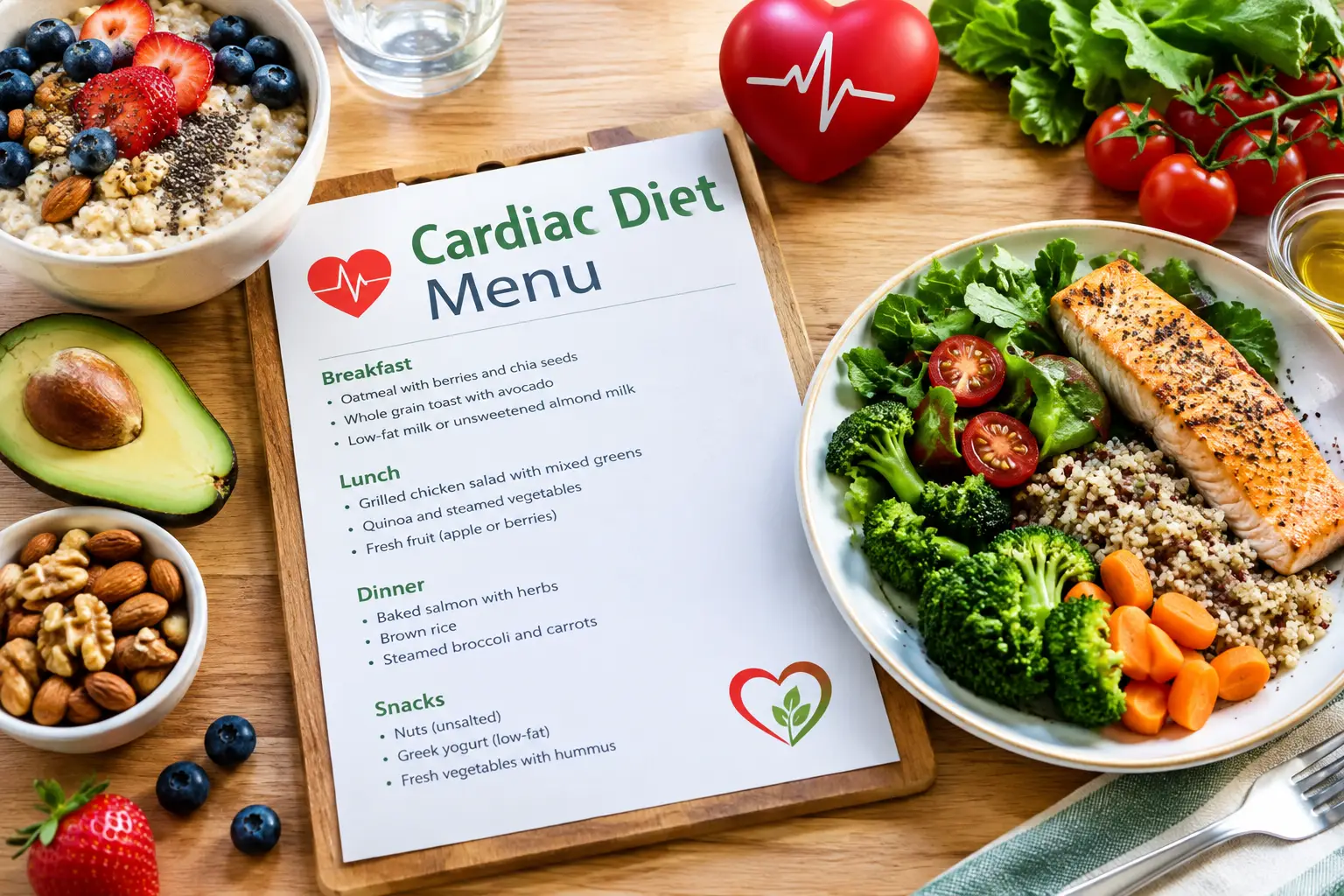
A menu cardiac diet is a planned set of daily meals built around heart-healthy eating principles: less sodium, limited saturated and trans fats, and more vegetables, fruits, whole grains, legumes, fish, and lean protein. Instead of vague “eat better” advice, it turns cardiology and dietitian guidance into specific breakfasts, lunches, dinners, and snacks.
That last part matters more than most people realize. 🫀 Hearing “cut back on salt” in a doctor’s office is easy; figuring out what to cook on a Tuesday night when you’re tired, hungry, and staring at a fridge full of deli meat is the hard part. A written menu removes that decision fatigue.
The numbers show why a plan beats good intentions. The American Heart Association’s sodium guidance sets a limit of 2,300 mg a day and an ideal target of 1,500 mg for most adults — yet the average American eats more than 3,100 mg daily. Even more telling, over 70% of that sodium comes from packaged, prepared, and restaurant food rather than the saltshaker. In other words, you can’t fix a cardiac diet by simply hiding the salt; you fix it by changing what’s on the menu.
That’s exactly where the right tools help. In this guide, you’ll find seven real, currently available products — heart-focused cookbooks, a salt-free seasoning, and a precision kitchen scale — each analyzed for who it genuinely suits, where it falls short, and how it fits into a working heart healthy menu. You’ll also get a sample 7 day cardiac diet menu, a cardiac diet food list, label-reading tactics, and the safety caveats (hello, potassium salt substitutes) that most listicles skip entirely.
One honest note before we dive in: nothing here replaces advice from your cardiologist or a registered dietitian. If you have heart failure, kidney disease, or take specific medications, your care team may set tighter sodium, fluid, or potassium limits than the general guidance used below.
Quick Comparison: The 7 Best Menu Cardiac Diet Picks at a Glance
Short on time? This table sums up each pick’s role in your kitchen. Price ranges are approximate at the time of writing — check the current price on Amazon, since prices change often.
| Product | Type | Standout Strength | Approx. Price | Best for |
|---|---|---|---|---|
| AHA Centennial Cookbook | Cookbook (800+ recipes) | Broadest heart-healthy recipe library | $25–$40 | AHA Centennial Cookbook: households wanting one master reference |
| AHA Low-Salt Cookbook | Cookbook (200+ recipes) | Sodium-first recipes with nutrition numbers | $15–$25 | AHA Low-Salt Cookbook: strict 1,500 mg targets |
| The Heart Healthy Cookbook for Two | Cookbook (125 recipes) | Two-serving portions + 4-week plan | $12–$20 | The Heart Healthy Cookbook for Two: couples and empty nesters |
| The Everyday DASH Diet Cookbook | Cookbook (150+ recipes) | DASH-based, blood-pressure focus | $15–$25 | The Everyday DASH Diet Cookbook: hypertension-driven menus |
| The Complete Mediterranean Cookbook | Cookbook (500 recipes) | Kitchen-tested flavor and variety | $20–$30 | The Complete Mediterranean Cookbook: confident, flavor-first cooks |
| Dash Salt-Free Original Seasoning Blend | Pantry staple | 0 mg sodium per serving | Under $5 (2.5 oz) | Dash Salt-Free Original Seasoning Blend: easy daily salt swaps |
| Escali Primo Digital Scale | Kitchen tool | 1 g accuracy for portion control | $25–$35 | Escali Primo Digital Scale: people tracking sodium per serving |
Looking at the table, the three AHA titles and the Everyday DASH Diet Cookbook form the “what to cook” backbone, while the Dash Salt-Free Original Seasoning Blend and Escali Primo Digital Scale solve the “how to execute” problem. If your budget only allows one purchase, a cookbook matched to your situation delivers the most value; the pantry and tool picks are inexpensive multipliers that make any cookbook easier to follow.
💬 One click helps other shoppers make an informed choice too! 😊
Top 7 Tools for Building Your Menu Cardiac Diet: Expert Analysis
1. The New American Heart Association Cookbook, Centennial Edition — the most complete heart-healthy library
If you want one book that covers nearly every meal you’ll ever plan, this is it. Released in 2024 for the AHA’s 100th anniversary, the AHA Centennial Cookbook is the 10th edition of the association’s flagship “Big Red” cookbook, with more than 800 recipes — 100 brand-new and 100 refreshed.
What that means in practice: you won’t run out of ideas by week three, which is when most people abandon a new eating plan. The book also includes chapters on menu planning, grocery shopping strategies, and stocking a healthy kitchen, plus recipes for air fryers, slow cookers, and pressure cookers — so it works whether you cook from scratch or lean on appliances.
Based on its scope, the AHA Centennial Cookbook fits households that want a single, authoritative reference rather than a stack of niche books. The trade-off is volume: 800 recipes can overwhelm a newly diagnosed reader who just wants a simple Monday plan.
On reviews: I couldn’t verify a representative sample of Amazon customer reviews for this edition, so I won’t summarize them. What is verifiable is its pedigree — the AHA notes the cookbook has evolved across roughly half a century, with more culturally diverse recipes than earlier editions.
Pros:
- ✅ Enormous variety prevents menu boredom
- ✅ Published by the leading US heart-health authority
- ✅ Includes appliance-friendly recipes for busy cooks
Cons:
- ❌ Sheer size can overwhelm true beginners
- ❌ Heavier hardcover is less handy on a counter
At roughly $25–$40 depending on format, the AHA Centennial Cookbook offers excellent cost-per-recipe value for long-term use.
2. American Heart Association Low-Salt Cookbook, 4th Edition — best for strict sodium targets
When your doctor gives you a hard number like 1,500 mg, this is the book built around it. The AHA Low-Salt Cookbook offers more than 200 low-sodium recipes, over 50 of them new to the fourth edition, spanning appetizers to desserts across 352 pages.
The most useful feature is simple: nutrition numbers for every recipe. That lets you total your day’s sodium on paper before you cook, instead of guessing afterward. The book also explains how to spot hidden sodium and shop smarter — context that no product listing gives you.
Here’s what to weigh: the fourth edition dates to 2013, so a few ingredient trends feel dated. However, the core math of low-sodium cooking hasn’t changed, and for anyone on a strict low sodium cardiac diet menu, precision matters more than trendiness.
Reader feedback aggregated on Goodreads is consistently positive about one thing: the book reworks dishes that are normally salty rather than just collecting foods that are naturally low in salt. One recurring minor complaint is that readers wanting low-sugar recipes found fewer options than hoped.
Pros:
- ✅ Nutrition data for every single recipe
- ✅ Adapts classic salty dishes intelligently
- ✅ Strong guidance on hidden sodium sources
Cons:
- ❌ Published in 2013, so some trends feel dated
- ❌ Limited low-sugar options for diabetic readers
Typically in the $15–$25 range, the AHA Low-Salt Cookbook is the best value for sodium-focused precision.
3. The Heart Healthy Cookbook for Two — perfectly portioned for couples
Most cookbooks serve four to six, which quietly sabotages a cardiac menu through leftovers and “just one more scoop.” The Heart Healthy Cookbook for Two fixes that with 125 recipes scaled for two people.
It’s written by Jennifer Koslo, a registered dietitian who worked in cardiac rehabilitation education, and cardiologist Sarah Samaan, MD, FACC. In practice, that pairing means the recipes reflect both kitchen reality and clinical priorities — low sodium, low saturated fat, and realistic portions. It also includes a four-week meal plan, which effectively hands you a ready-made cardiac diet meal plan for your first month.
Based on the format, The Heart Healthy Cookbook for Two fits empty nesters, couples where one partner was recently diagnosed, and caregivers cooking for a parent. Larger families will find themselves doubling every recipe, which defeats the purpose.
On customer sentiment: at the time of research, Amazon listed it as a #1 best seller in its low-cholesterol cooking category, but I couldn’t verify detailed review themes, so I’d judge it on its credentials and portioning rather than on claims I can’t confirm.
Pros:
- ✅ Two-serving portions curb overeating and waste
- ✅ Co-written by a dietitian and a cardiologist
- ✅ Four-week meal plan simplifies the start
Cons:
- ❌ Awkward for families of four or more
- ❌ Fewer recipes than the larger AHA titles
Usually priced around $12–$20, The Heart Healthy Cookbook for Two is the smartest budget buy for small households.
4. The Everyday DASH Diet Cookbook — best for blood-pressure-focused menus
If high blood pressure is the main reason you’re changing your diet, this book speaks your language. The Everyday DASH Diet Cookbook by registered dietitian Marla Heller and cookbook author Rick Rodgers offers more than 150 recipes built on the DASH eating pattern.
DASH (Dietary Approaches to Stop Hypertension) is backed by federal research, and this book translates it into everyday meals — breakfasts, soups, salads, poultry, seafood, vegetarian mains, sides, and desserts — using ingredients you can find at a regular supermarket. What that means for you: no specialty-store runs, which is where many heart-healthy plans quietly collapse.
Worth knowing: the book isn’t marketed as a strict “cardiac” cookbook, and it was published in 2013. Still, because DASH emphasizes potassium-rich produce, low-fat dairy, and whole grains, it maps closely to what most cardiologists recommend for hypertension.
Reader sentiment aggregated on Goodreads describes the recipes as doable and helpful for real diet change. A minority of readers find some dishes bland — likely a side effect of lower sodium, and easily fixed with acid, fresh herbs, or a salt-free blend (see pick #6).
Pros:
- ✅ Built on the clinically studied DASH pattern
- ✅ Uses easy-to-find supermarket ingredients
- ✅ Written by a registered dietitian
Cons:
- ❌ Some readers find certain recipes under-seasoned
- ❌ Not tailored to heart failure restrictions
Generally $15–$25, The Everyday DASH Diet Cookbook is strong value for anyone managing hypertension.
5. The Complete Mediterranean Cookbook (America’s Test Kitchen) — most flavorful kitchen-tested recipes
For cooks who fear heart-healthy food will taste like cardboard, this is the antidote. The Complete Mediterranean Cookbook from America’s Test Kitchen packs 500 recipes from Italy, Greece, Morocco, Egypt, Turkey, and beyond, organized across 12 chapters.
Every recipe goes through ATK’s famously exhaustive testing, which in practice means fewer failed dinners — a real advantage when you’re already adjusting to new ingredients. It also suggests recipe pairings to build a complete meal, which a dietitian quoted by Women’s Health highlighted as helpful for weekly planning. With over 600,000 copies sold, it’s one of the most popular Mediterranean cookbooks in the US.
Here’s the honest caveat: this is not a low-sodium cookbook by design. ATK seasons to taste, so you’ll need to check the per-recipe nutrition info and cut or replace salt where needed. That makes The Complete Mediterranean Cookbook better for confident cooks than for someone on a strict heart-failure sodium limit.
Aggregated professional reviews (Publishers Weekly, San Francisco Book Review) praise its thoroughness and accessible recipes; I couldn’t verify a representative sample of individual Amazon reviews, so I’ll leave customer star ratings out.
Pros:
- ✅ Rigorously tested recipes rarely fail
- ✅ Huge variety across Mediterranean cuisines
- ✅ Meal-pairing suggestions simplify weekly planning
Cons:
- ❌ Not designed around low-sodium targets
- ❌ Requires adapting salt amounts yourself
At around $20–$30 for the paperback, The Complete Mediterranean Cookbook delivers outstanding recipe value for flavor-first cooks.
6. Dash Salt-Free Original Seasoning Blend — easiest sodium swap in your pantry
This is the cheapest upgrade in this guide, and possibly the most-used. The Dash Salt-Free Original Seasoning Blend (formerly Mrs. Dash — and unrelated to the DASH diet, despite the name) combines 14 herbs and spices including onion, black pepper, parsley, celery seed, basil, oregano, and orange peel.
The key spec: 0 mg of sodium per ¼-teaspoon serving, with about 10 mg of potassium. What that means in practice is that you can season roasted vegetables, chicken, eggs, or soup without spending a single milligram of your daily sodium budget. It’s also kosher and MSG-free.
Why this matters more than it sounds: flavor fatigue is one of the main reasons people drift off a low-sodium plan. A reliable, savory, salt-free blend makes cookbook recipes taste “finished.” Importantly, unlike potassium-chloride salt substitutes, the Dash Salt-Free Original Seasoning Blend contains only a trivial amount of potassium — a meaningful distinction for people on certain heart medications (more on that in the safety section).
Retailer reviews I could find range from “household staple” to “fine for occasional use”; I couldn’t verify a large Amazon review aggregate, so treat that as directional.
Pros:
- ✅ Zero sodium per serving
- ✅ Versatile across proteins, vegetables, and soups
- ✅ Very low potassium, unlike salt substitutes
Cons:
- ❌ Doesn’t mimic a true salty taste
- ❌ Citrus notes won’t suit every dish
Often under $5 for a 2.5 oz shaker, the Dash Salt-Free Original Seasoning Blend is unbeatable value per meal.
7. Escali Primo Digital Scale (P115) — best budget portion-control tool
Every sodium number in a cookbook assumes you’re eating one serving — not “one generous serving.” The Escali Primo Digital Scale turns that assumption into a measurement.
It weighs up to 11 lb (5,000 g) in 1-gram increments, switches between grams, ounces, and pounds-plus-ounces, and has a tare button so you can zero out a bowl and weigh ingredients one after another. The buttons and display are sealed against spills, it shuts off after four minutes of inactivity to save its two AA batteries, and the Amazon listing mentions a lifetime warranty. In practice, that means you can weigh cheese, nuts, pasta, and meat — the foods where portion creep quietly adds sodium and saturated fat.
Based on the specs, the Escali Primo Digital Scale suits anyone tracking numbers for a doctor or dietitian. Kitchen retailers note it has been named a top pick by outlets including The New York Times and The Spruce; I couldn’t verify a representative Amazon review aggregate, so that editorial recognition is the strongest verifiable signal.
What the spec sheet doesn’t emphasize: it’s not waterproof, and it has no built-in nutrition database — you’ll still use cookbook data or an app for the sodium math.
Pros:
- ✅ Accurate 1-gram readings for precise portions
- ✅ Spill-resistant sealed controls
- ✅ Simple two-button operation
Cons:
- ❌ Four-minute auto-off can interrupt slow prep
- ❌ Not waterproof, so wipe clean only
At roughly $25–$35, the Escali Primo Digital Scale is a small, long-lasting investment in accuracy.
Head-to-Head: How the Top 7 Compare in Depth
| Product | Recipes / Key Spec | Sodium Focus | Learning Curve | Evidence Behind It | Best for |
|---|---|---|---|---|---|
| AHA Centennial Cookbook | 800+ recipes, menu-planning chapters | Moderate–high | Medium | AHA, 10th edition | AHA Centennial Cookbook: all-in-one reference |
| AHA Low-Salt Cookbook | 200+ recipes, nutrition data each | Very high | Low | AHA | AHA Low-Salt Cookbook: 1,500 mg plans |
| The Heart Healthy Cookbook for Two | 125 recipes, 4-week plan | High | Low | RDN + cardiologist authors | The Heart Healthy Cookbook for Two: two-person homes |
| The Everyday DASH Diet Cookbook | 150+ recipes | High | Low | DASH research, RD author | The Everyday DASH Diet Cookbook: hypertension |
| The Complete Mediterranean Cookbook | 500 tested recipes | Low–moderate (adapt) | Medium | ATK testing | The Complete Mediterranean Cookbook: flavor seekers |
| Dash Salt-Free Original Seasoning Blend | 14 herbs/spices, 0 mg sodium | Very high | None | Nutrition label | Dash Salt-Free Original Seasoning Blend: daily seasoning |
| Escali Primo Digital Scale | 11 lb capacity, 1 g increments | Indirect (portions) | Very low | Editorial picks | Escali Primo Digital Scale: portion tracking |
The pattern here is clear: the AHA Low-Salt Cookbook and The Heart Healthy Cookbook for Two have the lowest learning curve for strict sodium goals, while the AHA Centennial Cookbook and The Complete Mediterranean Cookbook reward cooks who want range. Notice that the flavor-richest book scores lowest on sodium focus — which is precisely why pairing it with the Dash Salt-Free Original Seasoning Blend makes sense.
✨ Build your heart-smart kitchen today!
🔍 Take your heart-healthy cooking to the next level with this carefully curated lineup. Click a highlighted item to check current pricing and availability. These picks will help you enjoy lower-sodium meals the whole family will actually look forward to!
A Sample 7 Day Cardiac Diet Menu You Can Start This Week
A plan on paper beats a perfect plan in your head. Below is a realistic 7 day cardiac diet menu modeled on the principles the NHLBI’s DASH eating plan recommends: vegetables, fruits, whole grains, low-fat dairy, fish, poultry, beans, nuts, and vegetable oils, with limited saturated fat and sweets. Adjust portions to your calorie needs and your care team’s sodium target.
🗓️ The week at a glance
- Monday: Oatmeal with berries and walnuts · lentil soup + side salad · baked salmon, brown rice, roasted broccoli
- Tuesday: Plain Greek yogurt with banana · turkey-and-avocado whole-grain wrap (low-sodium turkey) · chicken stir-fry with no-salt-added broth
- Wednesday: Veggie egg-white scramble · leftover stir-fry · black bean tacos with homemade salsa
- Thursday: Whole-grain toast with peanut butter · quinoa, chickpea, and cucumber bowl · sheet-pan chicken, sweet potatoes, green beans
- Friday: Overnight oats · tuna (no-salt-added) salad on greens · shrimp with garlic, lemon, and whole-wheat pasta
- Saturday: Veggie omelet with fruit · homemade minestrone · grilled lean pork loin, farro, roasted peppers
- Sunday: Whole-grain pancakes with fruit · leftover minestrone · roast chicken and vegetables
✅ How to make it stick in the first 30 days
- Cook twice, eat three times. Batch soups and grains on Sunday and Wednesday.
- Season with purpose. Keep the Dash Salt-Free Original Seasoning Blend, lemon, garlic, and vinegar within arm’s reach of the stove.
- Weigh the “creepers.” Use the Escali Primo Digital Scale for cheese, nuts, and pasta for two weeks — after that, your eye usually calibrates.
- Track one number. Log only sodium at first; adding calories, fat, and fiber all at once is how people burn out.
Real-World Scenarios: Matching the Right Tool to Your Kitchen
Specs only go so far; your life decides which picks actually get used. Here are three common profiles and the reasoning behind each match.
👵 Scenario 1: Newly diagnosed, cooking for two, modest budget
Linda, 67, just left the hospital after a cardiac event, and her husband does half the cooking. They want something simple, affordable, and sized for two. The Heart Healthy Cookbook for Two is the natural fit: its four-week meal plan removes planning from their plate, and the two-serving recipes prevent the leftovers that tempt second helpings. Add the Dash Salt-Free Original Seasoning Blend and the total spend stays in roughly the $20–$25 range.
👨💼 Scenario 2: Busy professional with high blood pressure
Marcus, 48, cooks three or four nights a week and eats lunch at his desk. His doctor mentioned DASH specifically. The Everyday DASH Diet Cookbook aligns with his physician’s language and uses standard grocery-store ingredients, which matters when he shops on the way home. The Escali Primo Digital Scale helps him portion batch-cooked lunches consistently, so his weekday sodium stays predictable.
👨👩👧 Scenario 3: A family that loves big flavors
The Nguyen family cooks daily for five, and one parent now needs a heart healthy menu. They’d revolt at bland food. The Complete Mediterranean Cookbook keeps meals exciting, while the AHA Centennial Cookbook covers weeknight staples. The key technique: cook with reduced or no salt, then let individual family members add their own at the table — the parent watching sodium doesn’t have to eat a separate dinner.
Problem → Solution: Fixing Common Menu Cardiac Diet Roadblocks
Even a great plan hits friction. These are the problems that most often derail people, with fixes that tie back to the products above.
Problem 1: “Everything tastes bland.” Solution: Your taste buds adapt to lower salt over a few weeks, according to FDA guidance. Meanwhile, layer acid (lemon, vinegar), aromatics (garlic, onion), and heat. A salt-free blend like the Dash Salt-Free Original Seasoning Blend adds instant complexity.
Problem 2: “I don’t know how much sodium I’m eating.” Solution: Choose recipes with nutrition numbers — the AHA Low-Salt Cookbook lists them for every recipe — and weigh portions with the Escali Primo Digital Scale so the numbers are actually true for your plate.
Problem 3: “I cook too much and overeat.” Solution: Switch to two-serving recipes from The Heart Healthy Cookbook for Two, or freeze half of any four-serving batch immediately, before it hits the table.
Problem 4: “I’m bored by week three.” Solution: Rotate cuisines. Pull Mediterranean dishes from The Complete Mediterranean Cookbook one week and classic American comfort dishes from the AHA Centennial Cookbook the next.
Problem 5: “Eating out wrecks my numbers.” Solution: Ask for sauces and dressings on the side, split entrées, and choose grilled over fried. Then balance the day with a lower-sodium home dinner.
How to Choose a Menu Cardiac Diet Resource
Choosing the right resource is less about “best overall” and more about matching your medical priorities and cooking habits. Follow these steps:
- Start with your medical target. Ask your care team for your sodium limit (2,300 mg, 1,500 mg, or another number). Strict targets favor sodium-first books like the AHA Low-Salt Cookbook.
- Identify your primary condition. Hypertension points toward DASH-based menus; high cholesterol emphasizes saturated-fat limits; heart failure may add fluid limits.
- Match serving sizes to your household. Two people? Portion-matched recipes save money and willpower.
- Demand nutrition data. Per-recipe sodium figures let you plan a day before you cook it.
- Check ingredient accessibility. Recipes built on supermarket staples get cooked; specialty lists get skipped.
- Consider your skill level. Beginners benefit from meal plans; confident cooks can adapt flavor-first books.
- Budget for execution tools. A seasoning blend and a scale often matter as much as the recipe source.
Following these steps usually narrows seven options down to one or two within minutes.
Cardiac Diet Food List: What to Eat, Limit, and Skip
A cardiac diet food list turns guidelines into grocery decisions. Use this as a shopping-cart filter, not a rigid rulebook.
✅ Eat freely (the foundation)
- Fresh or frozen vegetables without sauces
- Fresh fruit, and frozen fruit without added sugar
- Whole grains: oats, brown rice, quinoa, farro, whole-wheat pasta
- Beans, lentils, and chickpeas (rinse canned ones or buy no-salt-added)
- Fish, especially fatty fish like salmon, trout, and sardines
- Unsalted nuts and seeds, measured
- Olive, canola, and other liquid vegetable oils
⚠️ Limit (portion and label matter)
- Lean poultry and lean cuts of meat
- Low-fat or fat-free dairy
- Bread, tortillas, and cereals — surprising sodium sources
- Cheese, which packs both sodium and saturated fat
❌ Skip or save for rare occasions
- Deli meats, bacon, sausage, and hot dogs
- Canned soups and frozen dinners with high sodium
- Fried foods and pastries
- Sugar-sweetened drinks
- Tropical oils like coconut and palm oil, which the NHLBI flags for saturated fat
The biggest insight here is that the “limit” column is where most people go wrong: bread, cheese, and poultry feel healthy, but portion size and processing decide whether they fit your menu.
Low Sodium Cardiac Diet Menu: Reading Labels Like a Pro
A low sodium cardiac diet menu lives or dies at the grocery store, because most sodium arrives already inside packaged food. The good news: the Nutrition Facts label gives you a quick shortcut.
According to the FDA’s guide to sodium in your diet, a food with 5% Daily Value (DV) or less of sodium per serving counts as low, while 20% DV or more counts as high. Since the DV for sodium is 2,300 mg, that “5%” line works out to about 115 mg per serving.
🔎 Three label habits that change everything
- Check the serving size first. If you eat two servings, you eat double the sodium — which is why a scale like the Escali Primo Digital Scale pays off.
- Watch the sneaky categories. The FDA notes that cereals and pastries can contain sodium without tasting salty; additives like baking soda and sodium benzoate also count.
- Decode the claims. “No-salt-added” and “low sodium” versions of broth, canned beans, and tomatoes are among the easiest swaps in any heart healthy menu.
Practically speaking, if you plan three meals and two snacks, keeping each snack near the low line and each meal around 400–500 mg keeps most people close to a 1,500–2,000 mg day — but let your care team set your actual number.
Cookbook Menus vs. Meal Delivery Kits and Diet Apps
When building a menu cardiac diet, most people weigh three routes: cookbook-based home cooking, heart-healthy meal delivery, or tracking apps. Each has a place, but they differ sharply in cost and control.
| Approach | Sodium Control | Ongoing Cost | Skill Built | Best for |
|---|---|---|---|---|
| Cookbooks + tools (e.g., AHA Low-Salt Cookbook + Escali Primo Digital Scale) | Full | One-time purchase | High | Long-term, budget-conscious cooks |
| Meal delivery kits | Partial (varies by service) | Recurring weekly | Moderate | Busy people wanting convenience |
| Prepared “healthy” frozen meals | Low–moderate | Recurring | None | Occasional backup only |
| Tracking apps alone | Awareness, not cooking | Often subscription | Low | Pairing with cookbooks |
The main advantage of the cookbook route is control: you decide exactly how much salt goes into the pot, and you build skills that outlast any subscription. Meal kits genuinely help people who won’t cook otherwise, but sodium varies widely by service and recipe, so you still need to read nutrition info. Many people get the best results from a hybrid — cookbooks for the core week and an app for occasional tracking.
Features That Actually Matter (and Ones That Don’t)
Marketing copy for heart-healthy products is loud. Here’s how to cut through it.
✅ Features that matter
- Per-recipe nutrition data. Without sodium numbers, you’re guessing. This is the single most important cookbook feature for a cardiac diet meal plan.
- Credible authorship. Registered dietitians, cardiologists, or the AHA itself signal recipes built around clinical priorities rather than trend-chasing.
- Realistic ingredients. Supermarket staples beat specialty items every time.
- A starter meal plan. Newly diagnosed readers benefit enormously from not having to plan week one.
- Precise measurement. For tools, 1-gram accuracy — like the Escali Primo Digital Scale offers — is more useful than bells and whistles.
❌ Features that matter less than they seem
- “2,000+ days of recipes” claims. Several self-published titles advertise huge day counts; recipe count and quality matter far more than a marketing number.
- “Reverse heart disease” promises. Be cautious of any book making medical claims beyond eating guidance.
- Glossy photography alone. Nice, but it doesn’t lower sodium.
- Smart-scale app syncing. Handy for some, yet a basic scale plus a cookbook covers most needs.
The takeaway: authorship, nutrition data, and ingredient practicality are the three filters that matter most.
Heart Healthy Menu Advice for Specific Audiences
A heart healthy menu isn’t one-size-fits-all. Here’s how priorities shift for different readers.
👴 Seniors
Appetite often shrinks with age, so nutrient density matters more than volume. Smaller, balanced portions — the sweet spot of The Heart Healthy Cookbook for Two — reduce waste. Also, lighter kitchen tools with simple controls, like the two-button Escali Primo Digital Scale, keep the routine easy.
❤️🩹 People with heart failure
Heart failure often comes with individualized sodium and fluid limits, so general guidance may not apply. Soups and smoothies count toward fluids. Stick closely to recipes with nutrition data, such as the AHA Low-Salt Cookbook, and confirm every target with your cardiology team.
🩺 People with high blood pressure
DASH-based eating is the most studied pattern for blood pressure; NHLBI notes it pairs a sodium limit with a potassium-rich diet targeting 4,700 mg of potassium daily (unless your doctor restricts potassium). The Everyday DASH Diet Cookbook is the most direct match.
👨👩👦 Families and caregivers
Cook one lower-sodium base meal for everyone, then let others season at the table. The AHA Centennial Cookbook and The Complete Mediterranean Cookbook provide enough variety to keep kids and adults happy with the same dinner.
Safety First: Salt Substitutes, Medications, and Standards
This is the section most menu cardiac diet guides skip, and it’s arguably the most important.
⚠️ Potassium salt substitutes aren’t for everyone
Many “lite” salts and salt substitutes replace sodium chloride with potassium chloride. For healthy people, that can help lower blood pressure. However, a review of clinical guidelines published in Hypertension notes widespread caution for people with advanced kidney disease and those taking potassium-sparing diuretics or potassium supplements — and some guidelines, such as those in the UK, also caution people taking ACE inhibitors or ARBs. Those drug classes are extremely common in heart patients.
The practical rule: if you take an ACE inhibitor, an ARB, spironolactone, or another potassium-sparing medication, or you have kidney disease, ask your doctor before using any potassium-based salt substitute. That’s one reason this guide features the Dash Salt-Free Original Seasoning Blend, an herb-and-spice blend with only about 10 mg of potassium per serving, rather than a potassium salt.
🧾 Standards worth knowing
- Nutrition Facts labels are regulated by the FDA; use %DV for quick sodium decisions.
- AHA’s Heart-Check mark on packaged foods signals the product met the association’s certification criteria — useful, but still read the label.
- Kitchen scales for home use aren’t legal-for-trade devices; accuracy at the 1-gram level is plenty for portioning.
Finally, grapefruit can interact with some cholesterol and heart medications. Ask your pharmacist about food interactions with every new prescription.
Long-Term Cost and Maintenance of a Menu Cardiac Diet
A cardiac diet can look expensive at first glance, yet the math usually favors home cooking.
| Item | Approx. Upfront Cost | Ongoing Cost | Useful Life | Best for |
|---|---|---|---|---|
| AHA Centennial Cookbook | $25–$40 | None | Many years | AHA Centennial Cookbook: lowest cost per recipe |
| The Heart Healthy Cookbook for Two | $12–$20 | None | Many years | The Heart Healthy Cookbook for Two: cheapest start |
| Dash Salt-Free Original Seasoning Blend | Under $5 | Replace every few months | Consumable | Dash Salt-Free Original Seasoning Blend: daily flavor |
| Escali Primo Digital Scale | $25–$35 | AA batteries | Years (warranty-backed) | Escali Primo Digital Scale: accuracy over time |
Spread over a year, a cookbook costs pennies per meal, while the Escali Primo Digital Scale only needs occasional batteries. The Dash Salt-Free Original Seasoning Blend is the one true recurring cost, and it’s minor. Compared with recurring meal-kit subscriptions, a one-time kit of books and tools typically pays for itself within weeks.
🧰 Maintenance tips
- Wipe the scale with a damp cloth; never submerge it.
- Store seasonings away from the stove’s heat to preserve flavor.
- Bookmark your top 20 recipes; most people rotate a small core list.
Common Mistakes to Avoid When Building a Cardiac Diet Meal Plan
Even motivated people trip over the same pitfalls. Here’s what to watch for.
- Blaming only the saltshaker. Since most sodium comes from packaged and restaurant food, swapping out bread, deli meats, and canned soups matters far more than skipping a pinch at the table.
- Going “healthy” on processed foods. Many frozen “diet” meals are low in calories but high in sodium. Read the label.
- Ignoring serving sizes. A recipe’s nutrition data assumes one serving. Weigh until your eye learns.
- Cutting all fat. Heart-healthy eating limits saturated and trans fats, not olive oil, nuts, or fish.
- Using potassium salt substitutes blindly. As covered above, check with your doctor if you take certain medications.
- Buying a cookbook that doesn’t match your household. A family-size book for a solo cook breeds leftovers; a two-person book for a family breeds frustration.
- Trying to perfect everything at once. Start with sodium, then refine fats and fiber.
Avoid these seven and your menu cardiac diet has a far better chance of lasting beyond the first month.
💡 Ready to put your plan into action?
🍽️ Pick the one resource that fits your household, add a salt-free seasoning, and cook your first planned week. Click any highlighted product to check current availability and pricing — your heart will thank you!
FAQ: Menu Cardiac Diet Shopping Questions
❓ Is the American Heart Association cookbook worth buying for a cardiac diet?
❓ What's the best cookbook for a newly diagnosed heart patient?
❓ Is Mrs. Dash the same as Dash seasoning?
❓ Do I really need a food scale for a cardiac diet menu?
❓ Can I buy low-sodium foods for a cardiac diet on Amazon?
Conclusion: Your Heart-Healthy Menu Starts With One Good Decision
Building a menu cardiac diet isn’t about perfection — it’s about making the healthy choice the easy choice, meal after meal. The research is consistent: most sodium hides in packaged and restaurant food, so the most powerful move you can make is cooking more of your own meals from a reliable plan.
Here’s the quick recap. For one do-it-all reference, the AHA Centennial Cookbook is hard to beat. If you face a strict sodium target, the AHA Low-Salt Cookbook gives you the numbers. Couples and empty nesters will get the most mileage from The Heart Healthy Cookbook for Two, while anyone managing blood pressure should look at The Everyday DASH Diet Cookbook. Flavor-first cooks will love The Complete Mediterranean Cookbook — just adapt the salt. And two inexpensive helpers, the Dash Salt-Free Original Seasoning Blend and the Escali Primo Digital Scale, make any of those books easier to follow day after day.
Start small: choose one resource, plan three dinners, and use the 7 day cardiac diet menu above as your template. Most importantly, share your plan with your cardiologist or dietitian so your menu reflects your specific sodium, fluid, and medication needs.
❤️ Take the first step toward a stronger heart today!
🛒 Choose the pick that fits your kitchen, check its current price and availability, and start cooking your first heart-smart week. Small changes on your plate add up to big wins for your heart!
Recommended for You
- Microwave Safe Metal Containers: 7 Best Picks That Won’t Spark (2026)
- Meal Kits That Accept EBT: 7 Best SNAP-Smart Picks for 2026
- Stainless Steel Bento Box Lunch Box: 7 Brilliant Picks for 2026
Disclaimer: This post contains affiliate links. As an Amazon Associate, I earn from qualifying purchases made through these links, at no additional cost to you. This content is for general informational purposes only and is not medical advice; consult your healthcare provider before changing your diet or using salt substitutes.
✨ Found this article helpful? Share it with someone who needs it! 💬🤗