
In This Article
Restaurant Plastic Containers: The Quiet Backbone of Every Busy Kitchen
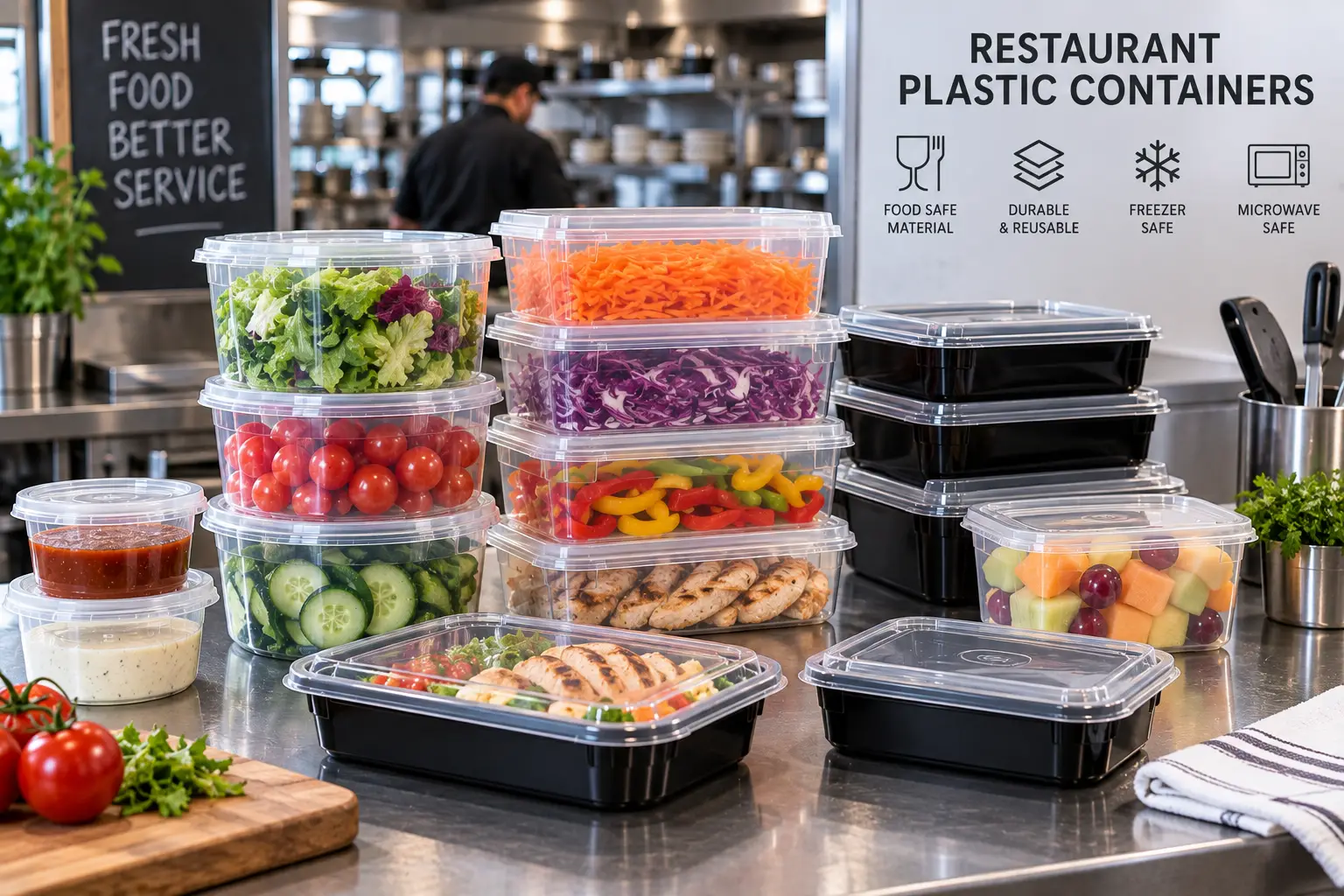
Walk into any walk-in cooler on a Friday night and you’ll see the same thing: towers of clear squares, stacks of deli cups, and rows of labeled pans. Restaurant plastic containers rarely get the attention a new combi oven does, yet they touch almost every ingredient you buy, prep, hold, and serve. Choose the right restaurant plastic containers and your shelves hold more, your prep cooks move faster, and your health inspector nods instead of frowning. Choose the wrong ones and you’ll spend the year fighting cracked corners, lids that don’t match, and mystery sauces nobody dated.
This guide cuts through the catalog noise. We compared real spec sheets from Cambro, Rubbermaid Commercial Products, Carlisle, Reditainer, and DuraHome, cross-checked them against supplier listings and public FDA guidance, and translated the numbers into plain kitchen language. You won’t find invented “I tested this for six months” stories here. Instead, you’ll get honest analysis of what each container is built to do, where it shines, and where it falls short, so you can spend your budget once and spend it well.
What Are Restaurant Plastic Containers?
Restaurant plastic containers are food-safe storage vessels, usually made of polycarbonate, polypropylene, or polyethylene, designed for commercial kitchens. They typically feature measurement graduations, stackable shapes, commercial-dishwasher durability, and certification to sanitation standards such as NSF/ANSI 2, so operators can store, portion, cool, and transport food safely at scale.
That short definition hides a lot of nuance. Polycarbonate is prized for glass-like clarity and impact strength, while polypropylene trades some clarity for flexibility, chemical tolerance, and a lower price. Knowing which plastic is in your hand is the first step toward containers that actually last, and it shapes every recommendation below.
Quick Comparison: 7 Restaurant Plastic Containers at a Glance
| Product | Material | Capacity | Temperature range (per listings) | Best for |
|---|---|---|---|---|
| Cambro CamSquares Classic 6SFSCW135 | Polycarbonate | 6 qt | -40°F to 210°F | All-around prep and bulk storage |
| Rubbermaid Commercial Space Saving Square FG630600CLR | Polycarbonate | 6 qt | -40°F to 212°F | Squeezing more onto tight shelves |
| Carlisle StorPlus Round 1076407 | Polycarbonate | 4 qt | Check listing for your version | Soups, stocks, and whisked liquids |
| Cambro Camwear 64CW135 Food Pan (6-Pack) | Polycarbonate | 1.6 qt (1/6 size, 4″ deep) | -40°F to 210°F | Prep tables and make lines |
| Rubbermaid Commercial FG330900CLR Food/Tote Box | Polycarbonate | 3.5 gal (18″ x 12″ x 6″) | Freezer- and dishwasher-safe | Proteins and bulk produce |
| Reditainer Extreme Freeze 32 oz Deli Containers | Modified polypropylene blend | 32 oz | Down to -40°F (brand claim) | Repeated freezing of batch items |
| DuraHome 32 oz Deli Containers (24-Pack) | Polypropylene | 32 oz | Freezer- and microwave-safe | Budget sauces, soups, and to-go |
Looking at the table, the first five picks are “infrastructure” containers you buy once and use for years, while the two deli-cup options are closer to semi-disposable workhorses. The Cambro CamSquares Classic 6SFSCW135 and the Rubbermaid Commercial Space Saving Square FG630600CLR compete head-to-head, so your tiebreaker is usually lid strategy and which brand your kitchen already stocks. If freezing is central to your operation, notice that only the Reditainer Extreme Freeze 32 oz Deli Containers is specifically engineered for deep-freeze cycles among the budget options.
One more pattern worth flagging: the temperature column matters more than most buyers think. A polypropylene container rated from roughly freezing up to around 170°F behaves very differently in a blast chiller than polycarbonate rated to -40°F. Match the rating to your real workflow, not to the photo on the listing.
💬 One click helps other shoppers make an informed choice too! Tap a highlighted product to check current pricing and availability. 😊
Top 7 Restaurant Plastic Containers for 2026: Expert Analysis
Each pick below was chosen to cover a different job in a commercial kitchen, from entry-level deli cups to rack-sized polycarbonate totes. For every product, you’ll find what the specs mean in practice, who it suits, what real buyer feedback we could verify, and an honest value verdict.
1. Cambro CamSquares Classic 6SFSCW135 — best all-around square workhorse
If you could stock only one container style, a mid-size clear polycarbonate square like this covers the most ground. The 6-quart body measures about 8-3/8″ x 8-3/8″ x 7-1/4″, which means it slides into standard reach-in shelving with room to stack, and its square footprint wastes far less shelf than a round of the same volume. Red graduations are molded in, so a line cook can confirm there’s enough pico for service without prying off a lid. The polycarbonate is rated from -40°F to 210°F, which covers everything from cold prep to warm sauces headed for the cooler.
Based on comparing the specs, this is the pick for full-service and fast-casual kitchens that want one system for brining, batching dressings, and holding diced produce. Its real edge over cheaper polypropylene is rigidity: a full container doesn’t bow when you grab it by the rim. What most buyers overlook is that Cambro’s FreshPro line isn’t interchangeable with the Classic line, so buy lids from the matching series.
Customer reviews we found on WebstaurantStore’s listing praise these containers for surviving drops and for accurate, easy-to-read markings; beyond that, we couldn’t verify a broad enough review pool to summarize with confidence.
Pros:
- ✅ Crystal-clear walls make inventory checks instant
- ✅ Square shape uses shelf space efficiently
- ✅ Wide temperature rating suits most kitchen tasks
Cons:
- ❌ Lids are sold separately in most listings
- ❌ FreshPro and Classic parts don’t mix
At the time of writing, a single container typically lands in the $15–$30 range depending on seller and pack size; check the current price, but for daily-use polycarbonate, the value is strong.
2. Rubbermaid Commercial Space Saving Square FG630600CLR — smartest lid strategy on the list
This 6-quart square is Rubbermaid’s direct answer to Cambro, and its biggest win is logistics rather than raw toughness. Rubbermaid says these containers store up to 25% more on a shelf than rounds in the same footprint; treat that as a manufacturer figure, but the geometry behind it is sound. Graduations appear in red for quarts and blue for liters, which is handy if your recipes come from different sources. The break-resistant polycarbonate is listed for -40°F to 212°F, and the containers nest when empty, so your dry storage doesn’t turn into a plastic avalanche.
Here’s what to weigh: Rubbermaid sells one large lid that fits its 2, 4, 6, and 8-quart squares. In practice, that means fewer lid sizes to hunt for during a hectic close, and that alone can justify choosing this system if you run several sizes. The listing also notes certification to NSF Standard #2 and support for HACCP compliance, which matters when an inspector asks about your storage program.
We couldn’t verify a large, consistent body of customer reviews for this exact model, so we’re leaning on the spec sheet here. What the specs do confirm is a close match to the Cambro CamSquares Classic 6SFSCW135 in capacity and temperature tolerance.
Pros:
- ✅ One lid size covers four container sizes
- ✅ Dual quart and liter graduations aid portioning
- ✅ Nests compactly when not in use
Cons:
- ❌ Lid purchased separately adds to startup cost
- ❌ Rounded corners slightly reduce usable volume
Expect roughly $15–$30 per container at the time of writing, with multi-packs priced higher; for kitchens juggling several sizes, the lid savings make it excellent value.
3. Carlisle StorPlus Round 1076407 — best for liquids and ladling
Round containers get dismissed as shelf hogs, but for soups, stocks, and anything you whisk or ladle, they’re the better tool. This 4-quart clear polycarbonate round has a smooth, “spoonable” interior bottom, meaning a spatula or ladle can reach every last ounce instead of leaving product trapped in corners. Carlisle also prints a labeling area on the exterior for contents, date, and days of the week, which nudges your team toward consistent date marking without extra supplies.
The detail that sets Carlisle apart is lid compatibility: according to supplier listings, Carlisle lids fit across its polypropylene, polyethylene, and polycarbonate containers of the same size. That lets you mix premium polycarbonate for high-traffic items with cheaper polypropylene for dry goods, without buying a second lid system. On paper, it’s the most flexible ecosystem here.
One caution: Carlisle’s translucent polypropylene StorPlus rounds are listed for only about 32°F to 170°F, so they’re not freezer containers. If you buy the round line for frozen stocks, stick with the polycarbonate version, and confirm the rating on the listing you’re ordering. We couldn’t verify enough reviews of this specific model to summarize buyer sentiment honestly.
Pros:
- ✅ Spoonable bottom reduces waste on liquids
- ✅ Printed label area supports date control
- ✅ Lids cross-fit other Carlisle materials
Cons:
- ❌ Round footprint uses more shelf space
- ❌ Polypropylene versions aren’t freezer-rated
Typically in the $10–$20 range per container at the time of writing, it’s a smart, affordable add-on for soup-heavy menus.
4. Cambro Camwear 64CW135 Food Pan (6-Pack) — the prep-table specialist
Not every container lives on a shelf; many live in the rail of a sandwich or pizza prep table, and that’s where this 1/6-size, 4-inch-deep pan earns its place. Each pan holds about 1.6 quarts, and a uniform 1/2″ flange lets it seat cleanly in standard prep units and food bars. The textured bottom resists scratching, and Cambro rates the polycarbonate from -40°F to 210°F, so the same pan can go from freezer to cold line.
Based on comparing the specs, the big advantage over stainless steel 1/6 pans is that polycarbonate won’t dent, bend, or rust, and the clear walls show staff exactly how much sliced tomato is left before a rush. The large-radius inner corners also mean less product clinging to the edges, which quietly improves yield over hundreds of shifts. The trade-off is heat: these standard Camwear pans top out around 210°F, so they’re not for hot holding in a steam table, where you’d want high-heat pans or stainless.
Supplier listings describe these pans as stackable without wedging, which matters more than it sounds when you’re pulling one from a stack with wet gloves. We couldn’t verify a broad review consensus for the 6-pack specifically.
Pros:
- ✅ Fits standard prep tables and food bars
- ✅ Won’t dent or rust like thin stainless
- ✅ Clear walls speed up mid-service restocking
Cons:
- ❌ Not suitable for steam-table hot holding
- ❌ Lids are a separate purchase
At the time of writing, a six-pack generally falls in the $40–$75 range; for any kitchen with a prep rail, it’s a high-value purchase.
5. Rubbermaid Commercial FG330900CLR Food/Tote Box — built for bulk proteins and produce
When a 6-quart square isn’t enough, you step up to a food box. This 3.5-gallon clear polycarbonate tote measures 18″ x 12″ x 6″, an industry-standard footprint designed to fit existing racks and counters. Ridges on the bottom let it lock onto boxes below when a compatible lid is used, and date-control panels on the box help you run first-in, first-out rotation without hunting for tape. It’s listed as freezer-safe and commercial-dishwasher-safe, and supplier listings note it was made in the USA with NSF certification.
Who is it for? Kitchens that break down whole cases of chicken, marinate large batches, or hold washed greens by the bushel. The shallow 6-inch depth is a feature, not a limitation: shallower product cools faster and is easier to reach into. Rubbermaid also markets this box as part of its ProSave system with an optional dual-action lid and claims productivity gains of up to 65%; that’s a manufacturer figure we couldn’t independently verify, so treat it as a best-case estimate.
We didn’t find a large enough pool of verifiable customer reviews to summarize sentiment fairly. The spec sheet, however, makes the use case clear: this is a storage-and-transport box, not a serving vessel.
Pros:
- ✅ Standard size fits most commercial racks
- ✅ Interlocking ridges keep stacks stable
- ✅ Shallow profile helps food cool faster
Cons:
- ❌ Lid is sold separately
- ❌ Too bulky for small reach-in coolers
Expect roughly $25–$45 for the box alone at the time of writing; for high-volume protein prep, the durability makes it good long-term value.
6. Reditainer Extreme Freeze 32 oz Deli Containers — the freezer-cycle champion
Standard deli cups are cheap and handy, but they have a weakness most buyers only discover after a freezer full of cracked lids. Reditainer’s Extreme Freeze line uses a polypropylene blend with added modifiers that the brand says withstands temperatures down to -40°F for extended periods without turning brittle. The brand also states that ordinary polypropylene containers can become brittle and crack over time when frozen well below 32°F, which lines up with how the material generally behaves.
In practice, that makes these quart cups the pick for banking stocks, sauces, and par-cooked components in the freezer. Interestingly, Reditainer’s own listing is candid that its regular containers are a bit cheaper and still microwave- and dishwasher-safe, but are not the best choice for repeated, long freezing. That kind of honesty is useful: if your cups never see the freezer, you don’t need to pay for the upgrade.
We couldn’t verify a broad, consistent body of customer reviews for this specific pack, so the freezer claims above are the brand’s, not independent test results. Label them and watch how they perform in your own deep freeze.
Pros:
- ✅ Engineered for repeated deep-freeze cycles
- ✅ Uniform quart size simplifies stacking
- ✅ Clear enough to identify contents quickly
Cons:
- ❌ Costs more than standard deli cups
- ❌ Thinner walls than rigid polycarbonate
At the time of writing, a 24-pack typically sells in the $25–$45 range; if you freeze weekly, the reduced breakage makes it worth it.
7. DuraHome 32 oz Deli Containers (24-Pack) — best budget pick for sauces and to-go
Sometimes you just need a stack of reliable quart cups that won’t blow the supply budget. DuraHome’s 24-pack uses BPA-free polypropylene and is listed as microwave-safe, freezer-safe, and top-rack dishwasher-safe. The lids are interchangeable across DuraHome’s deli sizes, so a mixed stock of 8, 16, and 32-ounce cups still uses one lid, which is a small detail that saves real time on a cluttered line.
These fit smaller cafés, food trucks, and family-meal programs that send soups home with staff or customers. Based on comparing the specs, they’re best treated as semi-disposable: great for sauces, dressings, and prepped mise en place, but not a replacement for rigid polycarbonate on heavy daily rotation. The listing advises venting or removing the lid in the microwave and recommends the top rack in a dishwasher, both signs that these are lighter-duty than commercial squares. The listing we reviewed also doesn’t mention NSF certification, so check with your local health department before building a whole commercial storage program around them.
DuraHome advertises a replacement guarantee if something goes wrong, but we couldn’t verify a large enough pool of reviews to summarize real-world durability.
Pros:
- ✅ Very low cost per container
- ✅ One lid size fits multiple cup sizes
- ✅ Microwave-, freezer-, and dishwasher-friendly
Cons:
- ❌ No NSF certification noted on listing reviewed
- ❌ Not built for heavy commercial dish cycles
Generally in the $15–$30 range for 24 at the time of writing, it’s the best cost-per-container value here for light-duty jobs.
Top 7 Compared: Price Range, Standout Feature, and Trade-Off
| Product | Approx. price range* | Standout feature | Main trade-off | Best for |
|---|---|---|---|---|
| Cambro CamSquares Classic 6SFSCW135 | $15–$30 each | Rigid, clear, wide temp range | Lids sold separately | Cambro CamSquares Classic 6SFSCW135 for all-around prep |
| Rubbermaid Commercial Space Saving Square FG630600CLR | $15–$30 each | One lid fits 2–8 qt | Lid adds startup cost | Rubbermaid Commercial Space Saving Square FG630600CLR for multi-size systems |
| Carlisle StorPlus Round 1076407 | $10–$20 each | Spoonable bottom, cross-fit lids | Shelf-hungry round shape | Carlisle StorPlus Round 1076407 for soups and stocks |
| Cambro Camwear 64CW135 Food Pan (6-Pack) | $40–$75 per 6 | Fits prep rails, won’t dent | Not for hot holding | Cambro Camwear 64CW135 Food Pan (6-Pack) for make lines |
| Rubbermaid Commercial FG330900CLR Food/Tote Box | $25–$45 each | Rack-standard 18″ x 12″ | Bulky for small coolers | Rubbermaid Commercial FG330900CLR Food/Tote Box for bulk proteins |
| Reditainer Extreme Freeze 32 oz Deli Containers | $25–$45 per 24 | Deep-freeze resistant blend | Pricier than basic cups | Reditainer Extreme Freeze 32 oz Deli Containers for freezer banking |
| DuraHome 32 oz Deli Containers (24-Pack) | $15–$30 per 24 | Lowest cost per unit | Light-duty build | DuraHome 32 oz Deli Containers (24-Pack) for budget to-go |
*Prices vary by seller, pack size, and date; check the current price before ordering.
Reading across the table, the polycarbonate picks cost more per unit but are built to survive years of commercial dish cycles, while the deli cups win on cost per container but wear out faster. The Rubbermaid Commercial Space Saving Square FG630600CLR edges out the Cambro CamSquares Classic 6SFSCW135 only if you value the universal lid; otherwise, it comes down to brand preference and what’s already in your kitchen. Budget-conscious buyers should pair a few rigid squares with a stack of DuraHome 32 oz Deli Containers (24-Pack) rather than buying a full set of either.
✨ Build a container system that works as hard as your crew!
🔍 Take your kitchen organization to the next level with this carefully curated lineup. Click a highlighted product to check current pricing and availability. These picks will help you store more, waste less, and pass inspections with confidence!
Getting Started: Setting Up Restaurant Food Storage Containers in Your First 30 Days
Buying new restaurant food storage containers is the easy part; getting a whole team to use them the same way is where most kitchens stumble. Here’s a practical rollout plan.
Week 1 — Standardize sizes. Pick two or three core sizes rather than eight. For most kitchens, a 2-quart, a 6-quart, and a food box cover about everything. Fewer sizes mean fewer lids, fewer mismatches, and faster closing.
Week 2 — Assign zones. Decide which containers live where. For example, 1/6 pans like the Cambro Camwear 64CW135 Food Pan (6-Pack) stay on the prep rail, squares hold backup mise en place in the walk-in, and the Rubbermaid Commercial FG330900CLR Food/Tote Box handles raw proteins on the lowest shelf.
Week 3 — Lock in labeling. Every container gets a label with contents, prep date, and discard date. Dissolvable labels save scrubbing time and keep sticky residue off your graduations.
Week 4 — Audit and adjust. Walk the cooler at close. Are lids missing? Are containers overfilled? Are round containers eating shelf space? Adjust your order before buying more.
🧽 Maintenance tip: Many polycarbonate manufacturers caution against harsh, highly alkaline cleaners and abrasive pads, which can cloud or craze the surface over time. Stick to recommended detergents, and air-dry containers inverted with lids off so moisture doesn’t linger.
⚠️ Common first-month mistake: Nesting containers while still wet. Trapped water breeds odors and can leave spots that make clear plastic look dirty even when it isn’t.
Real-World Scenarios: Matching Containers to Your Kitchen
Specs only matter in context, so here are three realistic profiles and the containers that fit them best.
🍕 Profile 1: The neighborhood pizzeria. Budget: around $300 to start. Daily use: heavy, with a prep rail running all shift. This kitchen lives on 1/6 pans, so a couple of six-packs of the Cambro Camwear 64CW135 Food Pan (6-Pack) anchor the setup. Add a handful of Cambro CamSquares Classic 6SFSCW135 containers for dough ingredients and sauce backups. Why? The pans fit the rail natively, and the squares keep walk-in shelves tidy.
🍜 Profile 2: The soup-and-sandwich café. Budget: $150 to $250. Daily use: moderate, with big batches of stock and soup made twice a week. Here, the Carlisle StorPlus Round 1076407 handles cooling and ladling, while the Reditainer Extreme Freeze 32 oz Deli Containers bank soup portions in the freezer. The round containers make whisking and scooping easy, and the freeze-rated cups prevent the cracked-lid problem that plagues cheap deli cups.
🚚 Profile 3: The food truck. Budget: under $150. Daily use: intense, but space is brutally limited. The Rubbermaid Commercial Space Saving Square FG630600CLR in a couple of sizes, all sharing one lid, keeps the tiny reach-in organized. A stack of DuraHome 32 oz Deli Containers (24-Pack) covers sauces and staff meals. The logic: every square inch counts, and one lid size means nothing gets lost in a cramped truck.
Notice the pattern: each kitchen mixes one rigid “system” container with one flexible, low-cost option. That hybrid approach usually beats going all-in on either extreme.
Problem → Solution: Fixing the 5 Most Common Container Headaches
Problem 1: Lids never match. Solution: Standardize on a system with shared lids. The Rubbermaid Commercial Space Saving Square FG630600CLR uses one lid across four sizes, and Carlisle lids cross-fit its materials of the same size.
Problem 2: Deli cups crack in the freezer. Solution: Switch freezer-bound items to the Reditainer Extreme Freeze 32 oz Deli Containers, and keep standard cups for refrigerated use only.
Problem 3: Hot food won’t cool fast enough. Solution: Stop cooling stock in deep containers. Divide it into shallow pans or the 6-inch-deep Rubbermaid Commercial FG330900CLR Food/Tote Box, leave lids off or loosely vented while cooling, and use an ice wand.
Problem 4: Shelves are overflowing. Solution: Replace rounds with squares for dry goods and cold prep. Square containers generally use shelf area more efficiently, which is exactly why the Cambro CamSquares Classic 6SFSCW135 and its Rubbermaid rival exist.
Problem 5: Containers look cloudy and “dirty.” Solution: Review your detergent and scrubbing tools. Harsh chemicals and abrasive pads are a frequent culprit on polycarbonate; switch to manufacturer-approved cleaners and soft sponges, and retire badly scratched containers, since scratches can harbor residue.
How to Choose Restaurant Plastic Containers
Use these seven steps as a quick decision checklist before you order.
- Map your workflow first. List where food actually lives: prep rail, walk-in, freezer, dry storage. Each zone may need a different container type.
- Match the material to the temperature. Polycarbonate handles freezer-to-warm use; many polypropylene lines are rated only from about freezing to 170°F.
- Look for sanitation certification. Containers certified by NSF International to food equipment standards give inspectors confidence and signal food-safe, cleanable design.
- Prioritize shape by job. Squares save shelf space; rounds excel for liquids you stir or ladle.
- Plan your lid strategy. Shared lids across sizes cut chaos and replacement costs.
- Check graduations. Molded-in markings in quarts and liters speed portioning and inventory counts.
- Budget for replacements. Deli cups wear out quickly, so price them as a recurring supply rather than a one-time buy.
Polycarbonate Food Storage Containers vs Polypropylene and Polyethylene
Polycarbonate food storage containers are the “glass-look” option: rigid, clear, and highly impact-resistant, which is why the Cambro CamSquares Classic 6SFSCW135 and Rubbermaid Commercial Space Saving Square FG630600CLR use it. Their downside is cost, plus sensitivity to harsh cleaners that can cause clouding over time.
Polypropylene is translucent rather than clear, more flexible, and usually cheaper. It’s the material behind most deli cups, including the DuraHome 32 oz Deli Containers (24-Pack). Standard polypropylene can grow brittle in deep freeze, which is exactly the gap the Reditainer Extreme Freeze 32 oz Deli Containers targets with its modified blend.
Polyethylene, often white or colored, is tough, chemical-tolerant, and common in lids and opaque food boxes, but you lose the ability to see contents at a glance.
What about BPA? Polycarbonate is made with bisphenol A, and many buyers ask whether that matters. The FDA’s BPA Q&A page states that currently approved uses of BPA in food containers are considered safe, while noting that the agency continues to review new research. If your customers prefer BPA-free storage, polypropylene lines offer an easy alternative.
Restaurant Plastic Containers vs Stainless Steel and Glass
| Factor | Plastic (PC/PP) | Stainless steel | Glass |
|---|---|---|---|
| Visibility | Excellent (PC) to good (PP) | None | Excellent |
| Break/dent resistance | High; no denting | Dents but won’t shatter | Can shatter |
| Weight and cost | Lightest; low to moderate | Heavier; moderate to high | Heaviest; moderate |
The table shows why restaurant plastic containers dominate cold storage: they combine visibility, low weight, and break resistance better than either alternative. Stainless steel still wins for steam-table hot holding, where products like the Cambro Camwear 64CW135 Food Pan (6-Pack) aren’t designed to go, and glass remains niche in commercial kitchens because breakage is a real food safety risk. The smart move for most operators is plastic for cold storage and prep, stainless for hot holding.
Deli Containers with Lids: The Unsung Workhorse
Deli containers with lids are the duct tape of professional kitchens. Cooks use them for sauces, dressings, garnishes, family meal, and grab-and-go portions, and their uniform diameter means one lid often fits several heights.
The key buying decision is freezer use. If your deli containers with lids stay in the refrigerator, a budget pack like the DuraHome 32 oz Deli Containers (24-Pack) is hard to beat on cost. If they cycle through the freezer every week, the Reditainer Extreme Freeze 32 oz Deli Containers is designed to resist the brittleness that makes ordinary cups crack.
A few practical habits make deli cups last longer: don’t overfill before freezing, since liquids expand; vent lids when reheating; and retire any cup with a warped rim, because a lid that doesn’t seal fully invites leaks and cross-contamination. Treat them as consumables and budget accordingly.
Commercial Food Storage Containers for Small Restaurants, Food Trucks, and Caterers
Commercial food storage containers aren’t only for large kitchens. Small operators arguably need them more, because every square inch and every dollar matters.
Small restaurants should build around one square system plus a few food boxes. The Cambro CamSquares Classic 6SFSCW135 handles daily prep, while the Rubbermaid Commercial FG330900CLR Food/Tote Box stores bulk proteins on the bottom shelf.
Food trucks benefit most from nesting and shared lids, which makes the Rubbermaid Commercial Space Saving Square FG630600CLR a natural fit.
Caterers transport food constantly, so rigid polycarbonate that won’t crack when bumped is worth the premium. Pair it with inexpensive deli cups for sauces and sides that travel to client sites and may not come back.
Whatever your size, buy commercial food storage containers with a clear labeling area or pair them with dissolvable labels; consistent labeling is what turns containers into a real storage system.
Safety, Regulations, and Standards
Containers don’t just organize food; they’re part of your food safety plan. The FDA Food Code, which many states adopt as the basis for their retail food rules, sets expectations that directly affect how you use storage containers.
Three rules matter most in daily practice. First, date marking: ready-to-eat, time/temperature control for safety (TCS) food held longer than 24 hours generally must be marked and used within seven days when held at 41°F or below. Second, cooling: cooked food must drop from 135°F to 70°F within two hours and to 41°F within six hours total, which is why shallow containers matter. Third, storage order: raw proteins go below ready-to-eat foods to prevent drips.
Also check for NSF certification on anything used commercially, and note that some polycarbonate listings carry a California Proposition 65 warning. Your local health department has the final word, so confirm requirements in your state.
Long-Term Cost and Maintenance
The cheapest container isn’t always the least expensive one to own. Here’s how the main classes compare over time.
| Container class | Upfront cost | Durability in commercial use | Best for |
|---|---|---|---|
| Budget deli cups (e.g., DuraHome 32 oz Deli Containers (24-Pack)) | Very low | Short; replace often | Sauces, to-go, family meal |
| Freeze-rated deli cups (e.g., Reditainer Extreme Freeze 32 oz Deli Containers) | Low | Moderate in freezer use | Freezer banking |
| Polycarbonate squares and pans (e.g., Cambro CamSquares Classic 6SFSCW135) | Moderate to high | Long with proper care | Daily prep and storage |
The takeaway is simple: rigid polycarbonate costs more on day one but usually wins on cost per year of service, while deli cups are a recurring expense you should track monthly. Replacing cracked, cloudy, or warped containers promptly also protects you from failed seals and inspection write-ups, which cost far more than the containers themselves.
Common Mistakes to Avoid When Buying Restaurant Plastic Containers
❌ Buying too many sizes. More sizes mean more lids and more confusion. Start with two or three.
❌ Ignoring temperature ratings. Polypropylene rated to about 170°F isn’t the right choice for hot liquids, and standard deli cups may crack in deep freeze.
❌ Forgetting lids in the budget. Many restaurant plastic containers ship without lids, so the “cheap” container can double in cost.
❌ Choosing rounds for dry storage. Squares make better use of shelf space for flour, sugar, and prepped produce.
❌ Skipping certification. For commercial use, NSF-certified options save headaches during inspections.
❌ Mixing incompatible lines. Cambro FreshPro and Classic parts don’t interchange, for example, so read compatibility notes before ordering.
FAQ About Restaurant Plastic Containers
❓ Where can I buy restaurant plastic containers in bulk?
❓ Are Cambro containers worth the extra money?
❓ Can restaurant plastic containers go in the freezer?
❓ Do I need NSF-certified containers for my restaurant?
❓ How often should I replace plastic food containers?
Conclusion: Choosing Restaurant Plastic Containers That Pay Off
The right restaurant plastic containers won’t make headlines, but they quietly shape how fast your team preps, how much food you waste, and how smoothly your inspections go. For most kitchens, the winning formula is a hybrid: a rigid polycarbonate system like the Cambro CamSquares Classic 6SFSCW135 or the Rubbermaid Commercial Space Saving Square FG630600CLR for daily prep, a rack-sized Rubbermaid Commercial FG330900CLR Food/Tote Box for proteins, and specialized pieces where your menu demands them.
Soup-heavy kitchens should add the Carlisle StorPlus Round 1076407, prep-rail operations need the Cambro Camwear 64CW135 Food Pan (6-Pack), and freezer-focused teams will appreciate the Reditainer Extreme Freeze 32 oz Deli Containers. If you’re on a tight budget, the DuraHome 32 oz Deli Containers (24-Pack) keeps sauces and to-go orders covered without straining cash flow.
Start small, standardize your sizes, label everything, and let your workflow, not a catalog photo, drive every purchase.
🚀 Ready to upgrade your kitchen storage?
🔍 Take your food prep to the next level with this carefully curated lineup. Click a highlighted product to check current pricing and availability. These picks will help you run a cleaner, faster, better-organized kitchen your whole crew will appreciate!
Recommended for You
- 1 Cup Glass Containers With Lids: 7 Best Picks for 2026
- WW Lunches: 7 Best Products to Nail Your Points in 2026
- Take Out Trays: 7 Best Picks for 2026 (Pros & Cons)
Disclaimer: This post contains affiliate links. As an Amazon Associate, I earn from qualifying purchases made through these links, at no additional cost to you.
✨ Found this article helpful? Share it with someone who needs it! 💬🤗