
In This Article
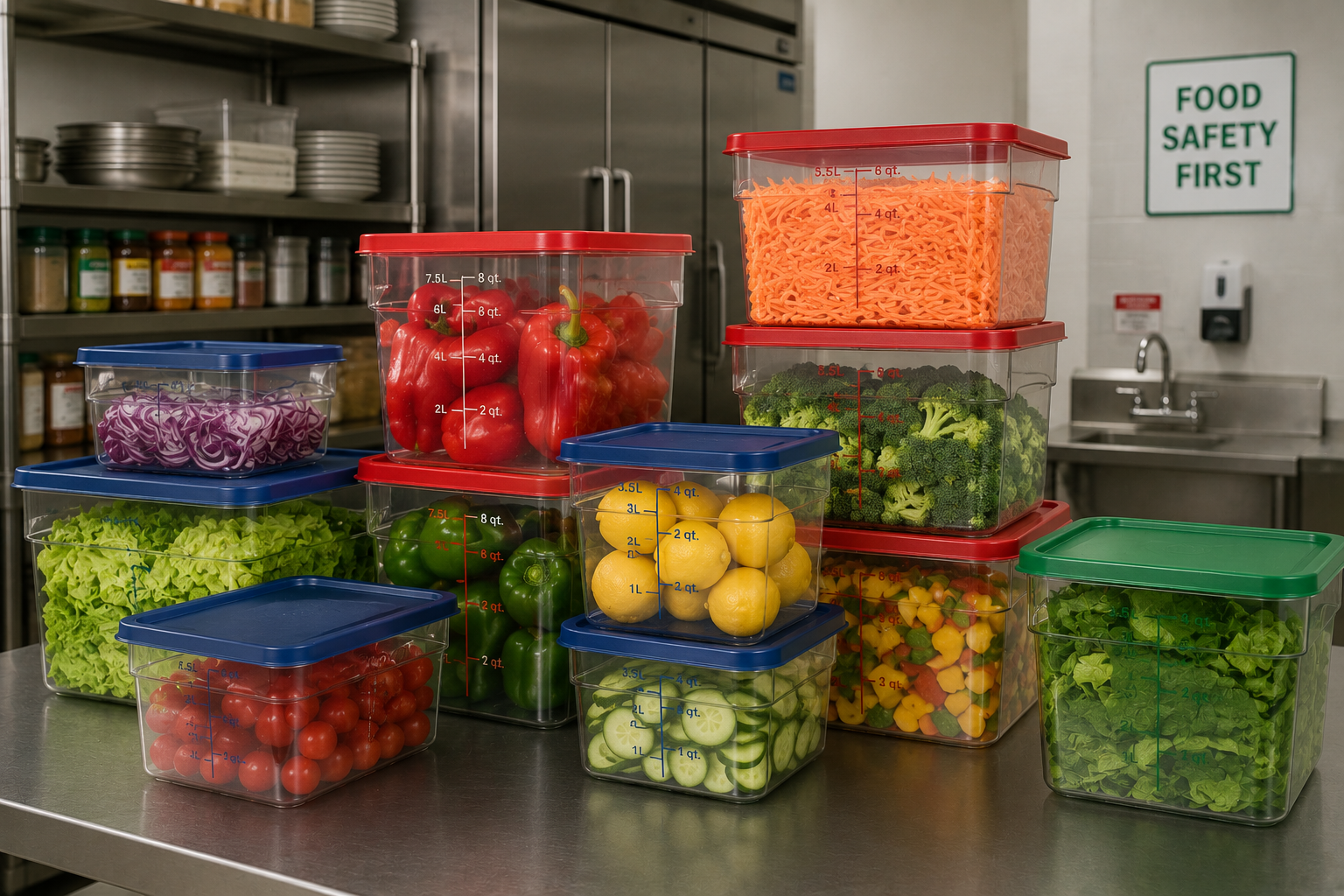
If you’ve ever pulled a lid-less container out of the walk-in cooler at 6 a.m. and lost ten minutes hunting for a match, you already know why commercial food storage containers matter more than almost any other back-of-house purchase. Commercial food storage containers are NSF-listed plastic or polycarbonate boxes, bins, and totes built to hold raw ingredients, prepped food, and leftovers safely between -40°F and 210°F, and they’re engineered to stack, nest, and seal in ways ordinary kitchen containers simply aren’t…
That distinction sounds small until you’re running a line during a Friday rush. Consumer-grade containers crack under repeated dishwasher cycles, warp near the flat-top, and rarely stack cleanly enough to make walk-in shelving efficient. Commercial-grade options are built for that abuse from day one, and they’re required by most local health codes — a point the FDA’s model Food Code addresses directly when it comes to food-contact surfaces and contamination prevention.
This guide breaks down seven real, currently available commercial food storage containers with lids — from budget multi-packs to mobile ingredient bins — along with honest analysis of who each one is actually for. We’ll also cover NSF certification, restaurant food storage container sizing, stackable commercial food storage containers for tight walk-ins, and the mistakes that quietly cost operators money. As an Amazon Associate, this post contains affiliate links, and we may earn a commission on qualifying purchases at no extra cost to you.
What Are Commercial Food Storage Containers, Really?
Commercial food storage containers are food-grade, NSF-certified containers made from polycarbonate, polypropylene, or high-density polyethylene, designed to withstand daily commercial dishwashing, temperature swings from freezer to line, and constant stacking. Unlike home containers, they’re built around standardized capacities (quarts and gallons) so lids, shelving, and labeling systems are interchangeable across an entire kitchen.
That standardization is the real value. A restaurant food storage container system only works if every cook can grab a 6-quart lid and know it fits every 6-quart base in the building — home containers rarely offer that consistency.
Quick Comparison: 7 Commercial Food Storage Containers at a Glance
| Container | Capacity | Shape/Material | Price Range | Best For |
|---|---|---|---|---|
| Cambro CamSquares 6SFSCW135 | 6 qt | Square polycarbonate | Around $10-$15 | All-purpose prep line storage |
| CURTA 8-Pack Square Containers | 8 qt (×8) | Square polycarbonate | Around $60-$80 | Budget color-coded multi-packs |
| Rubbermaid Commercial Space Saver 632200 | 22 qt | Square polycarbonate | Around $25-$35 | Maximizing walk-in shelf space |
| Carlisle StorPlus 1076807 | 18 qt | Round polycarbonate | Around $20-$25 | Stacking soups, sauces, stocks |
| Cambro Camwear RFSCW12135 | 12 qt | Round polycarbonate | Around $15-$20 (lid separate) | Portability and easy stirring access |
| Winco IB-2S Ingredient Bin | 2 gal (40 cup) | Square shelf bin with scoop | Around $20-$30 | Dry-goods FIFO rotation |
| Rubbermaid Commercial ProSave FG360288WHT | 3.5 cu ft | Mobile ingredient bin with wheels | Between $150 and $220 | High-volume bulk ingredient storage |
Looking at the table above, the Cambro CamSquares 6SFSCW135 and Carlisle StorPlus 1076807 cover the everyday prep-line workload most kitchens need first, while the Rubbermaid Commercial ProSave FG360288WHT justifies its higher price only once you’re moving 25+ pounds of a single dry ingredient per week. Budget-focused operators should start with the CURTA 8-Pack for color-coded compliance without the per-unit cost of name-brand square containers, then add specialty pieces like the Winco IB-2S as specific stations demand them.
💬 One click helps other shoppers make an informed choice too! 😊
Top 7 Commercial Food Storage Containers: Expert Analysis
1. Cambro CamSquares 6SFSCW135 — the professional-kitchen standard
There’s a reason this container shows up in nearly every commercial kitchen photo you’ve ever seen: it’s the default choice, and for good reason. The 6-quart square design measures roughly 8-3/8″ x 8-3/8″ x 7-1/4″, made from crystal-clear polycarbonate that resists staining from oils, acids, and sauces. Molded-in graduation marks let cooks eyeball volume during batch prep without pulling out a measuring cup, and the square footprint uses about a third more shelf space than an equivalent round container.
Based on comparing the specs against competing square containers, what sets the Cambro CamSquares 6SFSCW135 apart is its wide temperature tolerance (-40°F to 210°F), which means the same container goes from blast chiller to steam table without cracking — something cheaper polypropylene alternatives can’t always claim. It’s the right pick for kitchens standardizing on one shape and size across every station, from prep to walk-in to line.
Reviews consistently report that the polycarbonate resists yellowing and scratching far longer than off-brand equivalents, even after hundreds of dishwasher cycles, though a few buyers note the snap-on lids (sold separately) require a firm press to fully seal.
Pros:
- ✅ NSF-listed and rated for both freezer and steam-table temperatures
- ✅ Square shape stacks and stores more efficiently than round bins
- ✅ Graduation marks speed up portioning and inventory checks
Cons:
- ❌ Lids are sold separately, adding to the total cost
- ❌ Clear polycarbonate shows minor scuffing over years of heavy use
Priced around $10-$15 per container at the time of writing (check the current price before ordering), the Cambro CamSquares 6SFSCW135 delivers strong long-term value for kitchens that will use it daily for years.
2. CURTA 8-Pack Square Containers — best value for color-coded compliance
For operators outfitting a new kitchen or replacing a full color-coded set at once, buying eight matched containers together beats piecing together singles from multiple brands. Each 8-quart unit measures about 8-1/2″ x 8-1/2″ x 9″ and ships with a colored polypropylene lid, red in this configuration, letting kitchens assign specific colors to allergen zones or raw-protein stations.
What most buyers overlook with multi-packs like this is that the per-unit cost usually undercuts buying name-brand containers individually by a meaningful margin, while still carrying full NSF certification. The CURTA 8-Pack is built for operations that need volume fast — new restaurant openings, catering companies scaling up, or kitchens standardizing color-coding across a whole shift — rather than kitchens buying one or two replacement pieces.
Aggregated customer feedback on this line points to strong satisfaction with the built-in date indicator on the base, which helps with FIFO labeling without needing tape, though some buyers mention the graduation markings are harder to read than on premium-tier competitors.
Pros:
- ✅ Eight matched containers and lids for one consistent system
- ✅ Built-in date indicator supports FIFO rotation
- ✅ NSF-listed polycarbonate at a lower per-unit cost
Cons:
- ❌ Graduation markings are less crisp than premium competitors
- ❌ Bulk packaging means less flexibility if you only need a few
At around $60-$80 for the full 8-pack (prices may vary), the CURTA 8-Pack is one of the smartest ways to outfit a color-coded system without a premium-brand budget.
3. Rubbermaid Commercial Space Saver 632200 — most shelf-efficient large-format container
Walk-in cooler space is often the real bottleneck in a commercial kitchen, not counter space, and this container is designed specifically around that constraint. The 22-quart square container measures about 10.5″ x 11.3″ x 14.4″ and is built from break-resistant clear polycarbonate, with Rubbermaid’s signature square profile that the brand states stores up to 25% more volume per square foot of shelving than round containers of equivalent capacity.
Here’s what to weigh: the taller, narrower footprint means it fits standard wire shelving depths better than wide round tubs, which matters enormously if your walk-in is already tight. Reviews consistently report that this container holds up well under repeated stacking loads without warping, a common failure point in cheaper 22-quart alternatives, making it a strong fit for high-volume kitchens storing soups, stocks, or bulk-prepped vegetables.
Pros:
- ✅ Square design maximizes usable shelf space in walk-ins
- ✅ Break-resistant polycarbonate rated to 212°F
- ✅ Precise gradations in red and blue for quick measuring
Cons:
- ❌ Bulkier to lift and carry than smaller containers when full
- ❌ Premium pricing compared to generic 22-quart alternatives
Expect to pay in the $25-$35 range at the time of writing, and the Rubbermaid Commercial Space Saver 632200 earns that premium back quickly in kitchens that are chronically short on cooler shelving.
4. Carlisle StorPlus 1076807 — best stackable round for sauces and soups
Round containers still have a place in commercial kitchens, especially for liquids and semi-liquids where a square corner just traps residue. This 18-quart StorPlus container is built from durable polycarbonate that Carlisle states resists staining, breaking, and chipping, with molded-in capacity markers and a printed labeling surface for writing contents and dates directly on the exterior.
The spec sheet doesn’t say this, but the round shape genuinely does make a practical difference during service: cooks can run a whisk or ladle around the interior without corners catching solids, which speeds up sauce and soup work during a rush. Based on comparing this against square alternatives, the Carlisle StorPlus 1076807 trades some shelf efficiency for better in-use handling, making it the better call for stockpots’ worth of liquid-heavy prep rather than dry or solid ingredients.
Customer reviews frequently highlight the stackable design as compatible with other manufacturers’ round containers of the same capacity, which matters for kitchens with mixed-brand inventories, though a handful of buyers note the walls flex slightly when completely full.
Pros:
- ✅ Smooth round interior speeds up stirring and cleanout
- ✅ Stackable across multiple brands of same-size containers
- ✅ Printed exterior surface for labeling contents and dates
Cons:
- ❌ Round shape uses shelf space less efficiently than square
- ❌ Walls can flex slightly under full liquid loads
At around $20-$25 per unit, the Carlisle StorPlus 1076807 offers solid value specifically for liquid-heavy prep work.
5. Cambro Camwear RFSCW12135 — best round for portability and access
Sometimes a container needs to move — from prep table to line to cooler and back — and this is where Cambro’s classic round Camwear line earns its reputation. The 12-quart container is made from crystal-clear polycarbonate with molded-in handles positioned for a secure two-handed carry, even when full, and it withstands the same -40°F to 210°F range as Cambro’s square line.
What the spec sheet doesn’t fully convey is how much the round shape and handle placement matter for one-person transport during a busy shift; square containers of similar capacity are noticeably more awkward to carry safely when full of liquid. Reviews consistently mention that the molded handles include drainage holes so they dry quickly and don’t trap standing water, a small detail that matters for sanitation compliance during health inspections.
This container is the right call for kitchens where staff regularly move prepped food between stations rather than storing it in one fixed spot on a shelf.
Pros:
- ✅ Molded handles designed for secure one-person carrying
- ✅ Drainage holes in handles prevent standing water
- ✅ Wide temperature range covers freezer to steam table
Cons:
- ❌ Lid sold separately, adding to total system cost
- ❌ Round shape stores less efficiently than square on shelving
Priced around $15-$20 for the container alone, plus roughly $5-$8 for a matching lid, the Cambro Camwear RFSCW12135 is a smart addition anywhere staff carry food between stations regularly.
6. Winco IB-2S Shelf Ingredient Bin — smartest bin for dry-goods FIFO
Loose flour, sugar, rice, and other dry goods need a fundamentally different container than wet prep does, and this is where dedicated ingredient bins outperform standard square or round containers. The Winco IB-2S holds 2 gallons (roughly 40 cups) and includes a scoop with a dedicated clip, keeping the scoop off countertops and out of direct contact with prep surfaces — a detail that matters for sanitation audits.
What most buyers overlook with generic storage containers is that dry goods rotate faster and more visibly when stored in a purpose-built bin with a transparent lid you can open one-handed; digging through a stack of square containers for the right ingredient wastes real time during prep. Based on comparing this against improvised storage using leftover square containers, the Winco IB-2S pays for itself in reduced prep-time waste alone within a kitchen doing daily baking or high dry-ingredient turnover.
Aggregated review sentiment describes the wide base and stacking-friendly top as genuinely more stable than competing shelf bins, though a few buyers mention the scoop clip loosens with heavy daily use and eventually needs replacing.
Pros:
- ✅ One-handed transparent lid speeds up dry-ingredient access
- ✅ Included scoop clip supports sanitary handling practices
- ✅ Wide base and stacking top save shelf space
Cons:
- ❌ Scoop clip can loosen with sustained daily use
- ❌ Not ideal for wet prep or liquid-heavy ingredients
At around $20-$30, the Winco IB-2S is a targeted, worthwhile upgrade for any station doing consistent dry-goods work.
7. Rubbermaid Commercial ProSave FG360288WHT — best mobile bulk bin for high-volume kitchens
For kitchens moving large volumes of a single dry ingredient — think flour at a bakery or rice at a high-volume Asian concept — a mobile ingredient bin changes the workflow entirely. This 3.5-cubic-foot ProSave bin includes a 32-ounce scoop, a slanted front with a sliding lid for one-handed access, and casters that let staff wheel the entire bin to a mixer or steam table instead of carrying scoopfuls back and forth.
Here’s what to weigh: this is the highest-cost item on this list by a wide margin, and it only makes financial sense once ingredient volume justifies it. What most buyers overlook is that the real return isn’t the container itself, it’s the labor time saved not walking back and forth to a stationary bin dozens of times per shift; for a high-volume bakery or prep kitchen, that adds up fast. The Rubbermaid Commercial ProSave FG360288WHT is a poor fit for a low-volume kitchen storing modest quantities of several different dry goods — a shelf bin like the Winco IB-2S handles that better and far more cheaply.
Reviews consistently praise the mobility and one-handed sliding lid for speeding up high-frequency scooping, while some buyers note the front casters need periodic cleaning to keep rolling smoothly on kitchen floors.
Pros:
- ✅ Mobile casters eliminate repeated trips to a fixed bin
- ✅ Slant front and sliding lid enable true one-handed use
- ✅ Large 3.5-cubic-foot capacity reduces refill frequency
Cons:
- ❌ Significant upfront cost compared to stationary bins
- ❌ Overkill for kitchens with lower single-ingredient volume
Expect a price between $150 and $220 at the time of writing; the Rubbermaid Commercial ProSave FG360288WHT is worth that investment specifically for high-volume, single-ingredient operations, and a poor value otherwise.
Getting Started: Setting Up Your Commercial Food Storage System
Before buying anything, walk your walk-in cooler and dry storage area with a tape measure — shelving depth, not container capacity, is usually the real constraint. Standard wire shelving runs 18″ or 24″ deep, and square containers like the Cambro CamSquares 6SFSCW135 or Rubbermaid Commercial Space Saver 632200 fit that geometry far more efficiently than round containers of equal capacity.
Next, standardize on two or three capacities rather than buying one of everything. Most kitchens do fine with a small size (4-6 qt) for portioned items, a mid-size (12-22 qt) for batch prep, and a dedicated ingredient bin like the Winco IB-2S for dry goods. Buying five different brands in five different sizes creates a lid-matching nightmare within weeks.
Finally, build your color-coding and labeling system before containers arrive, not after. Decide which colors mean raw protein, produce, or allergens, and buy lids to match — a set like the CURTA 8-Pack with lids included makes this step far simpler than sourcing lids separately from a container-only purchase.
Real-World Scenarios: Matching Containers to Your Operation
A small café doing 60 covers a day with a tight walk-in doesn’t need mobile bins or 22-quart tubs; a handful of Cambro CamSquares 6SFSCW135 containers and a CURTA 8-Pack for color-coding covers daily prep, portioning, and next-day storage without wasting cooler space on unused capacity.
A catering company prepping in bulk for weekend events has different math entirely. Batch soups and sauces move fastest into stackable round containers like the Carlisle StorPlus 1076807, while the Rubbermaid Commercial Space Saver 632200 handles overflow bulk-prepped vegetables that need to fit efficiently into a rented or shared cooler space, where every inch of shelving counts.
A high-volume bakery running through 50-plus pounds of flour weekly is the clearest case for the Rubbermaid Commercial ProSave FG360288WHT. The mobile bin’s labor savings compound daily, while a smaller operation baking a few dozen loaves a week is better served sticking with a stationary bin like the Winco IB-2S and reinvesting the difference elsewhere.
Problem → Solution: Fixing Common Commercial Storage Headaches
Missing or mismatched lids are the single most common complaint in commercial kitchens, and the fix is standardization: commit to one or two brands per size so lids are always interchangeable, rather than mixing brands that look similar but don’t seal correctly across manufacturers.
Warped or cracked containers near hot lines usually trace back to using polypropylene containers rated for lower temperatures in a spot that needs polycarbonate’s wider heat tolerance; check the temperature rating before placing any container near a steam table, not after it fails.
Slow inventory counts during prep usually mean staff are opening containers to check contents instead of reading graduation marks and labels; containers like the Cambro CamSquares 6SFSCW135 with clear volume markings solve this directly, but only if staff are trained to actually use them instead of guessing.
Finally, cross-contamination concerns in shared coolers are best solved with color-coded lids rather than verbal reminders — a set like the CURTA 8-Pack gives every station a visual cue that doesn’t rely on memory during a rushed shift.
How to Choose Commercial Food Storage Containers
- Match capacity to actual batch sizes, not guesses — measure a typical prep batch and size containers around it rather than buying the largest size available “just in case.”
- Prioritize NSF certification on every purchase; it confirms materials and construction meet minimum food-safety and sanitation standards recognized by health inspectors, a point NSF’s food equipment certification program covers in detail.
- Choose shape based on contents, not habit — square for shelf efficiency and solids, round for liquids and easier stirring access.
- Confirm the temperature range covers your actual use case, from blast chiller to steam table, especially for containers that will sit near heat.
- Standardize lid compatibility across brands and sizes before ordering in bulk, since mismatched lids are the top complaint in commercial kitchens.
- Factor in labor time, not just unit price — mobile bins and one-handed lids cost more upfront but can reduce staff trips during high-volume shifts.
- Buy for your actual volume today, then scale — oversized systems waste cooler space, while undersized ones create daily bottlenecks.
Common Mistakes to Avoid When Buying Commercial Food Storage Containers
The most expensive mistake is buying based on price-per-unit alone without checking NSF certification; uncertified containers may fail sooner or fall outside local health code requirements, creating liability that dwarfs any short-term savings.
A second common mistake is mixing container brands within the same capacity size, assuming lids are universally interchangeable — they frequently aren’t, and mismatched seals lead directly to spoilage and food waste.
Buyers also tend to underestimate how much polycarbonate versus polypropylene matters for their specific use case. Polycarbonate resists higher heat and impact but costs more, while polypropylene is lighter and cheaper but less heat-tolerant; America’s Test Kitchen’s review of dry storage containers notes that some operations have shifted away from polycarbonate specifically over BPA concerns in acidic or fatty food contact, which is worth weighing if your kitchen handles a lot of oil- or acid-heavy prep.
Finally, operators frequently skip measuring shelving before ordering, then discover a “great deal” on round containers doesn’t actually fit their walk-in’s wire shelving as efficiently as the square option would have.
Commercial Food Storage Containers vs. Consumer-Grade Containers
The gap between commercial and consumer-grade containers isn’t marketing — it’s material and construction. Commercial containers use thicker-walled polycarbonate or polypropylene rated for repeated commercial dishwasher cycles at higher heat and chemical concentration than a home dishwasher ever reaches, while consumer containers are typically built for occasional hand-washing.
Commercial containers are also standardized around quart and gallon capacities with interchangeable, sold-separately lid systems, letting a kitchen mix and match across an entire inventory. Consumer sets are usually sold as fixed bundles that don’t scale or standardize the same way once a kitchen needs dozens of units.
The practical upshot: a home-grade container might survive fine in a low-volume setting, but it will crack, warp, or discolor faster under commercial-kitchen conditions, and it typically isn’t NSF-listed for commercial use, which can be a genuine problem during a health inspection.
Commercial Food Storage Containers for Different Types of Foodservice Operations
Quick-service restaurants generally do best standardizing on a handful of square containers like the Cambro CamSquares 6SFSCW135 across every station, since consistency speeds up training for a higher-turnover staff and simplifies restocking.
Full-service restaurants with more elaborate prep typically need a mixed inventory: square containers for solids and shelf storage, round containers like the Carlisle StorPlus 1076807 or Cambro Camwear RFSCW12135 for sauces and stocks, and at least one ingredient bin for bakery or garnish stations.
Catering operations should weight their buying toward large-capacity, stackable options like the Rubbermaid Commercial Space Saver 632200, since transport efficiency and shelf density in a shared or rented space matter more than they do in a fixed kitchen.
Bakeries and high-volume dry-goods operations are the clearest case for investing in a mobile bin like the Rubbermaid Commercial ProSave FG360288WHT, where the labor savings from reduced walking time compound daily across a busy production schedule.
Long-Term Cost and Maintenance
Commercial containers aren’t a one-time purchase; expect gradual replacement as lids wear out faster than bases, discoloration sets in around year two to three of heavy dishwasher use, and occasional cracking near high-heat stations. Budgeting for annual replacement of roughly 10-15% of your container inventory is a realistic baseline for a busy kitchen.
The real total cost of ownership favors buying fewer, better-made containers over cheap containers replaced constantly. A Cambro CamSquares 6SFSCW135 that lasts five years of daily use costs less annualized than a bargain container replaced every eight months, even though the upfront price is higher.
Maintenance itself is straightforward: run containers through a standard commercial dishwasher cycle, air-dry upside down to avoid trapped moisture (a detail Cambro and Rubbermaid both design their molded handles around), and inspect lids monthly for warping that could compromise the seal.
Safety, Regulations, and Standards
Every container in a licensed commercial kitchen needs to meet applicable local health codes, most of which are built around the FDA’s Food Code as a model framework, even though individual states and municipalities adopt and adapt it differently. NSF certification is the practical shorthand inspectors look for on-site, confirming a container’s materials and construction meet recognized sanitation standards without requiring the inspector to evaluate each product individually.
Beyond certification, practical compliance also means following your jurisdiction’s color-coding expectations if it has any, maintaining legible date labels for FIFO rotation, and replacing any container showing cracks, since compromised surfaces can harbor bacteria even after washing.
Frequently Asked Questions
❓ What size commercial food storage container do I need?
❓ Are commercial food storage containers dishwasher safe?
❓ What's the difference between polycarbonate and polypropylene containers?
❓ How often should commercial food storage containers be replaced?
❓ Can commercial food storage containers go in the freezer?
Conclusion
Choosing commercial food storage containers isn’t about finding one perfect product, it’s about matching shape, capacity, and material to how your specific kitchen actually moves food. For most operations, that means starting with a square all-purpose container like the Cambro CamSquares 6SFSCW135, adding round containers like the Carlisle StorPlus 1076807 for liquids, and layering in specialty pieces like the Winco IB-2S or Rubbermaid Commercial ProSave FG360288WHT only once volume actually justifies the investment.
Budget-conscious operators opening a new kitchen or rebuilding a color-coded system from scratch get the most immediate value from a matched multi-pack like the CURTA 8-Pack, while space-constrained walk-ins benefit disproportionately from square, stackable options like the Rubbermaid Commercial Space Saver 632200. Whichever mix you land on, prioritize NSF certification and standardized lid compatibility above price alone — those two factors do more for daily kitchen efficiency, and for passing your next health inspection, than any single container choice will.
✨ Don’t miss these exclusive deals! 🍽️ Take your back-of-house organization to the next level with this lineup of commercial food storage containers. Click a highlighted item to check current pricing and availability. These picks will help you build a system your whole kitchen team will actually stick to!
Recommended for You
- Best 5 Foil Pans with Foil Lids for Easy Meal Prep in 2026
- 7 Best dairy free meal delivery Services in 2026: Expert Tested
- 7 High Protein Bodybuilding Staples for Peak Muscle Growth (2026)
Disclaimer: This post contains affiliate links. As an Amazon Associate, I earn from qualifying purchases made through these links, at no additional cost to you.
✨ Found this article helpful? Share it with someone who needs it! 💬🤗