
In This Article
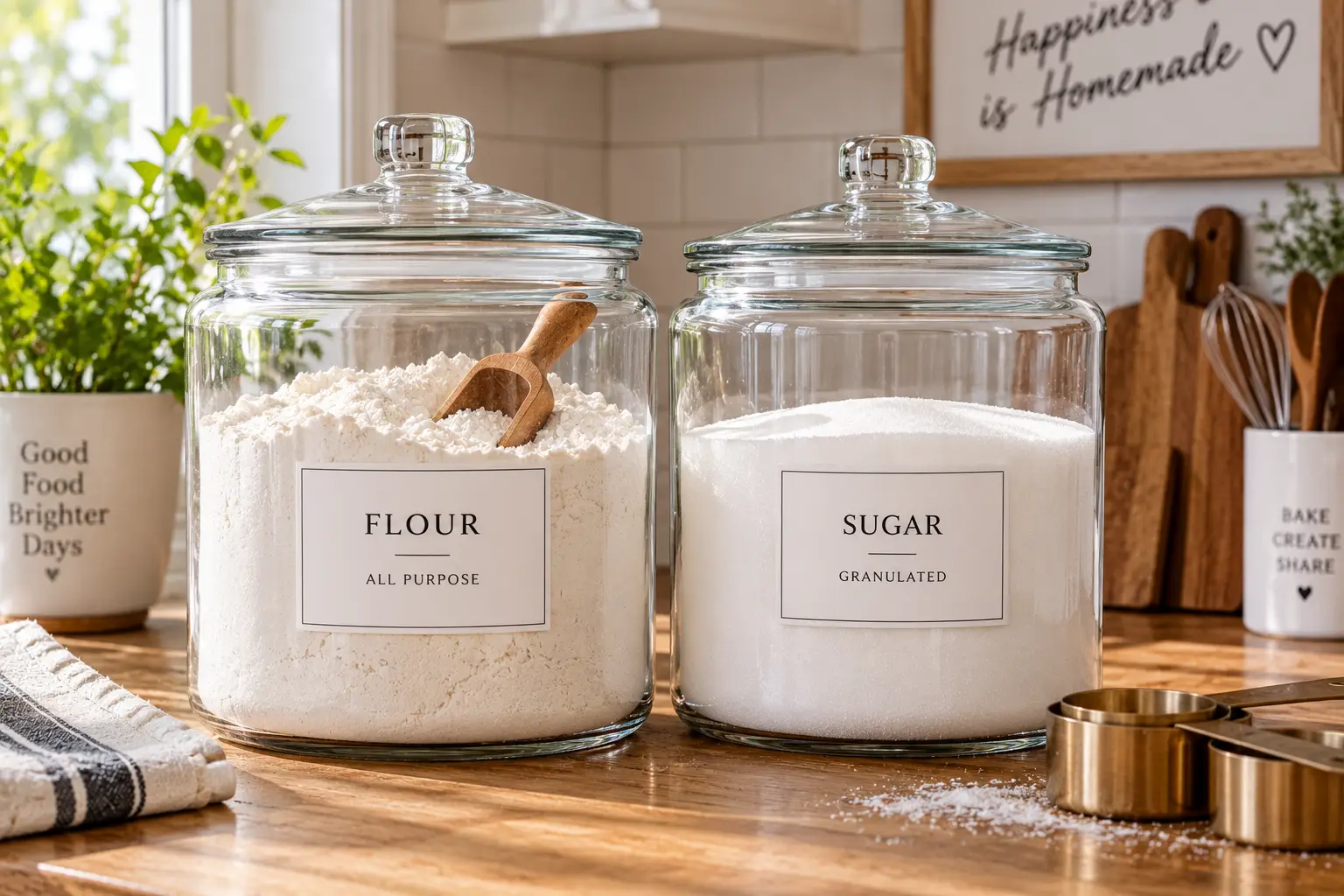
If you’ve ever poured a five-pound bag of flour straight into a cabinet shelf and watched it slowly harden into a brick, you already know why glass flour and sugar containers exist. They’re not just a Pinterest-board aesthetic choice — they’re a genuinely practical upgrade for anyone who bakes more than twice a year. What is a glass flour and sugar container, exactly? In short, it’s a non-porous glass vessel, usually fitted with a clamp, bamboo, or silicone-gasket lid, designed to create an airtight seal that keeps dry staples fresh, dry, and free of pantry pests far longer than the paper or plastic bags they came in.
Glass has a few advantages that plastic simply can’t match: it won’t absorb odors or oils, it doesn’t scratch in ways that trap bacteria, and you can actually see how much flour or sugar you have left without opening the lid. That last point sounds small until you’re mid-recipe and realize you’re out of powdered sugar. Beyond the practical case, there’s a design case, too — a matched set of glass flour and sugar containers on your counter looks a lot more put-together than a lineup of mismatched bags with the tops rolled down and clipped shut.
This guide walks through seven real, currently available glass flour and sugar containers spanning entry-level multi-packs to heritage European glassware, plus the buying criteria, common mistakes, and pantry-organization strategies that actually matter. We’ll also look at what the U.S. Environmental Protection Agency-backed university extension research says about why airtight storage affects baking results, because the “why” behind the seal matters as much as the container itself.
Disclosure: This post contains affiliate links. As an Amazon Associate, I earn from qualifying purchases made through these links, at no additional cost to you.
Quick Comparison: Top Glass Flour and Sugar Containers at a Glance
Before diving into the full breakdown, here’s a snapshot of how these seven options stack up on capacity, seal type, and who each one suits best.
| Product | Capacity | Lid/Seal Type | Best For | Price Range |
|---|---|---|---|---|
| Anchor Hocking Heritage Hill | 1 gallon (set of 2) | Glass knob lid | Classic countertop display | Around $35–$45 |
| Bormioli Rocco Fido | 101.5 oz | Hinged clamp, rubber gasket | Serious airtight sealing | Around $25–$35 |
| Kilner Square Clip Top Jar | 2 liters | Stainless clip, rubber seal | Heritage British styling | Around $20–$30 |
| Le Parfait Super Jar (3-pack) | 2 liters each | Wire bail, rubber gasket | Zero-waste, French craftsmanship | Around $55–$70 |
| Vtopmart Glass Food Storage Jars | 78 oz (3-pack) | Airtight clamp | Budget multi-container sets | Around $30–$40 |
| ComSaf Large Square Glass Jars | 1.1 gallon (2-pack) | Wire clamp, wide mouth | Bulk buyers | Around $30–$40 |
| CZSZYGHBAO Glass Containers | 100 fl oz | Bamboo airtight lid | All-in-one labeled starter kit | Around $25–$35 |
Looking at this table, a clear pattern emerges: the Bormioli Rocco Fido and Kilner Square Clip Top Jar dominate the mid-price, high-seal-quality lane, while the Vtopmart and ComSaf sets win on raw value per ounce of glass. If pantry aesthetics matter as much as function to you, the Anchor Hocking Heritage Hill and Le Parfait Super Jar sit at opposite ends of “classic American” versus “elevated European” style — and both cost more than the multi-packs, which is the trade-off you’re making for brand pedigree and thicker glass.
💬 One click helps other shoppers make an informed choice too! 😊
Top 7 Glass Flour and Sugar Containers: Expert Analysis
Choosing between seven genuinely solid options isn’t about finding a single “best” jar — it’s about matching the seal type, capacity, and price point to how you actually bake and shop. Below, each container gets an honest look at what its spec sheet means in daily use, plus what real buyers report once these jars have been living on a shelf for a few months.
1. Anchor Hocking Heritage Hill — timeless American-made glass
The Heritage Hill jar’s biggest selling point isn’t a feature spec at all — it’s the fact that Anchor Hocking has been producing this exact silhouette in Lancaster, Ohio, for decades, and the mold hasn’t needed to change. Each 1-gallon jar has thick glass side walls and a wide-mouth opening that makes scooping flour with a dry measuring cup genuinely easy, instead of the awkward tilt-and-pour required by narrow-necked jars. The glass knob lid rests on the jar rather than clamping down, which means it’s simple to use one-handed but doesn’t create the same airtight vacuum you’d get from a gasket-sealed design.
In practice, that trade-off matters: a resting glass lid keeps out dust, pantry moths, and casual humidity swings, but it isn’t the choice for a household in a genuinely humid climate storing brown sugar long-term. Based on comparing this jar against gasket-sealed competitors, the Heritage Hill line is best suited to buyers who prioritize display-worthy good looks and dishwasher-safe simplicity over lab-grade airtightness. It’s a strong fit for flour and white sugar in a climate-controlled kitchen, less ideal for brown sugar in a garage pantry.
Reviews consistently report that the jars arrive well-packed and that the glass feels noticeably thicker than mass-market alternatives, though a handful of buyers note the packaging itself could be sturdier for glass-on-glass shipping. What most buyers overlook is that this jar has been in continuous production since the 1940s — that’s a track record plastic containers simply can’t claim.
Pros:
- ✅ Thick, durable American-made glass construction
- ✅ Wide mouth makes scooping and filling effortless
- ✅ Dishwasher-safe and stain- and odor-resistant
Cons:
- ❌ Knob lid is not a true airtight gasket seal
- ❌ Heavier and bulkier than most competitors on this list
At around $35–$45 for a set of two, the Anchor Hocking Heritage Hill is a fair value pick if classic styling and USA manufacturing matter to you more than maximum seal performance.
2. Bormioli Rocco Fido — best hinged clamp seal
Bormioli Rocco has manufactured Fido jars in Italy since the brand’s founding, and the hinged wire clamp with a rubber gasket is the feature that sets this jar apart from knob-lid competitors. Pressing the metal clamp down compresses the gasket against the rim, creating a genuine airtight seal rated for both dry-goods storage and water-bath canning — which tells you something about how seriously the seal is engineered. At 101.5 fluid ounces, one jar comfortably swallows an entire 5-pound bag of flour with room to spare.
What that clamp mechanism means in practice: brown sugar stays soft for weeks longer than it would in a knob-lid jar, because the rubber gasket blocks the humidity exchange that causes sugar to either harden or clump. Here’s what to weigh, though — the clamp requires two hands and a bit more force than a push-button plastic lid, which some households with limited hand strength or young helper-bakers may find less convenient day to day.
Aggregated customer feedback frequently highlights the gasket’s durability over years of daily opening and closing, and several reviewers specifically mention using the same jars for both pantry storage and home canning, which speaks to build quality. A common complaint in customer reviews is that the wide mouth, while great for scooping, makes the jar less space-efficient on a narrow shelf than a squared container of the same capacity.
Pros:
- ✅ True airtight rubber gasket seal, canning-grade
- ✅ Holds a full 5-pound bag of flour per jar
- ✅ Italian glass with a proven decades-long track record
Cons:
- ❌ Two-handed clamp is less convenient for quick access
- ❌ Round shape uses more shelf width than square jars
Priced in the $25–$35 range, the Bormioli Rocco Fido delivers genuine canning-grade sealing at a price close to far less capable jars — a strong value case for anyone serious about freshness.
3. Kilner Square Clip Top Jar — best British heritage design
Kilner’s clip-top jar has been in continuous production in England since the 1840s, and the 2-liter square version brings a stainless-steel clip closure with an orange rubber seal that’s become something of a design signature. The square shape (as opposed to the round Fido jar above) is the real differentiator here — it packs more usable storage into the same shelf footprint, which matters if your pantry shelves are shallow or your cabinet space is tight.
The clip mechanism functions almost identically to the Bormioli Rocco’s — press down, and the rubber gasket compresses against the glass rim for an airtight fit. What the spec sheet doesn’t say, but the manufacturing details reveal, is that Kilner’s newer jars are made using roughly 30% recycled glass from curbside collection, which is a meaningful sustainability detail for buyers weighing environmental impact alongside function. For a household storing both flour and granulated sugar side by side, the square footprint means two or three jars line up flush against each other without wasted gaps.
Reviews consistently praise the seal quality and the embossed branding as a nice design touch, though a subset of buyers note that the rubber gasket on lower-capacity Kilner jars will eventually need replacing after a few years of heavy use — a normal wear item, but one worth knowing about upfront. Based on comparing this jar to the round Bormioli Rocco, the Kilner is the better pick specifically for shelf-space-constrained kitchens.
Pros:
- ✅ Space-efficient square shape for tight shelves
- ✅ Genuine airtight clip-and-gasket seal
- ✅ Made with roughly 30% recycled glass
Cons:
- ❌ Rubber gasket is a wear item requiring eventual replacement
- ❌ Smaller sizes hold less than a full flour bag
At roughly $20–$30, the Kilner Square Clip Top Jar is one of the more affordable heritage-brand options here, making it an easy recommendation for anyone who wants proven design without the premium price tag of French glassware.
4. Le Parfait Super Jar (3-Pack) — best zero-waste French craftsmanship
Le Parfait has manufactured this exact wire-bail, rubber-gasket design in France’s Auvergne region since 1930, and the 2-liter, 3-pack configuration is aimed squarely at buyers who want matching, display-ready jars for flour, sugar, and a third staple like rice or oats. The stainless-steel wire bail closure snaps the lid down with a satisfying, single-motion click, and unlike jars that rely on disposable rubber rings sold separately, the reusable gasket is designed to survive hundreds of open-close cycles.
What that reusability means in practice is a genuinely lower long-term cost of ownership than it first appears: you’re not periodically buying replacement lids or gaskets the way you might with cheaper clamp jars. On paper, this also means less plastic waste over the container’s lifespan, since there’s no plastic lid to eventually crack or discolor — the entire closure system is glass, rubber, and stainless steel. The tall, rounded silhouette holds slightly more per given footprint than a wide flat jar, but it also means less horizontal shelf clearance is needed, which suits narrow pantry cabinets well.
Aggregated review sentiment is strongly positive on build quality and the “built to last decades” framing that Le Parfait leans on in its own marketing — and independent reviewers tend to corroborate that these jars hold up to years of dishwasher cycles without clouding. The main friction point buyers report is price: at nearly double the cost of a comparable domestic clamp jar, it’s a harder sell for anyone shopping strictly on budget.
Pros:
- ✅ Fully reusable glass, rubber, and steel closure system
- ✅ Matching 3-pack simplifies a coordinated pantry look
- ✅ Decades-proven French manufacturing since 1930
Cons:
- ❌ Noticeably pricier than domestic or Asian-manufactured alternatives
- ❌ Tall shape needs more vertical shelf clearance
Running around $55–$70 for a 3-pack, the Le Parfait Super Jar set is the splurge pick here — worth it if you want a lifetime pantry system rather than a starter set.
5. Vtopmart Glass Food Storage Jars — best value 3-pack
The Vtopmart set targets exactly the shopper who wants “one glass jar per staple” without paying a per-jar premium for a heritage brand name. Each of the three 78-ounce jars uses a wire clamp lid with a silicone gasket, which is functionally similar to the Bormioli Rocco and Kilner mechanisms above, just manufactured to a lower price point. The wide, 4.3-inch mouth is specifically sized to accommodate a standard dry measuring cup without scraping the sides, which sounds minor until you’ve fought a narrow-mouth jar while trying to level off a cup of flour.
What three jars for the price of roughly one premium jar means practically: you can outfit flour, granulated sugar, and a third staple like rice in one purchase, rather than buying single jars from three different brands and hoping the sizes look cohesive together. Based on comparing the specs, the silicone gasket here performs comparably to rubber gaskets on pricier jars for day-to-day dry storage, though it hasn’t been tested or rated for water-bath canning the way the Bormioli Rocco has.
Reviews consistently describe the value proposition as the standout feature, with buyers frequently mentioning they bought a second or third set once they saw how well the first set sealed. A recurring critique in aggregated feedback is that the printed capacity markings on the glass can fade with repeated dishwasher cycles over a year or two of heavy use.
Pros:
- ✅ Three full-size jars for less than most single premium jars
- ✅ Wide mouth fits a standard measuring cup cleanly
- ✅ Silicone gasket seals reliably for daily dry storage
Cons:
- ❌ Not rated or tested for canning use
- ❌ Printed measurement markings can fade over time
At around $30–$40 for all three jars, the Vtopmart set is arguably the best entry point on this list for anyone assembling a full pantry system on a first-apartment budget.
6. ComSaf Large Square Glass Food Jars — best for bulk buyers
If you shop at a warehouse club and routinely bring home 10-pound bags of flour or sugar, the ComSaf 1.1-gallon square jars are sized specifically for that reality. The two-pack gives you enough combined capacity to decant a full bulk bag of flour and a full bulk bag of sugar in one go, with a wire clamp lid and rubber gasket that functions the same way as the higher-priced European options above. The 4.3-inch extra-wide mouth is generous enough to pour directly from a bulk bag without a funnel, which saves a genuinely annoying step during pantry restocking.
What the larger capacity means in practice is fewer total containers cluttering your shelf — instead of splitting a bulk bag across two or three smaller jars, one ComSaf jar holds the whole thing, which also means fewer seals to maintain and fewer opportunities for air exposure. The square footprint stacks and lines up efficiently against other square jars on this list, including the Kilner above, if you’re mixing brands in one pantry.
Customer feedback aggregated across major retail listings frequently praises the sheer capacity-to-price ratio, with many reviewers specifically calling out that the jars replaced multiple smaller containers they’d previously used. On the downside, a common theme in reviews is that the 1.1-gallon size, once full, becomes noticeably heavy to lift and reposition — worth considering if you have limited shelf height or upper-shelf storage.
Pros:
- ✅ Holds a full bulk-size bag of flour or sugar per jar
- ✅ Extra-wide mouth pours directly from bulk packaging
- ✅ Square shape stacks efficiently with other jars
Cons:
- ❌ Heavy to lift and reposition once fully filled
- ❌ Large footprint may not fit shallow cabinet shelves
At roughly $30–$40 for the pair, ComSaf earns its spot as the practical choice for bulk-buying households who want fewer, larger containers rather than more, smaller ones.
7. CZSZYGHBAO Glass Flour and Sugar Containers — best all-in-one starter kit
The CZSZYGHBAO set stands apart from every other entry on this list for one reason: it doesn’t just sell you a jar, it sells you an entire labeling and organization system alongside it. Each 100-fluid-ounce jar comes with a bamboo airtight lid and is bundled with 42 pantry labels, which means a first-time buyer can go from “unboxed jar” to “fully labeled, organized pantry shelf” in one afternoon without buying a single additional accessory. The bamboo lid uses a silicone seal ring pressed into the underside, giving genuine airtight performance while adding a warmer, more natural look than an all-metal clamp.
In practice, that bundled-labels detail solves a real problem: most glass jars look identical once flour, sugar, and rice are all decanted into clear glass, and mislabeled jars are a surprisingly common kitchen annoyance. What most buyers overlook when comparing jars purely on capacity and seal type is how much time a labeling kit saves versus buying labels separately or hand-writing on masking tape. The bamboo material itself also means the lid won’t warp or rust the way some metal-clamp mechanisms can after years of dishwasher exposure, though bamboo lids should generally be hand-washed to preserve the wood finish.
Aggregated reviews are especially positive about the “everything included” value proposition, with many buyers specifically highlighting the labels as the unexpected best part of the purchase. A recurring caution in customer feedback is that the bamboo lid, unlike an all-glass or all-metal lid, should not go in the dishwasher, which some buyers find at odds with the “low-maintenance” experience implied elsewhere in the packaging.
Pros:
- ✅ Includes 42 pantry labels for instant organization
- ✅ Bamboo lid adds a warmer aesthetic than metal clamps
- ✅ Large 100 fl oz capacity fits standard flour bags
Cons:
- ❌ Bamboo lid requires hand-washing, not dishwasher-safe
- ❌ Silicone seal ring is a replaceable wear part
For around $25–$35, the CZSZYGHBAO set is the strongest pick for anyone starting a pantry organization project completely from scratch and wanting the labels handled in the same purchase.
Glass Flour and Sugar Containers vs. Traditional Storage Alternatives
Now that you’ve seen the individual jars, it’s worth stepping back and asking why glass wins out over the storage methods most households default to — the original packaging, plastic bins, and metal canisters.
| Storage Method | Airtight Seal Quality | Odor/Stain Resistance | Visibility | Typical Lifespan |
|---|---|---|---|---|
| Original paper/plastic bag | Poor to none | Poor | None | Single use |
| Plastic storage bins | Fair to good | Fair — absorbs odors over time | Good, but can cloud | 1–3 years |
| Metal canisters | Good | Good, but can dent/rust | None (opaque) | 5+ years |
| Glass containers (this guide) | Good to excellent | Excellent — non-porous | Excellent | 10+ years |
The table makes the trade-offs fairly clear: metal canisters seal well and last a long time, but you lose all visibility into what’s left and how fresh it looks, which matters more than it sounds like for catching early clumping or pest activity. Plastic bins are the lightest and often cheapest option, but university extension research on pantry pests notes that plastic can develop microscopic scratches over repeated washing cycles, and those scratches can eventually harbor bacteria or odors in a way that non-porous glass never will. Glass containers land in the sweet spot of strong sealing, full visibility, and a lifespan measured in years rather than seasons — the trade-off being weight and a higher upfront cost per container.
✨ Don’t miss these exclusive deals!
🔍 Take your pantry organization to the next level with this carefully curated lineup of glass flour and sugar containers. Click a highlighted item to check current pricing and availability. These picks will help you get a fresher, more organized kitchen the whole family will enjoy!
How to Choose Glass Flour and Sugar Containers
With seven strong options on the table, narrowing down to the right one comes down to weighing a handful of concrete criteria rather than picking whatever looks nicest online.
- Seal mechanism first. A gasket-and-clamp or gasket-and-clip design (like the Bormioli Rocco or Kilner jars above) outperforms a resting knob lid for humidity control, which matters most for brown sugar and whole-wheat flour.
- Capacity matched to your buying habits. If you buy 5-pound bags, a jar in the 100-ounce range fits one full bag; if you buy in bulk, look at the 1-gallon-plus options like ComSaf.
- Mouth width for scooping. A wide mouth (4 inches or more) lets a standard dry measuring cup dip in and level off cleanly, which speeds up baking prep.
- Shape for your shelf. Square jars use vertical cabinet space more efficiently than round ones; round jars are often slightly easier to clean in every corner.
- Lid material and maintenance. Bamboo and wood lids look warmer but typically require hand-washing; all-glass or metal-and-rubber lids are usually dishwasher-safe.
- Labeling needs. If you’re organizing multiple staples at once, a kit that bundles labels (like CZSZYGHBAO) saves a separate purchase and prevents mismatched jars.
- Budget per jar versus per set. Multi-packs like Vtopmart or ComSaf typically offer a lower per-jar cost than single heritage-brand jars, though the latter often bring thicker glass and proven longevity.
Setting Up an Airtight Glass Pantry System in a Weekend
Buying the jars is the easy part — actually converting your pantry over is where most people either succeed or quietly give up halfway through. Here’s a realistic, low-friction approach for a single weekend project.
Start Saturday morning by inventorying what actually needs a container: flour, granulated sugar, brown sugar, powdered sugar, and maybe rice or pasta if you’re expanding beyond the two staples in this guide’s title. Buy — or better, decide on — your jar count before you start decanting anything, since running out of jars mid-transfer means half-transferred bags sitting open on the counter overnight, which defeats the entire purpose. Wash and fully dry every new jar before first use; residual moisture inside a “dry” jar is one of the most common causes of early clumping, especially for sugar.
When transferring flour, do it over a large bowl or the sink rather than directly over the jar opening — a poorly aimed pour wastes more flour than most people expect, and cleanup is easier before it’s compacted onto a countertop. Label each jar immediately, even if the contents look obviously different through clear glass, since flour and powdered sugar look nearly identical at a glance. Finally, do a “close and test” check on each lid: press or clip it shut, then gently tip the jar sideways over a sink. Any leaking confirms a seal problem before you’ve committed a full bag of ingredients to that container. Common first-30-days mistakes include over-filling jars to the very brim (leaving no air gap actually makes some gasket lids harder to seal) and storing jars in direct sunlight near a window, which can gradually degrade both the glass’s clarity over years and the contents’ freshness far sooner.
Real-World Scenarios: Matching a Container to Your Kitchen
The apartment baker on a budget. A college student or young professional baking a few times a month, working with limited cabinet space and an even more limited budget, is best served by a multi-pack like the Vtopmart or CZSZYGHBAO set — both deliver airtight sealing and a full set of jars for well under the cost of a single premium European jar, and the smaller apartment kitchen benefits from the included labels avoiding any guesswork.
The family that bakes weekly. A household running through a 5-pound bag of flour every couple of weeks needs both durability and capacity without a fragile, precious-object vibe kids might bump on a counter. The Anchor Hocking Heritage Hill or Bormioli Rocco Fido strike that balance — thick glass, dishwasher-safe, and inexpensive enough that a chip or crack isn’t a financial disaster.
The bulk-buying, high-volume home cook. Someone shopping at a warehouse club and stocking a genuine pantry rather than a single shelf should lean toward the ComSaf 1.1-gallon jars or a matched Le Parfait set, both of which are built to handle bulk-size refills without needing three separate containers per staple.
Common Problems and Their Glass Container Solutions
Even after switching to glass, a few recurring pantry headaches show up — here’s how the right container and habits solve each one.
Problem: Brown sugar keeps hardening into a brick. Solution: a gasket-sealed jar like the Bormioli Rocco or Kilner blocks the humidity exchange that causes hardening far more effectively than a resting-lid jar; adding a small terra cotta disk or a slice of bread inside can further help maintain moisture.
Problem: Flour attracts pantry moths. According to UC Statewide IPM Program research, infrequently used dry goods like flour are especially prone to insect infestation, and storing susceptible foods in truly airtight containers — or the freezer — for several months after any past infestation is the most effective long-term fix.
Problem: Jars look identical once filled. Solution: use a labeling kit bundled with a set like CZSZYGHBAO, or invest in a simple chalkboard label pen for any jar on this list.
Problem: Lids won’t seal after a year or two. Solution: rubber and silicone gaskets are wear items across every clamp-style jar here; most manufacturers, including Kilner and Bormioli Rocco, sell replacement gaskets separately rather than requiring a whole new jar.
Problem: Not enough shelf space for round jars. Solution: switch to a square-jar option like Kilner, ComSaf, or CZSZYGHBAO, which use vertical cabinet space more efficiently than round designs.
Long-Term Cost and Maintenance
A glass container’s price tag on the day you buy it is only part of the real cost story. Multi-packs like Vtopmart and ComSaf have a lower upfront cost per jar, but their silicone gaskets are wear parts that most buyers eventually replace every few years of daily use — a small, inexpensive fix, but a maintenance step nonetheless. Heritage brands like Bormioli Rocco, Kilner, and Le Parfait sell replacement gaskets and clamps individually, which means a jar with a worn seal doesn’t need to be thrown out; it needs a five-dollar part. The Anchor Hocking Heritage Hill’s simple glass-on-glass lid has effectively zero wear parts, which is a quiet advantage for anyone who wants to buy once and never think about maintenance again — the trade-off being a less airtight seal from day one.
Over a five-year ownership window, the total cost of a premium jar with occasional gasket replacements is often close to the cost of simply replacing a budget clamp jar outright once its seal degrades — meaning the “expensive” and “cheap” options can land in a similar place financially, with the real difference being glass thickness, brand reputation, and aesthetics rather than raw economics.
Everyday Performance: What the Spec Sheet Doesn’t Tell You
Capacity numbers and seal types only tell part of the story of how a jar behaves in daily use. In practice, wide-mouth jars like the Vtopmart and Bormioli Rocco genuinely do speed up baking prep — being able to plunge a full measuring cup straight in and level it off against the rim saves real time compared to angling a narrow-neck jar. Square jars, meanwhile, earn their keep less in scooping ease and more in the fact that they simply fit more efficiently against cabinet walls and each other, which matters most in kitchens where every inch of shelf is already spoken for.
Weight is an underrated everyday factor: a full 1-gallon ComSaf jar is noticeably heavier to lift down from an upper shelf than a half-full Anchor Hocking jar, which is worth considering if your pantry storage is above eye level rather than on a countertop. And while every jar on this list is marketed as airtight, the honest answer is that clamp-and-gasket designs (Bormioli Rocco, Kilner, Le Parfait, Vtopmart, ComSaf) outperform resting-lid designs (Anchor Hocking) specifically for humidity-sensitive contents like brown sugar — the difference is far less noticeable for dry, stable white sugar.
Safety, Regulations, and Standards for Food-Grade Glass
Glass food storage containers sold in the U.S. fall under general food-contact material safety expectations, and reputable manufacturers — including every brand featured in this guide — use soda-lime glass that is inert, non-toxic, and does not leach chemicals into dry food under normal storage conditions, unlike some lower-grade plastics. None of the containers featured here are marketed or rated for oven use; they’re designed specifically for room-temperature dry-goods storage, so treating them as bakeware would be outside their intended and tested use. For households concerned about material safety more broadly, the Wikipedia overview of soda-lime glass explains the composition differences between everyday glassware and heat-resistant borosilicate glass, which is a useful distinction if you’re also shopping for oven-safe bakeware alongside pantry jars.
On the labeling and marketing side, it’s worth knowing that affiliate content like this article — including the product recommendations and links above — falls under FTC guidance on endorsements and affiliate disclosures, which is why the disclosure at the top and bottom of this post exists: any commission earned through a purchase link doesn’t change the price you pay, and it doesn’t change the honesty of the analysis above.
Common Mistakes to Avoid When Buying Glass Flour and Sugar Containers
Even with a clear list of criteria, a few avoidable mistakes show up again and again in buyer feedback across every brand in this guide. Buying based purely on looks without checking the seal mechanism is probably the single most common one — a beautiful jar with a resting lid will still let humidity in over time. Underestimating capacity is a close second; a 32-ounce jar looks generous in a product photo but won’t hold even half of a standard 5-pound flour bag, leaving you with leftover flour and no home for it. Skipping the “close and test” check outlined earlier in this guide means some buyers don’t discover a defective gasket until sugar has already clumped inside. And finally, mixing dishwasher-safe and hand-wash-only lids across a matched set (a bamboo lid alongside all-metal clamps, for instance) without noting which is which leads to warped wood lids within a year — always check individual care instructions rather than assuming a whole set shares one washing method.
Frequently Asked Questions
❓ Are glass containers better than plastic for storing flour and sugar?
❓ How long does flour stay fresh in an airtight glass container?
❓ Can glass flour and sugar containers go in the dishwasher?
❓ What size glass container do I need for a 5-pound bag of flour?
❓ Do glass containers keep pantry pests out of flour and sugar?
Conclusion
Glass flour and sugar containers aren’t a one-size-fits-all purchase, and after comparing all seven options here, the right pick really does come down to how you shop, bake, and organize your kitchen. If you want proven, canning-grade sealing, the Bormioli Rocco Fido or Kilner Square Clip Top Jar are hard to beat. If budget and getting a complete, labeled set in one purchase matter most, the Vtopmart or CZSZYGHBAO sets deliver real value. Bulk shoppers should look toward ComSaf, while anyone wanting a lifetime, zero-waste pantry system with European pedigree should consider the Le Parfait Super Jar. And if timeless, made-in-the-USA glass with a lower price than the imports is the priority, the Anchor Hocking Heritage Hill remains a dependable classic.
Whichever jar or set you land on, the underlying goal is the same: an airtight, visible, non-porous home for the staples you reach for most, so your flour scoops smoothly and your sugar never turns into a brick. A well-organized glass pantry setup pays for itself the first time you avoid a wasted, clumped bag of brown sugar — and it looks better doing it than the original packaging ever could.
Recommended for You
- Plastic Shelving Bins: 7 Best Picks to Organize Any Room (2026)
- 7 Best Divider Boxes for 2026: Organize Any Space (Ranked)
- Plastic Covered Bowls: 7 Best Picks & Buying Mistakes to Avoid (2026)
Disclaimer: This post contains affiliate links. As an Amazon Associate, I earn from qualifying purchases made through these links, at no additional cost to you.
✨ Found this article helpful? Share it with someone who needs it! 💬🤗