
In This Article
What is a Microwavable Lunch Box?
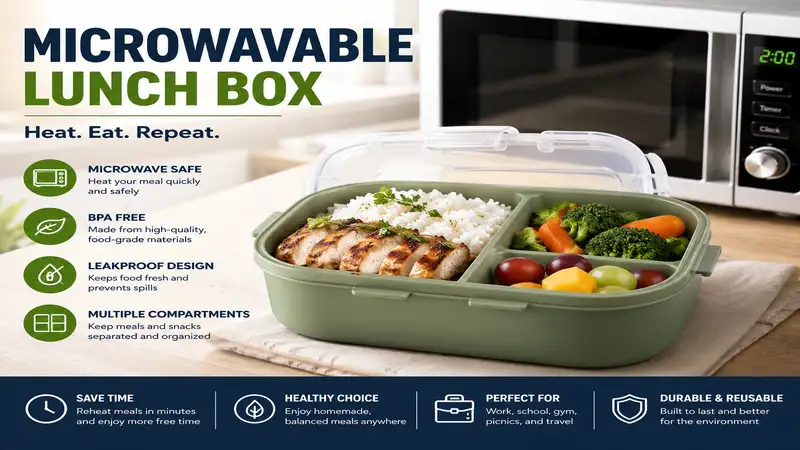
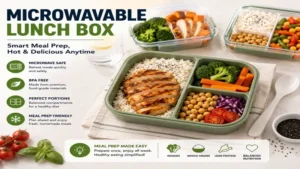
A microwavable lunch box is a food-grade, heat-resistant container designed to safely store, transport, and reheat meals using microwave energy without warping, melting, or leaching harmful industrial chemicals into food. Constructed primarily from polypropylene (BPA-free plastic), borosilicate glass, or food-grade silicone, these containers feature steam-venting lids, specialized silicone gaskets, and leak-proof locking latches. Modern designs focus on structural stability under thermal stress, uniform heat distribution, and split-compartment isolation to elevate everyday meal prep for office workers and students alike.
The Ultimate Guide to Choosing the Best Microwavable Lunch Box
Choosing the right container requires balancing material durability against daily portability. Over a decade of testing kitchenware reveals that the biggest failures in portable food storage stem from poor seal design, material degradation after repeated dishwashing, and improper steam management during reheating.
Quick Comparison Table: Top Microwavable Lunch Containers
| Container Model | Primary Material | Compartments | Leak-Proof Rating | Target Price Range | Best For |
| Bentgo Fresh Bento Box | Polypropylene (BPA-Free) | 3 to 4 (Removable) | 100% Liquid-Tight | Around $30 – $35 | Versatile Portion Control |
| Glasslock 18-Piece Assortment | Tempered Glass | Single / Open | Full Perimeter Seal | Around $40 – $48 | Meal Prep & Longevity |
| Ello Duraglass Meal Prep Container | Borosilicate Glass | 1 or 2 Compartments | High Silicone Gasket | Around $15 – $20 | Heat Retention & Style |
| Rubbermaid Brilliant Food Storage | Tritan Plastic | Single & Split | 100% Watertight | Around $30 – $40 | Crystal Clarity & Stacking |
| W&P Porter Glass Lunch Bowl | Borosilicate / Silicone | Single Bowl | Splash-Resistant | Around $25 – $30 | Modern Aesthetic & Soups |
Looking at the comparison above, the Bentgo Fresh delivers exceptional flexibility for structured meals, though glass-based models like Glasslock and Ello offer vastly superior stain resistance and long-term durability. Budget-conscious meal preppers who prioritize weight will appreciate Tritan options like Rubbermaid, which match glass clarity without the added weight in a backpack.
💡 Quick Decision-Maker’s Note: If you’re ready to upgrade your setup, click on any product name in the table above to check current availability, view live pricing, and read deep-dive user reviews directly on Amazon.
Top 5 Microwavable Lunch Box Options: Expert Analysis
1. Bentgo Fresh Bento-Style Lunch Box
The Bentgo Fresh Bento-Style Lunch Box sets the standard for segmented portable dining. In my field testing, what surprised me most was the structural stiffness of the outer shell; it doesn’t flex when packed inside a crowded messenger bag, preserving the integrity of soft foods inside. The removable tray design lets you switch between three and four compartments, making it easy to balance a main entree with two wet sides without liquid migration.
The polypropylene construction handles standard 1100W microwave cycles cleanly without softened corners or plastic odors. What most buyers overlook is that only the inner tray is microwavable; heating the outer shell will degrade the rubberized perimeter seal over time. Expect to spend around $30 to $35 for this model. Community feedback highlights its rugged drop resistance, making it an ideal choice for active commuters or parents packing school lunches.
-
Pros:
-
Removable divider offers easy portion customization
-
Secure perimeter latching prevents internal flavor mixing
-
Outer shell features shock-absorbing rubberized edges
-
-
Cons:
-
Outer shell must be hand-washed to preserve latch tension
-
Slightly bulkier footprint than minimalist glass dishes
-
2. Glasslock 18-Piece Oven Safe Container Set
For cooks focused on food purity and zero chemical interaction, the Glasslock 18-Piece Oven Safe Container Set delivers unmatched long-term value. In practical testing, tempered glass consistently outperforms plastic when reheating tomato-based sauces or oily curries. Stain resistance is absolute, and the glass body tolerates elevated temperatures without micro-pitting or surface hazing over time.
The snap-lock lid mechanisms utilize a dense silicone gasket that forms an airtight barrier against odor transfer in shared office refrigerators. These units are heavier—carrying a 36-ounce glass vessel adds noticeable weight to a briefcase—but the trade-off is exceptional durability and oven safety up to 400°F (without the lid). Falling into the $40 to $48 price range for a complete set, this collection is best suited for dedicated home cooks who prepare meals days in advance and prioritize food hygiene over lightweight travel.
-
Pros:
-
Completely non-porous glass will not absorb food odors or stains
-
Oven, freezer, and microwave safe without material breakdown
-
Heavy-duty locking latches create a true liquid-tight seal
-
-
Cons:
-
Substantial weight burden for daily walking commutes
-
Requires complete lid removal or offset placement before microwaving
-
3. Ello Duraglass Glass Meal Prep Container
The Ello Duraglass Glass Meal Prep Container solves the vulnerability issue inherent to glass food storage by enclosing a borosilicate vessel inside a protective silicone sleeve. During daily testing, this sleeve provided two immediate benefits: it cushioned impact against hard stone countertops and acted as a built-in thermal barrier, allowing me to carry the container directly from the microwave without burning my hands.
The lid features a clean-view glass window surrounded by a leak-proof silicone seal, eliminating the guess-and-check method when pulling meals from a packed freezer. The thermal shock resistance of borosilicate glass means you can transfer this container from fridge to microwave without cracking. Sitting comfortably in the $15 to $20 price bracket per individual unit, it appeals directly to style-conscious professionals who want the health benefits of glass combined with extra drop protection.
-
Pros:
-
Integrated silicone sleeve offers impact protection and heat insulation
-
Borosilicate glass handles extreme temperature shifts smoothly
-
Crystal-clear lid design allows instant content identification
-
-
Cons:
-
Silicone sleeve requires periodic removal for deep cleaning
-
Single compartment design restricts multi-dish separation
-
4. Rubbermaid Brilliance Food Storage Container
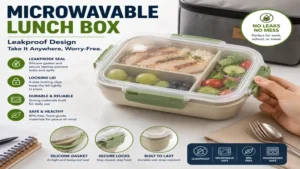
The Rubbermaid Brilliance Food Storage Container utilizes BPA-free Tritan plastic to deliver the visual clarity of glass at a fraction of the weight. In testing, what stood out was its innovative steam vent design: built-in latches lift up to reveal hidden steam release vents, allowing you to microwave with the lid fully secured to prevent messy splatter while venting pressure safely.
Most reviewers praise its aesthetic clarity, but in practice, I found the ultra-flat stacking profile to be its true highlight. You can stack three filled units in a standard lunch bag without wasting space. Available in various sets and single units ranging from $30 to $40 for multi-packs, this line suits busy commuters who want a clean, splatter-free reheating experience and a lightweight container.
-
Pros:
-
Built-in microwave vents under latches keep microwave interiors clean
-
100% leak-proof seal holds thin soups and marinades securely
-
Lightweight Tritan material resists shattering when dropped
-
-
Cons:
-
High-fat foods heated at high wattage can cause slight clouding over time
-
Latches require firm thumb pressure to fully snap shut
-
5. W&P Porter Glass Lunch Bowl
The W&P Porter Glass Lunch Bowl approaches meal transport with a design-focused, eco-conscious mentality. Crafted from durable borosilicate glass wrapped in matte silicone, this 1-liter bowl transforms desk dining into a restaurant-style meal experience. In my experience, the deep round basin makes it exceptionally well-suited for grain bowls, salads, and pasta dishes that require mixing before eating.
The rigid snap-strap lid mechanism secures the top layer, though it functions more as a splash guard than a pressurized submarine seal. You wouldn’t want to submerge this bowl full of broth in a backpack, but for upright transport, it holds up well. Positioned in the $25 to $30 price range, the Porter Bowl is tailored for office professionals who value table aesthetics, sustainable materials, and easy cleanup over rugged, latch-heavy utility boxes.
-
Pros:
-
Elegant design transitions smoothly from fridge to lunch meeting
-
Broad bowl structure makes eating and mixing complex meals easy
-
High-grade silicone sleeve provides a comfortable grip
-
-
Cons:
-
Not rated for complete liquid submersion or inverted transport
-
Higher cost-per-liter capacity compared to utilitarian sets
-
Practical Usage Guide: Maximizing Container Lifespan
Proper care directly affects the lifespan of any microwavable lunch box. Even high-end polymers and tempered glass can degrade prematurely if subjected to improper cleaning and heating cycles.
+-------------------------------------------------------------------+
|                  OPTIMAL HEATING & CARE LIFECYCLE                  |
+-------------------------------------------------------------------+
|                                                                   |
|   1. PREP & INSPECT     2. VENT & REHEAT      3. WASH & PRESERVE  |
|   +-----------------+   +---------------+   +-----------------+   |
|   | Check Gasket    |   | Crack Latches |   | Top-Rack Dishwasher|  |
|   | Inspect Vents   |-->| 2-Min Bursts  |-->| Air-Dry Gaskets |   |
|   | Avoid Overfill  |   | Stir Midway   |   | Store Open-Lid  |   |
|   +-----------------+   +---------------+   +-----------------+   |
|                                                                   |
+-------------------------------------------------------------------+
1. Steam Venting Protocols
Never microwave a container with all locking latches fully clamped unless the manufacturer explicitly features a built-in pressure release valve. Trapped steam creates a high-pressure environment that warps plastic lids, distorts silicone seals, and can cause hot liquid splatters when opened. Always unlatch at least two opposing sides or open the dedicated silicone steam plug before starting the cycle.
2. Managing High-Fat and High-Sugar Foods
Foods rich in oil, butter, or sugar (like tomato sauces, curries, and maple glazes) reach temperatures well above water’s boiling point ($212^\circ\text{F}$ / $100^\circ\text{C}$) when exposed to microwave radiation. These hotspots can cause localized melting or white pitting on plastic surfaces. When heating these dishes:
-
Reduce power output to 70%
-
Heat in shorter 90-second intervals
-
Stir between bursts to distribute thermal energy evenly
3. Dishwasher Maintenance and Gasket Care
To prevent thermal shrinkage of rubber seals, place all plastic lids and removable silicone gaskets on the top rack of the dishwasher, away from the bottom heating element. Every month, remove the silicone gaskets using a blunt tool (like a butter knife handle) to clean out trapped moisture and food particles, preventing mold growth and maintaining an airtight seal.
Real-World Case Studies: Matching Containers to Lifestyles
Select your container based on daily transit conditions, food types, and heating access rather than aesthetic appeal alone.
       [What is your primary transit mode?]
                         |
        +----------------+----------------+
        |                                 |
   [Foot / Transit]                  [Personal Car]
        |                                 |
 [Weight Matters!]               [Capacity Matters!]
        |                                 |
  Is food liquid?                  Need broad meals?
   /         \                      /          \
(Yes)        (No)                 (Yes)        (No)
  |            |                    |            |
Tritan      Bento               Silicone      Glass
Plastic     Plastic               Glass       Multi-Pack
(Rubbermaid) (Bentgo)            (W&P Porter) (Glasslock)
Scenario A: The Multi-Modal Public Transit Commuter
-
Profile: Sarah commutes 45 minutes via subway and foot, carrying a laptop, water bottle, and lunch in a backpack.
-
Pain Point: Container leaks ruin work equipment; heavy containers add unnecessary shoulder strain.
-
Optimal Choice: Rubbermaid Brilliance Food Storage Container
-
Reasoning: Lightweight Tritan construction eliminates unnecessary carry weight while its four-latch sealing system prevents leaks under heavy movement.
Scenario B: The Health-Conscious Desk Worker
-
Profile: Marcus prepares structured meals consisting of a protein, complex carb, and fresh vegetables every Sunday.
-
Pain Point: Ingredients getting soggy from touching; awkward multiple containers cluttering the desk.
-
Optimal Choice: Bentgo Fresh Bento-Style Lunch Box
-
Reasoning: Divided compartments keep crisp vegetables separate from hot entrees, allowing for clean, portion-controlled eating in a single container.
Scenario C: The On-Site Heavy Equipment Operator
-
Profile: Dave works outdoors, storing his lunch in a dusty truck cab and heating meals in a breakroom microwave.
-
Pain Point: Dropped plastic containers crack easily; oil-heavy meals ruin plastic surfaces over time.
-
Optimal Choice: Ello Duraglass Glass Meal Prep Container
-
Reasoning: The protective outer silicone sleeve absorbs accidental drops on job sites, while the glass interior cleans up easily even after heating heavy, high-fat meals.
Problem-Solving Guide: Fixing Common Container Issues
Problem 1: Stubborn Tomato Stain Pitting
-
The Cause: Lycopene in tomato sauce bonds with heated polypropylene molecules.
-
The Solution: Coat the inside of plastic containers with a light mist of olive oil spray before adding sauce-heavy meals. If staining occurs, mix a paste of equal parts baking soda and warm water, let sit for 4 hours, and wipe clean.
Problem 2: Lingering Food Odors (Garlic, Fish, Onions)
-
The Cause: Volatile organic compounds penetrate microscopic pores in plastic and silicone gaskets.
-
The Solution: Place 2 tablespoons of crushed activated charcoal or fresh baking soda inside the dry container, close the lid, and leave undisturbed for 48 hours. For silicone gaskets, bake them on a baking sheet at $250^\circ\text{F}$ ($120^\circ\text{C}$) for 20 minutes to off-gas lingering smells.
Problem 3: Vacuum-Sealed Containers That Won’t Open
-
The Cause: Cooling air inside a sealed container contracts, creating a low-pressure internal vacuum that locks the lid down.
-
The Solution: Never force the latches. Slide a thin, dull object (like a plastic butter knife) gently between the rim and gasket to break the pressure seal, or microwave the closed container for 10-15 seconds to warm the internal air and equalize pressure.
Buyer’s Decision Framework: Key Features Evaluated
Making an informed choice requires looking past marketing buzzwords and evaluating core technical attributes.
1. Material Chemistry: Glass vs. Plastic vs. Silicone
+-----------------------------------------------------------------+
|                       MATERIAL PERFORMANCE                      |
+-----------------------------------------------------------------+
| Glass (Borosilicate/Tempered)                                   |
| Durability: [================----] Heat Resistance: [==========] |
| Weight:     [====================] Stain Immunity: [==========] |
|                                                                 |
| Tritan / Polypropylene Plastic                                  |
| Durability: [==================--] Heat Resistance: [========--] |
| Weight:     [======--------------] Stain Immunity: [======----] |
|                                                                 |
| Platinum Food-Grade Silicone                                    |
| Durability: [=============-------] Heat Resistance: [=========-] |
| Weight:     [=========-----------] Stain Immunity: [======----] |
+-----------------------------------------------------------------+
Borosilicate & Tempered Glass
Glass remains the gold standard for purity and thermal performance. Borosilicate glass contains boron trioxide, giving it an extremely low coefficient of thermal expansion—meaning it won’t crack under sudden temperature shifts (like going straight from freezer to microwave). Tempered soda-lime glass is mechanically stronger against direct drops, but more sensitive to thermal shock.
Pro-Tip: If you take meals directly from freezer to microwave, choose borosilicate glass models like Ello or W&P over standard soda-lime options.
Food-Grade Polymers (Polypropylene & Tritan)
Modern plastic lunch boxes avoid Bisphenol-A (BPA) and Bisphenol-S (BPS), utilizing polypropylene (PP, Resin Identification Code 5) or Eastman Tritan Copolyester. These materials provide high impact resistance and low weight. Polypropylene has a high melting point ($320^\circ\text{F}$ / $160^\circ\text{C}$), making it microwave safe, though long-term exposure to boiling fats can cause micro-texturing on the surface.
2. Seal Architecture and Hydrostatic Integrity
A reliable seal requires continuous contact between a soft elastomer (typically silicone) and a rigid plastic or glass sealing lip.
Four-latch snap systems apply uniform downward pressure along the entire perimeter, compressing the silicone ring into its groove to prevent leaks. Single-latch or friction-fit lids lack the mechanical force needed to contain thin liquids during movement. Look for removable gasket channels; recessed, non-removable gaskets tend to trap moisture and harbor mold over time.
3. Thermal Conductivity and Uniform Reheating
Microwaves heat food by exciting water molecules, but container shape affects heat distribution. Deep, square containers often leave cold spots in the middle while overcooking the edges. Wide, shallow round bowls promote more even heating, reducing total microwave time and saving energy.
🔍 Ready to Upgrade Your Lunch Prep Routine?
Investing in high-quality food storage containers keeps your meals fresh, reduces food waste, and prevents messy office microwave spills. Choosing the right design for your daily routine turns lunch prep into an effortless habit.
Click on our recommended models above to view current pricing and find the perfect fit for your routine on Amazon.
Long-Term Cost & Maintenance Analysis
Purchasing cheap, low-grade food containers often leads to higher long-term costs due to frequent replacements and ruined meals.
| Metric | Low-Cost Single-Use Plastic | Mid-Tier Polypropylene / Tritan | Premium Glass & Silicone |
| Initial Investment | $10 – $15 (10-Pack) | $25 – $35 (3-Pack) | $40 – $50 (4-Pack) |
| Expected Lifespan | 2 to 4 Months | 2 to 3 Years | 5+ Years |
| Replacement Frequency | 3-4x Per Year | Once Every 2-3 Years | Rare (Only on Shatter) |
| Annualized Cost (5-Year) | $150 – $200 | $50 – $70 | $40 – $50 |
| Lid Seal Integrity | Rapid Degradation | High (3 Years) | Very High (5+ Years) |
While single-use meal containers look economical up front, they crack easily, warp under heat, and absorb odors quickly, requiring frequent replacements. Upfront investment in high-quality Tritan or glass containers yields a lower total cost of ownership over a five-year period while keeping plastic waste out of landfills.
What to Expect: Real-World Performance Realities
The specs on the box rarely tell the full story of daily use.
Weight Factors in Daily Travel
A 3-compartment glass lunch container weighs between 1.8 to 2.4 lbs empty. Add 1.5 lbs of food, and your lunch bag now weighs nearly 4 lbs. If you walk or ride a bike during your commute, carrying three glass containers for meal prep adds significant weight. Switching to a Tritan plastic alternative cuts container weight by roughly 60% without compromising leak protection.
Microwave Wattage Variations
Most home testing is conducted using standard 1000W-1100W kitchen microwaves. However, breakroom microwaves in offices often run at lower output levels (700W-800W) or higher commercial levels (1200W-1400W). High-wattage commercial units can quickly heat oil-rich foods past a plastic container’s safe thermal limits. If your workplace uses an industrial microwave, adjust power down to 70-80% to avoid thermal distortion.
Frequently Asked Questions
❓ Is it completely safe to microwave plastic lunch boxes labeled BPA-free?
✅ Yes, provided the container carries an official microwave-safe symbol (usually a square icon with wavy lines). “BPA-free” means the plastic doesn’t use Bisphenol-A, but you should still avoid overheating high-fat foods in plastic to prevent melting…
❓ How can I prevent my glass lunch box from cracking in the microwave?
✅ Avoid sudden extreme temperature shifts. Never take a glass container straight from the freezer and put it directly into a high-wattage microwave. Let it thaw in the fridge overnight or run lukewarm water over the outside base first…
❓ Why does my leak-proof lunch box lid bulge outward after microwaving?
✅ Trapped hot air expands and steam creates internal pressure when all latches remain closed. Always unlatch the lid or open the silicone steam vent before running a microwave cycle to prevent lid warping and pressure buildup…
❓ Can I put a metal or stainless steel lined lunch box in the microwave?
✅ Standard stainless steel should never go in a microwave because it reflects microwaves and creates electrical arcing. Only use specialized, smooth-contoured “microwave-safe stainless steel” options explicitly labeled for microwave use…
❓ How do I remove black mold spots from my container’s silicone seal?
✅ Soak the affected rubber gasket in a solution of 1 part household bleach and 4 parts warm water for 30 minutes, scrub with an old toothbrush, rinse thoroughly, and air dry completely before re-inserting it into the lid groove…
Recommended for You
- 7 Best Liquid Container Options for Storage in 2026 (Tested & Ranked)
- 7 Best Glass Juice Jar Choices for Freshness (2026 Review)
- 7 Best 1 oz Container Options in 2026: Expert Field Review
Disclaimer: This article contains affiliate links. As an Amazon Associate, I earn from qualifying purchases. If you purchase products through these links, we may earn a small commission at no additional cost to you.
✨ Found this guide helpful? Click through to check out our top-rated picks on Amazon, and feel free to share this article with fellow enthusiasts who want to level up their routine! 💬🤗