
In This Article
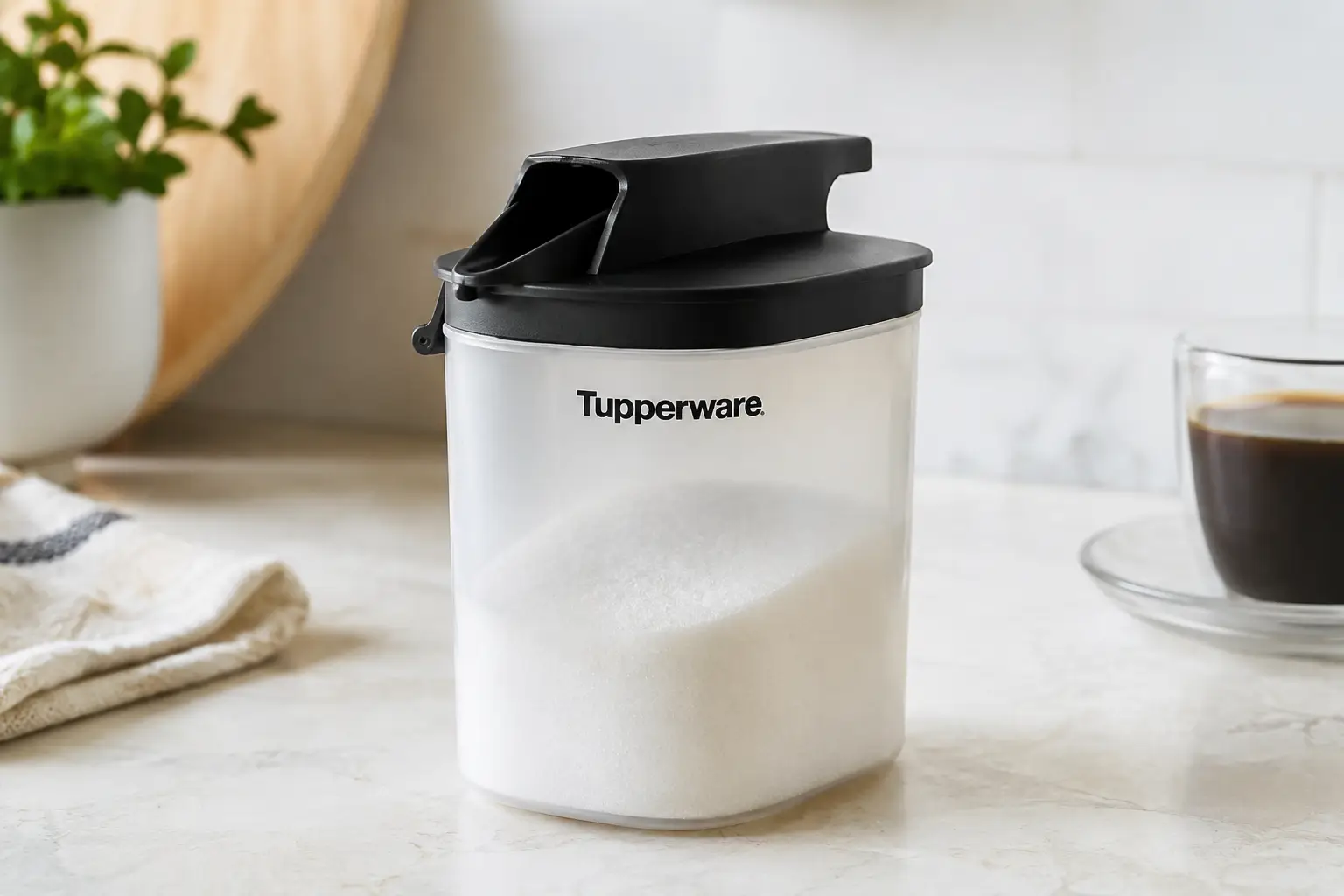
If you’ve ever tipped a crinkly paper bag of sugar into a bowl and watched half of it end up on the counter, you already understand the appeal of a tupperware sugar dispenser. A tupperware sugar dispenser is an airtight, pour-friendly kitchen container — made by Tupperware or by comparable competing brands — built to keep granulated, brown, or powdered sugar fresh, clump-free, and easy to portion without digging through a torn bag or a loose-lidded bowl. It’s a small upgrade, but anyone who bakes regularly or keeps a coffee station stocked knows how much friction it removes from a simple task.
In this guide, we’re comparing seven real, currently available sugar-storage containers on the US market — Tupperware’s own sifting design alongside strong competitors from OXO, Rubbermaid, and Progressive — so you can see how they actually differ in capacity, seal quality, and everyday usability. We looked at published spec sheets and aggregated customer review themes rather than marketing copy, and in the interest of transparency (see the FTC’s guidance on affiliate disclosures), we’ll flag clearly whenever we’re working from real review sentiment versus a manufacturer’s claim. Whether you want a heavy-duty sugar keeper for a 5-pound bag or a small glass dispenser for the coffee bar, there’s a practical option below.
Quick Comparison: 7 Sugar Dispensers and Sugar Keepers at a Glance
| Product | Type | Capacity | Price Range | Best For |
|---|---|---|---|---|
| Progressive Prepworks Sugar ProKeeper | Flip-top, silicone seal | 2.5 qt / 4 lb sugar | around $20 | Everyday granulated sugar |
| OXO Good Grips POP Container (2.8 Qt) | Push-button airtight | 2.8 qt / 5 lb sugar | in the $20–$25 range | Stackable pantry storage |
| Rubbermaid Brilliance Pantry Container (7.8 Cup) | Latch-lid, Tritan plastic | 7.8 cups | under $15 | Budget-conscious buyers |
| Tupperware Sift ‘N Store | One-hand sifter/dispenser | 8.8 oz / 250 g | around $20 | Baking and decorating |
| Anchor Hocking Essentials Glass Sugar Dispenser | Glass, stainless flip lid | 12 oz | under $15 | Tabletop and coffee bar |
| Progressive Prepworks Powdered Sugar Keeper | Sifter + leveler | 1.4 qt / 1 lb | in the $15–$20 range | Powdered sugar dusting |
| Progressive ProKeeper 6-Piece Baker’s Set | Multi-container set | 4 qt to 1.5 cups (6 pieces) | between $45 and $65 | Serious home bakers |
Prices reflect typical ranges at the time of writing and may vary — always check the current price on the product page before buying.
💬 Found the size you need already? Tap a highlighted product above to check current availability and pricing on Amazon.
Top 7 Sugar Dispensers and Sugar Keepers for 2026
Amazon’s own listings will tell you the capacity and the material. What they won’t tell you is which of these actually holds up after six months of daily scooping, or which lid seal starts to fail first. Here’s our honest breakdown, product by product.
1. Progressive Prepworks Sugar ProKeeper — best everyday flip-to-pour design
The Sugar ProKeeper is the closest thing to a “default” pick in this category, and for good reason: its flip-to-pour spout means you can dispense sugar one-handed without wrestling off an entire lid. The 2.5-quart capacity holds roughly a 4-pound bag of sugar with room to spare, and a silicone gasket around the hinged lid creates a genuinely airtight seal rather than just a loose-fitting cap. Measurement markings on the side let you glance at remaining stock instead of opening the container to check.
What stands out here is the contoured body — it’s shaped specifically for one-handed pouring, which matters more than it sounds like when your other hand is holding a mixing bowl. Based on comparing the specs against cheaper flip-top containers, the silicone seal is the real differentiator; many budget alternatives use a dry-fit lid that lets in humidity over time, which is precisely what causes sugar to clump. Reviews consistently report that the flip spout controls flow well even with fine granulated sugar, though a handful of buyers note the hinge can loosen with heavy daily use after a year or more.
Pros:
- ✅ Silicone seal keeps sugar noticeably clump-free
- ✅ One-handed flip-to-pour spout is genuinely convenient
- ✅ Clear body with measurement markings for quick checks
Cons:
- ❌ Hinge may loosen with very frequent daily use
- ❌ Not stackable the way boxier containers are
The Progressive Prepworks Sugar ProKeeper typically runs around $20, and given how much daily friction it removes from baking prep, it’s a strong value pick for a household that goes through sugar regularly. Check the current price before ordering, since Progressive periodically adjusts packaging and set options.
2. OXO Good Grips POP Container (2.8 Qt) — best airtight seal for stacking
OXO’s POP line trades the flip-spout approach for a push-button, airtight seal — press the button on top, and the entire lid engages a tight seal around the container’s rim. The 2.8-quart Big Square Short size is calibrated specifically for a 5-pound bag of sugar, and its square footprint is built to stack modularly with other POP containers of the same footprint, which matters if you’re organizing an entire pantry shelf rather than a single jar.
In practice, the push-button mechanism is the feature worth paying attention to: unlike screw-on or snap-on lids, it gives clear tactile and visual confirmation that the seal is engaged, which reduces the guesswork of “did I actually close this all the way.” What most buyers overlook with this model is that the button also serves as a built-in carrying handle for the lid — a small design detail that speeds up refilling. Reviews consistently report that the seal holds up well over years of use, with recurring praise for how the containers keep pantry moths and humidity out; some buyers do mention the square shape makes pouring slightly less controlled than a spouted container.
Pros:
- ✅ Push-button seal is easy to verify at a glance
- ✅ Stacks neatly with other POP-line containers
- ✅ Holds a full 5-pound bag with room to spare
Cons:
- ❌ No pour spout, so dispensing is less precise
- ❌ Hand-wash recommended for the seal component
Expect to pay in the $20 to $25 range for the OXO Good Grips POP Container, and if pantry organization matters as much as sugar storage to you, the modular stacking alone can justify the price over a standalone dispenser.
3. Rubbermaid Brilliance Pantry Container (7.8 Cup) — best budget entry point
Rubbermaid’s Brilliance line is built around a crystal-clear Tritan plastic body and a latched lid rather than a screw-top or push-button seal — you snap the latches down on either side, and the lid compresses against a gasket. At 7.8 cups, it’s sized well for a standard bag of brown sugar or granulated sugar, and it’s one of the more affordably priced entries in this roundup.
The shatter-resistant Tritan construction is the practical selling point here: unlike some lower-cost clear plastics, it resists the yellowing and clouding that make older containers look dingy after repeated dishwasher cycles. Here’s what to weigh: the latch mechanism is simple and reliable, but it doesn’t offer the one-handed convenience of a flip spout, so you’re unscrewing or unlatching the whole lid to dispense sugar rather than tipping it out through a small opening. Reviews consistently report strong satisfaction with how well the latches hold an airtight seal for the price, though a minority of buyers mention the plastic can develop a faint odor if used for strongly scented ingredients before switching to sugar.
Pros:
- ✅ Genuinely budget-friendly for an airtight container
- ✅ Shatter-resistant, stain- and odor-resistant Tritan build
- ✅ Fully dishwasher safe, including the lid
Cons:
- ❌ No pour spout — you remove the entire lid
- ❌ Slightly bulkier footprint than dedicated sugar keepers
At under $15, the Rubbermaid Brilliance Pantry Container is arguably the best value-for-money pick on this list if a spout isn’t a priority and budget is.
4. Tupperware Sift ‘N Store — best sifter-and-dispenser hybrid for baking
The Sift ‘N Store is Tupperware’s own take on this category, and it’s built around a genuinely different mechanic: a squeeze-and-release handle that sifts as it dispenses. Rather than simply pouring, you get powdered sugar, cocoa, or flour aerated and de-clumped in the same motion, which is a real advantage if you’re dusting a cake or lightening a batter. Interchangeable top and bottom lids let you seal leftover contents for storage between uses.
The one-hand design is the standout feature in practice — most sifters require a separate hand to hold a bowl steady and another to crank a handle, while this design lets you sift directly over a cake stand or mixing bowl with one hand free. The no-clog mechanism is specifically engineered to handle fine powdered sugar without jamming, a common complaint with cheaper mesh sifters. Based on comparing this to a standard flip-top sugar keeper, the Sift ‘N Store is a specialist tool rather than a general-purpose one: its 8.8-ounce capacity is meant for baking sessions, not for storing a full 4-pound bag of sugar day to day. It won’t replace a bulk sugar keeper, but as a companion tool for actual baking and decorating, reviewers highlight how much cleaner it keeps countertops compared to a handheld mesh sifter.
Pros:
- ✅ Sifts and stores in one BPA-free, rust-free unit
- ✅ Genuine one-hand operation over bowls or cakes
- ✅ Dishwasher-safe parts for easy cleanup
Cons:
- ❌ Small 8.8 oz capacity isn’t meant for bulk storage
- ❌ Best suited to powdered sugar, cocoa, or flour specifically
Available around $20, the Tupperware Sift ‘N Store earns its price as a baking-specific tool rather than a everyday sugar dispenser — pair it with one of the larger keepers on this list if you also need bulk storage.
5. Anchor Hocking Essentials Glass Sugar Dispenser — best classic glass tabletop pick
Not every kitchen wants a plastic pantry container — some people want something that looks good left out on the table or next to the coffee maker. Anchor Hocking’s Essentials dispenser is glass with a diner-style stainless steel flip lid, holding 12 ounces, which is enough for daily table use even if it’s not built for bulk pantry storage.
The glass construction is the main draw here: it won’t absorb odors, won’t scratch or cloud the way plastic can over years of dishwasher cycles, and it reads as a finished tabletop piece rather than a utilitarian storage bin. The stainless flip lid is designed for controlled, diner-style pouring rather than dumping, which suits coffee and tea service specifically. What the spec sheet doesn’t say, but reviews reveal, is that the lid’s self-closing action is genuinely convenient for keeping bugs and moisture out between uses, though a subset of reviewers have reported that some units shipped from overseas despite older “Made in USA” branding, so it’s worth reading current listing details closely. Because it’s glass, it’s also noticeably heavier than any plastic option on this list, which is a trade-off some buyers actively prefer for stability on a table.
Pros:
- ✅ Glass body won’t stain, scratch, or absorb odors
- ✅ Self-closing stainless lid limits contamination
- ✅ Attractive enough to leave out on a table or bar
Cons:
- ❌ Small 12 oz capacity, not for bulk storage
- ❌ Heavier and more breakable than plastic alternatives
At under $15, the Anchor Hocking Essentials Glass Sugar Dispenser is an easy add for anyone who wants their sugar dispenser to double as tableware.
6. Progressive Prepworks Powdered Sugar Keeper — best dedicated powdered sugar solution
Powdered sugar behaves differently than granulated — it packs, cakes, and clumps far more aggressively — and this keeper is built specifically to manage that. Its 1.4-quart capacity holds roughly a 1-pound bag, with a built-in leveler for accurate baking measurements and an integrated fine-mesh shaker for dusting baked goods directly from the container.
The dual leveler-and-duster design is the genuinely useful part: most powdered sugar containers force you to choose between accurate scooping and easy dusting, while this one does both from the same unit. Based on comparing it against generic mesh shakers sold separately, having the leveling bar built in removes a step (and a utensil) from the baking process, which matters if you bake often enough that extra dishes add up. Reviews consistently report that the fine-mesh shaker resists clogging better than standalone shaker jars, which is a common pain point specifically with powdered sugar because of how readily it compacts under humidity. The narrower opening that makes dusting work well does mean refilling is slightly slower than with a wide-mouth container.
Pros:
- ✅ Combines a measuring leveler and a dusting shaker
- ✅ Mesh shaker resists clogging with fine powdered sugar
- ✅ Hinged lid and silicone seal keep contents fresh
Cons:
- ❌ Narrower opening makes refilling a bit slower
- ❌ Sized for powdered sugar only, not general pantry use
In the $15 to $20 range, the Progressive Prepworks Powdered Sugar Keeper is a smart, targeted purchase for anyone who bakes cakes, cookies, or pastries with any regularity.
7. Progressive ProKeeper 6-Piece Baker’s Set — best complete baking storage system
If you’re setting up a baking station from scratch, buying one container at a time gets expensive and mismatched. This six-piece set solves that by bundling a 4-quart flour keeper, a 2.5-quart sugar keeper with flip-to-pour spout, a 1.5-quart brown sugar keeper, a 1.4-quart powdered sugar keeper with leveler and duster, and two 1.5-cup mini keepers for spices or extracts — all matched in size and clear plastic finish.
The terra cotta disk included with both the sugar and brown sugar keepers is a detail worth calling out: soaked briefly in water, it regulates humidity inside the container and is specifically effective at keeping brown sugar from hardening into a brick, a problem that plagues bagged brown sugar in every kitchen eventually. What most buyers overlook when comparing individual containers to a set like this is the cumulative cost: buying a flour keeper, sugar keeper, brown sugar keeper, and powdered sugar keeper separately typically costs more than this bundle, on top of getting mismatched shapes that don’t stack cleanly. Reviews consistently report that the matched set genuinely improves pantry organization versus a shelf of unrelated containers, with the main complaint being that the flour keeper, at 4 quarts, is the bulkiest single piece and needs real shelf clearance.
Pros:
- ✅ Covers flour, sugar, brown sugar, and powdered sugar in one set
- ✅ Terra cotta disk keeps brown sugar from hardening
- ✅ Matched sizing looks and stacks cleaner than mixed containers
Cons:
- ❌ The 4-quart flour keeper takes up significant shelf space
- ❌ Higher upfront cost than buying a single container
Priced between $45 and $65, the Progressive ProKeeper 6-Piece Baker’s Set is the best-value option for anyone building out a full baking pantry rather than solving for sugar alone.
Comparing the 7 Sugar Dispensers Side by Side
| Product | Seal Type | Best Feature | Ideal Household |
|---|---|---|---|
| Progressive Prepworks Sugar ProKeeper | Silicone gasket, flip-top | One-handed pour spout | Daily bakers |
| OXO Good Grips POP Container | Push-button airtight | Modular pantry stacking | Pantry organizers |
| Rubbermaid Brilliance Pantry Container | Latch-and-gasket | Budget-friendly durability | Cost-conscious buyers |
| Tupperware Sift ‘N Store | Interchangeable lids | Built-in sifting action | Dedicated bakers |
| Anchor Hocking Essentials Glass Sugar Dispenser | Self-closing flip lid | Tabletop-ready glass | Coffee bars, small tables |
| Progressive Prepworks Powdered Sugar Keeper | Silicone gasket, hinged lid | Leveler plus duster | Cake and pastry bakers |
| Progressive ProKeeper 6-Piece Baker’s Set | Mixed (silicone/hinged) | Complete matched system | Serious home bakers |
Looking at the table above, the Progressive Prepworks Sugar ProKeeper is the best all-around pick for a household that just wants a reliable, everyday granulated sugar container, while the OXO Good Grips POP Container makes more sense if pantry stacking and organization matter as much as sugar storage itself. If you bake often enough to justify a system rather than a single jar, the Progressive ProKeeper 6-Piece Baker’s Set ends up cheaper per container than buying pieces individually, even though the upfront price is higher.
How to Set Up and Maintain Your Sugar Dispenser (First 30 Days)
Getting a new sugar dispenser right starts before you even fill it. Wash the container and lid by hand or on the top rack of the dishwasher first — manufacturing residue and warehouse dust are common, even on new products, and skipping this step is one of the most frequent first-use mistakes. Let every part dry completely before adding sugar; even a small amount of trapped moisture on a silicone seal is enough to trigger clumping within the first week, which then gets blamed on the container rather than the setup.
When you first fill it, don’t pack the sugar down tightly — it compresses naturally with vibration and time, and packing it manually reduces airflow around the granules, which paradoxically speeds up caking in humid climates. For brown sugar specifically, add a damp (not wet) paper towel or a soaked terra cotta disk for the first 24 hours if your model doesn’t include one; it’s a low-cost trick that keeps sugar workably soft for weeks. Wipe the rim and seal area after every refill, since a few stray grains caught in the gasket are the single most common reason an “airtight” container stops sealing properly within a month or two of use. Finally, avoid storing the container near your stove or oven — heat cycling degrades silicone seals faster than steady room-temperature storage, shortening the lifespan of even well-made dispensers.
Real-World Scenarios: Matching a Sugar Dispenser to Your Kitchen
If you’re a once-a-week home baker on a tight counter budget, a single flip-top container like the Progressive Prepworks Sugar ProKeeper covers granulated sugar needs without crowding your shelves, and its sub-$25 price keeps the investment low while you figure out how often you’ll actually use it.
If you’re a frequent baker who makes cookies, cakes, and pastries on a near-weekly basis, the case for a matched system is stronger. The Progressive ProKeeper 6-Piece Baker’s Set removes the guesswork of buying containers piecemeal and gives every ingredient — flour, sugar, brown sugar, powdered sugar — a dedicated, appropriately sized home, which becomes genuinely time-saving once you’re baking at that frequency.
If you’re setting up a small home coffee bar or entertaining space where the sugar container will actually be visible on a counter or table, function alone isn’t the whole story — the Anchor Hocking Essentials Glass Sugar Dispenser fits that context better than a utilitarian plastic pantry container would, even though it holds less sugar.
✨ Ready to stock your pantry? Check current pricing on the pick that fits your kitchen — availability and pricing can shift, so always confirm before you buy.
How to Choose a Sugar Dispenser: 6 Things That Actually Matter
What’s the best way to choose a sugar dispenser? Prioritize the seal type, then match capacity to how often you buy sugar, and confirm the material is dishwasher safe before comparing price.
- Seal mechanism first. Silicone gaskets and push-button seals outperform simple screw-on or snap-on lids at keeping humidity out, which is the single biggest factor in whether sugar clumps.
- Match capacity to your buying habits. A 2.5-quart container that holds a standard 4-pound bag makes more sense for most households than an oversized bin that’s mostly empty.
- Consider pour control separately from sealing. A tight seal and a controlled pour spout are two different engineering problems — some containers solve one well and not the other.
- Check material and dishwasher compatibility. BPA-free, Tritan, or comparable food-grade plastics resist staining and odor absorption far better than basic polystyrene.
- Decide if you need a sifter or duster built in. If you regularly dust cakes or cookies with powdered sugar, a dedicated sifting container saves real time over pouring and sifting separately.
- Weigh a single container against a matched set. If you’re storing more than one baking staple, a coordinated set often costs less per container and organizes more cleanly than mismatched pieces.
Common Mistakes to Avoid When Buying a Sugar Dispenser
The most common mistake is buying based on capacity alone. A container sized for 5 pounds of sugar sounds efficient, but if you only go through a pound or two a month, that much headspace actually accelerates clumping because there’s more air circulating around the sugar between refills.
A second mistake is ignoring the seal type in favor of price. The cheapest containers in this category almost always use a simple snap-on lid without a gasket, and while they cost less upfront, sugar exposed to ambient humidity clumps within weeks in most US climates — meaning you end up replacing the container, the sugar, or both sooner than expected. A third mistake is assuming glass and plastic are interchangeable choices; glass resists odor and staining better long-term, but it’s heavier, less shatter-resistant, and typically holds less volume for the same footprint, so it suits tabletop use better than bulk pantry storage. Finally, buyers frequently overlook whether the lid itself is dishwasher safe — some silicone-sealed lids specify hand-washing only, and running them through repeated dishwasher cycles anyway is a common cause of premature seal failure reported in customer reviews.
Tupperware Sugar Dispenser vs. Traditional Sugar Bowls and Bags
| Factor | Sugar Dispenser (e.g. Tupperware Sift ‘N Store) | Traditional Sugar Bowl or Bag |
|---|---|---|
| Moisture protection | Airtight or near-airtight seal | Minimal to none |
| Portion control | Built-in spout, sifter, or leveler | None — manual scooping |
| Shelf life quality | Sugar stays loose and pourable longer | Clumps and hardens faster |
| Pantry organization | Stackable, uniform shapes | Bulky bags, irregular bowls |
Tupperware’s approach to sealed food storage traces back decades — the company built its reputation on the patented “burping seal” it introduced in the mid-20th century, and that same airtight-seal philosophy is what modern sugar dispensers, from Tupperware and competitors alike, are still built around. A loose bag or an open bowl leaves sugar exposed to ambient humidity constantly, which is precisely why bagged sugar tends to harden into a solid mass faster than sugar stored in any of the sealed containers reviewed above. The trade-off is upfront cost and shelf space — a dispenser is a one-time purchase that needs a permanent spot in your pantry, while a bag can simply be tossed in a cabinet. For anyone who bakes more than occasionally, though, the reduced waste from clump-free sugar tends to offset that investment within a few months.
Which Sugar Dispenser Fits Your Household
For a small household or someone who bakes occasionally, a single mid-capacity container like the Rubbermaid Brilliance Pantry Container or the Progressive Prepworks Sugar ProKeeper covers granulated sugar needs without excess bulk or cost.
For a larger family that goes through sugar quickly — sweet tea, regular baking, kids’ cereal — the OXO Good Grips POP Container at 2.8 quarts holds a full 5-pound bag and stacks efficiently with other pantry staples stored the same way.
For someone newer to baking who’s building a kitchen from scratch, starting with the Progressive ProKeeper 6-Piece Baker’s Set avoids the piecemeal-purchasing trap and gives every core baking ingredient a proper home from day one, which tends to encourage more consistent organization long-term than buying containers as needs arise.
Features That Actually Matter (and Ones That Don’t)
Marketing copy for pantry containers leans heavily on words like “premium” and “elegant,” but a few concrete features are worth paying for, and a few are mostly cosmetic.
Actually matters: a genuine gasket or push-button seal (not just a snap-fit lid), dishwasher-safe components so the seal doesn’t degrade from hand-washing residue, and — if you bake with powdered sugar — an integrated leveler or duster that saves you from owning a separate tool. Capacity that roughly matches your real usage also matters more than manufacturers imply, since an oversized container with excess air space works against freshness rather than for it.
Doesn’t matter much: decorative embossing or color-matched lids add cost without functional benefit for most kitchens, and “restaurant-style” branding on glass dispensers is largely aesthetic rather than a meaningful performance claim. Stackability is genuinely useful if you’re organizing a full pantry shelf, but it’s close to irrelevant if the container is going in a single dedicated spot on the counter.
Long-Term Cost and Maintenance
A well-sealed sugar dispenser is a low-maintenance purchase, but it isn’t a zero-maintenance one. Silicone gaskets typically need replacing or the whole unit needs replacing after a few years of daily use, since repeated compression gradually reduces how tightly the seal closes — this is a normal wear pattern rather than a defect, and it’s worth budgeting for eventual replacement rather than expecting indefinite performance. Sugar itself is effectively non-perishable when stored properly; the USDA-backed guidance on safe pantry storage confirms that keeping dry staples in a cool, dry, airtight container is the main variable that affects quality over time, not the sugar’s inherent shelf life.
On a pure cost basis, a single well-made dispenser in the $15 to $25 range that lasts three to five years works out to a few dollars a year — cheaper over time than repeatedly discarding clumped, wasted sugar from an unsealed bag or bowl. The math shifts further in the dispenser’s favor for households that bake often enough that wasted or hardened sugar is a recurring, not occasional, cost. Where the math is less favorable is for someone who uses sugar rarely; in that case, the convenience is real, but the payback period is longer, and a smaller, lower-cost container makes more financial sense than an oversized one that sits mostly empty.
Safety, Regulations, and Standards
Food-contact plastics sold in the US, including the containers in this roundup, fall under FDA oversight for food-contact materials. Most modern sugar dispensers and pantry containers are marketed as BPA-free, and it’s worth knowing what that claim actually means in context: the FDA’s current safety assessment holds that BPA is safe at the levels currently found in approved food-contact uses, while acknowledging the agency continues to review new research as it emerges. Many buyers still prefer BPA-free products as a precaution, and every plastic container reviewed here is manufactured and marketed as BPA-free, which is worth confirming directly on the product listing since formulations can change between production runs.
Beyond the plastic itself, look for dishwasher-safe ratings that specify top-rack only versus full-cycle safe, since running a component through the wrong cycle repeatedly can void manufacturer guidance and accelerate wear. Glass options like the Anchor Hocking Essentials Glass Sugar Dispenser carry their own consideration: while glass itself has no chemical migration concerns, it should be inspected periodically for chips or hairline cracks near the rim, which can both compromise the seal and pose a minor safety risk during use.
Frequently Asked Questions
❓ Is a tupperware sugar dispenser dishwasher safe?
❓ What's the best sugar dispenser for brown sugar specifically?
❓ How do I stop sugar from clumping in a container?
❓ Are tupperware sugar dispensers BPA-free?
❓ How much does a good sugar dispenser cost?
Conclusion
A good sugar dispenser is one of those small kitchen upgrades that pays off far more often than its price suggests. Across the seven options here, the right pick really does come down to how you actually use sugar: the Progressive Prepworks Sugar ProKeeper covers most everyday households well, the OXO Good Grips POP Container is the better fit if pantry stacking matters, the Tupperware Sift ‘N Store earns its keep specifically for baking and decorating, and the Progressive ProKeeper 6-Piece Baker’s Set is the smartest buy if you’re outfitting a full baking station rather than solving for sugar alone. Whichever you choose, the underlying principle is the same — a genuine airtight seal and a capacity that matches your real usage will do more for freshness than any marketing claim on the box.
🔍 Take your pantry organization to the next level with this lineup — click a highlighted pick above to check current pricing and availability before it changes.
Recommended for You
- BPA Free Containers: 7 Best Picks for Safer Storage in 2026
- Asian Meal Prep Ideas: 7 Genius Tools to Save Time in 2026
- 8 Ounce Jar: 7 Best Picks for Canning & Storage (2026)
Disclaimer: This post contains affiliate links. As an Amazon Associate, I earn from qualifying purchases made through these links, at no additional cost to you.
✨ Found this article helpful? Share it with someone who needs it! 💬🤗