
In This Article
What Are Commercial Food Storage Containers with Lids?
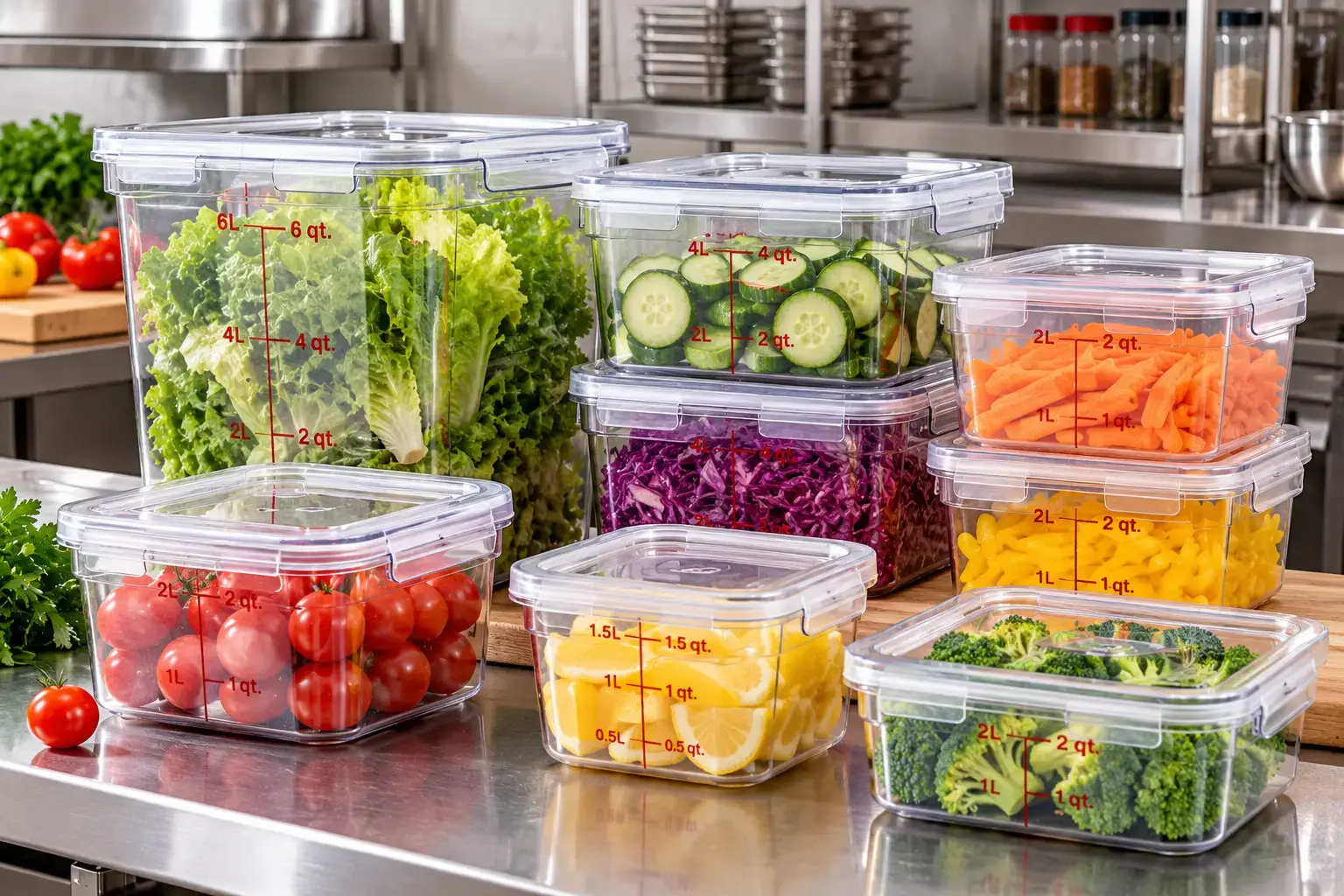
Commercial food storage containers with lids are heavy-duty, food-safe containers (usually polycarbonate, polypropylene, or polyethylene) built for restaurants, caterers, and serious home cooks. They feature snap-tight covers, printed capacity graduations, stackable footprints, and dishwasher-safe construction, and many are certified to NSF standards for commercial foodservice use.
That’s the textbook answer. Here’s the practical one: these are the boxes that quietly decide whether your walk-in looks like a well-run pantry or a game of refrigerator Jenga. Open any busy restaurant cooler and you’ll see the same thing — rows of clear squares and rounds, each wearing a strip of masking tape with a date on it. That’s not an accident. It’s a system built around one simple idea: if you can see it, measure it, and stack it, you can control it.
Commercial food storage containers with lids solve three problems that consumer containers rarely do. First, they survive commercial dishwashers, freezer-to-counter temperature swings, and staff who drop things. Second, their graduations double as measuring tools, so prep cooks can portion straight into storage. Third, they’re built around shared lid sizes and footprints, which means fewer orphaned lids and more usable shelf space.
The rules matter too. The FDA Food Code 2022 — the model most state and local health departments adopt — expects food to be covered, protected from contamination, and date-marked when it’s ready-to-eat and held longer than a day. Good containers make all of that easier rather than harder.
In this guide, you’ll find seven real, widely available options on amazon.com, from budget translucent squares to a rolling ingredient bin, plus honest analysis of what each one does well and where it falls short.
Quick Comparison: The 7 Best Commercial Food Storage Containers with Lids at a Glance
| Product | Material | Shape / Format | Lid Situation | Best for |
|---|---|---|---|---|
| Cambro CamSquares Translucent | Polypropylene | Square, 2–22 qt | Often sold as sets with lids | Cambro CamSquares Translucent: budget-minded kitchens starting a system |
| Cambro CamSquares FreshPro | Camwear polycarbonate (PP version too) | Square, recessed handles | Lids sold separately, FreshPro-only | Cambro CamSquares FreshPro: high-volume prep lines |
| Rubbermaid Commercial Space Saving Square | Polycarbonate (Carb-X) | Square, 2–22 qt | One lid fits 2–8 qt | Rubbermaid Commercial Space Saving Square: hot-and-cold versatility, sous vide |
| Carlisle StorPlus Square | Polycarbonate or polyethylene | Square, handles on small sizes | One lid fits PC and PE bodies | Carlisle StorPlus Square: easy lifting and date tracking |
| Cambro Round Translucent | Polypropylene | Round, 1–22 qt | Commonly sold with lids | Cambro Round Translucent: sauces, stocks, and value packs |
| Cambro Camwear Food Storage Box | Polycarbonate | 18″ x 26″ box, multiple depths | Flat or sliding lid sold separately | Cambro Camwear Food Storage Box: bulk produce and proteins |
| Rubbermaid ProSave Mobile Ingredient Bin | Plastic, on casters | Mobile bin, ~21–31 gal | Sliding lid and scoop included | Rubbermaid ProSave Mobile Ingredient Bin: flour, sugar, rice in bulk |
Looking at the table above, the split is clear: the Cambro CamSquares Translucent and Cambro Round Translucent are the value entry points, while the Rubbermaid Commercial Space Saving Square, Carlisle StorPlus Square, and Cambro CamSquares FreshPro trade a higher per-unit cost for tougher polycarbonate and wider temperature ranges. The Cambro Camwear Food Storage Box and Rubbermaid ProSave Mobile Ingredient Bin aren’t competitors to the squares at all — they solve the bulk-storage problem that quart containers can’t.
💬 Found the comparison useful? One click on a highlighted product helps other shoppers make an informed choice too! 😊
Top 7 Commercial Food Storage Containers with Lids: Expert Analysis
1. Cambro CamSquares Translucent — best budget starter system
If you’re building a storage system from scratch, the Cambro CamSquares Translucent line is the most common place to start, and for good reason. Models like the 4SFSPP (4-quart) and 2SFSPP (2-quart) are made of BPA-free polypropylene, NSF-listed, dishwasher safe, and stain-resistant to food acids, oils, and alcohol. The 4-quart measures about 7-1/4″ square by 7-3/8″ tall with the cover on, so it slides neatly onto standard reach-in shelves.
What this means in practice: the translucent body lets you identify contents at a glance without the crystal clarity (or the price) of polycarbonate. The printed graduations are large enough to read across a cooler, which matters when a line cook is checking pars at 4 p.m. Classic CamSquare lids are designed to fit across the Classic CamSquares line regardless of material, so you can mix translucent bodies with polycarbonate ones as your budget grows.
Who it’s for: new restaurants, food trucks, and home cooks who want commercial behavior without commercial spending. The trade-off is that polypropylene is less rigid and less heat-tolerant than polycarbonate, so it’s not the right pick for hot-filling straight from the stove.
Customer reviews on retailer sites consistently praise durability and stacking, while a recurring complaint involves lid confusion — several buyers report ordering a “recommended” lid that didn’t fit a FreshPro-series container, because the two lines aren’t interchangeable.
Pros:
- ✅ Low cost per quart for a full system
- ✅ Shared lids across Classic CamSquares materials
- ✅ Easy-to-read graduations for quick portioning
Cons:
- ❌ Less rigid than polycarbonate competitors
- ❌ Not compatible with FreshPro-series lids
💲 Multi-packs with lids typically land between $20 and $40 depending on size — check the current price; strong value for a first system.
2. Cambro CamSquares FreshPro — smartest design for busy prep lines
The Cambro CamSquares FreshPro series is Cambro’s redesigned square container, and its improvements target real kitchen friction. The polycarbonate versions use Camwear, rated from -40°F to 210°F, and every size from 2 to 22 quarts has molded-in, recessed handles that Cambro says take up less shelf space than traditional handled containers.
Here’s what those features mean day to day. Recessed handles stop containers from catching on wire shelving — a small thing until you’re pulling a full 22-quart of stock off a top rack. Curved corners allow four-sided pouring, so you don’t have to rotate a heavy container to find “the spout.” Color-coded graduations match the lids and optional drain trays, which help keep proteins elevated out of their own liquid.
Who it’s for: high-volume kitchens that live by color-coding and want fewer spills and dropped containers. The catch is strict compatibility: FreshPro items only fit other FreshPro items, so mixing them with older CamSquares means two lid inventories.
Reviewers on WebstaurantStore highlight the recessed handles and textured grips as genuine upgrades, and note the lids seal very snugly — secure, though harder to pop off one-handed. Opinions are mixed on the polypropylene versions, which some buyers find less clear than the polycarbonate.
Pros:
- ✅ Recessed handles save shelf space
- ✅ Four-sided pouring reduces spills
- ✅ Color-coded lids, graduations, and drain trays
Cons:
- ❌ Lids and containers only work within FreshPro
- ❌ Snug lids can be tough to remove one-handed
💲 Polycarbonate bodies generally run around $10 to $25 each, with lids sold separately — a fair premium for the workflow gains.
3. Rubbermaid Commercial Space Saving Square — widest temperature range for hot and cold
The Rubbermaid Commercial Space Saving Square (for example, the FG630600CLR 6-quart) is built from break-resistant polycarbonate rated from -40°F to 212°F. That top number is the headline: it covers freezer storage, refrigerated holding, and the kind of hot water bath you’d use for sous vide, which is why Rubbermaid markets the line for exactly that.
Rubbermaid says the square shape stores up to 25% more on a shelf than round containers in the same footprint. On paper, that’s the difference between fitting six containers or eight across a reach-in shelf. The measurement graduations are printed in red (US units) and blue (metric), and pocket-style handles have drain holes so they don’t trap rinse water after the dish machine.
The lid strategy is clever. A single white polyethylene lid (FG650900WHT) fits the 2-, 4-, 6-, and 8-quart sizes, with corner pull tabs for easy removal, and a second lid covers the 12- to 22-quart sizes. Fewer lid SKUs mean fewer lost lids.
Who it’s for: kitchens doing sous vide, hot prep, or anyone who wants one container line for freezer to water bath. Be aware that containers are often listed with the lid sold separately on Amazon, so check the listing before you add to cart.
Verified review volume on major retail listings is modest — one Walmart listing shows a 4.5-star average from only a handful of ratings — so treat the feedback as directional; buyers mainly mention stacking and using them for grains and rice.
Pros:
- ✅ Rated -40°F to 212°F for hot and cold use
- ✅ One lid covers four container sizes
- ✅ Nests compactly when empty
Cons:
- ❌ Lids frequently sold separately
- ❌ Higher per-container price than polypropylene
💲 Expect roughly $20 to $40 per container depending on size, plus a few dollars for the lid — good value if you need the heat tolerance.
4. Carlisle StorPlus Square — easiest to lift and track by date
The Carlisle StorPlus Square line is the quiet workhorse of this list. Clear polycarbonate versions (for example, the 1195007 2-quart and 1072307 8-quart) are rated from -40°F to 212°F, NSF listed, dishwasher safe, and made in the USA. Carlisle says it’s the only maker offering square containers in 1- to 8-quart sizes with handles on both sides.
Why that matters: handles on small containers sound trivial until you’re carrying a slippery, wet 8-quart of brined chicken. Easy-grip handles with drain holes, reinforced stacking lugs, and a textured non-slip finish add up to fewer drops. The lids include a writing surface for contents and dates — useful for the date-marking routine the Food Code expects.
Another practical win: one StorPlus lid fits both the polycarbonate and polyethylene bodies of the same size, and Carlisle markets its lids as cross-compatible with some competitors’ containers. Verify the exact sizing before relying on that, but it can rescue you from lid shortages. The lids even have a hanging hole for sanitary drying.
Who it’s for: catering operations, kitchens with older staff or heavy loads, and anyone serious about inventory rotation. Note that the 8-quart is rated for about 7.5 quarts at the fill line and 8 quarts rim-full.
Large-volume, verifiable customer review data for this specific line was limited during research, so we can’t summarize a reliable consumer consensus; the analysis here is based on Carlisle’s published specifications.
Pros:
- ✅ Handles on both sides of small sizes
- ✅ Built-in date and content writing area
- ✅ One lid fits polycarbonate and polyethylene bodies
Cons:
- ❌ Fewer verified consumer reviews to judge long-term wear
- ❌ Lids are typically purchased separately
💲 Single containers usually fall between $8 and $30 depending on size; solid value for the handling advantages.
5. Cambro Round Translucent — best value for liquids and sauces
The Cambro Round Translucent containers (like the RFS4PP190 4-quart) are probably the most recognizable containers in American restaurant kitchens. They’re made of durable, stain-resistant polypropylene, NSF listed, BPA-free, dishwasher safe, and rated from roughly -40°F to 160°F. The 4-quart measures about 8-3/16″ across and 8-9/16″ tall.
What that means in practice: round containers are naturally better for liquids. There are no corners for sauce or stock to cling to, so they pour more cleanly and scrape out more completely. Retail listings also note that the round shape promotes air circulation around the container, which can help product chill more evenly in a walk-in. The trade-off is wasted shelf space between circles compared with squares.
The 160°F ceiling is the key limitation. Let soups and stocks cool before they go in — which you should be doing anyway under the Food Code’s two-stage cooling rules.
Who it’s for: kitchens storing sauces, dressings, stocks, and brines, plus home bakers who want inexpensive, durable proofing and storage tubs.
Real aggregated sentiment is strong. At the time of writing, a Walmart listing for the 4-quart 3-pack shows a rating near 4.9 stars from a few hundred reviews, and a Sam’s Club 6-quart 2-pack shows about 4.8 stars from close to 900 ratings, with the vast majority at five stars.
Pros:
- ✅ Excellent for pouring and scraping liquids
- ✅ Very strong ratings across major US retailers
- ✅ Inexpensive multi-packs with lids
Cons:
- ❌ Lower 160°F heat limit
- ❌ Round shape wastes shelf space versus squares
💲 Multi-packs typically sit between $15 and $35 — check the current price; arguably the best value per quart on this list.
6. Cambro Camwear Food Storage Box — top pick for bulk produce and proteins
When quart containers stop making sense, you graduate to the Cambro Camwear Food Storage Box. These 18″ x 26″ boxes come in several depths — from about 3-1/2″ up to 15″, the deepest holding roughly 22 gallons — and are made of clear Camwear polycarbonate rated from -40°F to 210°F. They’re NSF listed and made in the USA.
Practically, an 18″ x 26″ footprint matches full-size sheet pan racks, so these boxes slide into rack systems and walk-in shelving you probably already own. The polycarbonate resists stains and odors, which matters if the box holds onions one week and fish the next. Matching lids include a flat cover (1826CCW135) for stacking and a SlidingLid (1826SCCW135) that lets staff grab product without fully removing the cover.
Who it’s for: restaurants receiving cases of produce, butchers and barbecue joints brining or holding whole cuts, and caterers moving bulk items. Cambro also sells a colander kit that pairs a box with a drain insert — handy for washed greens.
Reviews summarized on WebstaurantStore indicate most buyers find the lids fit securely, though some mention occasional fit issues — a reminder to buy matching Cambro lids rather than mixing brands.
Pros:
- ✅ Fits standard 18″ x 26″ rack systems
- ✅ Resists odors and stains from strong foods
- ✅ Sliding lid option speeds access
Cons:
- ❌ Lids sold separately add to the cost
- ❌ Too large for most home refrigerators
💲 Boxes generally range from about $25 to $70 depending on depth, with lids in the $15 to $30 range; excellent long-term value for bulk storage.
7. Rubbermaid ProSave Mobile Ingredient Bin — best bulk dry storage on wheels
The Rubbermaid ProSave Mobile Ingredient Bin (for example, the 21-gallon FG360088WHT, with 26-gallon and roughly 31-gallon versions) is a different animal: a rolling bin built for flour, sugar, rice, and grains. It features a slant-front design, a clear sliding lid, smooth-rolling casters, and an included 32-ounce scoop.
Here’s why those details matter. The sliding lid opens with one hand, so a baker can scoop while holding a bowl. The clear window lets you check levels without opening the bin and letting humidity in. Most importantly, the scoop hook system keeps the scoop stored inside the bin — off the product — which supports the food code expectation that utensils aren’t left buried in bulk ingredients. Casters let you roll it under a prep table or out for cleaning.
Who it’s for: bakeries, pizzerias, and any operation buying dry goods by the 50-pound bag. Rubbermaid also makes a 12.6-gallon ProSave shelf bin whose lid opens even when bins are stacked, which suits smaller kitchens.
Verified customer review volume on these bins is limited on major retail listings, so we can’t report a dependable consensus. What’s verifiable is the design intent and specifications from Rubbermaid’s published product data.
Pros:
- ✅ One-handed sliding lid with clear window
- ✅ Built-in scoop storage keeps utensils off food
- ✅ Casters make cleaning and repositioning easy
Cons:
- ❌ Significant upfront investment
- ❌ Large footprint for small kitchens
💲 Prices vary widely by capacity and seller, roughly $250 to $550 — check the current price; worth it if you move bulk dry goods daily.
Head-to-Head Spec Comparison
| Product | Temp Range (approx.) | NSF | Lids Included? | Price Range |
|---|---|---|---|---|
| Cambro CamSquares Translucent | Polypropylene range; check listing | Yes | Often in sets | $20–$40 per set |
| Cambro CamSquares FreshPro | -40°F to 210°F (PC) | Yes | Usually separate | $10–$25 each |
| Rubbermaid Commercial Space Saving Square | -40°F to 212°F | Yes | Usually separate | $20–$40 each |
| Carlisle StorPlus Square | -40°F to 212°F (PC) | Yes | Usually separate | $8–$30 each |
| Cambro Round Translucent | -40°F to 160°F | Yes | Often in sets | $15–$35 per set |
| Cambro Camwear Food Storage Box | -40°F to 210°F | Yes | Separate | $25–$70 box |
| Rubbermaid ProSave Mobile Ingredient Bin | Dry storage use | Varies by part | Yes, with scoop | $250–$550 |
The spec table shows that heat tolerance is the real dividing line: if anything hot goes in, the Rubbermaid Commercial Space Saving Square, Carlisle StorPlus Square, and Cambro CamSquares FreshPro are the safe bets, while the Cambro Round Translucent belongs in cold-only duty. Also notice how often lids are sold separately — when budgeting, add the lid cost to every polycarbonate container before comparing prices.
✨ Don’t miss these kitchen-ready picks!
🔍 Take your food storage to the next level with this carefully curated lineup. Click a highlighted item to check current pricing and availability. These picks will help you get a cleaner, safer, better-organized kitchen your whole team will appreciate!
Getting Started: Building a Container System That Actually Works
Buying containers is easy. Building a system — one that survives a Saturday night rush — takes a little planning. Here’s a practical setup sequence.
Step 1: Standardize on one or two lid families
Every additional lid size is another thing to lose. The Rubbermaid Commercial Space Saving Square covers 2- to 8-quart sizes with one lid, and Classic CamSquares lids fit across that line’s materials. Pick a family and stick with it.
Step 2: Match sizes to real prep volumes
Look at your prep list, not the catalog. Diced onions for a day? Probably a 6- or 8-quart. House dressing? A 4-quart round. Buying “one of everything” creates half-empty containers that waste shelf space.
Step 3: Set up labeling from day one
Keep a roll of removable labels or painter’s tape and a marker at every station. Write the item, the prep date, and the discard date. The Carlisle StorPlus Square lids have a built-in writing area, which helps.
Step 4: Establish FIFO shelving
Put new product behind or below old product. It sounds obvious; it’s the most commonly broken rule in any cooler.
First 30 days: common mistakes
- ✅ Run every new container through the dishwasher before first use
- ✅ Don’t hot-fill polypropylene above its rated temperature
- ✅ Don’t stack containers without lids — rims scratch and crack
- ✅ Air-dry lids fully before snapping them on to avoid trapped moisture
Real-World Scenarios: Matching Containers to Your Operation
The “best” container depends entirely on what you cook, how much, and where it lives. Here are three realistic profiles.
Scenario 1: The 40-seat neighborhood bistro
Budget: around $300–$500 for a starter set. Use: daily prep, two reach-ins, one small walk-in. A bistro this size benefits most from a square system for prepped vegetables and proteins plus rounds for sauces. A mix of Cambro CamSquares Translucent (6- and 8-quart) and Cambro Round Translucent (2- and 4-quart) keeps costs down. Add two or three Cambro Camwear Food Storage Box units for produce deliveries. Reasoning: low cost, broad coverage, and the translucent lines are easy to replace as they wear.
Scenario 2: The sous vide–heavy modern kitchen
Budget: $600+. Use: hot water baths, rapid chilling, high turnover. Here, heat tolerance is non-negotiable. The Rubbermaid Commercial Space Saving Square is rated to 212°F, and its graduations double as measuring tools for brines. Pair it with Cambro CamSquares FreshPro for cold storage where color-coding by protein reduces cross-contamination. Reasoning: polycarbonate handles the temperature swings that would stress polypropylene.
Scenario 3: The pizza shop or home micro-bakery
Budget: $300–$700. Use: 50-pound bags of flour weekly, dough proofing. Start with a Rubbermaid ProSave Mobile Ingredient Bin for flour and a second for semolina or sugar. For dough proofing and portioned toppings, Carlisle StorPlus Square containers with handles make lifting dense dough easier. Reasoning: bulk dry storage with scoop management is where this operation loses the most time, so that’s where the money goes first.
Notice the pattern: each scenario combines one bulk solution, one everyday square line, and one specialty piece. That three-tier approach scales from a home kitchen to a 200-cover restaurant.
Problem → Solution: Fixing the Most Common Storage Headaches
Every kitchen runs into the same handful of problems. Here’s how the right containers solve them.
Problem 1: “We can never find the matching lid.” ✅ Solution: Consolidate to a lid family with shared sizes. The Rubbermaid Commercial Space Saving Square uses one lid for four sizes; the Carlisle StorPlus Square uses one lid for both polycarbonate and polyethylene bodies of the same size. Store lids vertically in a dish rack, sorted by size.
Problem 2: “Our containers smell like garlic forever.” ✅ Solution: Polycarbonate resists odors and stains better than many cheaper plastics. The Cambro Camwear Food Storage Box and Cambro CamSquares FreshPro are good picks for alliums and fish. Wash promptly and avoid letting strongly flavored food sit in containers for days.
Problem 3: “Shelves are always overcrowded.” ✅ Solution: Move from round to square containers for solids. Rubbermaid’s own figure is up to 25% more storage on the same shelf. Keep rounds for liquids, where they pour better.
Problem 4: “Containers crack after a few months.” ✅ Solution: Check temperature limits. Polypropylene rounds rated to 160°F shouldn’t take boiling stock. Also stop stacking unlidded containers, which concentrates stress on the rims.
Problem 5: “The flour bin is a mess and the scoop is always buried.” ✅ Solution: The Rubbermaid ProSave Mobile Ingredient Bin stores its scoop on a hook inside the bin, keeping the handle off the product and making the bin easier to keep clean.
How to Choose Commercial Food Storage Containers with Lids
Choosing the right commercial food storage containers with lids comes down to seven decisions. Work through them in order.
- Decide hot or cold. If anything goes in above 160°F, choose polycarbonate rated to around 210–212°F. Polypropylene is fine for cold storage only.
- Pick your material. Polycarbonate is glass-clear, rigid, and impact resistant. Polypropylene is cheaper and translucent. Polyethylene is flexible, opaque, and tough. Each has a place.
- Choose square for solids, round for liquids. Squares maximize shelf space; rounds pour and scrape more cleanly.
- Confirm NSF certification. Look for the NSF mark if a health inspector will see your kitchen. It signals the container meets recognized sanitation standards for commercial food contact.
- Check lid compatibility before buying. Lines like Cambro CamSquares FreshPro only fit their own lids. Mixing lines creates lid chaos.
- Size to your workflow. Buy for actual prep volumes, then add one size up for overflow.
- Budget for lids and labels. Many polycarbonate containers ship without lids. Factor that in before comparing prices.
If you remember only one rule, make it the first: temperature rating decides material, and material decides almost everything else — price, clarity, durability, and lifespan.
Commercial vs. Consumer Containers: Is the Upgrade Worth It?
It’s tempting to grab a 24-piece consumer set from the grocery aisle. For a home pantry, that may be fine. For anything resembling commercial use — or a home cook who batch-preps weekly — commercial food storage containers with lids pull ahead quickly.
| Feature | Commercial Containers | Typical Consumer Sets | Best for |
|---|---|---|---|
| Durability | Built for daily commercial dishwashing | Often top-rack only | Commercial: Cambro Camwear Food Storage Box |
| Graduations | Printed in quarts and liters | Usually none | Commercial: Rubbermaid Commercial Space Saving Square |
| Lid system | Shared sizes across a line | Unique lid per container | Commercial: Carlisle StorPlus Square |
| Certification | Often NSF listed | Rarely certified | Commercial for any inspected kitchen |
| Replacement | Sold individually for years | Sets get discontinued | Commercial: Cambro CamSquares Translucent |
The table shows that the biggest difference isn’t toughness — it’s replaceability and standardization. Commercial lines stay in production for years, so you can replace one cracked 6-quart instead of buying a whole new set. The graduations also turn containers into measuring tools, which cuts down on extra measuring cups to wash.
The trade-off? Commercial containers are less attractive and less compact for a home fridge. Consumer containers win on aesthetics and nesting variety. But if you prep in quantity, the switch usually pays for itself within a year through fewer replacements and less wasted food.
Features That Actually Matter (and Ones That Don’t)
Marketing copy on storage containers can get breathless. Here’s how to separate useful features from noise.
Features that matter
- Temperature rating. This determines what you can safely put in the container. It’s the first spec to check.
- Graduations you can read across a room. Large, high-contrast numbers save time during inventory counts.
- Lid compatibility across sizes. Fewer lid SKUs mean fewer lost lids — a daily headache in busy kitchens.
- Handles with drain holes. They make wet containers safer to carry and prevent trapped water after washing.
- Stain and odor resistance. Essential if containers rotate between garlic, fish, and fruit.
Features that matter less than you’d think
- “Airtight” claims. Commercial snap lids are designed to be tight and leak-resistant, but few are true vacuum seals. For dry goods, a good snap lid is plenty.
- Color variety for its own sake. Color-coding is valuable only if your team actually follows a protein or allergen color scheme. Otherwise, it’s decoration.
- Microwave-safe labels. Most commercial kitchens don’t microwave in storage containers, and polycarbonate generally isn’t recommended for it.
Square vs. round: the real answer
Squares win for shelf efficiency and stacking solids. Rounds win for liquids, sauces, and stocks. Most kitchens need both — roughly 70% squares and 30% rounds is a sensible starting ratio.
Safety, Regulations, and Standards for Commercial Food Storage
Containers aren’t regulated in isolation; they’re part of a kitchen’s overall food safety system. Here’s what matters for US operators.
NSF certification
NSF International develops widely used food equipment standards, including NSF/ANSI 2 for food equipment, which sets sanitation requirements for materials, design, and construction. An NSF-listed container has been evaluated for cleanability and suitability for commercial food contact. Most health inspectors look for it on equipment in commercial kitchens.
The FDA Food Code
Most states base their retail food rules on the FDA Food Code. Key provisions that touch storage containers include:
- Cold holding: time/temperature control for safety (TCS) foods held at 41°F or below.
- Date marking: ready-to-eat TCS foods held more than 24 hours must be date-marked and used within 7 days at 41°F or below.
- Cooling: cooked foods must drop from 135°F to 70°F within 2 hours and to 41°F within a total of 6 hours.
- Protection from contamination: food must be covered and stored to prevent cross-contamination, with raw proteins below ready-to-eat items.
BPA and materials
Many polypropylene and polyethylene containers are marketed as BPA-free. Polycarbonate is made using bisphenol A; commercial polycarbonate containers are sold for food contact, but if BPA is a concern for you, polypropylene and polyethylene lines are the alternative. Check each manufacturer’s current material statement.
State variations
Adoption of the Food Code varies by state and county, so always confirm the specific requirements with your local health department.
Long-Term Cost and Maintenance: What You’ll Really Spend
The sticker price is only part of the story. Lids, replacements, and lost product add up.
| Product | Upfront Cost Range | Expected Lifespan* | Value Verdict | Best for |
|---|---|---|---|---|
| Cambro CamSquares Translucent | Low | Moderate | Great entry value | Cambro CamSquares Translucent: tight budgets |
| Cambro Round Translucent | Low | Moderate | Best per-quart value | Cambro Round Translucent: cold liquids |
| Rubbermaid Commercial Space Saving Square | Mid | Long | Pays off with hot use | Rubbermaid Commercial Space Saving Square: versatility |
| Carlisle StorPlus Square | Mid | Long | Strong for heavy handling | Carlisle StorPlus Square: catering |
| Rubbermaid ProSave Mobile Ingredient Bin | High | Very long | Worth it for daily bulk use | Rubbermaid ProSave Mobile Ingredient Bin: bakeries |
*Lifespan is a qualitative estimate based on material properties and use conditions, not a manufacturer guarantee.
The table makes the core trade-off visible: polypropylene costs less upfront but tends to be replaced sooner under heavy use, while polycarbonate’s higher price is spread over a longer life. For a kitchen washing containers multiple times daily, the Rubbermaid Commercial Space Saving Square or Carlisle StorPlus Square can end up cheaper per year than buying translucent containers twice.
Maintenance tips that extend lifespan
- Avoid abrasive scouring pads, which scratch polycarbonate and create spots for bacteria to hide.
- Follow the manufacturer’s chemical guidance; some harsh cleaners can weaken certain plastics over time.
- Let containers cool before stacking them after a hot dish cycle.
- Retire containers with deep cracks or cloudy, crazed surfaces.
Common Mistakes to Avoid When Buying Commercial Food Storage Containers
Even experienced operators make these errors. Avoiding them saves money and frustration.
Mistake 1: Ignoring lid compatibility. This is the most common complaint in customer reviews. Buyers order the “recommended” lid only to find it fits a different series. Always match series names — CamSquares Classic and FreshPro, for example, don’t mix.
Mistake 2: Assuming lids are included. Many polycarbonate containers on Amazon are listed with “lid sold separately” in the fine print. Read the title carefully before checkout.
Mistake 3: Buying all one size. Six 22-quart containers won’t help when you need to store a pint of aioli. Spread purchases across sizes based on real prep volumes.
Mistake 4: Hot-filling polypropylene. The Cambro Round Translucent line is rated to about 160°F. Pouring boiling stock into it shortens its life and risks deformation.
Mistake 5: Skipping NSF for “home use” that’s actually commercial. If you sell food — at a farmers market, cottage bakery, or pop-up — inspectors may care. Buy NSF-listed from the start.
Mistake 6: Underestimating bulk storage. Kitchens often buy dozens of quart containers and then store flour in its original paper bag on the floor. A proper ingredient bin like the Rubbermaid ProSave Mobile Ingredient Bin solves a bigger problem than another ten squares would.
Restaurant Food Storage Containers for Small Operations and Home Cooks
You don’t need a 100-seat restaurant to benefit from restaurant food storage containers. Food trucks, cottage bakers, meal-preppers, and large families all fit the profile.
For food trucks: space is everything. Square containers in 2- to 6-quart sizes maximize tight reach-ins, and shared lids reduce clutter. The Cambro CamSquares FreshPro recessed handles help when every inch of shelf counts.
For cottage bakers: a 12.6-gallon ProSave shelf bin or a couple of Carlisle StorPlus Square containers handle flour and sugar without needing a full mobile bin. Handles help when moving heavy dough.
For serious home meal-preppers: the Cambro CamSquares Translucent 2- and 4-quart sizes fit standard home refrigerators well, and graduations let you batch soups and grains precisely. The Cambro Round Translucent 4-quart is a favorite for homemade stock (cooled first).
For large families: bulk-buying rice, oats, and beans is where commercial containers shine. A pair of 18- or 22-quart squares often replaces a cabinet full of mismatched bags.
The common thread: commercial containers bring durability and standardization to any kitchen that cooks in volume, regardless of whether there’s a health inspector involved.
FAQ: Commercial Food Storage Containers with Lids
❓ Are commercial food storage containers with lids dishwasher safe?
❓ Which size food storage container should a restaurant buy first?
❓ Can you put hot food in commercial food storage containers?
❓ Do Cambro lids fit Rubbermaid containers?
❓ Are NSF food storage containers worth the extra cost for home use?
Conclusion: Building a Smarter Kitchen, One Container at a Time
The right commercial food storage containers with lids don’t just hold food — they shape how your kitchen runs. Clear, graduated, stackable containers make inventory faster, reduce waste, and support the cold-holding and date-marking habits that health codes expect.
If you’re starting from zero, the Cambro CamSquares Translucent and Cambro Round Translucent give you the most coverage for the least money. If heat tolerance and durability matter more, the Rubbermaid Commercial Space Saving Square and Carlisle StorPlus Square earn their premium. For workflow-obsessed prep lines, the Cambro CamSquares FreshPro is the most thoughtfully designed of the bunch. And for bulk storage, the Cambro Camwear Food Storage Box and Rubbermaid ProSave Mobile Ingredient Bin solve problems no quart container can.
Before you buy, remember the essentials: decide hot or cold, standardize on one lid family, confirm NSF listing, and budget for lids. Keep the FoodSafety.gov cold food storage chart handy for storage time guidance, and label everything with a date.
Get those basics right, and your cooler will stop being a puzzle and start being a system.
🚀 Ready to upgrade your storage?
🛒 Click any highlighted product above to check current pricing and availability on Amazon. Pick the containers that match your menu, and turn your fridge into the organized, inspection-ready system your kitchen deserves!
Recommended for You
- Meal Prep Meat: 7 Best Tools to Cook and Store It Safely (2026)
- Anchor Containers: 7 Best Glass Picks for Smarter Storage (2026)
- 16 ounce plastic containers with lids: 7 Best Leakproof Picks (2026)
Disclaimer: This post contains affiliate links. As an Amazon Associate, I earn from qualifying purchases made through these links, at no additional cost to you.
✨ Found this article helpful? Share it with someone who needs it! 💬🤗