
In This Article
If you’ve ever stood in the canning aisle staring at a wall of glass, you already know the problem: not every jar is built for every job. 8 oz mason jars with lids — sometimes labeled “half-pint” jars — are the unsung workhorses of the kitchen, sized perfectly for small-batch jam, spice storage, salad dressing, wedding favors, and portioned meal prep. They’re small enough that nothing goes to waste, yet sturdy enough to survive a boiling-water canner, a freezer, and a dishwasher cycle without complaint.
This guide skips the fluff you’d get from an Amazon listing. Instead, you’ll get honest, spec-backed analysis of seven real half-pint jar sets, a breakdown of how regular mouth compares to wide mouth, and practical guidance pulled from university extension research and safety standards — not marketing copy. Whether you’re canning your first batch of pepper jelly or building a pantry of matching spice jars, you’ll walk away knowing exactly which set fits your kitchen, your budget, and your project.
What Is an 8 Oz Mason Jar?
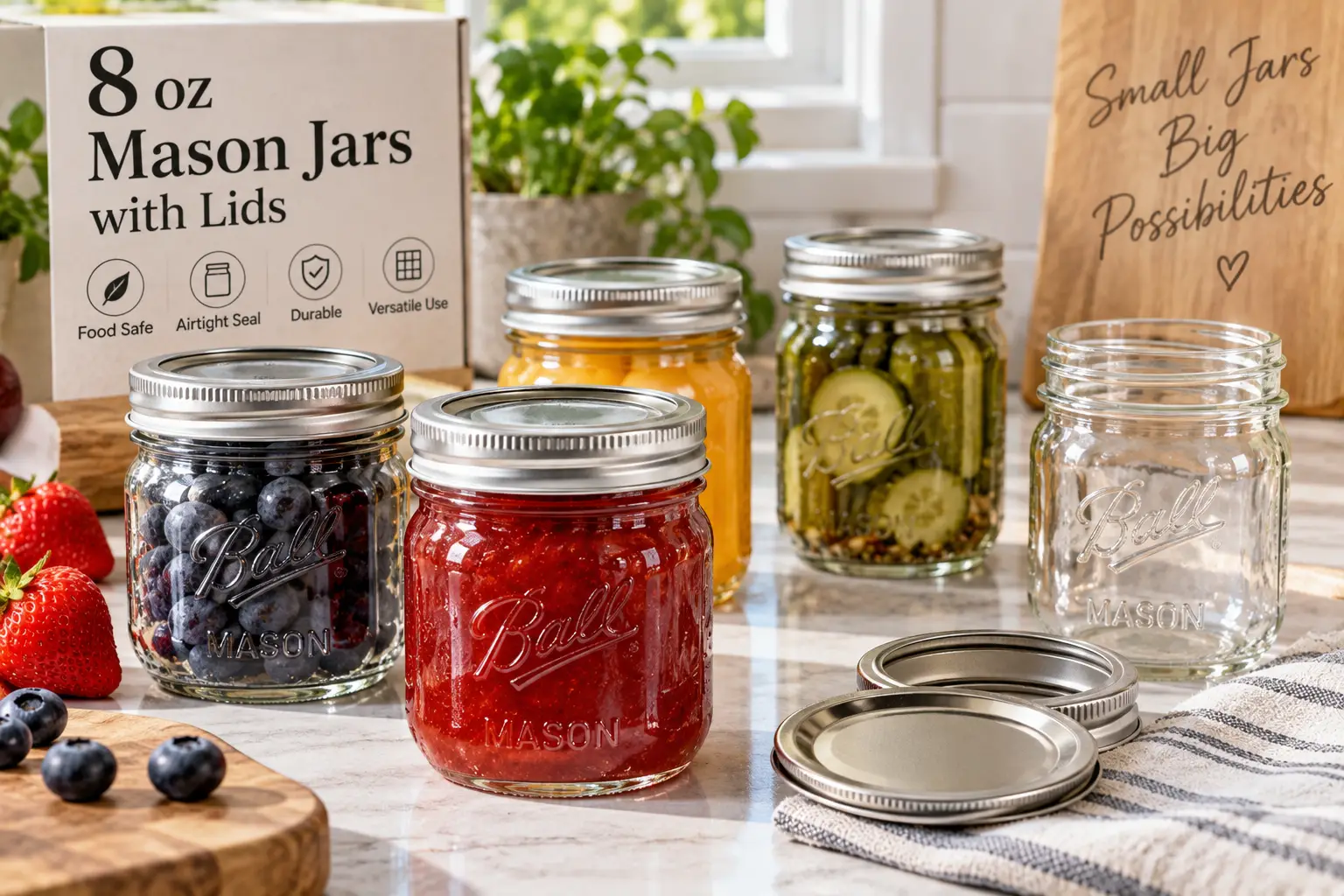
An 8 oz mason jar — also called a half-pint jar — is a small glass canning jar holding 8 fluid ounces (about 237 ml), roughly 2.5 inches wide and 2.5–3 inches tall depending on the brand. It comes in regular mouth or wide mouth styles, uses a two-piece lid (flat lid plus screw band), and is the standard size US home canners use for jams, jellies, and single-serving portions.
The design traces back to the original Mason jar patented in the 1850s, and while today’s glass and lid technology has improved, the core screw-top concept hasn’t changed much — which is exactly why modern half-pint jars from Ball, Kerr, and newer entrants (more on those below) still work interchangeably with lids and bands from a century of jar-making history. You’ll also see this size marketed as “8 oz glass jars with lids,” “small mason jars for canning,” or simply “half pint mason jars with lids” — they’re the same product, just described differently by different sellers.
Quick Comparison: Best 8 Oz Mason Jars With Lids at a Glance
Before diving into the full reviews, here’s a fast snapshot of how the seven jars stack up on the factors that matter most: mouth style, best use case, and approximate price range.
| Jar | Mouth Style | Best For | Price Range |
|---|---|---|---|
| Ball Wide Mouth Half-Pint | Wide | All-around canning & storage | $12–$18 (12-pack) |
| Kerr Wide Mouth Half-Pint | Wide | Fresh preserving, longer seal life | $13–$19 (12-pack) |
| Ball Regular Mouth Half-Pint | Regular | Classic jam & jelly canning | $10–$16 (12-pack) |
| FORJARS Premium 8 oz | Regular | Bulk gifting & crafts | $20–$26 (12-pack) |
| JoyJolt 8 Oz With Labels & Measures | Wide | Meal prep, overnight oats, gifting | $22–$28 (6-pack) |
| KAMOTA Wide Mouth 8 oz | Wide | Budget bulk favors & crafts | $18–$24 (12-pack) |
| ComSaf Wide Mouth 8 oz | Wide | Beginners, small first batches | $14–$19 (6-pack) |
Looking at the table, a clear pattern emerges: the legacy canning brands ( Ball and Kerr ) sit in the mid-price range and earn their reputation through consistent sealing performance, while newer entrants like JoyJolt and FORJARS charge a premium for extras — printed labels, measurement markings, or heavier glass — that legacy brands don’t bundle in. If you just need reliable jars for a first canning batch, the budget-tier options ( ComSaf and KAMOTA ) hold their own, but they trade off some of the glass consistency you get from the century-old manufacturers.
💬 One click helps other shoppers make an informed choice too! 😊
Top 7 8 Oz Mason Jars With Lids — Expert Analysis
Before the individual breakdowns, here’s a fuller side-by-side look at how these seven half-pint jars compare on the specs that actually affect how they perform in your kitchen.
| Jar | Glass Origin | Lid Type | Pack Size | Dishwasher Safe | Rating Trend |
|---|---|---|---|---|---|
| Ball Wide Mouth Half-Pint | Made in USA | Two-piece flat lid + band | 4 or 12 | Yes | Consistently high |
| Kerr Wide Mouth Half-Pint | Made in USA | Sure-Tight two-piece lid | 12 | Yes | Consistently high |
| Ball Regular Mouth Half-Pint | Made in USA | Two-piece brushed-silver lid | 12 | Yes | Consistently high |
| FORJARS Premium 8 oz | Imported | Two-piece flat lid + band | 12 | Yes | Generally positive |
| JoyJolt 8 Oz With Labels & Measures | Imported | One-piece airtight lid | 6 | Yes | Generally positive |
| KAMOTA Wide Mouth 8 oz | Imported | Two-piece flat lid + band | 12 | Yes | Mixed on lid seal |
| ComSaf Wide Mouth 8 oz | Imported | Two-piece flat lid + band | 6 | Yes | Generally positive |
This table tells you something the individual listings won’t: the two American-made legacy brands consistently show fewer complaints about lid seating and glass consistency, which matters most if you’re processing jars in a boiling-water canner where a hairline flaw can cause a seal failure. The imported jars, by contrast, tend to win on price-per-jar and creative extras (labels, measuring lines) but ask you to inspect each jar’s rim more carefully before you can with them.
1. Ball Wide Mouth Half-Pint Mason Jars — the benchmark wide mouth pick
The wide 3-inch opening is what earns this jar its reputation: you can get a spoon, a small ladle, or even your fingers in to pack, scoop, or clean without a funnel. That single design choice is why so many home canners default to it for anything chunky — think relish, salsa, or diced fruit — where a narrow neck would mean scraping food off the jar’s threads. Made-in-USA glass and a two-piece lid system (flat lid plus metal screw band) give it the classic canning look, and the glass itself is noticeably more uniform in thickness than the imported alternatives on this list, which reduces the risk of hairline stress cracks during processing.
Reviews consistently report that these jars seal reliably straight out of the box for water-bath canning, and that the wide mouth makes cleanup meaningfully faster than regular mouth jars. A recurring critique in customer feedback is that the screw bands can develop light rust spots if stored wet, so drying bands thoroughly before shelving is worth the extra 30 seconds. This is the safest default pick for a first-time canner who doesn’t yet know whether they’ll prefer wide or regular mouth. At around $12–$18 for a 12-pack, it’s a fair value for jars you’ll likely keep refilling for years — the glass itself, absent chips or cracks, is reusable indefinitely.
Pros:
- ✅ Wide 3-inch mouth speeds up filling and cleanup
- ✅ Made-in-USA glass with consistent wall thickness
- ✅ Reliable seal performance reported across reviews
Cons:
- ❌ Metal bands can rust if not fully dried before storage
- ❌ Slightly pricier per jar than imported bulk alternatives
2. Kerr Wide Mouth Half-Pint Mason Jars — best for longer seal retention
Kerr and Ball are sister brands under the same parent company, which shows in nearly identical glass quality — but Kerr differentiates itself with its “Sure-Tight” lid technology, engineered specifically to extend how long a sealed jar stays vacuum-tight in storage. In practice, that means less second-guessing when you pull a jar of preserves off the shelf ten months later. The wide mouth opening carries over the same filling and cleaning advantages as the Ball version, and the jar’s printed volume markings on the glass make portioning liquids or dry goods straightforward without a separate measuring cup.
The manufacturer’s own guidance states the improved lids are designed to help keep canned food sealed for up to 18 months, which lines up with what canners report anecdotally when jars are processed and stored correctly. Reviews frequently mention the wide mouth as the standout feature, with several buyers noting it made packing sauces and salsas noticeably easier than narrower alternatives. On the downside, some reviewers note the lids are single-use by design (a standard canning-safety practice, not a defect), so you’ll want to budget for replacement lids each canning season rather than reusing the flats indefinitely. Priced around $13–$19 for a 12-pack, it’s a strong pick if extended pantry storage — rather than quick refrigerator jams — is your priority.
Pros:
- ✅ Sure-Tight lids built for longer sealed shelf life
- ✅ Wide mouth simplifies filling thick or chunky foods
- ✅ Printed volume markings aid accurate portioning
Cons:
- ❌ Flat lids are single-use, adding a recurring cost
- ❌ Nearly identical to Ball, so little differentiation beyond the lid
3. Ball Regular Mouth Half-Pint Mason Jars — the classic jam and jelly choice
The narrower 2.5-inch regular-mouth opening isn’t a downgrade — it’s a deliberate trade-off that favors liquids and semi-liquids like jelly, syrup, and vinegar-based pickles, where a wide mouth just means more surface area to wipe clean before sealing. The brushed-silver two-piece lid gives it a slightly more polished look than the plain tin lids on older canning jars, which matters if you’re gifting these rather than just storing pantry staples. Like its wide-mouth sibling, the glass is US-made and holds up to repeated freezer, microwave, and dishwasher cycles without clouding.
What most buyers overlook with this style is that the narrower opening actually improves the vacuum seal’s mechanical reliability slightly, since there’s less lid surface area for imperfections to affect — a detail that matters more for jelly and juice canning than for chunky preserves. Aggregated reviews describe the seal as dependable, and multiple buyers specifically call these “the standard when it comes to canning jars,” reflecting decades of brand trust. A common complaint in customer reviews is that the narrow mouth makes packing whole small fruits (like whole cherry tomatoes) more fiddly than the wide-mouth version. At roughly $10–$16 per 12-pack, this is typically the most budget-friendly of the two Ball options.
Pros:
- ✅ Excellent for jellies, syrups, and other liquids
- ✅ Polished brushed-silver lid look, good for gifting
- ✅ Slightly more affordable than the wide-mouth version
Cons:
- ❌ Narrow opening slows down packing chunky foods
- ❌ Harder to clean by hand than wide-mouth jars
4. FORJARS Premium 8oz Mason Jars — best for bulk crafts and gifting
FORJARS positions itself squarely at the DIY and gifting market rather than serious canners, and the spec sheet backs that up: a 12-pack of regular-mouth jars finished with a clean, embossed glass pattern that photographs well for wedding favors, candle pours, or spice organization. The two-piece lid and band system is functionally similar to the legacy brands, but the glass is imported, which is reflected in a noticeably higher price point relative to Ball or Kerr for the same jar count — you’re paying for presentation, not necessarily performance.
Where this jar earns its “premium” label is consistency of finish — reviewers highlight that the glass looks and feels more refined out of the box than typical bargain-bin jars, with fewer visible seams or bubbles. That’s a real advantage if these are going on display at a wedding or a farmers market table. On the practical side, honest analysis of the spec sheet suggests these are food-safe and BPA-free like the rest of this list, but they aren’t marketed with the same canning-specific guarantees as Ball or Kerr, so cautious canners should still follow standard processing guidelines rather than relying on brand reputation alone. At $20–$26 for a 12-pack, the value proposition depends entirely on whether aesthetics matter for your project.
Pros:
- ✅ Clean, photogenic embossed glass finish
- ✅ BPA-free and food-safe two-piece lid system
- ✅ Well suited to gifting, favors, and craft projects
Cons:
- ❌ Priced higher than Ball or Kerr for a comparable pack size
- ❌ Fewer canning-specific guarantees than legacy brands
5. JoyJolt 8 Oz Mason Jars With Labels and Measures — best for meal prep and gifting sets
JoyJolt takes a different approach entirely: instead of competing on canning credentials, this 6-pack bundles wide-mouth jars with printed chalkboard-style labels and built-in measurement markings on the glass, clearly targeting the overnight-oats, sourdough-starter, and salad-jar crowd rather than traditional preservers. The one-piece airtight lid (rather than the two-piece flat-and-band system) trades canning compatibility for daily convenience — it seals tightly for refrigerator storage but isn’t designed for boiling-water processing.
What sets this apart, practically speaking, is that the built-in measuring lines mean you don’t need a separate liquid measuring cup for portioning overnight oats or salad dressing — a small feature, but one that reviewers repeatedly single out as genuinely useful rather than gimmicky. Aggregated customer sentiment describes the labels as a nice touch for organizing a fridge or pantry, though a few buyers note the chalkboard labels can smudge if wiped with a wet cloth before the ink fully cures. If you’re not canning and instead want attractive glass storage for daily kitchen use, this is one of the more thoughtfully designed options here. At $22–$28 for 6 jars, it’s the priciest per-jar option on this list, but the accessories justify some of that premium for the right buyer.
Pros:
- ✅ Built-in measurement lines reduce need for extra tools
- ✅ Included labels help organize meal-prep or pantry jars
- ✅ Airtight lid performs well for fridge storage
Cons:
- ❌ One-piece lid isn’t rated for boiling-water canning
- ❌ Highest price per jar among the seven options
6. KAMOTA Wide Mouth 8 oz Mason Jars — best budget bulk pick
KAMOTA’s pitch is straightforward: a 12-pack of wide-mouth jars with embossed volume marks, priced to undercut the legacy brands while still hitting the basics — BPA-free glass, two-piece lids, dishwasher and freezer safety. For DIY projects, spice organization, or wedding favors where you need a dozen matching jars without a big spend, that’s a genuinely useful trade-off.
Honest analysis of the review pattern shows a wider spread of experiences than the top-tier brands: many buyers report the jars perform exactly as expected for storage and crafts, but a noticeable minority mention lids that don’t seat as snugly out of the box, which matters if you intend to can with them rather than simply store dry goods or trinkets. That’s a meaningful distinction — for non-canning use (dry spice storage, candle pours, craft supplies) inconsistent lid seating is a non-issue, but if boiling-water canning is your goal, budget imports deserve a closer rim inspection before use, per standard canning-safety practice from extension services. At $18–$24 for a 12-pack, the per-jar cost undercuts FORJARS while still beating rock-bottom no-name listings on glass consistency.
Pros:
- ✅ Strong value for a 12-pack of wide-mouth jars
- ✅ Embossed volume marks aid quick measuring
- ✅ Versatile for crafts, storage, and small-batch canning
Cons:
- ❌ Some reports of inconsistent lid seating
- ❌ Less brand-backed canning reliability than Ball or Kerr
7. ComSaf Wide Mouth 8 oz Mason Jars — best small starter pack
Not everyone wants to commit to a dozen jars for a first attempt at canning or crafting, and that’s exactly the gap ComSaf’s 6-pack fills. It’s the same core formula as the other wide-mouth entries — two-piece lid, BPA-free glass, dishwasher safe — just sized down to a lower-commitment quantity, which also keeps the total spend modest for anyone testing the waters.
Based on comparing the spec sheet against the rest of this list, ComSaf doesn’t differentiate on features so much as on accessible entry pricing and pack size flexibility, which is precisely why it shows up often in “starter” recommendations rather than serious canning setups. Reviews describe the jars as reliable for small projects like jam samples, spice storage, or party favors, with the compact 6-pack size specifically praised for not overcommitting new canners to a large batch before they know if they’ll stick with the hobby. The trade-off, as with KAMOTA, is that imported budget glass hasn’t earned the multi-decade track record of Ball or Kerr, so it’s worth a visual rim check before processing a canner-full. At $14–$19 for 6 jars, it’s an easy, low-risk way to test whether half-pint jars fit your routine before buying in bulk.
Pros:
- ✅ Low-commitment 6-pack size ideal for beginners
- ✅ BPA-free glass suitable for storage or light canning
- ✅ Budget-friendly entry point into half-pint jars
Cons:
- ❌ Smaller pack size means a higher price per individual jar
- ❌ Less proven long-term seal performance than legacy brands
✨ Don’t miss these exclusive picks! 🔍 Take your pantry organization to the next level with this carefully curated lineup. Click a highlighted item above to check current pricing and availability. These half-pint jars will help you get a stocked, organized kitchen the whole family will enjoy!
How to Choose the Best 8 Oz Mason Jars With Lids
Picking the right half-pint jar isn’t just about grabbing whatever’s cheapest on the shelf. Work through these criteria in order, and you’ll land on the right set for your actual use case rather than a generic “best seller.”
- Decide your primary use first. Canning demands a two-piece lid rated for boiling-water or pressure processing; daily fridge storage can use a one-piece airtight lid like JoyJolt’s, which seals well but isn’t canning-safe.
- Pick mouth style based on what you’re filling. Wide mouth wins for chunky foods, easy scooping, and simple cleanup; regular mouth is better suited to liquids like syrups and jellies where a smaller lid means a slightly more reliable seal.
- Check the glass origin if canning is the goal. Made-in-USA jars from Ball and Kerr have a longer track record for consistent wall thickness, which matters when jars are exposed to rapid temperature swings in a canner.
- Match pack size to your commitment level. A 6-pack like ComSaf’s is a low-risk way to test a new size before buying a 12-pack or case.
- Factor in lid replacement costs. Two-piece canning lids are single-use by design — following safe food preservation practices means budgeting for fresh flats each canning season rather than reusing old ones on sealed batches.
- Consider extras only if they solve a real problem. Printed labels or measurement lines (JoyJolt) are genuinely useful for meal prep, but they add cost without improving canning safety.
- Read the aggregated review pattern, not just the star average. A jar with fewer reviews but a tight cluster around “reliable seal” is often a safer bet than one with more reviews but a wider spread of complaints about lid fit.
Regular Mouth vs Wide Mouth 8 Oz Mason Jars
This is the single most common fork in the road for anyone shopping half pint mason jars with lids, and the honest answer is: neither style is objectively better — they’re optimized for different contents. Regular mouth mason jars 8 oz size down the opening to about 2.5 inches, which concentrates the lid’s sealing surface into a smaller ring. That smaller ring is mechanically a bit more forgiving of minor glass imperfections, which is part of why regular mouth jars have long been the default for jellies, syrups, and juice — thin liquids don’t need a big opening, and a tighter seal margin matters more when there’s no pulp to help create a vacuum barrier.
Wide mouth 8 oz mason jars open up to roughly 3 inches, essentially matching the jar’s body diameter. That extra room is a genuine practical upgrade for anything with texture: salsa, relish, diced fruit, or pickled vegetables go in — and come back out — without scraping product off the threads. It also make wide mouth jars noticeably easier to hand-wash and to pack with a spoon rather than a funnel. The trade-off, per aggregated canning experience, is a marginally larger surface for the lid to seal against, which in practice rarely causes issues as long as jar rims are free of nicks or food residue before processing. For a first-time buyer without a strong preference, wide mouth is the safer general-purpose pick; if you’re specifically stocking a jam-and-jelly pantry, regular mouth is the traditional, well-proven choice.
8 Oz Mason Jars vs Plastic Storage Containers
It’s worth stepping back and asking whether glass is even the right call versus stackable plastic containers, since both compete for the same pantry and fridge space.
| Factor | 8 Oz Glass Mason Jars | Plastic Storage Containers |
|---|---|---|
| Odor & stain resistance | Excellent — glass doesn’t absorb | Poor — plastic stains and holds smells |
| Microwave/dishwasher safe | Yes, consistently | Varies by container |
| Canning compatible | Yes (two-piece lid styles) | No |
| Reusable lifespan | Years, with proper care | Often degrades within 1–2 years |
| Upfront cost | Slightly higher | Usually lower |
The table makes the long-term case for glass pretty clearly: while plastic containers often undercut mason jars on sticker price, they tend to stain, absorb odors, and warp faster — especially in the microwave or dishwasher — which means more frequent replacement. Glass jars like the Ball and Kerr half-pint options are also the only choice here if canning is even a remote possibility down the line, since standard food-storage plastic isn’t rated for boiling-water processing. For pure short-term convenience with no canning ambitions, plastic still has a place, but for anyone planning to keep jars in rotation for years, the total cost of ownership favors glass.
Getting Started: Canning and Using 8 Oz Mason Jars the Right Way
If this is your first time using small mason jars for canning, a few habits in the first month make the difference between a shelf of confidently sealed jars and a batch of second-guessing.
Before you start: inspect every jar rim by running a finger around the edge — chips or nicks (even tiny ones) prevent a proper vacuum seal, and a jar that won’t seal isn’t safe for shelf storage. Always use new flat lids for each canning batch; bands can be reused, but the sealing compound on flats is single-use.
During processing: leave the headspace your recipe specifies (usually ¼–½ inch for half-pint jars), since too little headspace can cause food to bubble out during processing and compromise the seal, while too much can prevent proper vacuum formation. Wipe the rim clean of any food residue before placing the lid — this is the single most common cause of seal failures among new canners.
In the first 30 days: resist the urge to press down on a cooling lid to “test” the seal repeatedly; you can check once it’s fully cooled by pressing the center gently — if it doesn’t flex, it’s sealed. Store sealed jars without their bands (remove them after 24 hours) so you can visually confirm a seal hasn’t failed during storage. According to guidance from the University of Missouri Extension, jar size isn’t just a container choice — using a smaller jar than a tested recipe calls for is generally fine, but you should never can in a jar larger than what a recipe was developed and tested for, since heat penetration timing changes with jar volume.
Real-World Scenarios: Who Actually Needs 8 Oz Mason Jars?
The weekend jam-maker: If you’re putting up 6–8 jars of strawberry or pepper jelly a season for family and neighbors, the Ball Regular Mouth Half-Pint jars are the practical default — the narrow mouth suits a thin, spreadable product, and a 12-pack covers a full batch with room to spare for gifting.
The meal-prep planner: For someone portioning overnight oats, salad dressings, or pre-measured snacks five days a week, the JoyJolt set’s built-in measurement lines and printed labels save real time — you’re optimizing for daily convenience, not shelf-stable canning, so the one-piece lid is a non-issue.
The bride-to-be on a budget: Planning 80 wedding favor jars filled with local honey or candy doesn’t call for premium glass — it calls for consistent-looking jars at a manageable per-unit cost. A case of KAMOTA Wide Mouth or FORJARS Premium jars (depending on whether budget or polish matters more) covers the bulk-count need without breaking a decor budget.
Common Problems With Small Mason Jars (and How to Fix Them)
Problem: Lids won’t seal after processing. Usually caused by rim residue, an old or reused flat lid, or insufficient headspace. Solution: re-inspect the rim, replace the flat with a fresh one, and reprocess within 24 hours, or refrigerate and use the contents promptly instead.
Problem: Rust spots on screw bands. Bands trap moisture if jars are shelved while still damp. Solution: hand-dry bands fully after washing, or store them separately from jars and only thread them on right before use.
Problem: Glass jars crack during processing. Almost always a temperature shock issue — cold jars going into boiling water, or hot jars set on a cold counter. Solution: keep jars warm (not cold) before filling, and set hot jars on a folded towel rather than directly on a cold surface.
Problem: Chalkboard or printed labels smudge (common with JoyJolt-style jars). The ink needs time to cure. Solution: avoid wiping labels with a wet cloth for the first 24–48 hours after writing on them.
Problem: Inconsistent lid fit on budget imported jars. Solution: buy a slightly larger quantity than you need and set aside any jar-lid pairing that doesn’t seat with a firm, even click before you rely on it for canning.
Common Mistakes to Avoid When Buying Mason Jars With Lids
The most common misstep is buying based on price-per-jar alone without checking whether the lid type matches your intended use — a beautiful, cheap 12-pack with one-piece lids is a poor fit if canning is the goal. A second frequent mistake is assuming “mason jar” always means canning-ready; some decorative or storage-focused jars (particularly bundles marketed heavily around labels or aesthetics) explicitly aren’t rated for boiling-water processing, and the packaging usually says so if you read past the headline features. Third, buyers often overlook mouth style entirely, then discover mid-recipe that a regular mouth jar makes packing diced peaches unnecessarily fiddly. Finally, skipping a rim inspection on arrival — especially with budget imports — means a chipped jar sometimes doesn’t get caught until a failed seal wastes an entire batch of ingredients.
Long-Term Cost and Maintenance of Glass Canning Jars
Half-pint glass jars are one of the rare kitchen purchases where the sticker price barely reflects the real cost of ownership. The jar itself, absent chips or cracks, is essentially permanent — many home canners are still using Ball and Kerr jars purchased a decade or more ago. The recurring cost is the flat lids, which are single-use for safe canning and typically sold separately in bulk packs for a modest sum; bands, by contrast, can be reused indefinitely as long as they’re kept dry and rust-free. Reviewed independently, testing-based outlets like TechGearLab’s mason jar testing have found that build quality and seal consistency vary meaningfully across brands, which reinforces that spending slightly more upfront on proven glass (Ball or Kerr) can reduce failed batches — and wasted ingredients — over years of repeated use. Amortized over a jar’s realistic lifespan, the true cost of canning in 8 oz jars comes out to just a few cents in flat-lid replacement per batch, making it one of the more economical food-preservation methods available to a home cook.
Safety, Regulations, and Standards for Canning Jars
Safe home canning isn’t just a matter of picking a sturdy jar — it’s governed by tested processing times developed by food-science researchers, most notably the guidance maintained by the USDA-funded National Center for Home Food Preservation. Using an untested jar size or ignoring recommended headspace can result in underprocessed food, which is the leading cause of home-canning-related foodborne illness risk. Reputable jar brands sold in the US, including everything on this list, use BPA-free glass and lids, and manufacturers are required to meet general consumer product safety standards enforced by the Consumer Product Safety Commission for household glassware. That said, safety standards cover the container — they don’t replace following a tested recipe’s processing time, jar size, and headspace instructions exactly as published, since those variables were tested together as a system, not independently.
8 Oz Mason Jars for Different Uses and Audiences
Beginner canners should prioritize proven glass (Ball or Kerr) over novelty features — a reliable seal matters more than a printed label when you’re still learning the process. Meal-prep enthusiasts get more daily value from accessory-loaded sets like JoyJolt, where measurement lines and labels solve a real, recurring annoyance. Event planners and gift-givers should weigh FORJARS or KAMOTA depending on whether polished presentation or bulk-count economy matters more for the occasion. Homesteaders and serious preservers running through dozens of jars a season will find the cost-per-jar math favors buying Ball or Kerr in case quantities rather than repeatedly restocking smaller 6-packs.
Frequently Asked Questions
❓ Are 8 oz mason jars the same as half-pint jars?
❓ Can I reuse the metal lids on 8 oz mason jars for canning?
❓ What's the difference between wide mouth and regular mouth 8 oz mason jars?
❓ Are 8 oz mason jars with lids dishwasher safe?
❓ How many 8 oz mason jars do I need for a small canning batch?
Conclusion
Choosing the right 8 oz mason jars with lids really comes down to matching the jar to the job: Ball and Kerr remain the safest bet for anyone actually canning, thanks to their long track record of consistent seals and glass quality. JoyJolt earns its premium price for meal-prep and gifting use where measurement lines and labels solve real daily friction, while FORJARS and KAMOTA offer solid middle-ground options for bulk crafts and favors. If you’re just testing whether half-pint jars fit your routine, ComSaf‘s smaller 6-pack keeps the commitment — and the spend — low. Whichever set you land on, the core habits matter more than the brand: inspect rims, use fresh flat lids each canning season, and follow tested processing guidance rather than guesswork.
✨ Ready to stock your pantry?
🛒 Compare the seven picks above, check current pricing, and grab the set that matches your project — your future self restocking the pantry will thank you today!
Recommended for You
- Italian Dishes for Dinner Party: 7 Best Recipes
- Lunch Bowl Ideas: 7 Best Picks for Healthier Lunches (2026)
- Wide Mouth Jelly Glass Jars: 7 Best Picks for Easy Canning in 2026
Disclaimer: This post contains affiliate links. As an Amazon Associate, I earn from qualifying purchases made through these links, at no additional cost to you.
✨ Found this article helpful? Share it with someone who needs it! 💬🤗