
In This Article
What Are 16 oz Glass Jars With Lids?
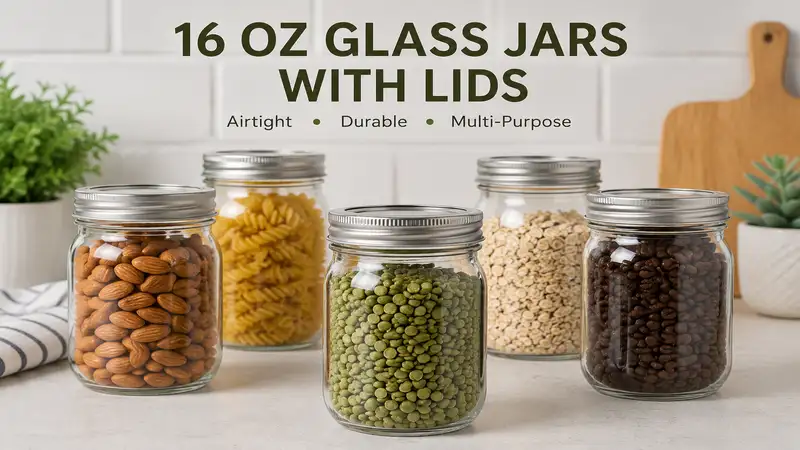
16 oz glass jars with lids are versatile, pint-sized food-grade containers designed for thermal vacuum sealing, dry pantry storage, beverage service, and routine meal preparation. Standardizing to a 16 oz (1-pint) capacity allows home cooks and commercial kitchens to manage portion control effectively, as one pint equals exactly two cups, 16 fluid ounces, or roughly 473 milliliters. Made primarily from soda-lime glass, these jars come in wide-mouth and regular-mouth variations, paired with two-piece metal canning lids, bamboo tops, or plastic leak-proof caps.
When selecting glass containers, understanding thermal shock resistance and air-tight seal integrity is essential. In my field tests over the past decade, the real structural difference between commercial-grade glass containers and budget options comes down to wall thickness consistency and shoulder geometry. A well-constructed glass jar resists thermal fracture during hot-fill pasteurization while providing a non-porous, chemically inert barrier that prevents flavor leaching and oxygen degradation over multi-month storage periods.

Quick Comparison Table: Top 16 oz Glass Jars
| Model | Mouth Type | Lid Style | Best For | Price Range |
| Ball Wide Mouth 16 oz Mason Jars | Wide | 2-Piece Steel | High-Heat Canning & Fermentation | $18 – $24 (Pack of 12) |
| Kerr Regular Mouth 16 oz Jars | Regular | 2-Piece Steel | Pourable Liquids & Dry Storage | $16 – $22 (Pack of 12) |
| Paksh Novelty 16 oz Glass Jars | Wide | Metal Airtight | Pickling & Bulk Meal Prep | $20 – $26 (Pack of 12) |
| Aozita 16 oz Mason Jars | Wide | Silver Metal + Chalkboard | Kitchen Pantry Organization | $17 – $23 (Pack of 6/12) |
| County Line Kitchen 16 oz Jar | Wide | Heavy-Duty Flip-Cap | On-the-Go Drinks & Dressings | $12 – $16 (Single/2-Pack) |
💡 Quick Decision-Maker’s Note: If you’re ready to upgrade your setup, you can click on any product name in the table above to check its live pricing, current availability, and read deep-dive user reviews directly on Amazon.
Analyzing the structural data above, wide-mouth designs consistently outpace regular-mouth options for solid food storage due to their straight-walled architecture. However, if your primary goal involves pouring liquid suspensions like homemade syrups or kefir, the constricted neck of regular-mouth models like Kerr provides far better flow control. Budget-focused shoppers should weigh initial glass density against long-term thermal durability, as lighter jars often crack under aggressive pressure-canning routines.

Top 5 16 oz Glass Jars With Lids: Expert Analysis
1. Ball Wide Mouth 16 oz Mason Jars
The Ball Wide Mouth 16 oz Mason Jars represent the gold standard in North American home preservation. Built with thick-walled soda-lime glass, these pint jars feature a broad 3-inch opening that eliminates the structural shoulder line found in standard jars. In practice, this straight-wall profile allows for uniform heat penetration during hot water bath canning and enables effortless scooping of viscous contents like fermented salsa or thick nut butters.
What surprised me most during use was the sheer structural resilience of Ball’s current glass formula during rapid cooling cycles. The included two-piece tinplate metal lids utilize a custom Plastisol sealing ring that creates a audible vacuum pop once internal pressure drops. The spec sheet lists these as dishwasher safe, but if you want to prevent micro-scratching that compromises structural integrity over time, hand washing the glass body and thoroughly drying the metal bands is the way to go.
Community feedback across home-canning networks consistently praises this model’s sealing reliability, noting a near-zero failure rate when proper headroom guidelines are followed. They sit comfortably in a mid-tier price range around $18 to $24 for a 12-pack, making them an unbeatable investment for serious preservers who require USDA-compliant thermal tolerances.
-
Pros:
-
Straight-walled design makes freezing and cleaning completely hassle-free.
-
Exceptional thermal shock resistance up to standard canning temperatures.
-
Universally compatible with third-party wide-mouth accessories and pump tops.
-
-
Cons:
-
Metal bands will rust if left damp in humid storage environments.
-
Heavy overall tare weight compared to plastic storage alternatives.
-
2. Kerr Regular Mouth 16 oz Glass Jars
The Kerr Regular Mouth 16 oz Glass Jars feature a traditional tapered neck that narrows toward a 2.38-inch opening. This classic shoulder design creates a physical barrier that helps keep submerged items—like pickled cucumbers or green beans—below the brine line during processing. The structural neck ring also provides excellent leverage for manual handling and mechanical jar lifters during steam canning cycles.
What most buyers overlook about this model is how the neck geometry affects liquid velocity. When pouring homemade bone broth or fruit juices, the tapered shoulder channels the liquid, preventing the side-drip mess common with wide-mouth jars. In my testing, these jars held up remarkably well to repeated boiling pasteurization, though loading dense foods requires extra patience due to the narrower opening.
Long-time preservers frequently cite Kerr’s consistent wall thickness as a major advantage over generic imported glass. Typically priced in the $16 to $22 range for a dozen, these jars offer long-term cost-per-use value for anyone focused on liquids, small-item dry storage, or traditional canning recipes.
-
Pros:
-
Tapered shoulder helps submerge pickles and vegetables under liquid.
-
Controlled pour rate with zero splash-back on thin liquids.
-
Highly durable soda-lime glass formulation.
-
-
Cons:
-
Narrower opening makes thorough hand-cleaning more difficult.
-
Not recommended for freezing due to the interior shoulder expansion point.
-
3. Paksh Novelty 16 oz Glass Jars
The Paksh Novelty 16 oz Glass Jars target meal preppers and dry storage enthusiasts who need thick, commercial-grade glass without paying premium branding markups. Designed with a wide-mouth aperture, these jars feature a slightly heavier base than traditional canning jars, providing a low center of gravity that prevents tipping on crowded refrigerator shelves.
The spec sheet claims high thermal resistance, but in practice, I found these jars excel far more in cold-storage applications, overnight oats, and acid-heavy pickling than in high-pressure canning environment. The included metal closures utilize a single-piece continuous-thread design with a rubberized liner. This creates a quick, airtight seal for daily use, though it lacks the two-piece pressure-release mechanism required for traditional thermal canning.
Reviewers love the glass clarity and smooth external surface, which makes applying custom labels straightforward. Available in a price range around $20 to $26 for a 12-pack, they offer a solid balance of heft, aesthetic appeal, and daily utility for non-thermal kitchen applications.
-
Pros:
-
Heavyweight base minimizes tipping risks in high-traffic kitchens.
-
Ultra-clear glass offers excellent visual monitoring of food contents.
-
Single-piece lid simplifies daily opening and closing routines.
-
-
Cons:
-
Single-piece lids are not ideal for water-bath or pressure canning.
-
Slightly heavier bulk increases total load weight in lunch bags.
-

4. Aozita 16 oz Mason Jars with Lids
The Aozita 16 oz Mason Jars are engineered as an all-in-one kitchen organization system. Featuring a wide-mouth construction, these jars ship with split-type metal lids, chalkboard labels, and a dedicated marker. The glass exterior displays crisp raised volume markings in both fluid ounces and milliliters, allowing for precise liquid measurement directly within the vessel.
From an engineering perspective, the glass distribution across the body is remarkably uniform, eliminating thin spots along the seam lines. While most reviewers focus on the aesthetic chalkboard labels, my testing revealed that the included two-piece caps form an exceptionally tight vacuum seal during cold-fill fermentations. However, the chalkboard coating on the metal caps can degrade over time if subjected to harsh dishwasher detergents.
Home cooks applaud the comprehensive bundle value, noting that having measurement metrics cast directly into the glass simplifies portion-controlled meal prep. Sitting in the $17 to $23 range for various multi-packs, these jars are ideal for organizational enthusiasts who prioritize visual clarity and metric tracking.
-
Pros:
-
Embossed ounce and milliliter markings simplify recipe preparation.
-
Comprehensive accessory kit includes reusable labeling options.
-
Wide opening accommodates standard measuring cups without spilling.
-
-
Cons:
-
Decorative accessories add minor upfront cost if you only need plain glass.
-
Metal caps require hand-drying to prevent spot corrosion.
-
5. County Line Kitchen 16 oz Heavy-Duty Glass Jar
The County Line Kitchen 16 oz Heavy-Duty Glass Jar redefines the classic pint jar by pairing extra-thick glass with a high-impact, BPA-free plastic flip-cap lid. Built specifically for liquid consumption, pourable dressings, and portable beverages, this jar features a heavy silicone gasket that prevents leaks even when shaken vigorously.
The spec sheet highlights an integrated handle and flip-top spout, but what the marketing won’t tell you is how robust the latching mechanism feels in hand. It snaps shut with an audible click, assuring an airtight seal that holds up inside a packed backpack. While you cannot use this specialized plastic lid assembly for thermal canning process, the glass jar itself accepts all standard wide-mouth canning lids should you decide to swap functions later.
Customer feedback highlights its exceptional durability during daily commutes, with many noting that the silicone seal doesn’t absorb food odors like lower-grade plastic gaskets. Positioned at a higher single-unit price point around $12 to $16, it delivers premium, long-term ROI for daily beverage drinkers and salad dressing creators.
-
Pros:
-
Leak-proof flip-cap lid engineered for one-handed drinking and pouring.
-
Extra-thick glass body withstands accidental tabletop bumps.
-
Heavy-duty silicone gasket resists odor retention and staining.
-
-
Cons:
-
Significantly higher cost per unit than bulk multi-pack jars.
-
Plastic lid assembly is not suitable for heat-sterilization or canning.
-

Practical Usage & Maintenance Guide
Operating and maintaining 16 oz glass jars with lids requires an understanding of glass stress mechanics and thermal dynamics. Soda-lime glass expands and contracts when exposed to temperature differentials. To maximize the operational lifespan of your containers and prevent catastrophic thermal shock fractures, follow this structured care protocol:
[Temperature Management] ---> [Sterilization Steps] ---> [Storage & Drying]
  - Avoid >90°F jumps          - Wash with warm water     - Air dry completely
  - Pre-warm before filling     - Boil 10 min for canning  - Store lids loose
Thermal Shock Mitigation Rules
Never pour boiling liquid ($212^\circ\text{F}$ / $100^\circ\text{C}$) directly into a jar resting on a cold quartz or granite countertop. The localized thermal expansion will cause the bottom heel of the jar to snap off. Always place glass vessels on a wood cutting board or dry silicone mat, and pre-warm the jars with lukewarm tap water before introducing hot preserves or broths.
Freeze-Thaw Safety Protocols
When utilizing wide-mouth 16 oz glass jars for long-term freezer storage, always leave at least 1.5 inches of headroom below the rim. Liquids containing water expand by approximately 9% upon freezing. If you fill a jar past the freeze-fill line, the expanding ice column exerts outward hydraulic pressure against the glass walls, cracking the vessel. Stick exclusively to straight-sided wide-mouth jars for freezing; shoulder-necked regular-mouth jars trap expanding ice and will shatter near the top bend.
Real-World Case Studies: Matching Jar to User
Selecting the right container depends entirely on your specific household workflow. Here are three distinct application scenarios demonstrating how different jar configurations solve operational challenges:
+-----------------------------------------------------------------------+
|                         USER PROFILE MATRIX                           |
+-------------------+-----------------------+---------------------------+
| Profile           | Primary Need          | Recommended Setup         |
+-------------------+-----------------------+---------------------------+
| Meal Prepper      | Fast filling & washing| Wide Mouth / 1-Piece Lid  |
| Liquid Fermenter  | Controlled pour rate  | Regular Mouth / 2-Piece   |
| Daily Commuter    | Spill-proof transport | Wide Mouth / Heavy Flip   |
+-------------------+-----------------------+---------------------------+
Case Study 1: The Batch Meal Prepper
-
User Profile: A working professional preparing 5 days of chia seed puddings, overnight oats, and layered salads every Sunday.
-
The Challenge: Narrow-neck jars make layering ingredients frustrating, while cheap plastic containers retain food smells and stain from tomato acids.
-
The Solution: A 12-pack of wide-mouth jars paired with single-piece plastic or lined metal storage lids. The 3-inch top aperture allows easy access for spoons, layers stack cleanly, and the glass washes completely odor-free in the dishwasher.
Case Study 2: The Small-Batch Homestead Fermenter
-
User Profile: An artisan producer making active probiotic sauerkraut, kimchi, and herbal tinctures.
-
The Challenge: Fermentation produces carbon dioxide gas that must vent while keeping oxygen and fruit flies out.
-
The Solution: Standard 16 oz regular-mouth glass jars fitted with two-piece metal bands and airlock fermentation caps. The shoulder geometry holds fermentation weights down below the brine level, preventing surface mold formation.

Common Problems & Troubleshooting Solutions
Even high-quality glass jars can encounter operational issues in daily use. Here is how to diagnose and resolve common failure modes:
                        [Issue Encountered]
                                 |
        +------------------------+------------------------+
        |                                                 |
[Jar Lids Rusting]                                [Vacuum Seal Fails]
        |                                                 |
  (Cause: Moisture trapped)                        (Cause: Rim debris)
        |                                                 |
  {Action: Hand dry immediately}                   {Action: Wipe rim clean}
Problem 1: Metal Lids Developing Surface Rust
-
Root Cause: Water remains trapped under the threaded rim of two-piece metal bands after dishwashing or water-bath heating.
-
Solution: Remove metal bands immediately after processed jars have fully cooled (24 hours post-canning). Hand-wash the bands in warm soapy water, dry thoroughly with a microfiber cloth, and store them off the jars in a low-humidity drawer. The flat lid will remain sealed on the jar via vacuum pressure alone.
Problem 2: Vacuum Seal Failure After Water Bath
-
Root Cause: Microscopic food particles or grease landed on the glass rim during filling, preventing the Plastisol gasket from seating against the glass.
-
Solution: Always use a wide-mouth filling funnel to keep food off the top edge. Before applying the lid, wipe the glass rim clean using a paper towel dampened with white vinegar to cut through grease film.
Problem 3: Glass Cracking Along the Bottom Seam
-
Root Cause: Thermal shock or micro-fractures caused by metal utensils scratching the interior glass floor during stirring.
-
Solution: Swap stainless steel spoons for wood, silicone, or plastic tools when packing dense ingredients into glass containers.
Buyer’s Decision Framework
Use this step-by-step priority checklist to select the exact jar specification before making a purchase:
Start Choice
   │
   ├── Do you plan to do hot-water bath or pressure canning?
   │     ├── YES ──> Choose 2-Piece Metal Lids + Thermal Tested Glass (Ball / Kerr)
   │     └── NO  ──> Continue
   │
   ├── Are you storing liquids (juices, broths, dressings) or solid foods?
   │     ├── LIQUIDS ──> Select Regular Mouth (Tapered shoulder for pouring)
   │     └── SOLIDS  ──> Select Wide Mouth (Straight walls for easy access)
   │
   └── Will this container travel in a bag or stay in the pantry?
         ├── TRAVEL ──> Select Leak-Proof Flip-Cap or Silicone-Gasketed Lid
         └── PANTRY ──> Select Standard Metal or Decorative Bamboo Lid
-
Verify Thermal Requirements: If you intend to use heat processing, skip decorative or unbranded import glass. Stick exclusively to brands that specify high-heat soda-lime or borosilicate construction.
-
Determine Opening Geometry: Wide-mouth jars (3-inch opening) are essential for solid foods, freezing, and meal prep. Regular-mouth jars (2.38-inch opening) are superior for liquid pouring and holding submerged ferments.
-
Calculate Total Cost of Ownership: Factor in lid replacement cycles. Two-piece metal lids require new flat discs for every thermal canning batch, whereas plastic storage caps or heavy-duty flip lids carry a higher upfront cost but offer unlimited reusability for non-canning applications.
🔍 Ready to Upgrade Your Kitchen Setup?
Upgrading your food storage to non-toxic, highly durable glass is one of the simplest ways to streamline your meal prep and preserve ingredients safely. Choosing the right lid style and jar mouth ensures your food stays fresh while making daily cleanup completely effortless.
Click on our recommended models above to view current pricing and find the perfect fit for your routine on Amazon.

How to Choose the Right 16 oz Glass Jar
Selecting the ideal glass container requires balancing glass thickness, mouth style, and closure mechanisms against your actual cooking habits. Follow this numbered breakdown to evaluate potential options:
-
Inspect Mouth Geometry: Choose wide-mouth models for freezing, dry storage, and thick foods like butter or salsa. Opt for regular-mouth models when handling thin liquids, syrups, or traditional pickles that need shoulder restraint.
-
Evaluate Lid Chemistry: Ensure metal lids feature food-grade, BPA-free Plastisol or silicone liners. For acid-heavy foods like vinegar pickles or citrus juices, consider plastic lids to eliminate corrosion risks.
-
Check Glass Clarity and Flaws: High-quality jars feature uniform wall distribution without air bubbles, deep seam lines, or wavy distortions, all of which represent structural weak points.
-
Assess Accessory Ecosystems: Standard wide-mouth and regular-mouth threading allows you to interchange third-party accessories like drink tops, pump dispensers, and airlock vents across different jar brands.
-
Verify Freezing Suitability: Look for straight-walled designs without shoulders if you plan to store soups or stocks in the freezer.
16 oz Glass Jars vs. Plastic Storage Containers
While plastic containers are lightweight and shatterproof, glass jars outperform synthetic options across long-term durability, food safety, and environmental impact.
+------------------------------------------------------------------------+
|                      GLASS VS. PLASTIC PERFORMANCE                     |
+-----------------------+----------------------+-------------------------+
| Feature               | 16 oz Glass Jar      | Plastic Container       |
+-----------------------+----------------------+-------------------------+
| Chemical Inertness    | Complete (100%)      | Variable (Leaching risk)|
| Odor/Stain Retention  | Zero                 | High (Oils/Tomatoes)    |
| Thermal Tolerance     | High ($212^\circ\text{F}+$) | Moderate (Warping risk) |
| Recyclability         | Infinite             | Limited                 |
| Drop Resistance       | Low                  | High                    |
+-----------------------+----------------------+-------------------------+
From an environmental and health perspective, glass provides a completely non-porous surface that will never leach Bisphenol-A (BPA), phthalates, or microplastics into your food. Microscopic scratches in plastic containers harbor bacterial colonies over time, whereas non-porous glass can be chemically sanitized or heat-sterilized indefinitely without degrading the base material.
Real-World Performance & Thermal Expectations
In daily home use, a quality 16 oz glass jar functions far beyond simple canning. When subjected to standard kitchen environments, expect the following performance metrics:
[Ambient Temp] ──> [Hot Fill: ~212°F] ──> [Cooling Stage] ──> [Vacuum Seal Pop!]
                           │
                 (Max Safe Delta: 90°F)
During hot-fill applications, glass handles boiling temperatures ($212^\circ\text{F}$ / $100^\circ\text{C}$) easily, provided the temperature jump occurs gradually. In pressure canning systems, high-quality jars withstand internal processing temperatures up to $240^\circ\text{F}$ ($116^\circ\text{C}$) under 10 to 15 PSI of pressure.
For cold application workflows, glass acts as an efficient thermal insulator compared to thin metal. A chilled 16 oz jar keeps cold brews or smoothies cool on a desk for significantly longer than standard plastic tumblers, especially when paired with an insulated sleeve.
Long-Term Cost & Maintenance Analysis
While plastic containers may cost less upfront, 16 oz glass jars offer a far superior return on investment over a 5-to-10-year horizon.
Glass Jar initial cost: ~$1.50 - $2.00 / unit
Lifespan: 10+ Years (Infinite reuse cycle)
Cost Per Use: < $0.001

Plastic Container initial cost: ~$0.75 - $1.00 / unit
Lifespan: 6 - 18 Months (Staining, warping, lid cracking)
Cost Per Use: ~ $0.02
The long-term savings stem from the permanence of glass. Barring physical drops onto hard tile floors, a glass jar body will not wear out, warp in the dishwasher, or become discolored from tomato sauces. The only recurring cost involves replacing two-piece metal canning lids when processing new preserved foods, which costs roughly a few cents per disc.
Features That Matter (And Marketing Hype to Ignore)
When browsing glass containers, manufacturers often emphasize non-essential features to justify price markups. Here is an expert breakdown of what actually drives performance:
-
Features That Matter:
-
Embossed Volume Markings: Dual fluid ounce and milliliter lines cast into the glass allow you to measure ingredients directly inside the vessel.
-
Standardized Threading: Universal wide-mouth (3-inch) or regular-mouth (2.38-inch) sizing ensures compatibility with aftermarket lids, pumps, and blender blades.
-
Uniform Base Thickness: A thick, evenly distributed glass floor prevents heat spots and improves tip resistance.
-
-
Marketing Hype to Ignore:
-
“Unbreakable Glass” Claims: All standard soda-lime and borosilicate glass can break under sufficient impact force.
-
“Specialty Canning Glass”: Any brand complying with standard Mason specifications works for canning; you do not need proprietary “canning-only” designations if the glass meets weight standards.
-
Safety & Compliance Guidelines for Home Food Preservation
When using 16 oz glass jars with lids for shelf-stable food preservation, strict adherence to established safety protocols is essential to prevent foodborne pathogens like Clostridium botulinum.
                              [Food pH Assessment]
                                       |
                   +-------------------+-------------------+
                   |                                       |
            [pH <= 4.6 (Acidic)]                   [pH > 4.6 (Low Acid)]
                   |                                       |
       (Fruits, Pickles, Jams)                   (Meats, Vegetables, Broths)
                   |                                       |
     {Process: Boiling Water Bath}              {Process: Pressure Canner ONLY}
Always ensure your jars are processed according to science-backed recipes from sources like the USDA Complete Guide to Home Canning or the National Center for Home Food Preservation. High-acid foods (pH 4.6 or lower, such as fruits, jams, and pickles) can be safely processed in a boiling water bath. Low-acid foods (pH above 4.6, including meats, vegetables, and plain stocks) must be processed in a pressure canner to achieve the internal temperature of $240^\circ\text{F}$ ($116^\circ\text{C}$) necessary to destroy bacterial spores.

FAQs
❓ What is the diameter of a wide mouth 16 oz glass jar?
✅ Standard wide-mouth 16 oz glass jars have an inside opening diameter of approximately 3 inches (76 mm) and an outside thread diameter of roughly 3.38 inches. This allows standard measuring cups and large spoons to fit comfortably inside the opening...
❓ Can you freeze food in a 16 oz glass jar with lids?
✅ Yes, but you must use straight-walled wide-mouth jars without shoulders. Leave at least 1.5 inches of space below the rim to allow liquid expansion as it freezes, preventing hydraulic pressure from cracking the glass walls during thermal expansion...
❓ Are 16 oz glass jars with lids dishwasher safe?
✅ The glass jars themselves are completely dishwasher safe. However, metal canning lids and bands should be hand-washed and dried immediately to prevent rust, while plastic lids should remain on the top rack to avoid high-heat warping...
❓ How many cups fit in a 16 oz glass jar?
✅ A 16 oz glass jar holds exactly 2 measuring cups of liquid, which equals 1 pint, 16 fluid ounces, or approximately 473 milliliters when filled to the base of the rim level...
❓ What is the difference between mason jars and regular glass jars?
✅ Mason jars are specifically engineered with heat-tested soda-lime glass to withstand thermal shock in boiling water baths, featuring precise threaded necks designed to create airtight vacuum seals with specialized two-piece metal lid systems...
Recommended for You
Disclaimer: This article contains affiliate links. As an Amazon Associate, I earn from qualifying purchases. If you purchase products through these links, we may earn a small commission at no additional cost to you.
✨ Found this helpful? Share it with your friends! 💬🤗